 SKY
Sky catalog › Solar System
Venus
A planet
What is it?
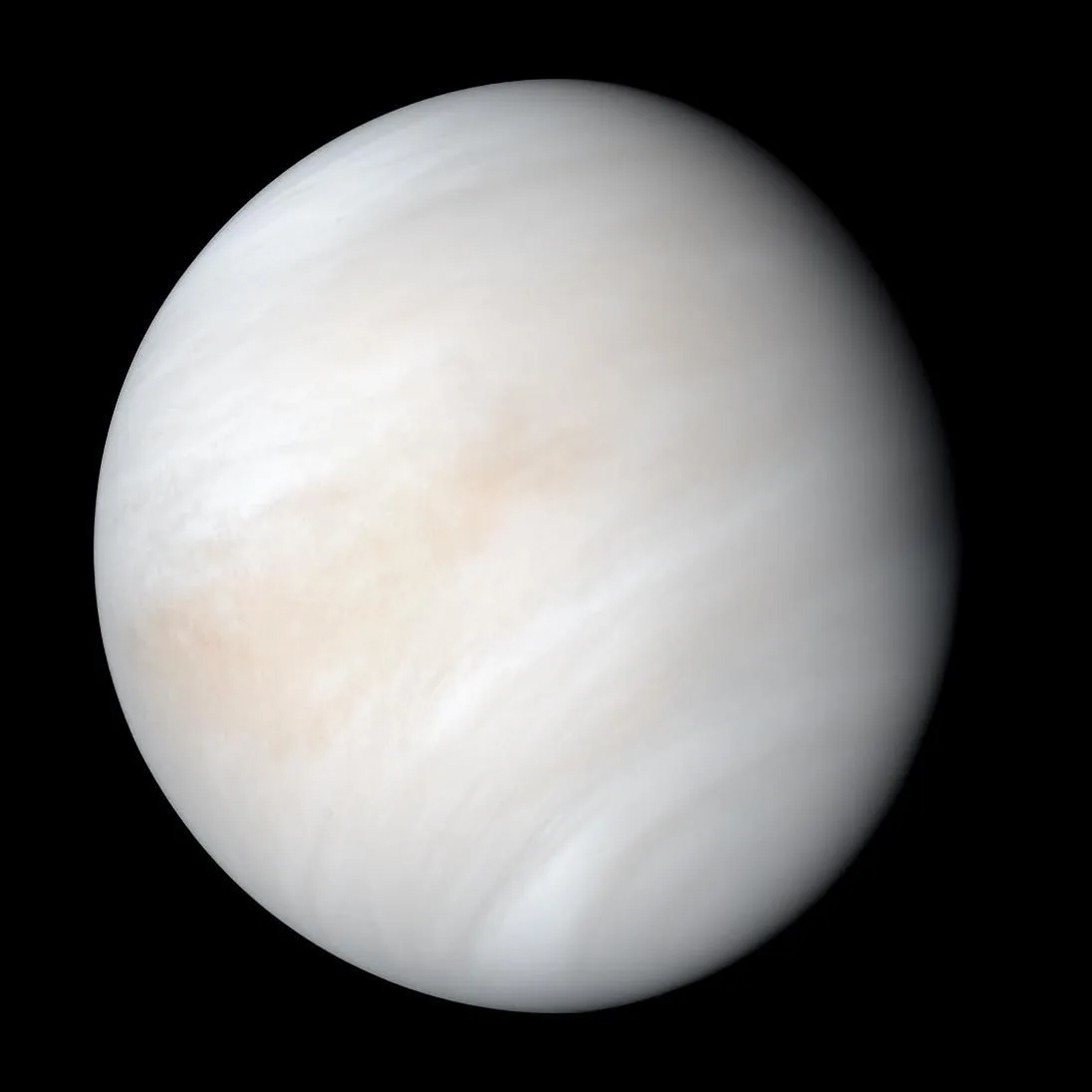
Venus is a planet. A world that orbits the Sun and shines by reflected sunlight.
Why Venus is interesting
What you see: The bright, smooth disk is the top of thick clouds of sulfuric acid, floating in an atmosphere made mostly of carbon dioxide. The clouds hide the ground, so NASA's Magellan used radar to map it. science.nasa.gov
How it formed: Venus formed about 4.6 billion years ago from the same disk of gas and dust as Earth, and it is nearly as big around. Its thick air traps heat in a runaway greenhouse effect. science.nasa.gov
To scale: The air pressure on Venus is about 93 times Earth's, like being more than 3,000 feet (930 m) underwater. science.nasa.gov
Three things to know
- Venus is the hottest planet, at about 464 to 467 °C (867 to 872 °F), hot enough to melt lead.
- Venus spins backward and so slowly that one turn takes 243 Earth days, longer than its 225-day trip around the Sun.
- Through a telescope Venus shows phases like the Moon, and Galileo's view of them helped prove that planets go around the Sun.
12 more fun facts
- The air pressure on Venus is about 93 times Earth's, like being more than 3,000 feet (930 m) underwater. science.nasa.gov
- Venus is wrapped in thick clouds of sulfuric acid, floating in an atmosphere made mostly of carbon dioxide. science.nasa.gov
- On Venus, the time from one sunrise to the next is about 117 Earth days. nssdc.gsfc.nasa.gov
- The cloud tops of Venus race around the whole planet in about 4 days, roughly 60 times faster than the planet itself turns. en.wikipedia.org
- Venus has a mountain about 11 km (36,000 feet) tall, higher than Mount Everest, and thousands of volcanoes. science.nasa.gov
- The surface of Venus may be young for a planet, on average perhaps only about 150 million years old. science.nasa.gov
- Venus has no moons, but a small asteroid named Zoozve, about 200 to 500 meters across, travels along with it as a quasi-satellite. science.nasa.gov
- The first pictures from the surface of Venus came from the Soviet landers Venera 9 and 10 in 1975. en.wikipedia.org
- NASA's Magellan spacecraft used radar to see through the clouds and map the surface of Venus, finishing its five-year mission in 1994. science.nasa.gov
- Venus crossed the face of the Sun in 2004 and 2012. The next such transits will not happen until December 2117 and December 2125. en.wikipedia.org
- Venus is bright enough to see with the naked eye in a clear daytime sky if you know exactly where to look. Napoleon is said to have spotted it in daylight. en.wikipedia.org
- In 2020 scientists reported a possible sign of phosphine gas in the clouds of Venus, hinting at life, but later studies blamed sulfur dioxide or found no signal at all. en.wikipedia.org
In the game these unlock one by one as you keep photographing Venus.
At a glance
- Type
- Planet
- Distance
- 38.2 to 261 million km from Earth, closer than any other planet
- Brightness
- magnitude -4.8
- Size in our sky
- 9.7 to 66 arcseconds
Looking back in time
Right now, sunlight bouncing off Venus takes 3 minutes to reach us, so you see it as it was 3 minutes ago.
How to see it yourself
Easy to see with the naked eye. A small telescope shows its disk and its phase, like a tiny Moon.
Finding it: No star-hop needed. After the Moon it is the brightest thing in the night sky, a brilliant white point that is easy to see even from a city.
When to look: Venus is only seen in twilight: low in the west after sunset as the 'evening star', or low in the east before sunrise as the 'morning star', depending on where it is in its orbit.
What you will see: To the naked eye Venus is a dazzling white point. A small telescope at about 30x shows its changing phase and size, from a small round disk to a large thin crescent. Cloud markings are very faint and usually need a violet filter and an 8-inch telescope.
Easy to confuse with:
- Jupiter: Venus is clearly brighter and stays fairly near the horizon in twilight, while Jupiter can shine high in a fully dark sky late at night.
- Aircraft lights: A plane's lights blink and cross the sky within minutes, while Venus shines steadily and holds its place among the stars.
Where and when: Venus moves against the stars, so where it is depends on the date. The box above shows where it is from your sky.
How it is photographed: thousands of short video frames, keeping only the sharpest moments (lucky imaging), because the air above you blurs the view.
Name and story
The name: Venus is named for the Roman goddess of love and beauty, called Aphrodite by the Greeks. The Greeks called the morning star Phosphorus and the evening star Hesperus, and the Romans used Lucifer and Vesper for the same two appearances.
People and history: The Maya followed the cycles of Venus closely for their calendar, and the Dresden Codex records them. Its symbol, a circle with a small cross below, was also the alchemists' sign for copper and is now the symbol for female.
Record: After the Moon, Venus is the brightest natural object in the night sky. It is also the only planet named after a female god.
Explored by: NASA's Mariner 2, the first successful interplanetary mission, flew past Venus on December 14, 1962. The Soviet Venera landers later reached the scorching surface. NASA's VERITAS and DAVINCI and ESA's EnVision are planned to launch no earlier than 2031.
Test yourself
After every photo of Venus the game asks one of these. A right answer earns sky points for your observatory.
Why is Venus hotter than Mercury, even though Mercury is closer to the Sun?
- Its thick air traps the heat (the answer)
- It spins much faster than Mercury
- Its moon reflects extra sunlight
Venus has a thick atmosphere, mostly carbon dioxide, that traps heat in a runaway greenhouse effect, so the surface reaches about 464 to 467 °C (867 to 872 °F). science.nasa.gov
What did Galileo see on Venus that helped show planets circle the Sun?
- Phases, like the Moon's (the answer)
- Two small moons circling it
- A ring like the one around Saturn
Through a telescope Venus changes from a small round disk to a thin crescent, like the Moon. Galileo's view of these phases helped prove that planets go around the Sun. en.wikipedia.org
Point a telescope at Venus in the game: capture it in real time, then develop the frames like an astrophotographer.
Point a telescope at VenusLearn more
- Magnitude: why brighter stars get smaller numbers
Why a star of magnitude 1 is brighter than one of magnitude 6, why the Sun is -26.7, and how far each step goes.
More solar system
 The Sun
 The Moon
 Mars
 Jupiter
Sources
- science.nasa.gov
- nssdc.gsfc.nasa.gov
- en.wikipedia.org
- astronomy.com
- Positions: astronomy-engine (Don Cross).