 SKY
Sky catalog › Solar System
The Sun
A star
What is it?
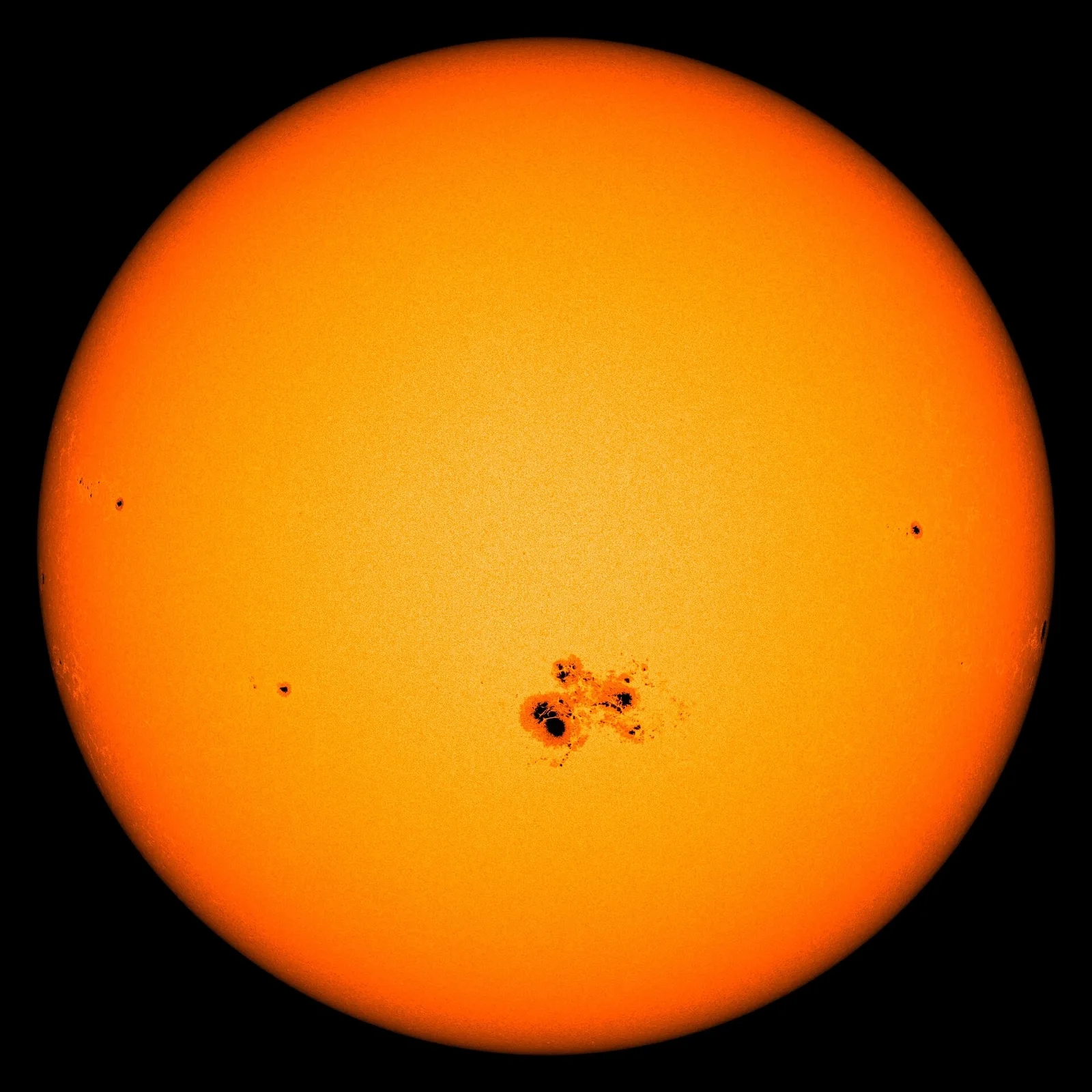
The Sun is a star. A huge ball of hot gas that makes its own light by fusing hydrogen into helium. The Sun is the only star close enough to show a disk.
Why the Sun is interesting
What you see: The bright disk is the Sun's visible surface, the photosphere, at about 5,500 °C (10,000 °F). Dark specks are sunspots, patches slightly cooler than the gas around them. science.nasa.gov
How it formed: Deep in the core, hydrogen is fused into helium. These nuclear reactions power all of the Sun's heat and light. science.nasa.gov
To scale: It would take about 1.3 million Earths to fill the Sun's volume. science.nasa.gov
Three things to know
- About 1.3 million Earths could fit inside the Sun.
- Sunlight takes about 8 minutes to travel from the Sun to Earth.
- Sunspots are patches slightly cooler than the rest of the Sun's surface, which is why they look dark.
12 more fun facts
- The Sun holds about 99.8 percent of all the mass in our solar system. Everything else, planets included, is the leftover crumbs. science.nasa.gov
- Energy made in the Sun's core takes a very long time to work its way out. Estimates range from about 10,000 to 170,000 years. en.wikipedia.org
- Ghostly particles called neutrinos, made in the Sun's core, shoot straight out to the surface in only about 2.3 seconds. en.wikipedia.org
- The Sun's thin outer atmosphere, the corona, reaches up to about 2 million °C (3.5 million °F), far hotter than the visible surface at about 5,500 °C (10,000 °F). science.nasa.gov
- The center of the Sun is about 15 million °C (27 million °F). science.nasa.gov
- Every second, the Sun turns about 4 billion kilograms (about 4 million metric tons) of matter into pure energy. en.wikipedia.org
- The Sun is not solid, so it spins faster at its equator, about once every 25 days, than near its poles, about once every 36 days. science.nasa.gov
- The Sun carries us around the Milky Way at about 720,000 km/h (450,000 mph), and one lap takes about 230 million years. science.nasa.gov
- From Earth, the Sun looks almost 13 billion times brighter than Sirius, the brightest star in the night sky. en.wikipedia.org
- Helium was found in the Sun before it was found on Earth. Norman Lockyer named it in 1868 after Helios, the Greek sun god, and it was isolated on Earth about 25 years later. en.wikipedia.org
- NASA's Parker Solar Probe has passed just 3.8 million miles (6.2 million km) from the Sun's surface, moving at about 430,000 mph (687,000 km/h). science.nasa.gov
- In roughly 5 billion years the Sun will swell into a red giant, then shed its outer layers and settle down as a small, slowly cooling white dwarf. en.wikipedia.org
In the game these unlock one by one as you keep photographing the Sun.
At a glance
- Type
- Star
- Distance
- about 150 million km (93 million miles); 147.1 to 152.1 million km during the year
- Brightness
- magnitude -26.74
- Size in our sky
- about half a degree (31.5 to 32.5 arcminutes)
Looking back in time
Sunlight takes 8 minutes to reach you. You always see the Sun as it was 8 minutes ago.
How to see it yourself
Never look at the Sun directly or through any optics without a certified solar filter over the front. Eclipse glasses for the eye, a proper filter for a telescope.
Finding it: No searching needed. The easiest safe view is pinhole projection: stand with the Sun at your back and let light through a small hole in a card fall on paper. For a closer look, use a telescope with a certified solar filter fitted over the front.
When to look: The Sun is up every day, but never look at it directly, even for a moment, and never through binoculars, a telescope or a camera unless a proper solar filter covers the front end. Regular sunglasses, however dark, are not safe.
What you will see: Through eclipse glasses that meet the ISO 12312-2 standard the Sun is a plain disk; never use those glasses behind binoculars or a telescope. Through a small telescope with a white-light front filter you see dark sunspots and bright patches called faculae near the edge, and with 3 inches of aperture and steady air, a grainy texture called granulation. Special hydrogen-alpha filters reveal flamelike prominences at the edge.
Where and when: the Sun is up during the day, of course; its position changes through the year.
Name and story
The name: Our word 'Sun' comes from the Old English 'sunne'. Scientists use 'solar', from the Latin name Sol, and the Greek name Helios lives on in words like helium and heliosphere. No one discovered the Sun, but it took until Copernicus in the 1500s for a detailed model showing the planets go around it.
People and history: Many peoples worshipped the Sun: Ra in ancient Egypt, Helios in Greece, Amaterasu in Japanese Shinto, and Sol Invictus, the 'Unconquered Sun', in late Rome. Monuments were built around it too. Stonehenge marks the solstices, Newgrange in Ireland was built to catch the winter solstice, and El Castillo at Chichén Itzá casts serpent-shaped shadows at the equinoxes.
Record: The Sun is the brightest object in Earth's sky and the largest and most massive object in the solar system, holding about 99.86 percent of its mass.
Explored by: A whole fleet of spacecraft watches the Sun, including SOHO, the Solar Dynamics Observatory, Hinode, IRIS, STEREO, Solar Orbiter and Parker Solar Probe.
Test yourself
After every photo of the Sun the game asks one of these. A right answer earns sky points for your observatory.
Why do sunspots look dark?
- They are holes that go deep inside
- They are shadows of passing planets
- They are a bit cooler than the gas around them (the answer)
Pieces of the Sun's magnetic field break through the surface and leave patches slightly cooler than the photosphere, so they glow less and look dark by contrast. science.nasa.gov
Which element was found on the Sun before it was found on Earth?
- Helium (the answer)
- Oxygen
- Iron
Norman Lockyer spotted it in sunlight and named it in 1868 after Helios, the Greek sun god. It was isolated on Earth about 25 years later. en.wikipedia.org
Point a telescope at the Sun in the game: capture it in real time, then develop the frames like an astrophotographer.
Point a telescope at the SunMore solar system
 The Moon
 Venus
 Mars
 Jupiter
Sources
- science.nasa.gov
- nssdc.gsfc.nasa.gov
- en.wikipedia.org
- science.nasa.gov
- science.nasa.gov
- astronomy.com
- Positions: astronomy-engine (Don Cross).