 SKY
Sky catalog › Solar System
The Moon
A moon
What is it?
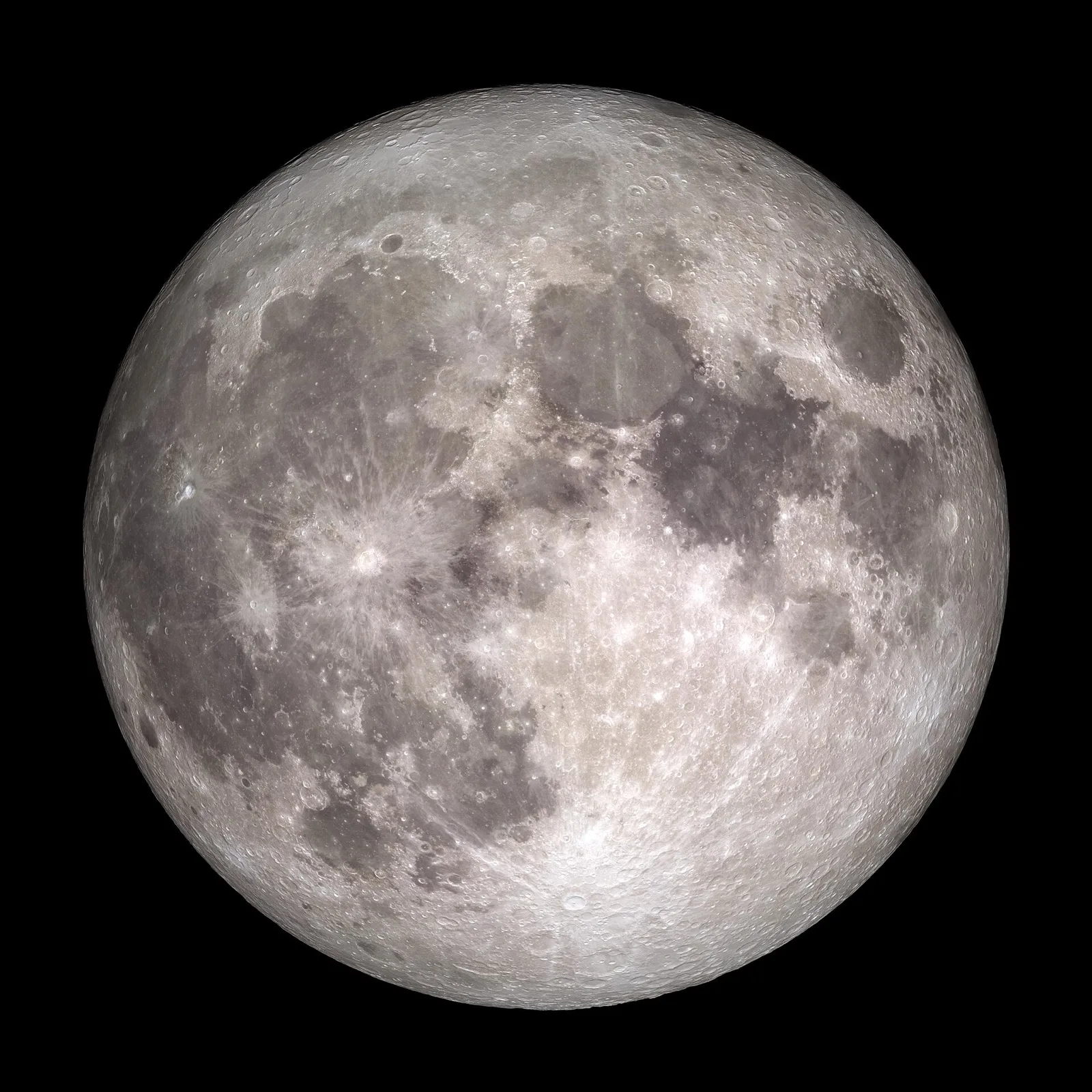
The Moon is a moon. A rocky world that orbits a planet. Ours is about 384,000 km away.
Why the Moon is interesting
What you see: The dark gray patches are maria, plains of hardened volcanic lava, and the lighter areas are the old highlands. Round craters and the bright streaks around Tycho were made by asteroid and meteorite impacts. science.nasa.gov
How it formed: The Moon probably formed after a Mars-sized body slammed into the young Earth. Debris from both bodies then came together in orbit and became the Moon. science.nasa.gov
To scale: The Moon is so far away that about 30 Earth-sized planets could fit in the gap between Earth and the Moon. science.nasa.gov
Three things to know
- The Moon always shows us the same side, because it spins around exactly once each time it circles Earth.
- The Moon is slowly drifting away from Earth, about 3.8 cm (1.5 inches) farther every year.
- Twelve people have walked on the Moon, all on six Apollo missions that ended in 1972.
12 more fun facts
- The Moon probably formed after a Mars-sized body slammed into the young Earth, and debris from both bodies came together in orbit. science.nasa.gov
- The Moon is so far away that about 30 Earth-sized planets could fit in the gap between Earth and the Moon. science.nasa.gov
- In full sunlight the Moon's surface reaches about 127 °C (260 °F), and in darkness it drops to about minus 173 °C (minus 280 °F). science.nasa.gov
- Gravity on the Moon is about one-sixth of Earth's, so someone who weighs 120 pounds at home would weigh about 20 pounds there. science.nasa.gov
- The coldest temperature any spacecraft has measured in the solar system, 26 kelvins (about minus 247 °C or minus 413 °F), was found in Hermite crater on the Moon. en.wikipedia.org
- The Moon looks bright at night, yet its surface reflects about as much light as asphalt does. en.wikipedia.org
- Nobody had seen the Moon's far side until October 7, 1959, when the Soviet probe Luna 3 photographed it. en.wikipedia.org
- China's Chang'e 4 made the first landing on the Moon's far side, in early 2019. en.wikipedia.org
- Moonquakes are weaker than earthquakes, but they can keep shaking for up to an hour because the dry, broken crust lets the vibrations bounce around. en.wikipedia.org
- On the Moon's near side, night is lit by earthshine about 43 times brighter than a full-Moon night on Earth. en.wikipedia.org
- Apollo astronauts brought home 842 pounds (382 kg) of Moon rock and soil. science.nasa.gov
- The Moon's tides slowly brake Earth's spin. About 3.2 billion years ago, a day on Earth lasted only around 13 hours. en.wikipedia.org
In the game these unlock one by one as you keep photographing the Moon.
At a glance
- Type
- Moon
- Distance
- 384,400 km (about 239,000 miles) on average
- Brightness
- magnitude -12.74
- Size in our sky
- about half a degree (29.3 to 34.1 arcminutes)
Looking back in time
Right now, sunlight bouncing off the Moon takes 1.2 seconds to reach us, so you see it as it was 1.2 seconds ago.
How to see it yourself
Easy to see with the naked eye. A small telescope shows its disk, craters and mountains.
Finding it: No star-hop needed. Aim your eyes or your telescope at the terminator, the line between the Moon's day side and night side, where long shadows make the landscape pop out.
When to look: Some phase of the Moon is up on most nights, and often in daytime too. For the best detail, skip the full Moon: at other phases the shadows are longer and craters and mountains stand out.
What you will see: With the naked eye you see dark lava plains called maria and bright highlands, and sharp eyes may pick out big craters like Copernicus, Kepler, Aristarchus and Tycho. Binoculars of at least 7x show craters and the bright rays around Tycho. A small telescope reveals mountains, crater chains, valleys and winding rilles.
Where and when: the Moon moves about 13° across the sky each day and goes through its phases every 29.5 days.
How it is photographed: thousands of short video frames, keeping only the sharpest moments (lucky imaging), because the air above you blurs the view.
Name and story
The name: The word 'Moon' comes from the Old English 'mona', which goes back to an ancient word meaning 'month'. Its Latin name Luna gives us 'lunar', and the Greek Selene was both the Moon and its goddess.
People and history: People have tracked the Moon for a very long time: possible cave paintings of its phases may be up to 40,000 years old. A stone carving at Knowth in Ireland from about 3000 BCE may show it, and the Nebra sky disc (about 1800 to 1600 BCE) shows the Moon near the Pleiades.
Record: The Moon is the brightest object in the night sky. It is the fifth-largest moon in the solar system and the largest compared with the size of its planet.
Explored by: Galileo published his telescope views of lunar mountains and craters in 1610. Luna 9 made the first soft landing in 1966, Apollo 11 landed the first people on July 20, 1969, and China's Chang'e 6, launched in 2024, brought back the first samples from the far side.
Test yourself
After every photo of the Moon the game asks one of these. A right answer earns sky points for your observatory.
Why do we always see the same side of the Moon?
- It spins once for every trip around Earth (the answer)
- Earth's shadow always hides the other side
- It does not spin at all
The Moon turns exactly once each time it circles Earth, so the same face keeps pointing at us. science.nasa.gov
Which spacecraft took the first pictures of the Moon's far side?
- Apollo 11, in 1969
- Luna 3, in 1959 (the answer)
- Voyager 1, in 1977
The Soviet probe Luna 3 photographed the far side on October 7, 1959. Until then nobody had ever seen it, because that side never faces Earth. en.wikipedia.org
Point a telescope at the Moon in the game: capture it in real time, then develop the frames like an astrophotographer.
Point a telescope at the MoonLearn more
- Lucky imaging: keep the sharp moments, throw away the rest
How planet photographers beat the shimmering air: record thousands of short video frames, keep only the sharpest, then stack and sharpen them.
More solar system
 The Sun
 Venus
 Mars
 Jupiter
Sources
- science.nasa.gov
- nssdc.gsfc.nasa.gov
- en.wikipedia.org
- science.nasa.gov
- Positions: astronomy-engine (Don Cross).