 SKY
Sky catalog › Solar System
Jupiter
A planet
What is it?
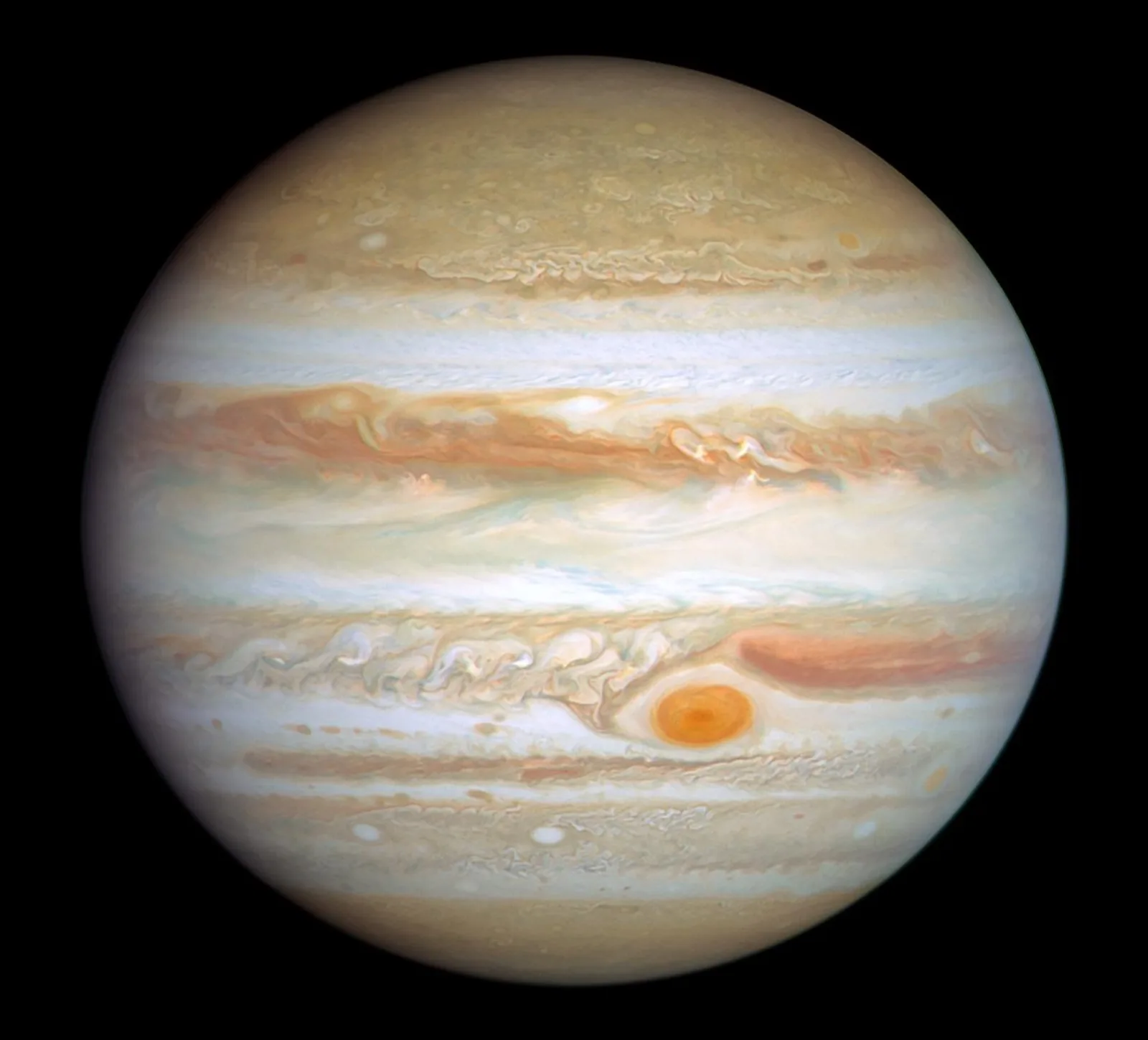
Jupiter is a planet. A world that orbits the Sun and shines by reflected sunlight.
Why Jupiter is interesting
What you see: The stripes are cold, windy clouds of ammonia and water: dark orange belts and lighter zones. The orange oval is the Great Red Spot, a storm about twice as wide as Earth. science.nasa.gov
How it formed: Jupiter took shape with the rest of the solar system about 4.6 billion years ago, as gravity gathered gas and dust. It has the same ingredients as a star but never grew massive enough to ignite. science.nasa.gov
To scale: Jupiter's volume is about 1,321 times Earth's, so roughly 1,300 Earths could fit inside it. nssdc.gsfc.nasa.gov
Three things to know
- Jupiter is so big that more than 1,300 Earths could fit inside it.
- A day on Jupiter lasts only about 10 hours, the shortest day of any planet.
- The Great Red Spot is a storm wider than the whole Earth, and people have watched it for more than 150 years.
12 more fun facts
- Jupiter has about 318 times the mass of Earth. nssdc.gsfc.nasa.gov
- Jupiter gives off more heat than it gets from the Sun, mostly because its inside is slowly shrinking. en.wikipedia.org
- Jupiter is so heavy that it and the Sun circle a shared balance point that lies just outside the Sun's surface. en.wikipedia.org
- In 1610 Galileo spotted four moons circling Jupiter, strong evidence that not everything goes around Earth. You can see the same four moons today with steady binoculars. en.wikipedia.org
- Jupiter's moon Ganymede is the largest moon in the solar system, bigger even than the planet Mercury. science.nasa.gov
- Jupiter's moon Io is the most volcanically active world in the solar system. science.nasa.gov
- Jupiter's moon Europa probably hides an ocean of liquid water under its icy crust. NASA's Europa Clipper launched on October 14, 2024, to study it. science.nasa.gov
- In July 1994 the pieces of comet Shoemaker-Levy 9 slammed into Jupiter while observatories around the world, the Hubble Space Telescope included, watched. en.wikipedia.org
- Jupiter has rings too. They are made of small, dark dust particles, were discovered by Voyager 1 in 1979, and are hard to see unless the Sun shines from behind them. science.nasa.gov
- Jupiter's magnetic field is 16 to 54 times as powerful as Earth's, and its magnetic bubble stretches a tail as far as Saturn's orbit. science.nasa.gov
- On December 7, 1995, the Galileo probe dove into Jupiter's clouds and radioed data for about 57.6 minutes before it was destroyed. en.wikipedia.org
- Jupiter spins so fast that it bulges at the middle: its width at the equator is about 7 percent larger than from pole to pole. en.wikipedia.org
In the game these unlock one by one as you keep photographing Jupiter.
At a glance
- Type
- Planet
- Distance
- 588 to 968 million km from Earth (629 million km on average at opposition)
- Brightness
- magnitude -2.7
- Size in our sky
- 30 to 50 arcseconds
Looking back in time
Right now, sunlight bouncing off Jupiter takes 42 minutes to reach us, so you see it as it was 42 minutes ago.
How to see it yourself
Easy to see with the naked eye. A small telescope shows its disk, cloud bands and four large moons.
Finding it: Look for a very bright, steady cream-white 'star' along the band of the zodiac. Usually only the Moon and Venus outshine it at night.
When to look: Jupiter takes about 12 years to circle the Sun, so it moves slowly and stays well placed for months at a time. It is best around opposition, when it rises at sunset and is up all night.
What you will see: To the naked eye Jupiter is a brilliant point. Steady binoculars show up to four tiny star-like moons in a line beside it, and their positions change from night to night. Even a small telescope shows dark belts on either side of the equator, and with patience and steady air the Great Red Spot.
Easy to confuse with:
- Venus: Venus is even brighter and shows up only in twilight near the horizon, while Jupiter can ride high in a fully dark sky at midnight.
- Sirius: Sirius twinkles hard and flashes colors when low, while Jupiter shines with a calmer, steadier light and slowly shifts against the stars.
Where and when: Jupiter moves against the stars, so where it is depends on the date. The box above shows where it is from your sky.
How it is photographed: thousands of short video frames, keeping only the sharpest moments (lucky imaging), because the air above you blurs the view.
Name and story
The name: Jupiter is named for the king of the Roman gods, known to the Greeks as Zeus. The planet has been known since ancient times, and its four big moons were discovered by Galileo in 1610, with Simon Marius finding them independently a day later.
People and history: Babylonian astronomers tied Jupiter to Marduk, the chief of their gods. Chinese astronomers called it the 'year star', and in Chinese, Japanese, Korean and Vietnamese it is also the 'wood star'. The Trojan asteroids that share its orbit are named after heroes of the Iliad.
Record: Jupiter is the largest and most massive planet in the solar system, and it has the strongest magnetic field of any planet.
Explored by: Nine robotic probes have visited Jupiter since Pioneer 10 flew past on December 3, 1973, including the Galileo orbiter. NASA's Juno has orbited Jupiter since July 4, 2016, and ESA's JUICE and NASA's Europa Clipper are on their way.
Test yourself
After every photo of Jupiter the game asks one of these. A right answer earns sky points for your observatory.
How long is one day on Jupiter?
- About 3 days
- About 2 months
- About 10 hours (the answer)
Jupiter spins once in about 9.9 hours, the shortest day of any planet. The spin is so fast that the planet bulges at its middle. en.wikipedia.org
What did Galileo spot near Jupiter in 1610?
- A comet crashing into it
- Four moons circling it (the answer)
- Rings around its middle
Moons going around Jupiter were strong evidence that not everything circles Earth. Its rings were found much later, by Voyager 1 in 1979, and the comet crash came in 1994. en.wikipedia.org
Point a telescope at Jupiter in the game: capture it in real time, then develop the frames like an astrophotographer.
Point a telescope at JupiterLearn more
- Seeing: the air between you and the stars
Why stars twinkle, why planets look blurry and boiling in a telescope, and why the biggest observatories sit on high mountains.
- Lucky imaging: keep the sharp moments, throw away the rest
How planet photographers beat the shimmering air: record thousands of short video frames, keep only the sharpest, then stack and sharpen them.
More solar system
 The Sun
 The Moon
 Venus
 Mars
Sources
- science.nasa.gov
- nssdc.gsfc.nasa.gov
- en.wikipedia.org
- astronomy.com
- Positions: astronomy-engine (Don Cross).