 SKY
Sky catalog › Solar System
Mars
A planet
What is it?
Mars is a planet. A world that orbits the Sun and shines by reflected sunlight.
Why Mars is interesting
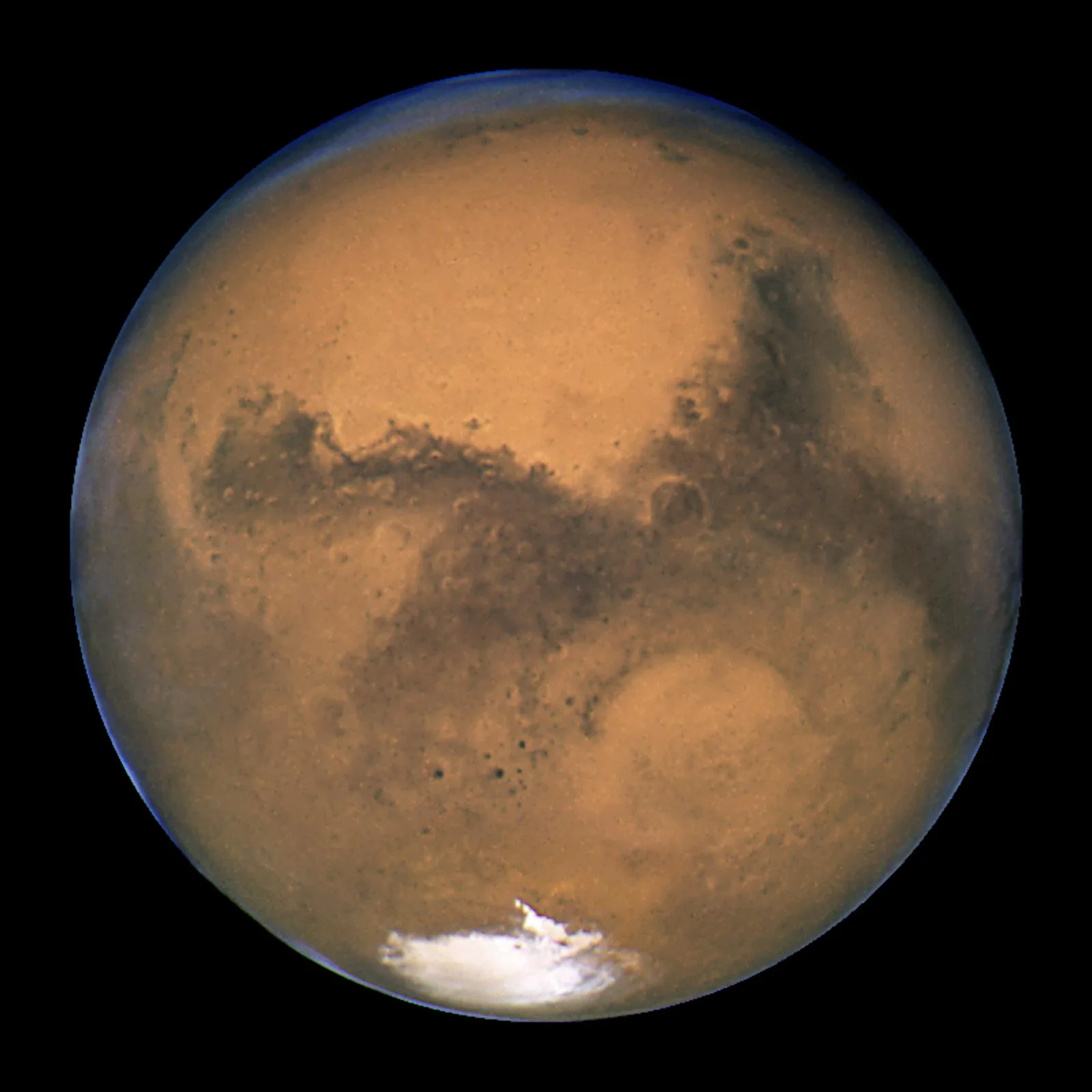
What you see: The orange-red color is rust: iron in Mars's rocks and dust has oxidized. A small white spot at the top or bottom can be one of its polar ice caps. science.nasa.gov
How it formed: Mars formed when gravity pulled swirling gas and dust together into the fourth planet from the Sun. Dry river valleys and old lakebeds show it was once wetter and warmer than today. science.nasa.gov
To scale: Mars is about half the size of Earth. If Earth were the size of a nickel, Mars would be about as big as a raspberry. science.nasa.gov
Three things to know
- Mars looks red because iron minerals in its dirt have rusted.
- Mars has Olympus Mons, a volcano about 22 km (13.6 miles) tall, and Valles Marineris, a canyon about 4,000 km long.
- Mars has two small, potato-shaped moons, Phobos and Deimos, which may be captured asteroids.
12 more fun facts
- Sunsets on Mars glow blue, because fine Martian dust scatters blue light so that it stays close to the Sun's direction. NASA's Curiosity rover recorded one on April 15, 2015. jpl.nasa.gov
- A day on Mars lasts about 24.6 hours, very close to ours. Mission teams call a Martian day a 'sol'. science.nasa.gov
- A year on Mars lasts 687 Earth days, so a 12-year-old on Earth would be just over 6 in Mars years. science.nasa.gov
- Mars is tilted about 25 degrees, close to Earth's 23.4, so it has seasons. Its northern spring is the longest, at 194 sols. science.nasa.gov
- The air on Mars is so thin that its average surface pressure is only about 0.6 percent of Earth's. en.wikipedia.org
- Temperatures on Mars swing from about 20 °C (70 °F) on a warm day to about minus 153 °C (minus 225 °F). science.nasa.gov
- Dust storms on Mars can grow to cover much of the planet, and the dust can take months to settle afterward. science.nasa.gov
- NASA's Ingenuity helicopter made the first powered, controlled flight on another planet on April 19, 2021, and went on to fly 72 times. science.nasa.gov
- Mars's moon Phobos is slowly sinking toward the planet. In about 50 million years it may crash into Mars or break apart into a ring. en.wikipedia.org
- Gravity on Mars is about 38 percent of Earth's, so a 100-pound person would weigh about 38 pounds there. nssdc.gsfc.nasa.gov
- Dry river valleys, deltas and old lakebeds show that Mars was once much wetter and warmer than the frozen desert it is today. science.nasa.gov
- Mariner 4 made the first successful flyby of Mars in 1965, and spacecraft have been working at Mars without a break since 1997. en.wikipedia.org
In the game these unlock one by one as you keep photographing Mars.
At a glance
- Type
- Planet
- Distance
- 54.6 to 401 million km from Earth (78 million km on average at opposition)
- Brightness
- magnitude -2
- Size in our sky
- 3.5 to 25.6 arcseconds
Looking back in time
Right now, sunlight bouncing off Mars takes 10 minutes to reach us, so you see it as it was 10 minutes ago.
How to see it yourself
Easy to see with the naked eye. A small telescope shows its disk and, near closest approach, dark markings and a polar cap.
Finding it: Look for a bright, distinctly orange-red 'star' along the band of the zodiac constellations. Over weeks it drifts against the stars, and around opposition it seems to loop backward for about 72 days.
When to look: Mars is best around opposition, which comes about every 2.1 years, when it is closest, brightest and up all night. It shows the most detail for a few months on either side of that date.
What you will see: To the naked eye Mars is a steady orange-red point, and binoculars show only a tiny dot. Near opposition, a small telescope at high power on a steady night can show dark markings and a white polar cap.
Easy to confuse with:
- Antares: Antares in Scorpius is also red, and its name means 'rival of Mars', but it stays fixed in its constellation while Mars wanders against the stars over weeks.
Where and when: Mars moves against the stars, so where it is depends on the date. The box above shows where it is from your sky.
How it is photographed: thousands of short video frames, keeping only the sharpest moments (lucky imaging), because the air above you blurs the view.
Name and story
The name: Mars is named for the Roman god of war, Ares to the Greeks, because of its blood-red color. Asaph Hall discovered its two moons in 1877, and they were named Phobos and Deimos after the twin sons of Ares, gods of panic and dread.
People and history: The Sumerians linked Mars with Nergal, their god of war and plague, and in East Asia it is traditionally called the 'fire star'. In 1877 Giovanni Schiaparelli mapped lines he called 'canali', and Percival Lowell spread the idea of Martian canals, which later turned out to be an optical illusion.
Record: Olympus Mons on Mars is either the tallest or second-tallest mountain in the solar system, rising roughly three times higher than Mount Everest above the plains around it.
Explored by: NASA's Curiosity and Perseverance rovers are exploring the surface today, and Perseverance is collecting rock samples while searching for signs of ancient life. NASA's twin ESCAPADE orbiters are on their way and due to arrive in September 2027.
Test yourself
After every photo of Mars the game asks one of these. A right answer earns sky points for your observatory.
What gives Mars its orange-red color?
- Rusted iron in its rocks and dust (the answer)
- Red-hot lava covering the ground
- A thick layer of red clouds
Iron in Martian rocks and dust has oxidized, or rusted, much like an old iron nail left out in the rain. That rusty dust tints the whole surface. science.nasa.gov
In 2021 NASA's Ingenuity made which first on Mars?
- Rock samples flown back to Earth
- A powered, controlled flight (the answer)
- A crewed landing with astronauts
Ingenuity was a small helicopter that flew on April 19, 2021, the first powered, controlled flight on another planet. It went on to make 72 flights. science.nasa.gov
Point a telescope at Mars in the game: capture it in real time, then develop the frames like an astrophotographer.
Point a telescope at MarsLearn more
- Seeing: the air between you and the stars
Why stars twinkle, why planets look blurry and boiling in a telescope, and why the biggest observatories sit on high mountains.
More solar system
 The Sun
 The Moon
 Venus
 Jupiter
Sources
- science.nasa.gov
- nssdc.gsfc.nasa.gov
- en.wikipedia.org
- jpl.nasa.gov
- science.nasa.gov
- astronomy.com
- Positions: astronomy-engine (Don Cross).