 SKY
Sky catalog › Solar System
Saturn
A planet
What is it?
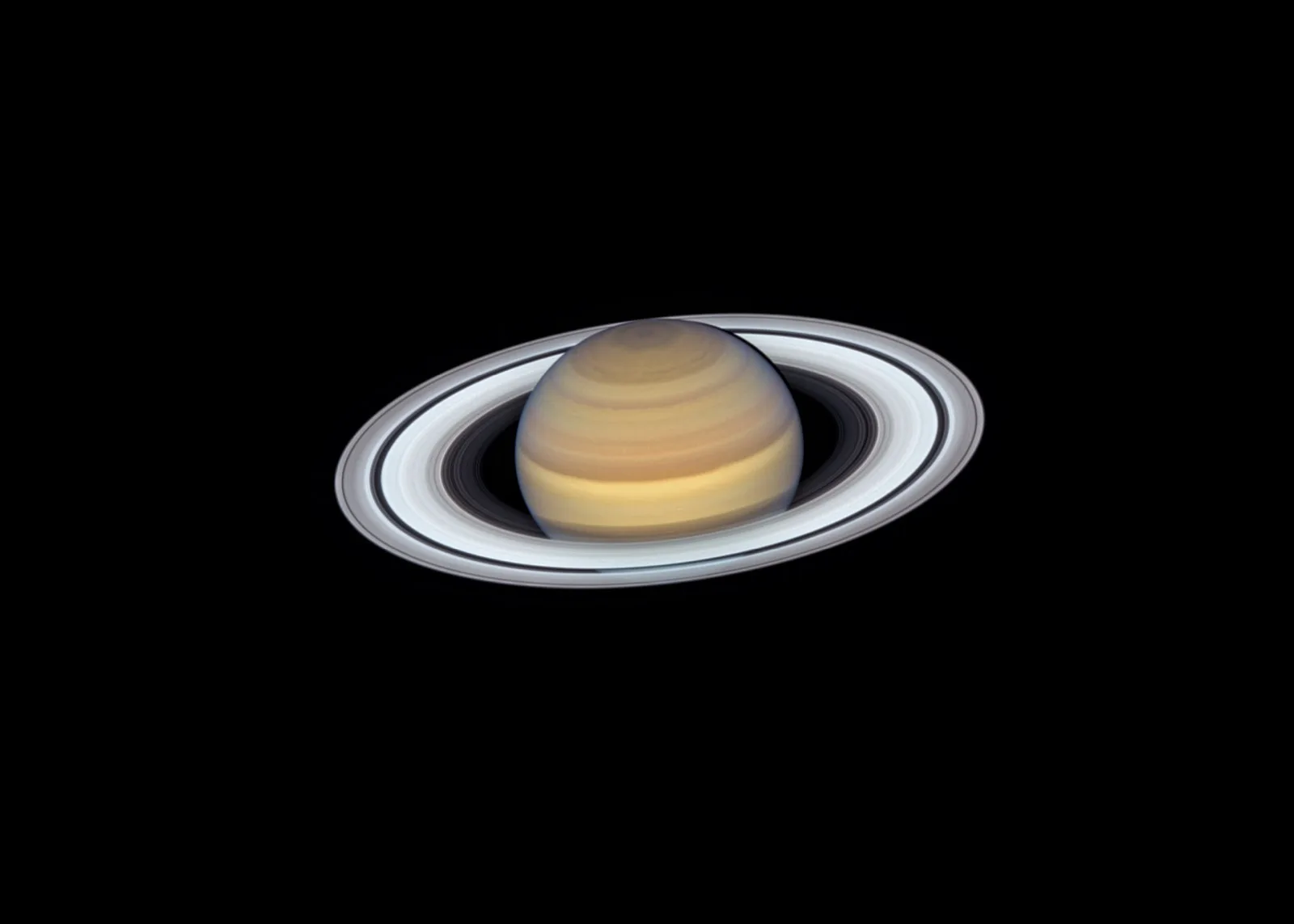
Saturn is a planet. A world that orbits the Sun and shines by reflected sunlight.
Why Saturn is interesting
What you see: The banded ball is the top of Saturn's clouds, in shades of yellow, brown and gray. The rings are billions of small chunks of ice and rock, coated with dust, all circling the planet. science.nasa.gov
How it formed: Saturn took shape about 4.5 billion years ago, along with the rest of the solar system, when gravity pulled swirling gas and dust together into this gas giant. science.nasa.gov
To scale: If Earth were the size of a nickel, Saturn would be about as big as a volleyball. It is about 9 times wider than Earth. science.nasa.gov
Three things to know
- Saturn is less dense than water, so it could float in a bathtub big enough to hold it.
- Saturn's rings reach up to 282,000 km from the planet, yet the main rings are usually only about 10 meters thick.
- Saturn has more known moons than any other planet: over 270 confirmed.
12 more fun facts
- Saturn's north pole is crowned by a six-sided cloud pattern, the hexagon, about 30,000 km (20,000 miles) across, with a giant storm at its center. science.nasa.gov
- Winds at Saturn's equator blow at about 500 meters per second, roughly 1,800 km/h (1,100 mph). science.nasa.gov
- A year on Saturn lasts about 29.4 Earth years. science.nasa.gov
- Saturn spins so fast that it is visibly squashed: its width at the equator is more than 10 percent larger than from pole to pole. en.wikipedia.org
- Saturn gives off about 2.5 times as much energy as it receives from the Sun. en.wikipedia.org
- About every 15 years Earth lines up with the plane of Saturn's rings, and the thin rings almost vanish from view. The last time was in 2025. en.wikipedia.org
- Saturn's rings are billions of chunks of ice and rock, from dust-sized grains to pieces as big as a house, and a few as large as mountains. science.nasa.gov
- Saturn's moon Titan is the only moon with a thick atmosphere, and apart from Earth it is the only place known with rivers, lakes and seas on its surface, made of liquid methane and ethane. science.nasa.gov
- Saturn's small moon Enceladus sprays water into space from more than 100 geysers, fed by liquid water hidden under its ice. en.wikipedia.org
- On January 14, 2005, the Huygens probe parachuted down and landed on Saturn's moon Titan. en.wikipedia.org
- Lightning on Saturn is about 1,000 times more powerful than lightning on Earth. en.wikipedia.org
- About once every Saturn year, roughly every 30 Earth years, a huge storm called a Great White Spot breaks out. One was seen in 1990. en.wikipedia.org
In the game these unlock one by one as you keep photographing Saturn.
At a glance
- Type
- Planet
- Distance
- 1.2 to 1.66 billion km from Earth (1.28 billion km on average at opposition)
- Brightness
- magnitude 0.7
- Size in our sky
- 14.5 to 20 arcseconds (planet only, without the rings)
Looking back in time
Right now, sunlight bouncing off Saturn takes 74 minutes to reach us, so you see it as it was 74 minutes ago.
How to see it yourself
Easy to see with the naked eye. A small telescope shows its disk and rings.
Finding it: Look for a steady, yellowish 'star' along the band of the zodiac. It is the most distant of the five planets you can see with the naked eye and moves the most slowly against the stars.
When to look: Saturn is best around opposition, which comes about every 378 days, a little later each year. Then it rises at sunset and is up all night.
What you will see: To the naked eye Saturn is a bright yellowish point. You need about 30x magnification to see the rings clearly, which even a small telescope gives. On a steady night look for the Cassini Division, a dark gap between the two brightest rings, and faint belts on the planet.
Where and when: Saturn moves against the stars, so where it is depends on the date. The box above shows where it is from your sky.
How it is photographed: thousands of short video frames, keeping only the sharpest moments (lucky imaging), because the air above you blurs the view.
Name and story
The name: Saturn is named after the Roman god Saturn, Kronos to the Greeks. When Galileo first saw the rings in 1610, his small telescope made them look like two moons on either side; Christiaan Huygens saw that they were rings in 1655.
People and history: Saturday is named after Saturn. In Hindu astrology Saturn is Shani, said to judge people by their deeds, and ancient Chinese and Japanese cultures called it the 'earth star'. It has appeared in fiction at least since Voltaire's Micromégas in 1752.
Record: Saturn is the most distant planet you can see with the naked eye and has been known since prehistoric times. Its largest moon, Titan, holds more than 90 percent of all the mass orbiting Saturn.
Explored by: Pioneer 11 made the first flyby in September 1979, passing within about 20,000 km (12,000 miles) of the clouds, followed by Voyager 1 and 2. Cassini orbited Saturn from 2004 until its final plunge on September 15, 2017. NASA's Dragonfly is due to launch in 2028 to explore Titan.
Test yourself
After every photo of Saturn the game asks one of these. A right answer earns sky points for your observatory.
How thick are Saturn's main rings, usually?
- About 30,000 km (19,000 miles)
- About 10 meters (30 feet) (the answer)
- About 1,000 km (620 miles)
The rings reach out hundreds of thousands of kilometers, yet the main rings are usually only about 10 meters (30 feet) thick, about the height of a three-story building. science.nasa.gov
Which spacecraft orbited Saturn from 2004 until 2017?
- Cassini (the answer)
- Pioneer 11
- Voyager 1
Pioneer 11 and Voyager 1 only flew past, in 1979 and 1980. Cassini stayed in orbit for 13 years and ended with a planned plunge into Saturn on September 15, 2017. en.wikipedia.org
Point a telescope at Saturn in the game: capture it in real time, then develop the frames like an astrophotographer.
Point a telescope at SaturnLearn more
- Seeing: the air between you and the stars
Why stars twinkle, why planets look blurry and boiling in a telescope, and why the biggest observatories sit on high mountains.
- Lucky imaging: keep the sharp moments, throw away the rest
How planet photographers beat the shimmering air: record thousands of short video frames, keep only the sharpest, then stack and sharpen them.
More solar system
 The Sun
 The Moon
 Venus
 Mars
Sources
- science.nasa.gov
- nssdc.gsfc.nasa.gov
- en.wikipedia.org
- science.nasa.gov
- astronomy.com
- Positions: astronomy-engine (Don Cross).