 SKY
Sky catalog › Nebulae
Ring Nebula
M57, NGC 6720 · A planetary nebula in Lyra
What is it?
Ring Nebula is a planetary nebula. A shell of gas puffed off by a dying Sun-like star. It has nothing to do with planets: early telescopes made it look like a small planet disk.
Why the Ring Nebula is interesting
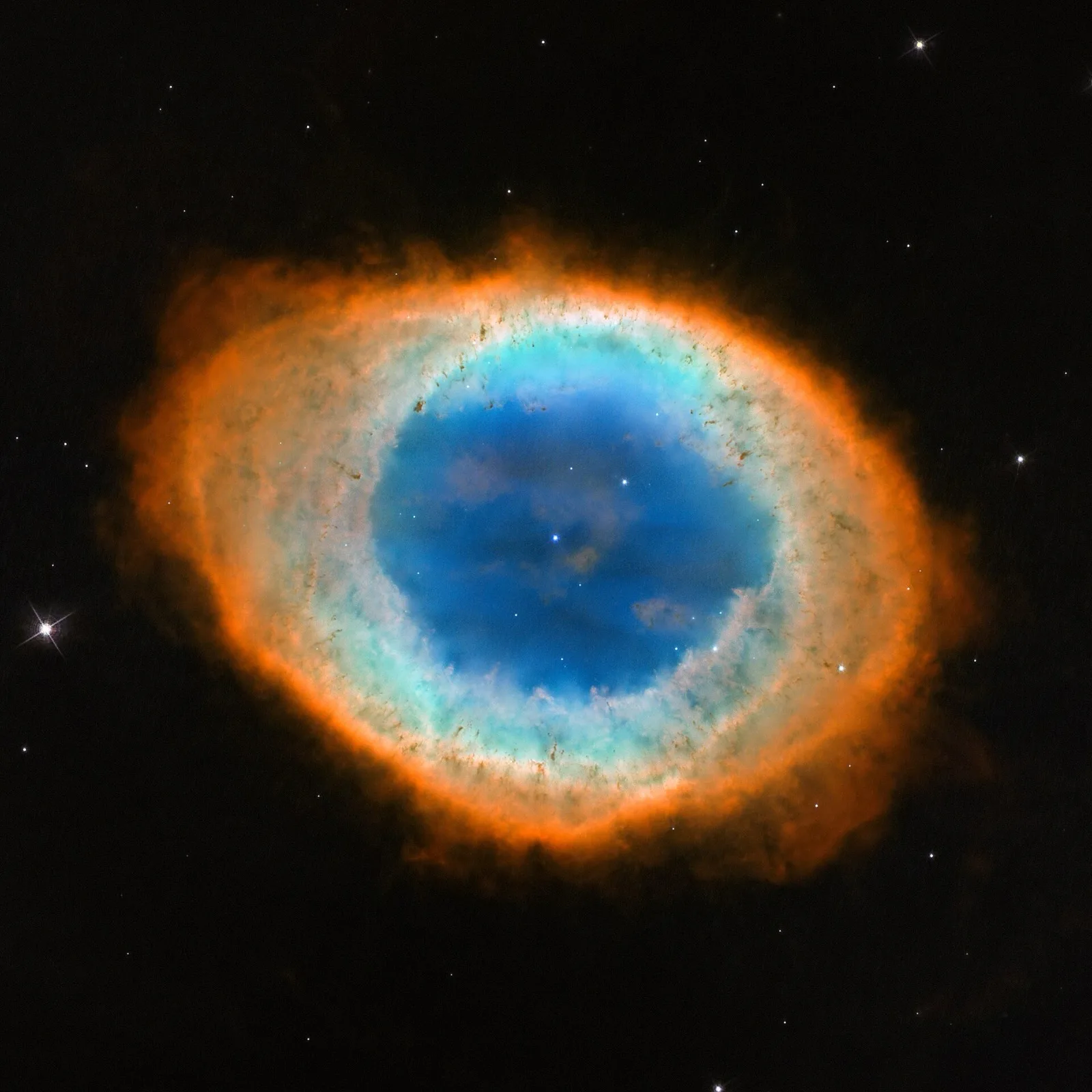
What you see: The ring is the glowing remains of a Sun-like star. The deep blue center is helium, the light blue ring is hydrogen and oxygen, and the reddish outer ring is nitrogen and sulfur. science.nasa.gov
How it formed: The old star swelled into a red giant, then shed its outer layers into space. Radiation from the white dwarf left in the middle makes that gas glow. science.nasa.gov
To scale: The Ring is roughly 1 light-year across, so a beam of light would need about a year to cross it. science.nasa.gov
Three things to know
- The Ring Nebula is the glowing shell of gas thrown off by a dying star much like our Sun.
- The star left in the middle is now a white dwarf, the small, hot leftover core of the old star.
- It looks like a flat ring, but it is really shaped more like a football seen end-on poking through a doughnut.
12 more fun facts
- In 2026 astronomers announced a strange bar of iron gas inside the Ring, about 500 times as long as Pluto's orbit around the Sun, holding roughly as much iron as the whole planet Mars. ras.ac.uk
- Webb's 2023 images revealed about 20,000 dense clumps of gas in the Ring, each rich in molecular hydrogen. esawebb.org
- Just outside the bright ring, Webb found about ten faint, evenly nested arcs, probably shaped by a small companion star circling the central star at about the distance of Pluto from the Sun. esawebb.org
- The Ring is growing at more than 43,000 miles per hour (about 69,000 km/h), and its center is moving outward faster than the ring itself. science.nasa.gov
- The Ring is roughly 1 light-year across, so a beam of light would need about a year to cross from one side to the other. science.nasa.gov
- The Ring will keep spreading for about another 10,000 years, then fade away until it blends into the thin gas between the stars. science.nasa.gov
- The tiny star in the middle has a surface of about 125,000 kelvin (roughly 225,000 degrees Fahrenheit) and shines about 300 times as brightly as the Sun. en.wikipedia.org
- Dark, dense knots line the inside edge of the ring, and their tails make them look like the spokes of a bicycle wheel. science.nasa.gov
- In Hubble's colors, deep blue in the middle is helium, the light blue ring is hydrogen and oxygen, and the reddish outer ring is nitrogen and sulfur. science.nasa.gov
- The Ring's blue-green tint comes from oxygen atoms that have lost two electrons, glowing at a wavelength of 500.7 nanometers. en.wikipedia.org
- The Sun should become a white dwarf in about 6 billion years, but its glowing shell will be fainter than the Ring because the Sun is less massive than the Ring's original star. science.nasa.gov
- Photographs taken over 50 years show the Ring slowly getting bigger on the sky, by about 1 arcsecond per century. en.wikipedia.org
In the game these unlock one by one as you keep photographing the Ring Nebula.
At a glance
- Type
- Planetary nebula
- Catalog
- M57, NGC 6720
- Constellation
- Lyra
- Distance
- about 2,570 light-years
- Brightness
- magnitude 8.8
- Size in our sky
- about 1 x 1.4 arcminutes
- Discovered
- Charles Messier and Antoine Darquier de Pellepoix, independently, in 1779
- Position (J2000)
- RA 18h 54m, Dec +33.0°
Looking back in time
The light in this photo left the Ring Nebula about 2,570 years ago, when the Greek and Roman world watched this same sky; Greek thinkers worked out from the round shadow on the Moon during eclipses that the Earth is a ball.
How to see it yourself
Needs a telescope and a dark sky. Photos show far more than the eye can see.
Finding it: Find brilliant Vega, then look just south of it for the two 3rd-magnitude stars Sheliak and Sulafat at the bottom of the lyre shape of Lyra. The Ring sits between them, a little less than halfway from Sheliak to Sulafat.
When to look: Best on summer evenings from mid-northern latitudes; in August the Summer Triangle, which includes Vega in Lyra, is high overhead soon after dark.
What you will see: It is too faint for the naked eye and 10x50 binoculars cannot show its shape. A 3-inch (7.5 cm) telescope shows a small oval, and a 4-inch at about 100x shows the dark hole in the middle; the central star is far too faint for small scopes.
Easy to confuse with:
- Dumbbell Nebula (M27): M27 is many times larger and shaped like an apple core, while the Ring is a tiny, neat oval smoke ring.
- A faint star: At low power the Ring can pass for a slightly fuzzy star, but at 100x or more it swells into an oval with a darker center.
Best months: July is when it is highest around midnight. About two months later it is highest in the early evening, at around 8 to 9 PM.
Where on Earth: easy from the Northern Hemisphere. South of latitude 47°S it never climbs more than 10° above the horizon. From 57°N and farther north it never sets.
How it is photographed: long exposures through filters, then the frames are stacked, stretched and combined into color.
Name and story
The name: It is called the Ring Nebula because small telescopes show it as a glowing oval with a darker middle, like a smoke ring. Charles Messier found it in January 1779 and listed it as number 57, and Antoine Darquier de Pellepoix found it about two weeks later. Darquier said it looked like a fading planet as large as Jupiter, a description that may have helped inspire the term planetary nebula.
Explored by: In August 2023 the James Webb Space Telescope photographed the Ring with its NIRCam and MIRI cameras. The infrared images showed about 20,000 dense gas clumps, a thin ring of glowing carbon-rich PAH molecules, and about ten faint arcs beyond the main ring.
Test yourself
After every photo of the Ring Nebula the game asks one of these. A right answer earns sky points for your observatory.
What is the Ring Nebula's true 3D shape like?
- A flat coin with a hole
- A football poking through a doughnut (the answer)
- A spiral like a galaxy
A football-shaped blue structure, seen end-on, pierces a red doughnut of gas. Because we look straight down its length, the whole thing looks like a neat ring. science.nasa.gov
Who found the Ring Nebula in January 1779?
- Galileo Galilei
- Charles Messier (the answer)
- Edwin Hubble
Messier listed it as number 57. Darquier found it about two weeks later and said it looked like a fading planet, which may have helped inspire the term planetary nebula. en.wikipedia.org
Point a telescope at the Ring Nebula in the game: capture it in real time, then develop the frames like an astrophotographer.
Point a telescope at the Ring NebulaLearn more
- The Messier catalog: 110 things that are not comets
Why a French comet hunter listed fuzzy objects to avoid, and how his list became the favorite checklist of amateur astronomers.
More nebulae
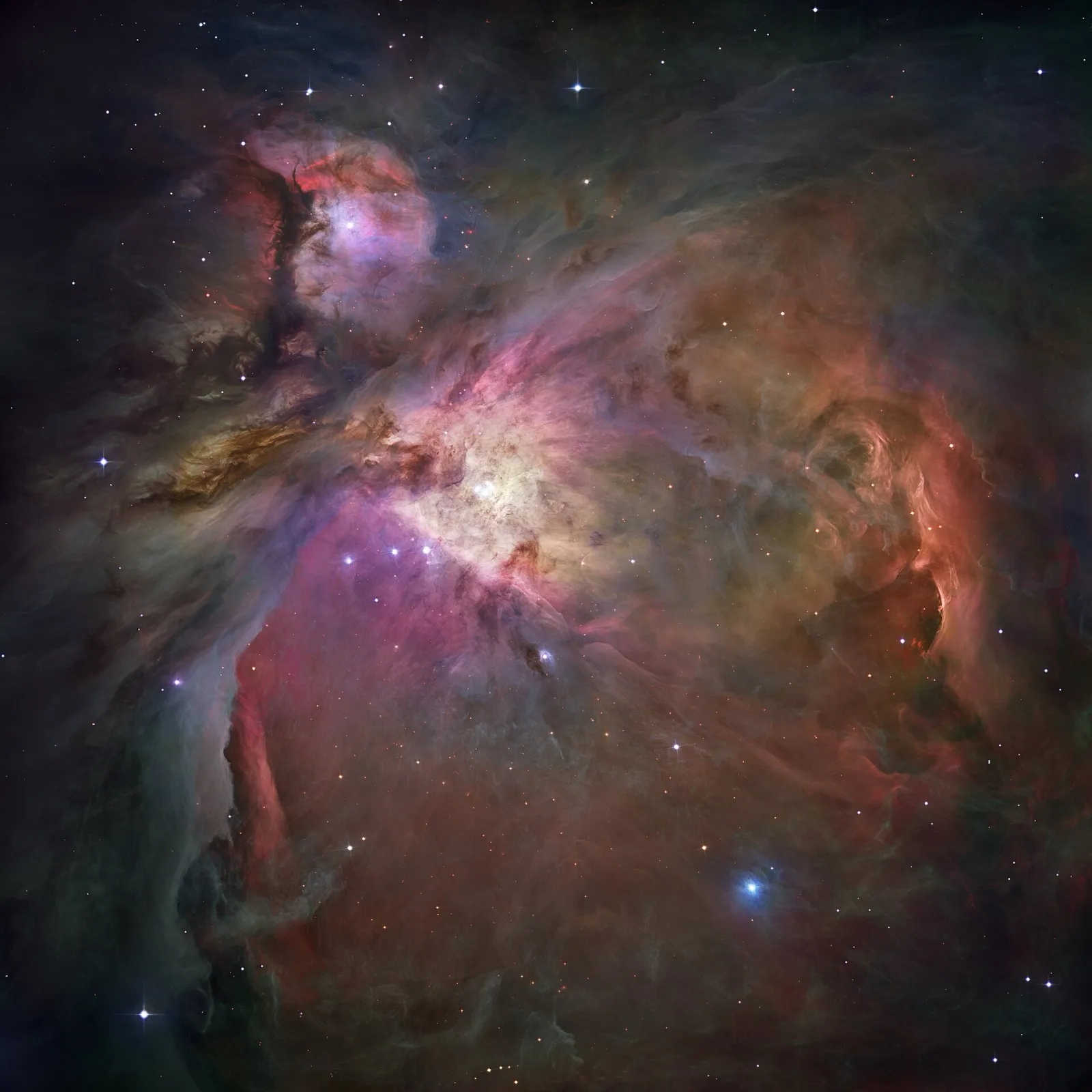 Orion NebulaM42 · star-forming nebula
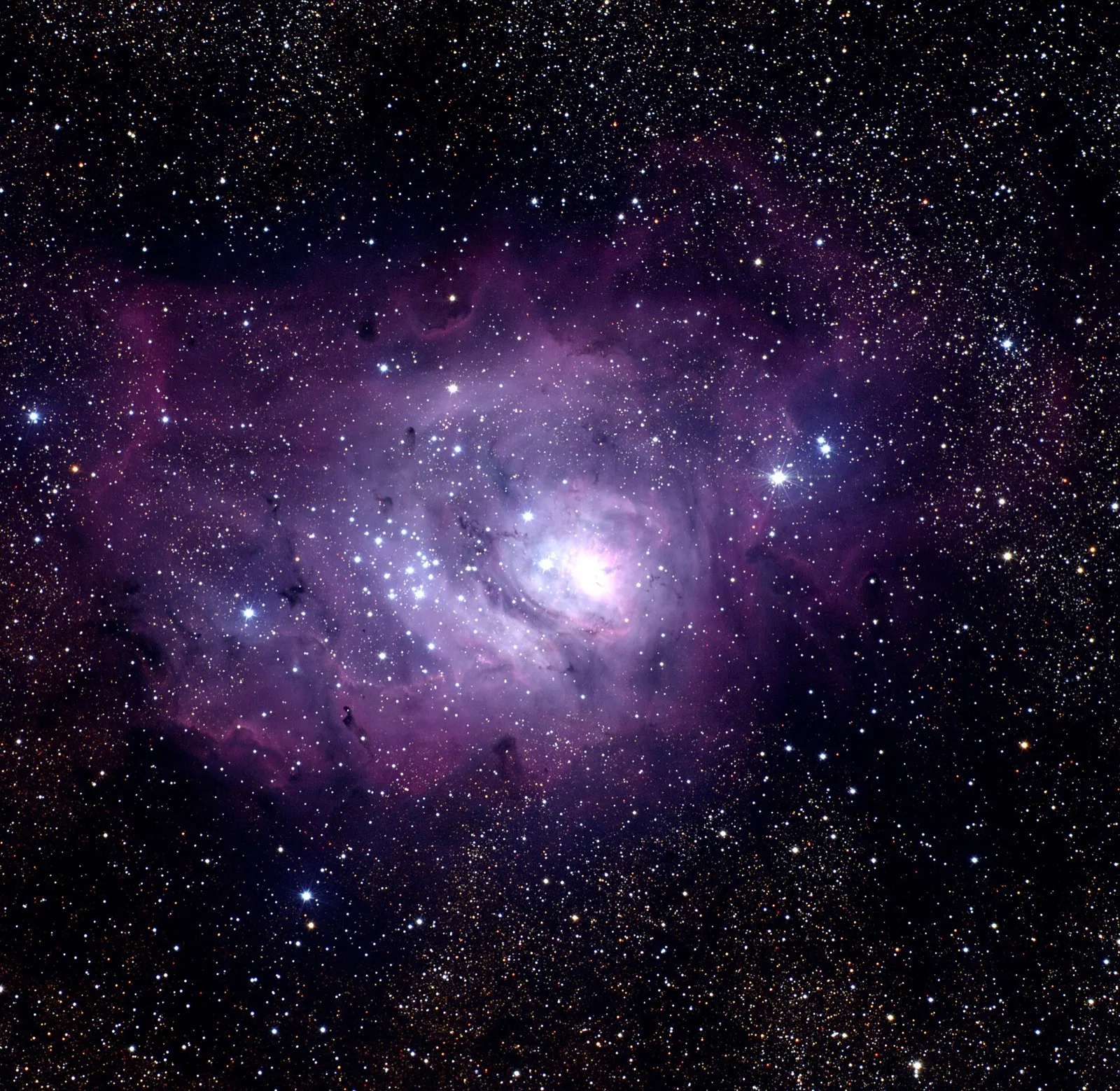 Lagoon NebulaM8 · star-forming nebula
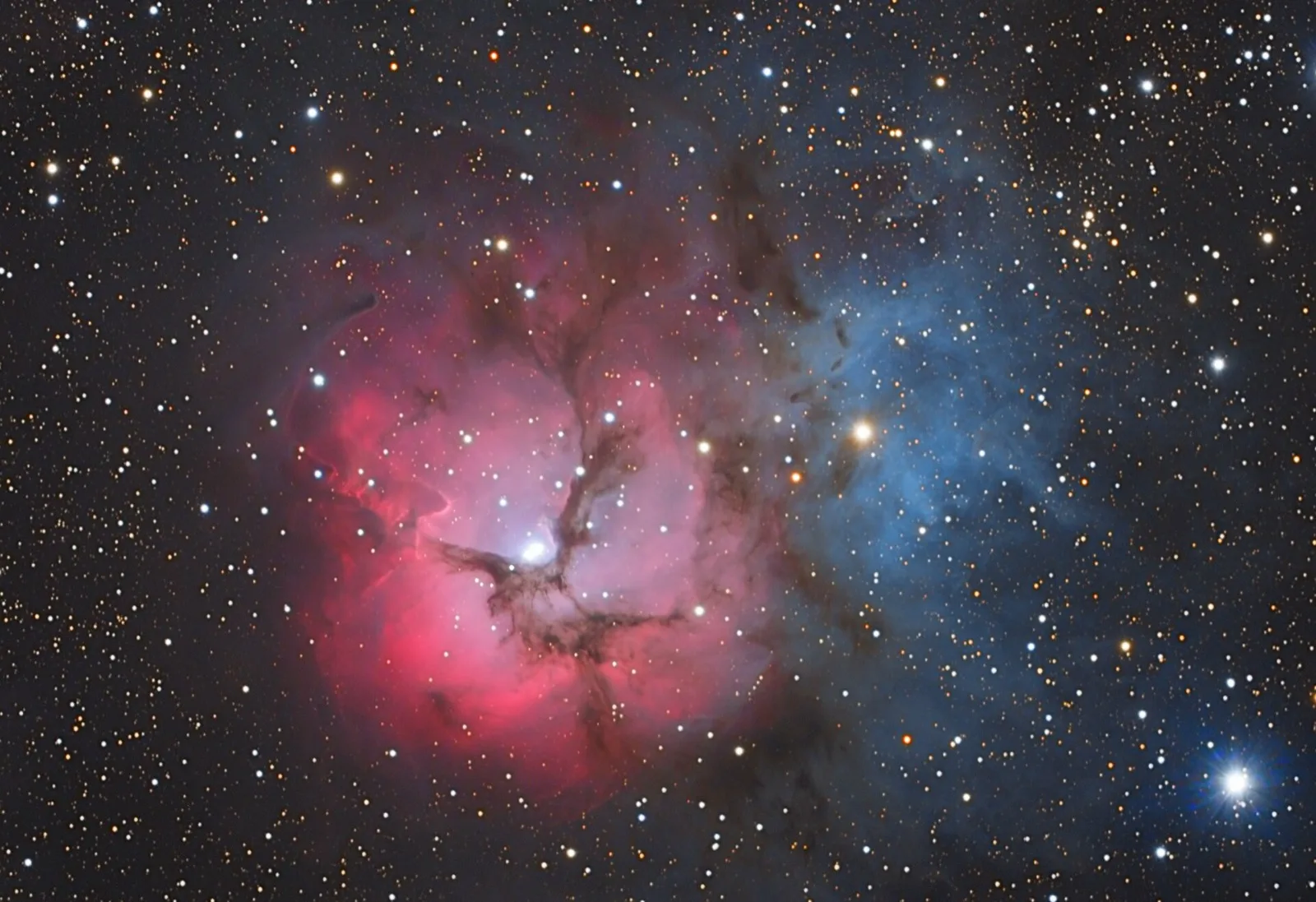 Trifid NebulaM20 · star-forming nebula
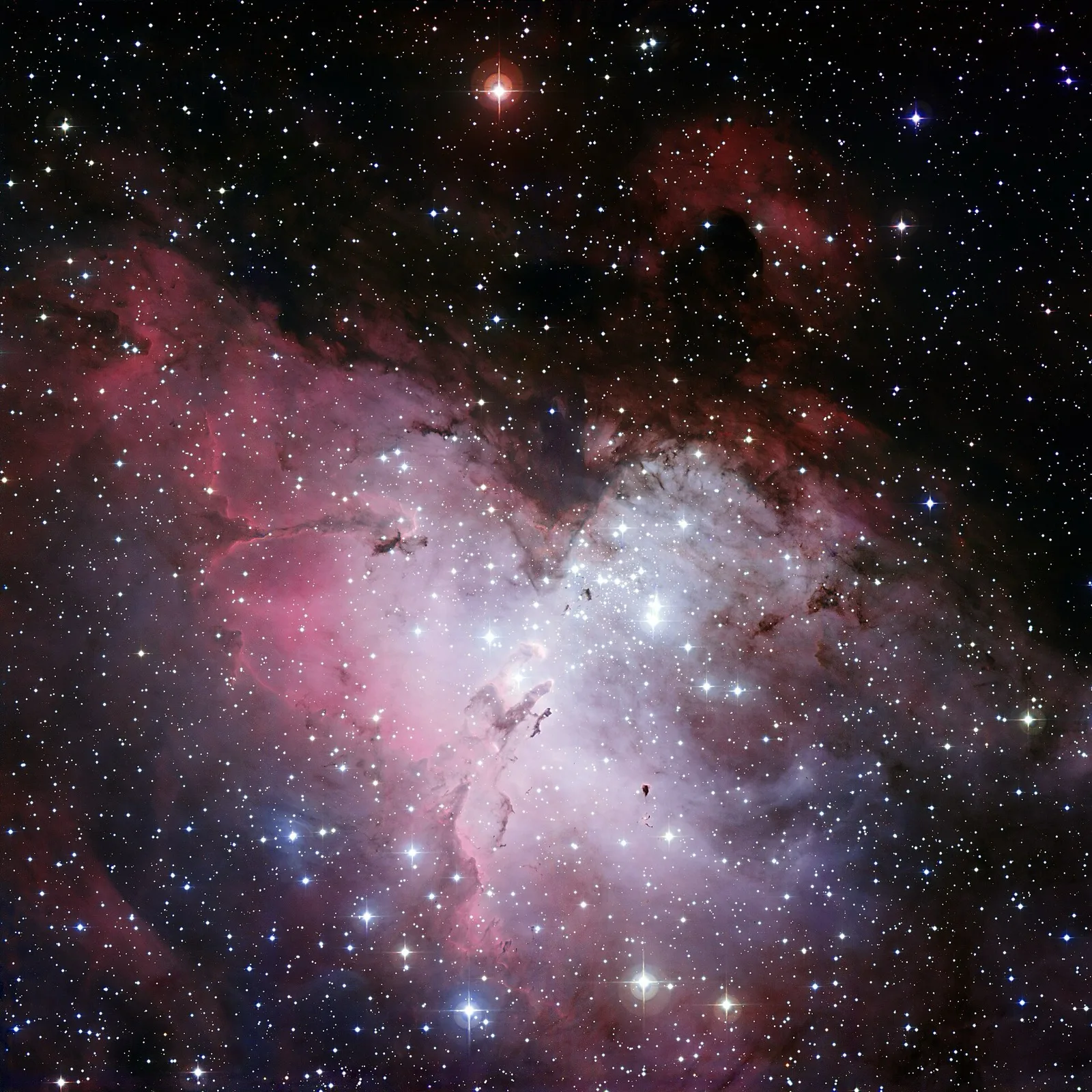 Eagle NebulaM16 · star-forming nebula
Sources
- en.wikipedia.org
- science.nasa.gov
- ras.ac.uk
- esawebb.org
- science.nasa.gov
- science.nasa.gov
- Positions: astronomy-engine (Don Cross).