 SKY
Sky catalog › Nebulae
Trifid Nebula
M20, NGC 6514 · A star-forming nebula in Sagittarius
What is it?
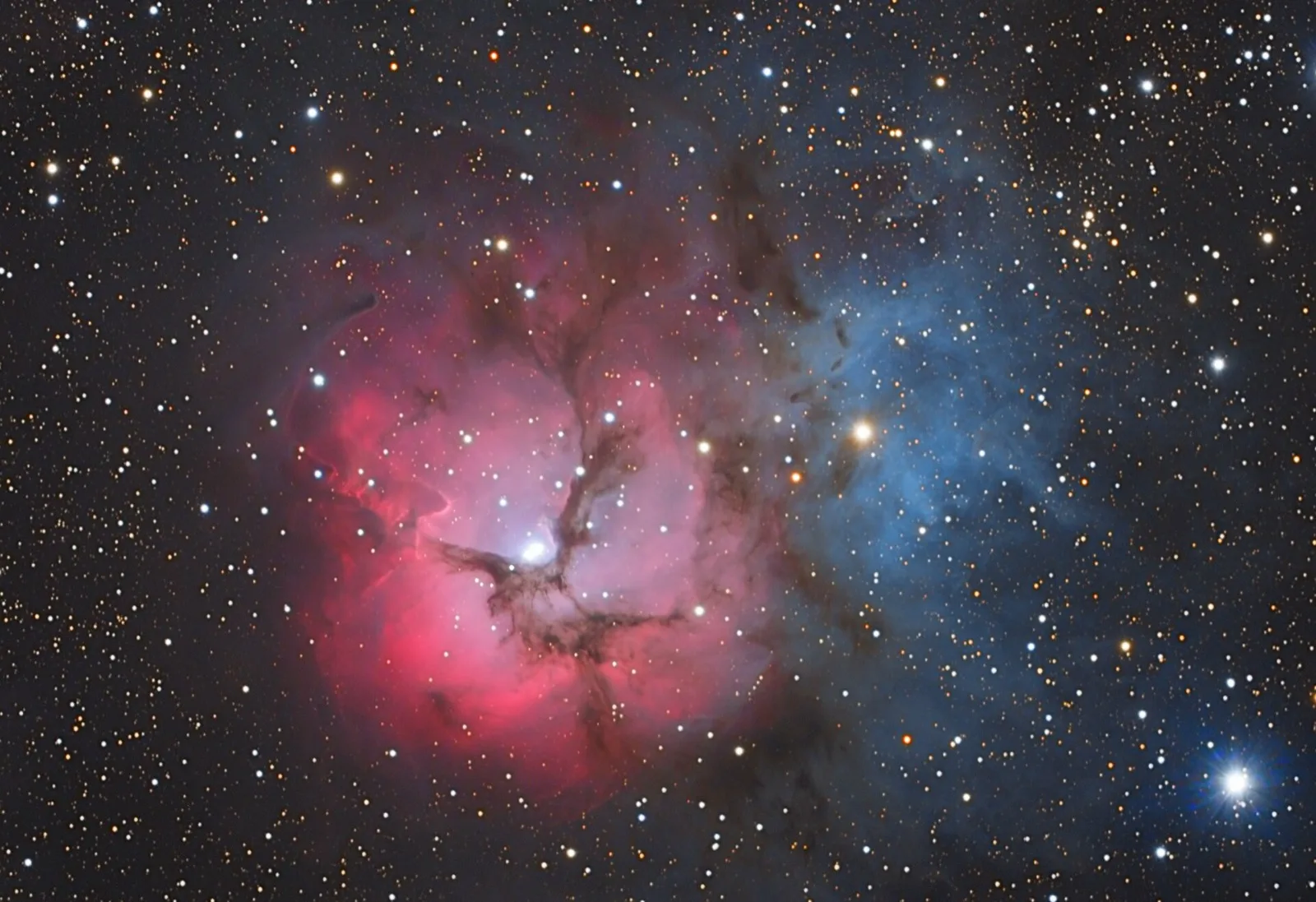
Trifid Nebula is a star-forming nebula. A huge cloud of gas lit up by hot young stars born inside it.
Why the Trifid Nebula is interesting
What you see: The reddish-pink part is glowing gas, the blue part is dust reflecting starlight, and dark lanes of dust split the glow into three lobes. en.wikipedia.org
How it formed: Several massive stars have shaped it for at least 300,000 years. Their ultraviolet light and winds blow a huge bubble and strip away gas and dust, carving its pillars and stalks. esahubble.org
To scale: The Trifid Nebula is about 42 light-years across, so light needs about 42 years to cross it. constellation-guide.com
Three things to know
- Trifid means "three-lobed": dark lanes of dust split its glowing cloud into three parts.
- It is three kinds of nebula in one: a red glowing cloud, a blue cloud that reflects starlight, and dark dust.
- About 3,100 young stars surround its biggest star, which has more than 20 times the mass of the Sun.
11 more fun facts
- For its 36th birthday in April 2026, Hubble released a Trifid Nebula picture of a dusty cloud nicknamed the "Cosmic Sea Slug" or sea lemon, with a young star's jet as one of its horns. esahubble.org
- Hubble photographed the same part of the Trifid in 1997 and again in 2026, 29 years apart, letting astronomers watch a young star's jet change and measure how fast it flows. esahubble.org
- In 1997 Hubble found a jet about 0.75 light-years long shooting from the head of a dense cloud in the Trifid Nebula. en.wikipedia.org
- In 2005 the Spitzer Space Telescope found 30 embryonic stars and 120 newborn stars in the Trifid that are hidden in ordinary visible-light pictures. en.wikipedia.org
- Massive stars have been sculpting the gas and dust of the Trifid Nebula for at least 300,000 years. esahubble.org
- A finger-shaped stalk in the Trifid points toward its central star. It is an evaporating gaseous globule, or EGG, a dense knot of gas. en.wikipedia.org
- The dark lanes that split the Trifid Nebula are a dust cloud of their own, cataloged by E. E. Barnard as Barnard 85. constellation-guide.com
- Charles Messier found the Trifid Nebula on June 5, 1764, and described it as a cluster of stars. He found the star cluster M21 the same night. constellation-guide.com
- In the 1780s William Herschel gave the Trifid Nebula four separate numbers in his catalogs. constellation-guide.com
- The Trifid Nebula is about 42 light-years across, and Gaia data place it at about the same distance as the nearby Lagoon Nebula. constellation-guide.com
- The Trifid's brightest central star is really part of a triple star system. constellation-guide.com
In the game these unlock one by one as you keep photographing the Trifid Nebula.
At a glance
- Type
- Star-forming nebula
- Catalog
- M20, NGC 6514
- Constellation
- Sagittarius
- Distance
- about 4,100 to 5,000 light-years (estimates differ)
- Brightness
- magnitude 6.3
- Size in our sky
- about 28 arcminutes
- Discovered
- Charles Messier, June 5, 1764
- Position (J2000)
- RA 18h 02m, Dec -23.0°
Looking back in time
The light in this photo left the Trifid Nebula 4,100 to 5,000 years ago, when the Great Pyramid of Giza was already standing (it was built about 4,500 years ago).
How to see it yourself
Too faint for most eyes, but binoculars show it from a dark site. A small telescope shows its shape.
Finding it: It is in Sagittarius, above the spout of the Teapot. The bright Lagoon Nebula (M8) lies close by to the southeast and the star cluster M21 about 0.75 degrees to the northeast; a small telescope can fit the Lagoon and Trifid in one wide field.
When to look: Best on August evenings, low in the south for mid-northern observers. It can be seen from anywhere south of latitude 66 degrees north and rides much higher from the Southern Hemisphere.
What you will see: Binoculars show a small, fuzzy round patch. A 3-inch (80 mm) telescope begins to show the dark dust lanes, and a 6-inch (150 mm) shows three dark lanes spreading from the center of an irregular glow.
Easy to confuse with:
- Lagoon Nebula (M8): The Lagoon is much larger and brighter with a star cluster in its glow, while the Trifid is a smaller round patch cut by dark lanes.
- Messier 21: M21, just to the northeast, is a cluster of stars with no glowing cloud around it.
Best months: June is when it is highest around midnight. About two months later it is highest in the early evening, at around 8 to 9 PM.
Where on Earth: best from the Southern Hemisphere. North of latitude 57°N it never climbs more than 10° above the horizon.
How it is photographed: long exposures through filters, then the frames are stacked, stretched and combined into color.
Name and story
The name: John Herschel named it Trifid for the dark dust lanes that divide it into three lobes. Charles Messier discovered it on June 5, 1764, and it became number 20 in his catalog; John Dreyer later listed it as NGC 6514 in the New General Catalogue.
People and history: A picture of the Trifid Nebula appears on the cover of King Crimson's album Islands.
Explored by: Hubble first imaged the Trifid in 1997, and the Spitzer Space Telescope looked through its dust in infrared light in 2005. The Vera C. Rubin Observatory pictured it in 2025, and Hubble returned to it for its 36th birthday image in 2026.
Test yourself
After every photo of the Trifid Nebula the game asks one of these. A right answer earns sky points for your observatory.
What splits the Trifid Nebula's glow into three parts?
- Gaps between three galaxies
- Dark lanes of dust (the answer)
- Shadows of three planets
Thick dust in front blocks the glowing gas behind it, leaving dark gaps. E. E. Barnard listed those lanes as a dust cloud of their own, Barnard 85. constellation-guide.com
Why did Hubble image the same Trifid spot in 1997 and 2026?
- To search for a lost spacecraft
- To see a young star's jet change (the answer)
- To track a comet passing by
A young protostar shoots out a jet of plasma in bursts over centuries. Pictures 29 years apart, the second with a better camera, show how it changes. esahubble.org
Point a telescope at the Trifid Nebula in the game: capture it in real time, then develop the frames like an astrophotographer.
Point a telescope at the Trifid NebulaMore nebulae
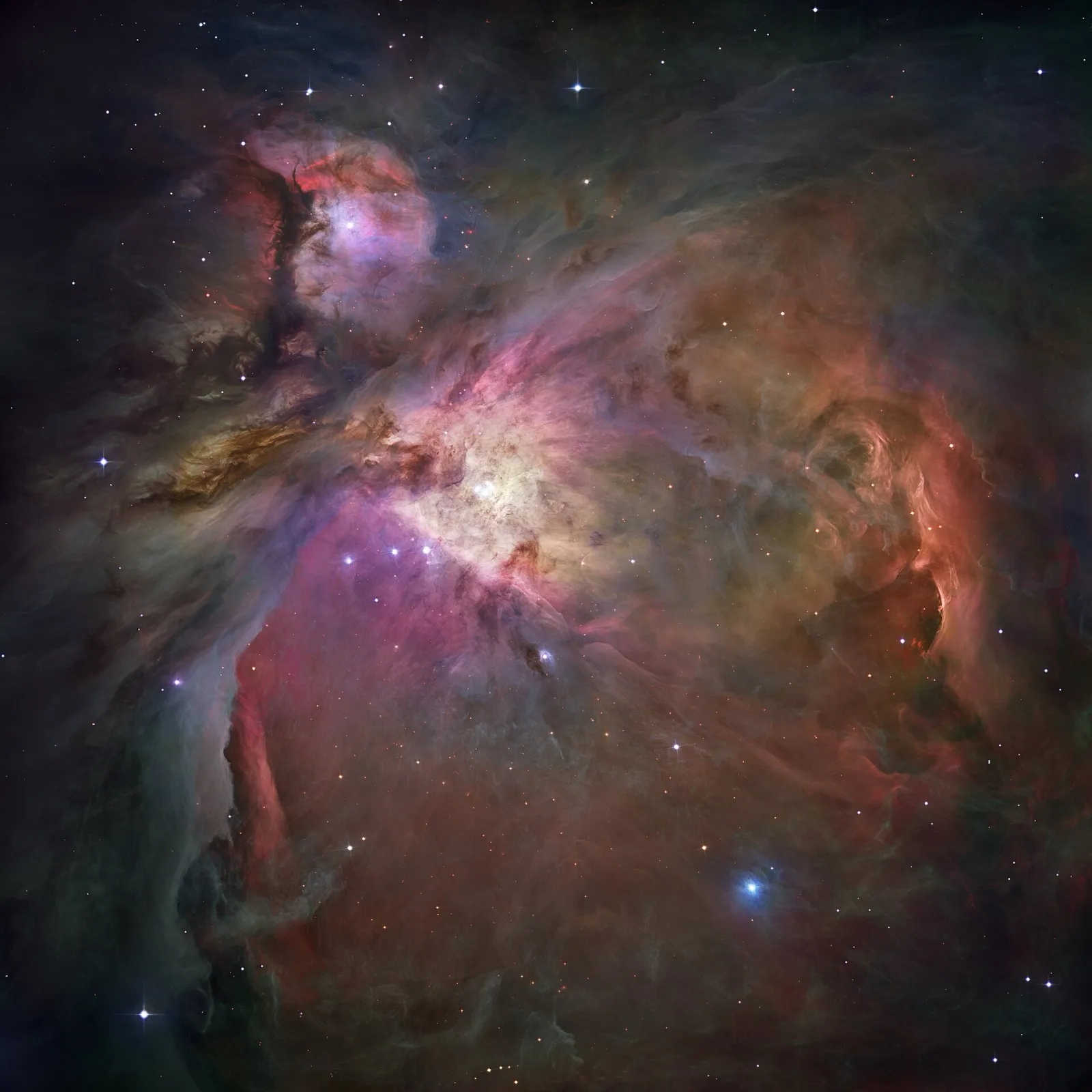 Orion NebulaM42 · star-forming nebula
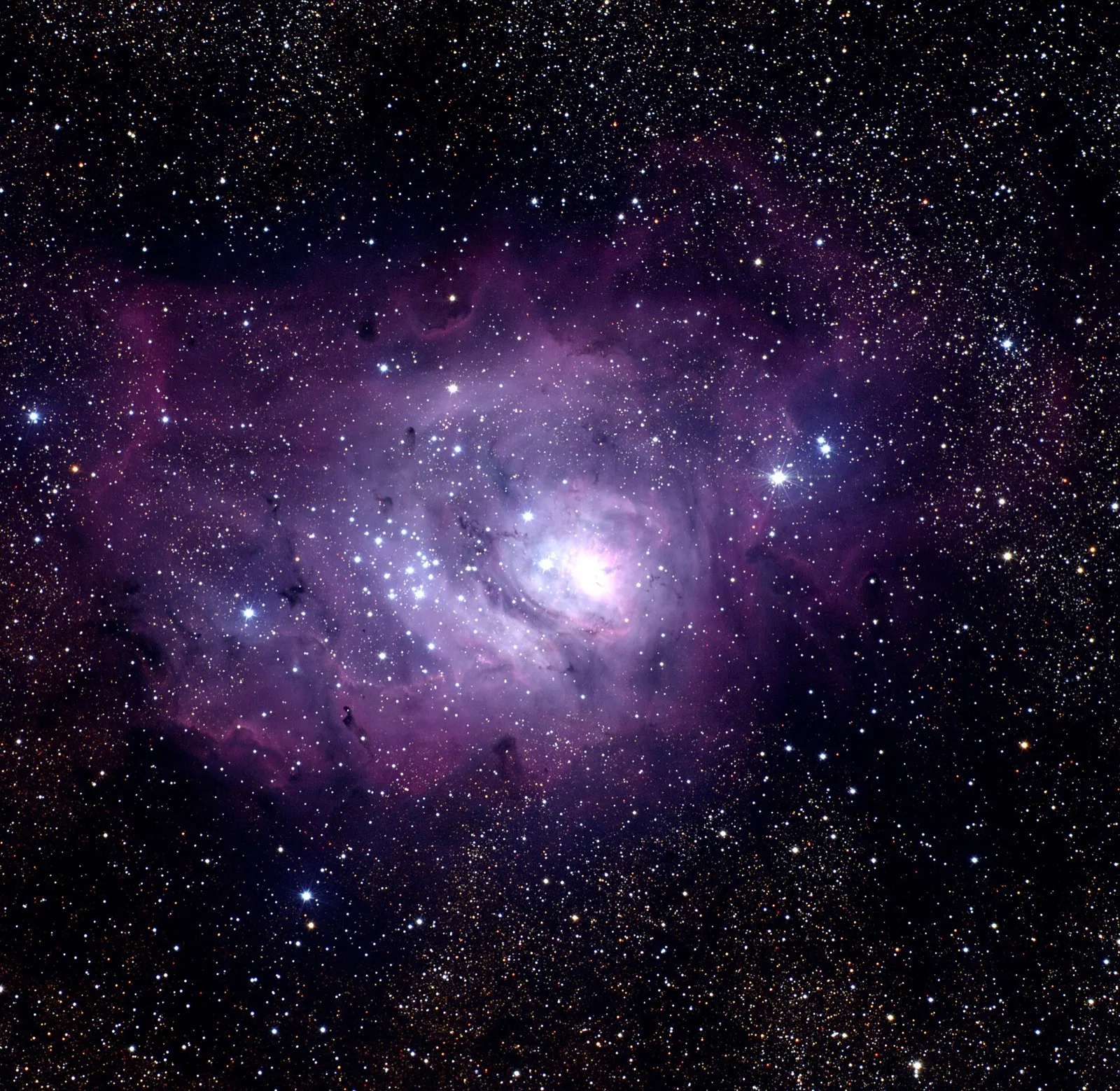 Lagoon NebulaM8 · star-forming nebula
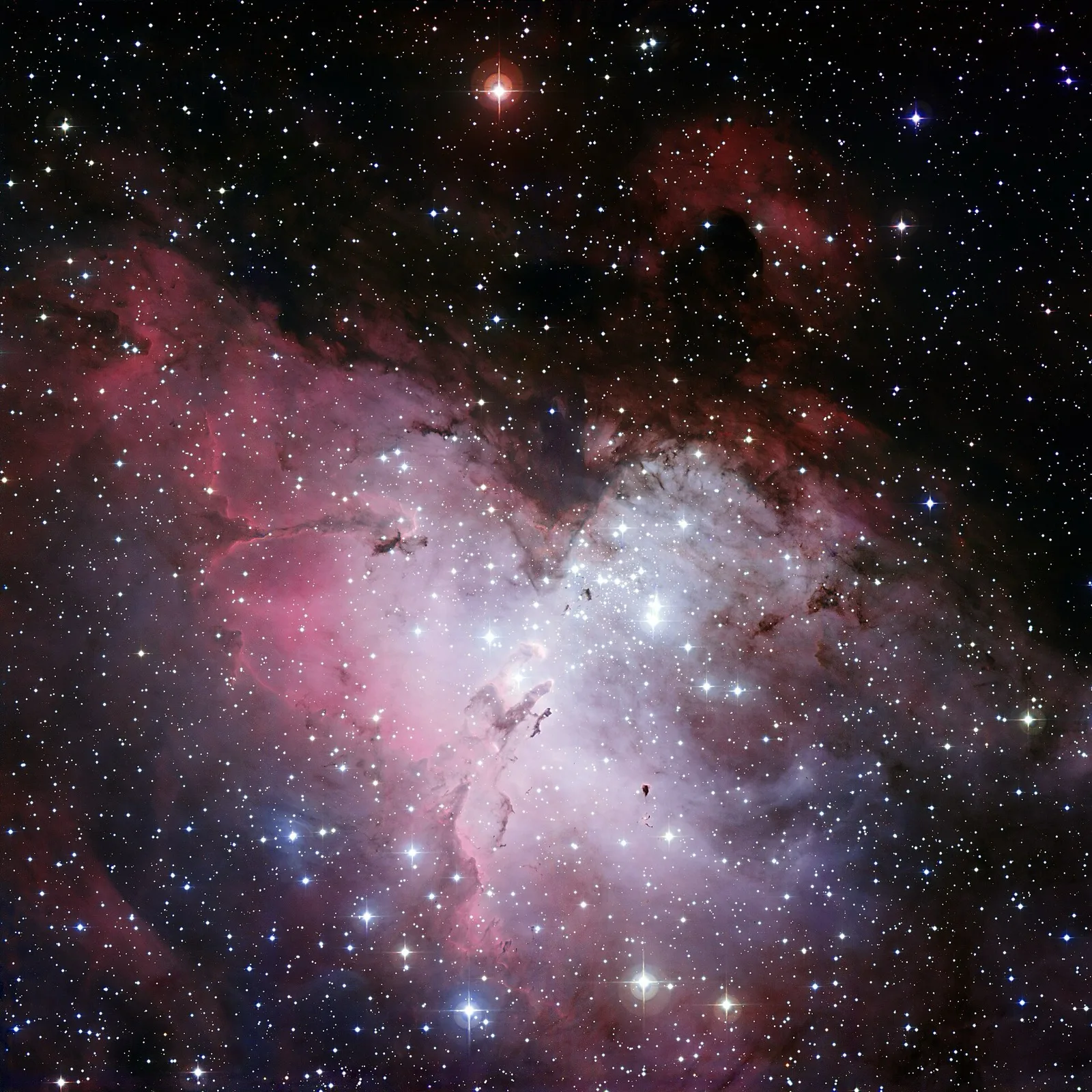 Eagle NebulaM16 · star-forming nebula
 Carina NebulaNGC 3372 · star-forming nebula
Sources
- en.wikipedia.org
- science.nasa.gov
- esahubble.org
- constellation-guide.com
- Positions: astronomy-engine (Don Cross).