 SKY
Sky catalog › Nebulae
Orion Nebula
M42, NGC 1976 · A star-forming nebula in Orion
What is it?
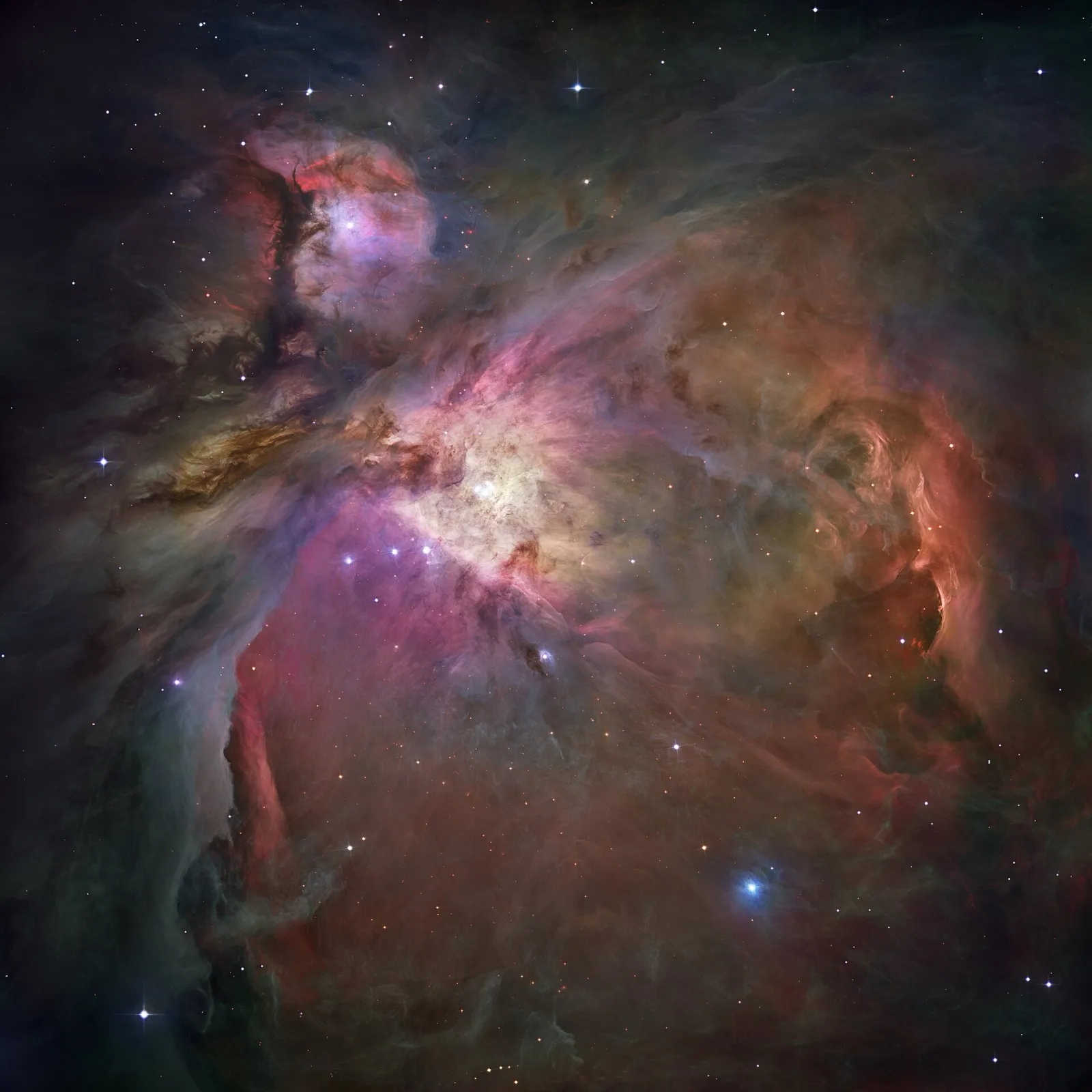
Orion Nebula is a star-forming nebula. A huge cloud of gas lit up by hot young stars born inside it.
Why the Orion Nebula is interesting
What you see: The red glow is hydrogen gas, lit up by the hot young stars of the Trapezium at the nebula's heart. About 2,800 stars crowd near its center. en.wikipedia.org
How it formed: Stars are born here as clumps of hydrogen and other gases shrink under their own gravity. Hubble has found more than 150 dusty disks around newborn stars, where planets can form. en.wikipedia.org
To scale: The Orion Nebula holds about 2,000 times the mass of the Sun in gas and dust, enough to build a whole crowd of new stars. en.wikipedia.org
Three things to know
- The Orion Nebula is a giant star nursery where new stars are being born right now.
- Some of its brightest stars may be only about 10,000 years old, which is very young for a star.
- The cloud is about 25 light-years across, and you can see it without a telescope as a fuzzy spot just below Orion's belt.
11 more fun facts
- About 500 years ago, two young stars hidden in the cloud behind the Orion Nebula had a close encounter that flung gas outward at more than 150 km (93 miles) per second. earthsky.org
- On September 30, 1880, Henry Draper photographed the Orion Nebula with a 51-minute exposure. It was the first astrophotograph ever taken of a nebula. en.wikipedia.org
- The nebula's green glow puzzled early astronomers so much that some proposed a new element called "nebulium." The color actually comes from oxygen atoms that have lost two electrons. en.wikipedia.org
- At the nebula's heart sit the four bright stars of the Trapezium, packed within about 1.5 light-years. Galileo spotted three of them on February 4, 1617. en.wikipedia.org
- Hubble has found more than 150 dusty disks around newborn stars in the Orion Nebula, the kind of disk from which planets can form. en.wikipedia.org
- Hubble's 2006 portrait of the Orion Nebula revealed about 3,000 stars, some only one hundredth as bright as any seen there before. It took 105 orbits of the telescope. esahubble.org
- In 2023 the Webb telescope made the first detection of the methyl cation, a key carbon molecule, in a planet-forming disk around a small red dwarf star in the Orion Nebula. esa.int
- The Orion Nebula holds about 2,000 times the mass of the Sun in gas and dust. en.wikipedia.org
- About 2,800 stars crowd within 20 light-years of the nebula's center, forming the Orion Nebula Cluster. en.wikipedia.org
- Runaway stars such as AE Aurigae and Mu Columbae may have been flung out of the Orion Nebula's cluster about two million years ago, at more than 100 km (62 miles) per second. en.wikipedia.org
- The hottest gas in the Orion Nebula reaches about 10,000 kelvin, roughly 17,500 degrees Fahrenheit. en.wikipedia.org
In the game these unlock one by one as you keep photographing the Orion Nebula.
At a glance
- Type
- Star-forming nebula
- Catalog
- M42, NGC 1976
- Constellation
- Orion
- Distance
- about 1,300 light-years (measurements range from 1,270 to 1,500)
- Brightness
- magnitude 4
- Size in our sky
- 65 x 60 arcminutes (about 1 degree)
- Discovered
- Nicolas-Claude Fabri de Peiresc, 1610 (first recorded telescope observation; visible to the naked eye)
- Position (J2000)
- RA 5h 35m, Dec -5.4°
Looking back in time
The light in this photo left the Orion Nebula about 1,300 years ago, when the Maya were building great stone cities in Central America.
How to see it yourself
Visible to the naked eye from a dark site. Binoculars show it well, and a small telescope shows more detail.
Finding it: Find the three stars of Orion's Belt, then look below them for a short line of three fainter stars, Orion's Sword. The middle "star" of the sword looks hazy, and that haze is the Orion Nebula.
When to look: Best on winter evenings for mid-northern observers; NASA names January as the best month, with Orion high in the south by about 10 p.m. It sits only about 5 degrees south of the celestial equator, so it can be seen from nearly everywhere on Earth.
What you will see: From a dark site the naked eye shows a small fuzzy spot in the sword. Binoculars turn it into a hazy, puffy ball, and a small telescope at 30x to 50x shows wispy wings of glow; at 75x to 100x the four Trapezium stars appear at its center.
Easy to confuse with:
- Messier 43: M43 is a small detached patch of haze just north of the main nebula, wrapped around a single 7th-magnitude star.
- NGC 1981: NGC 1981, about 1 degree north, is a loose open cluster of stars rather than a glowing cloud.
Best months: December is when it is highest around midnight. About two months later it is highest in the early evening, at around 8 to 9 PM.
Where on Earth: close to the celestial equator, so it can be seen from almost everywhere on Earth.
How it is photographed: long exposures through filters, then the frames are stacked, stretched and combined into color.
Name and story
The name: The name M42 comes from Charles Messier, who observed it on March 4, 1769, and made it the 42nd entry in his catalog. Nicolas-Claude Fabri de Peiresc made the first known record of it as a nebula on November 26, 1610, and Johann Baptist Cysat published the first observation in 1619.
People and history: Some scholars suggest the Maya saw the nebula in their story of the Three Hearthstones: it is the glowing embers at the center of a cosmic hearth formed by the stars Rigel, Saiph and Alnitak.
Record: The Orion Nebula is the closest region of massive star formation to Earth. In 1880 it became the first nebula ever photographed, and it remains one of the most studied and photographed objects in the night sky.
Explored by: Hubble's big mosaic of the Orion Nebula used 520 exposures and holds more than a billion pixels, which NASA calls the sharpest view of the nebula ever obtained. Hubble has also peered through the dust in infrared light, where the Trapezium stars glitter like gems.
Test yourself
After every photo of the Orion Nebula the game asks one of these. A right answer earns sky points for your observatory.
What makes the green glow that once had people talking about 'nebulium'?
- A brand-new chemical element
- Light from one green star
- Oxygen atoms missing two electrons (the answer)
Early astronomers could not match the green color to any known element. The color actually comes from ordinary oxygen atoms that have lost two electrons. en.wikipedia.org
What made 1880 a big year for the Orion Nebula?
- Someone saw it for the very first time
- It became the first nebula photographed (the answer)
- A space probe flew close to it
Henry Draper took a 51-minute exposure on September 30, 1880. It was the first astrophotograph ever taken of a nebula, though people had seen it since at least 1610. en.wikipedia.org
Point a telescope at the Orion Nebula in the game: capture it in real time, then develop the frames like an astrophotographer.
Point a telescope at the Orion NebulaLearn more
- Color from three black and white pictures
Most astronomy cameras see only in black and white. Color images come from exposures through filters, combined into red, green and blue. Here is how, and what narrowband colors mean.
- A light-year, and why looking far means looking back
A light-year is a distance, not a time: how far light travels in a year. Here is how big it is, and why every look into space is a look into the past.
More nebulae
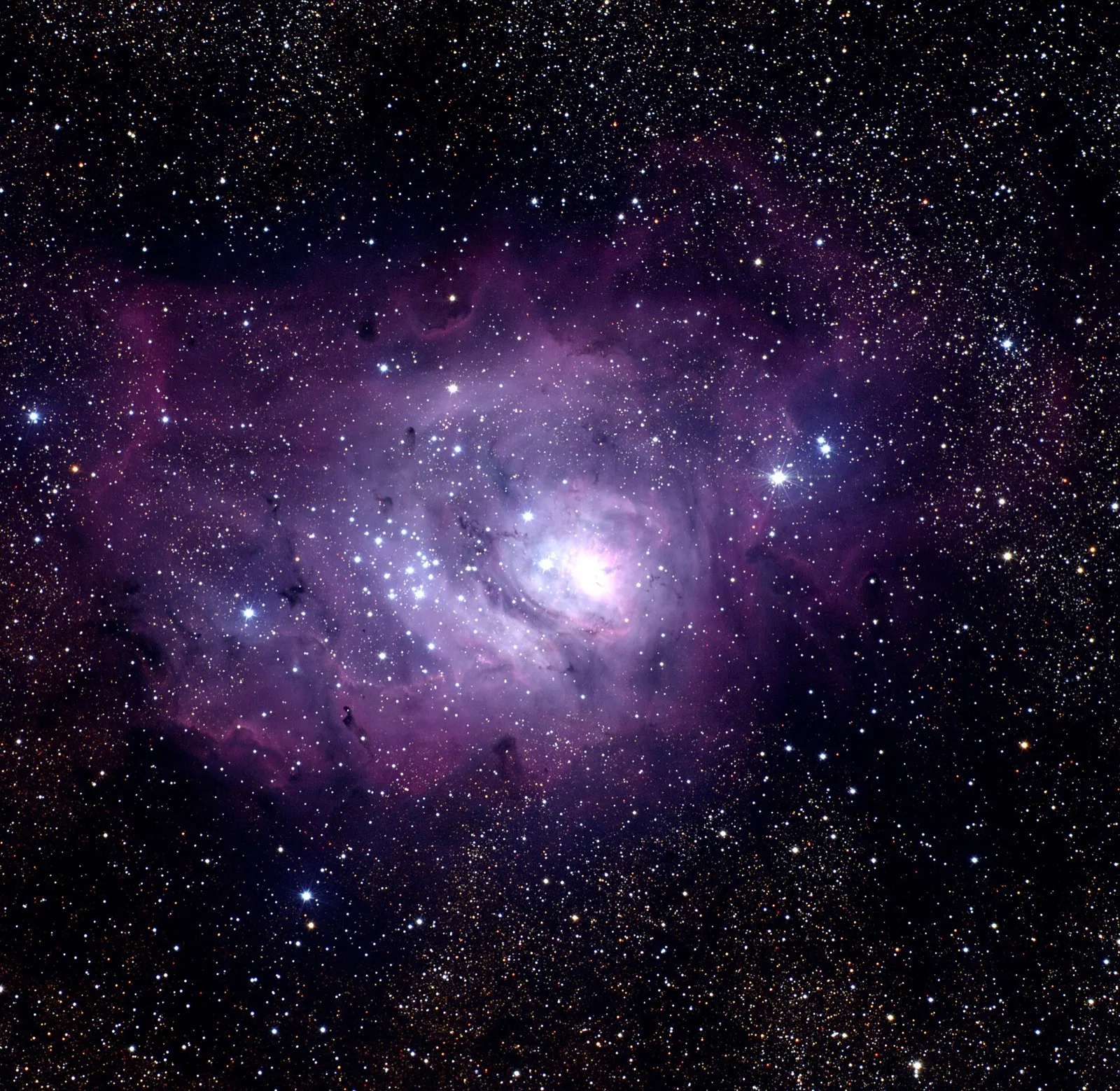 Lagoon NebulaM8 · star-forming nebula
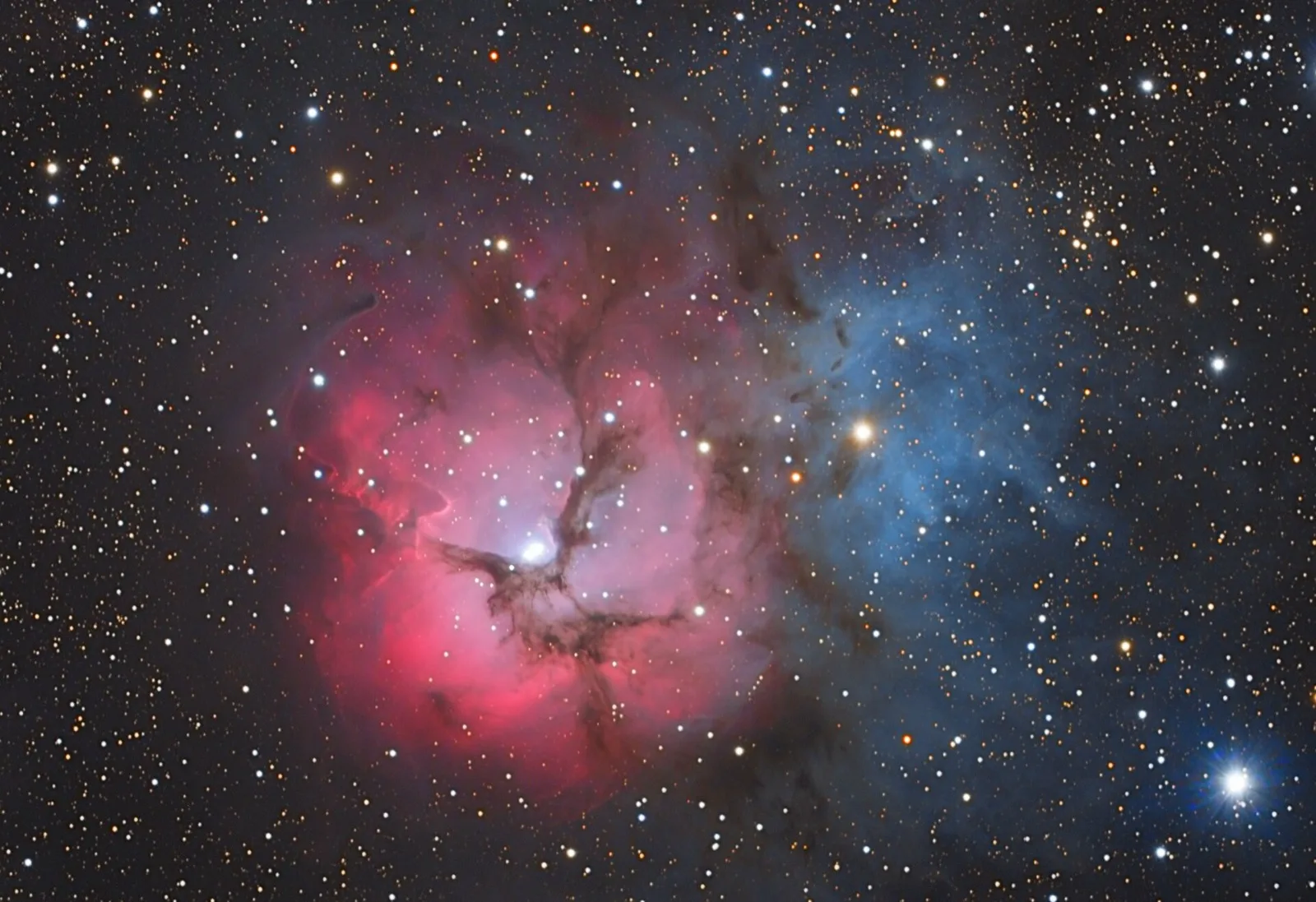 Trifid NebulaM20 · star-forming nebula
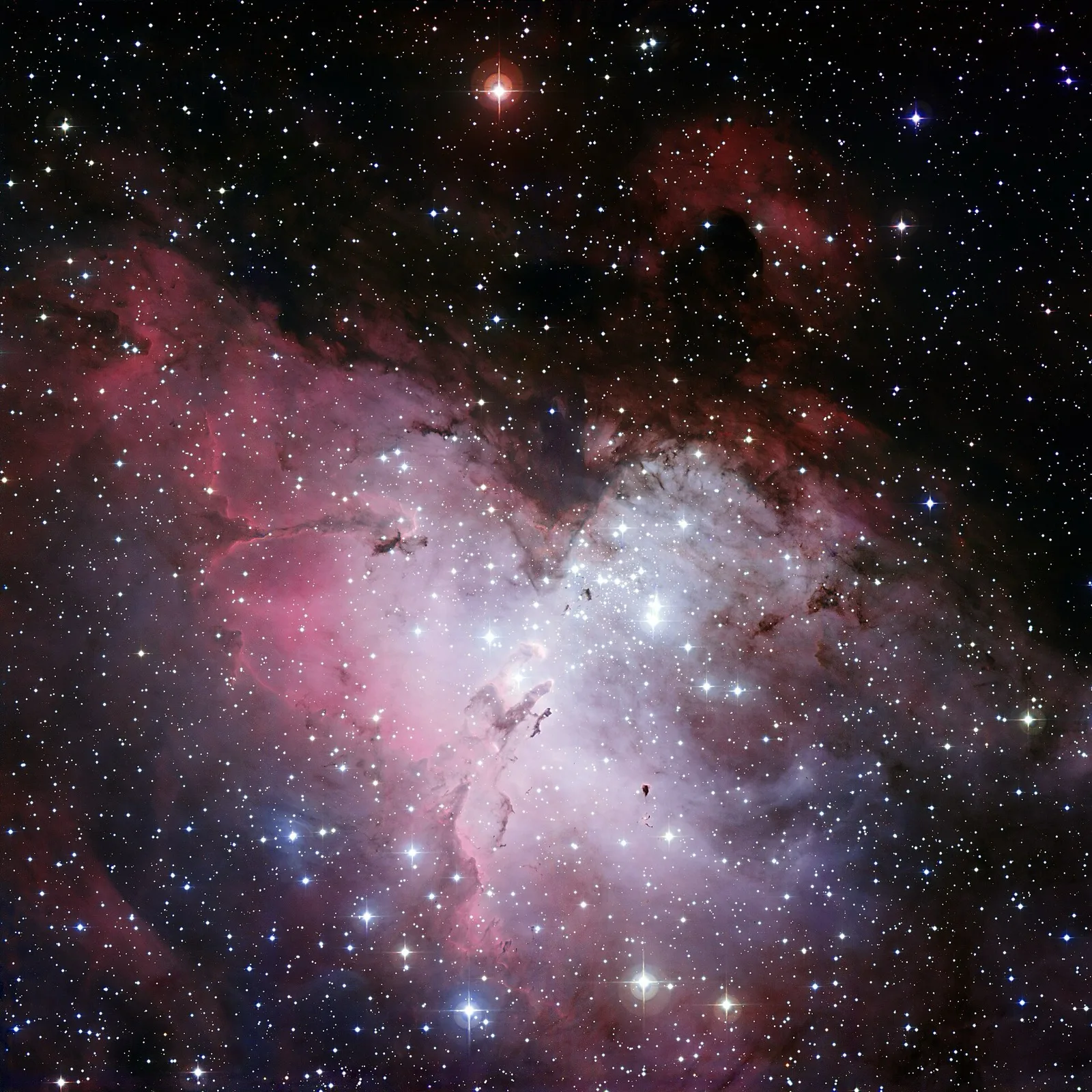 Eagle NebulaM16 · star-forming nebula
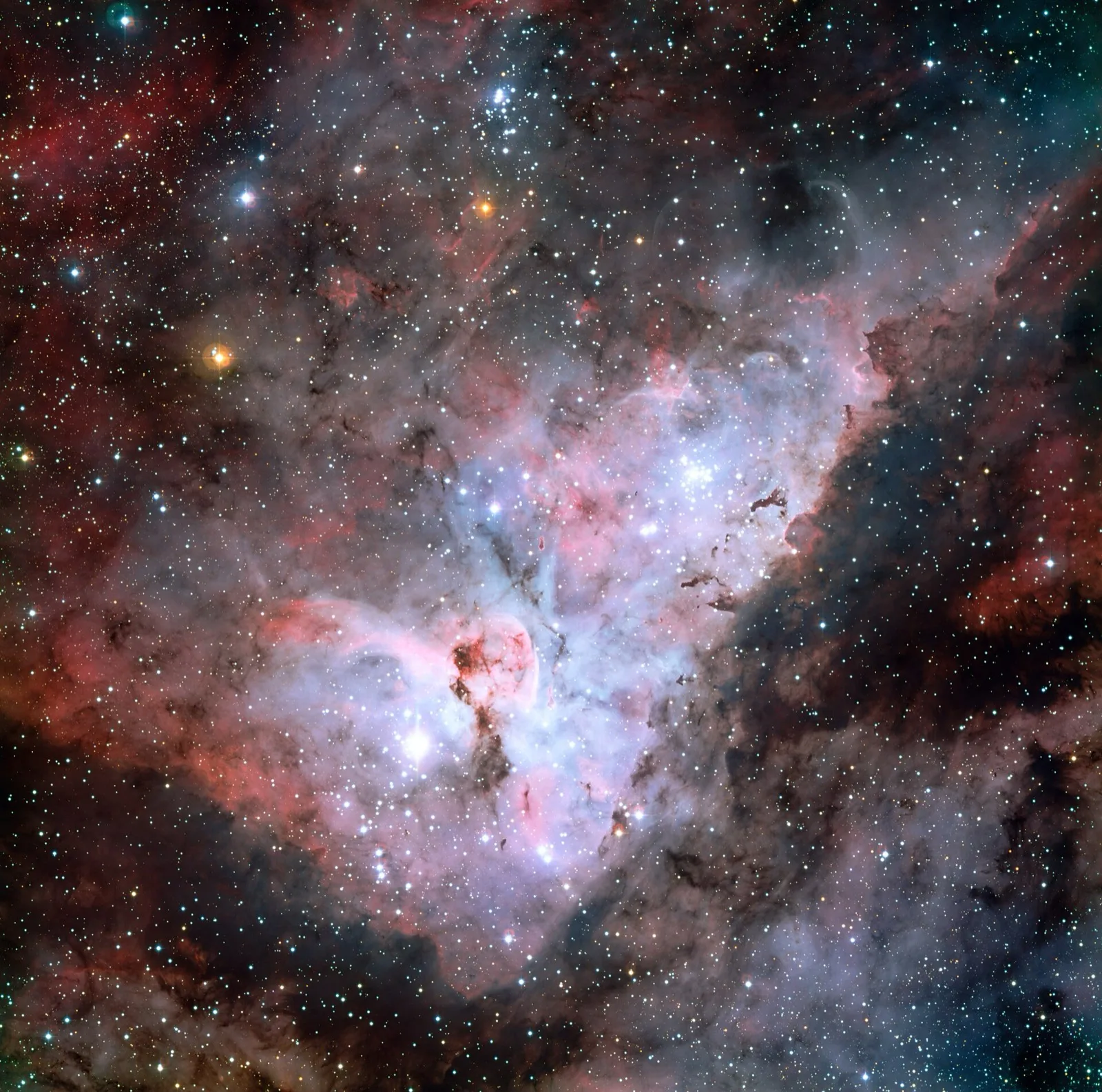 Carina NebulaNGC 3372 · star-forming nebula
Sources
- en.wikipedia.org
- science.nasa.gov
- earthsky.org
- esahubble.org
- esa.int
- astronomy.com
- Positions: astronomy-engine (Don Cross).