 SKY
Sky catalog › Nebulae
Eagle Nebula
M16, NGC 6611 · A star-forming nebula in Serpens
What is it?
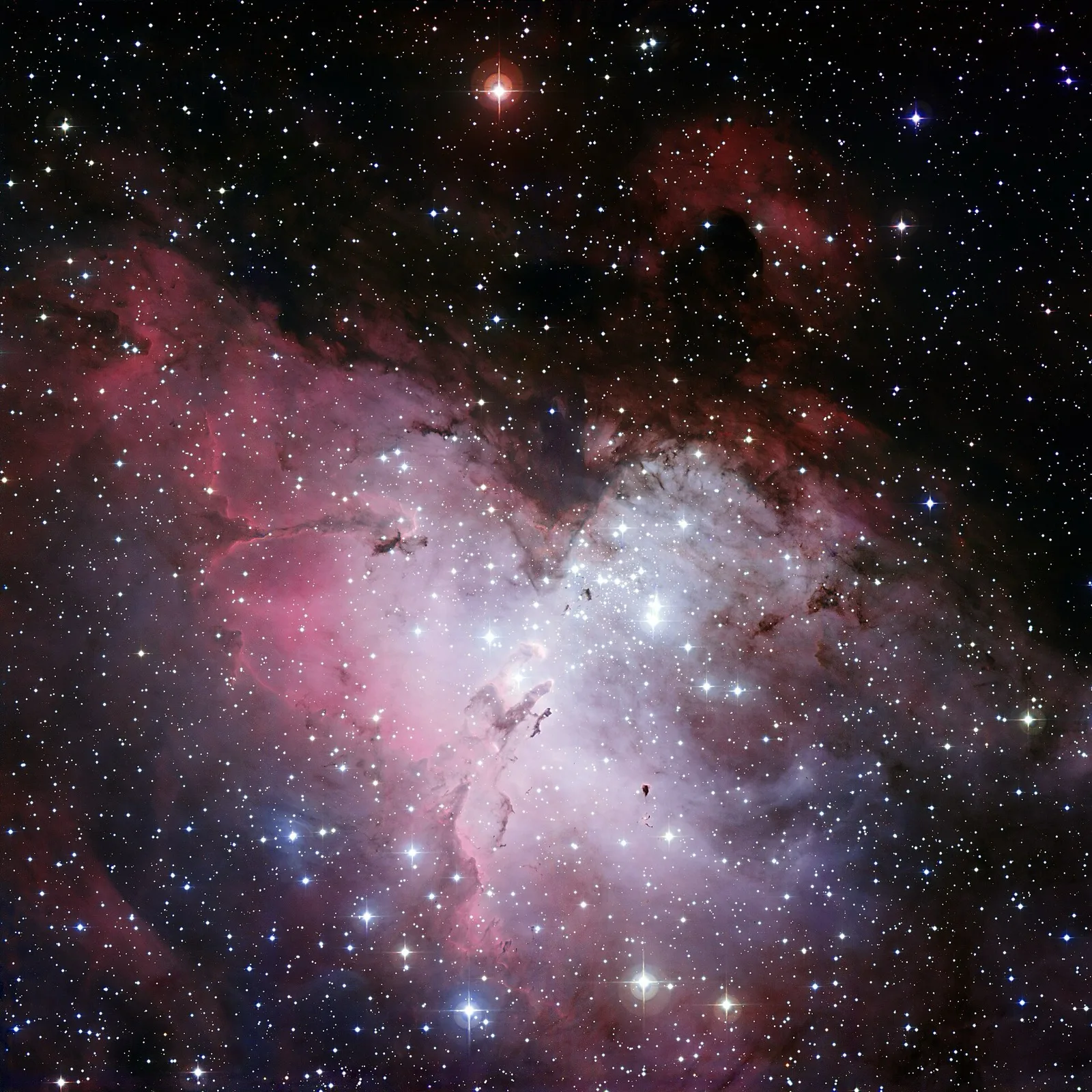
Eagle Nebula is a star-forming nebula. A huge cloud of gas lit up by hot young stars born inside it.
Why the Eagle Nebula is interesting
What you see: The glow is gas around a young star cluster. The dark fingers near the center are the Pillars of Creation, made of cool hydrogen gas and dust, where new stars are being born. en.wikipedia.org
How it formed: Ultraviolet light from nearby hot young stars slowly boils away the pillars' gas and dust, a process called photoevaporation. Inside the pillars, the gas is still collapsing into new stars. en.wikipedia.org
To scale: One spire of gas in the Eagle stretches 9.5 light-years, more than twice the distance from our Sun to its nearest neighboring star. science.nasa.gov
Three things to know
- The famous Pillars of Creation are inside the Eagle Nebula: towers of gas and dust about 4 to 5 light-years tall with new stars hidden in them.
- The whole nebula is about 70 by 55 light-years across, so the pillars are only a small part of it.
- Its young star cluster holds about 8,100 stars.
12 more fun facts
- The fingertips at the tops of the Pillars of Creation are each larger than our whole solar system. en.wikipedia.org
- Hubble took its famous Pillars of Creation picture on April 1, 1995, stitching it together from 32 separate images. en.wikipedia.org
- In Webb's 2022 view of the Pillars of Creation, wavy red lines that look like lava are really jets from stars still forming, slamming into the surrounding gas and dust. esawebb.org
- Some of the stars forming inside the Pillars of Creation are only a few hundred thousand years old. esawebb.org
- Webb's picture of the Pillars of Creation shows no background galaxies at all, because the gas and dust block the view of the deeper universe. esawebb.org
- The Eagle Nebula's brightest star, HD 168076, has about 80 times the mass of the Sun and shines up to a million times as brightly. en.wikipedia.org
- A spire of gas in the Eagle Nebula stretches about 9.5 light-years, more than twice the distance from the Sun to its nearest neighboring star. science.nasa.gov
- The Eagle Nebula's star cluster is only about 1 to 2 million years old. en.wikipedia.org
- Astronomer John Charles Duncan first recorded the pillars, then called "elephant trunks," in 1920 on a photographic plate from Mount Wilson Observatory. en.wikipedia.org
- When Hubble revisited the Pillars of Creation in 2014 with a newer camera, it caught a heated fragment of gas flying away from the top of the left pillar. esahubble.org
- E. E. Barnard took the first photograph of the Eagle Nebula in 1895. constellation-guide.com
- The Chandra X-ray Observatory found few X-ray sources inside the Pillars of Creation themselves. en.wikipedia.org
In the game these unlock one by one as you keep photographing the Eagle Nebula.
At a glance
- Type
- Star-forming nebula
- Catalog
- M16, NGC 6611
- Constellation
- Serpens
- Distance
- about 5,700 to 7,000 light-years (estimates differ)
- Brightness
- magnitude 6.4
- Size in our sky
- 70 x 50 arcminutes
- Discovered
- Jean-Philippe Loys de Cheseaux, 1745 to 1746
- Position (J2000)
- RA 18h 19m, Dec -13.8°
Looking back in time
The light in this photo left the Eagle Nebula 5,700 to 7,000 years ago, when nobody could write yet (writing began about 5,200 years ago) and the first farming villages were growing.
How to see it yourself
Too faint for most eyes, but binoculars show it from a dark site. A small telescope shows its shape.
Finding it: It lies in Serpens, north of the Teapot of Sagittarius near the small constellation Scutum. From the Teapot, follow a line from Kaus Australis past Kaus Media and keep going north; in binoculars the Omega Nebula (M17) shares the same field.
When to look: A summer and early autumn object, best on August evenings, when it stands in the southern sky for mid-northern observers.
What you will see: Binoculars show about 20 stars with a little haze around them. A small telescope at low power shows the star cluster easily, but the nebula is faint, and the dark pillars need a telescope of about 30 cm (12 inches) or more and good conditions.
Easy to confuse with:
- Omega Nebula (M17): The nearby Omega Nebula is a brighter, checkmark-shaped streak of glow, while the Eagle shows a scattered star cluster wrapped in fainter haze.
Best months: June is when it is highest around midnight. About two months later it is highest in the early evening, at around 8 to 9 PM.
Where on Earth: best from the Southern Hemisphere. North of latitude 66°N it never climbs more than 10° above the horizon.
How it is photographed: long exposures through filters, then the frames are stacked, stretched and combined into color.
Name and story
The name: The Eagle name comes from the nebula's shape, which resembles an eagle; Robert Burnham Jr. also called it the Star Queen Nebula, seeing a queen in silhouette in the central pillar. Jean-Philippe Loys de Cheseaux found the star cluster in 1745 to 1746, and Charles Messier first noticed the glowing gas on June 3 to 4, 1764.
People and history: Hubble's 1995 Pillars of Creation picture became one of the best-known space images ever. As National Geographic noted on its 20th anniversary, it has appeared on everything from t-shirts to coffee mugs.
Explored by: Jeff Hester and Paul Scowen made the 1995 Hubble image of the Pillars of Creation, and Hubble returned in 2014 for a sharper view. Chandra studied the region in X-rays, the Herschel space observatory imaged it too, and Webb released its own infrared view in October 2022.
Test yourself
After every photo of the Eagle Nebula the game asks one of these. A right answer earns sky points for your observatory.
What are the wavy red lines in Webb's view of the pillars?
- Lightning between clouds
- Rivers of glowing lava
- Jets from stars still forming (the answer)
Newborn stars shoot out jets that slam into the surrounding gas and dust and make it glow. Some of these stars are only a few hundred thousand years old. esawebb.org
What were the pillars called when first recorded in 1920?
- Elephant trunks (the answer)
- Dragon teeth
- Eagle wings
John Charles Duncan found these long dark shapes in 1920. Hubble's 1995 photo, built from 32 separate images, later made them famous as the Pillars of Creation. en.wikipedia.org
Point a telescope at the Eagle Nebula in the game: capture it in real time, then develop the frames like an astrophotographer.
Point a telescope at the Eagle NebulaLearn more
- Color from three black and white pictures
Most astronomy cameras see only in black and white. Color images come from exposures through filters, combined into red, green and blue. Here is how, and what narrowband colors mean.
More nebulae
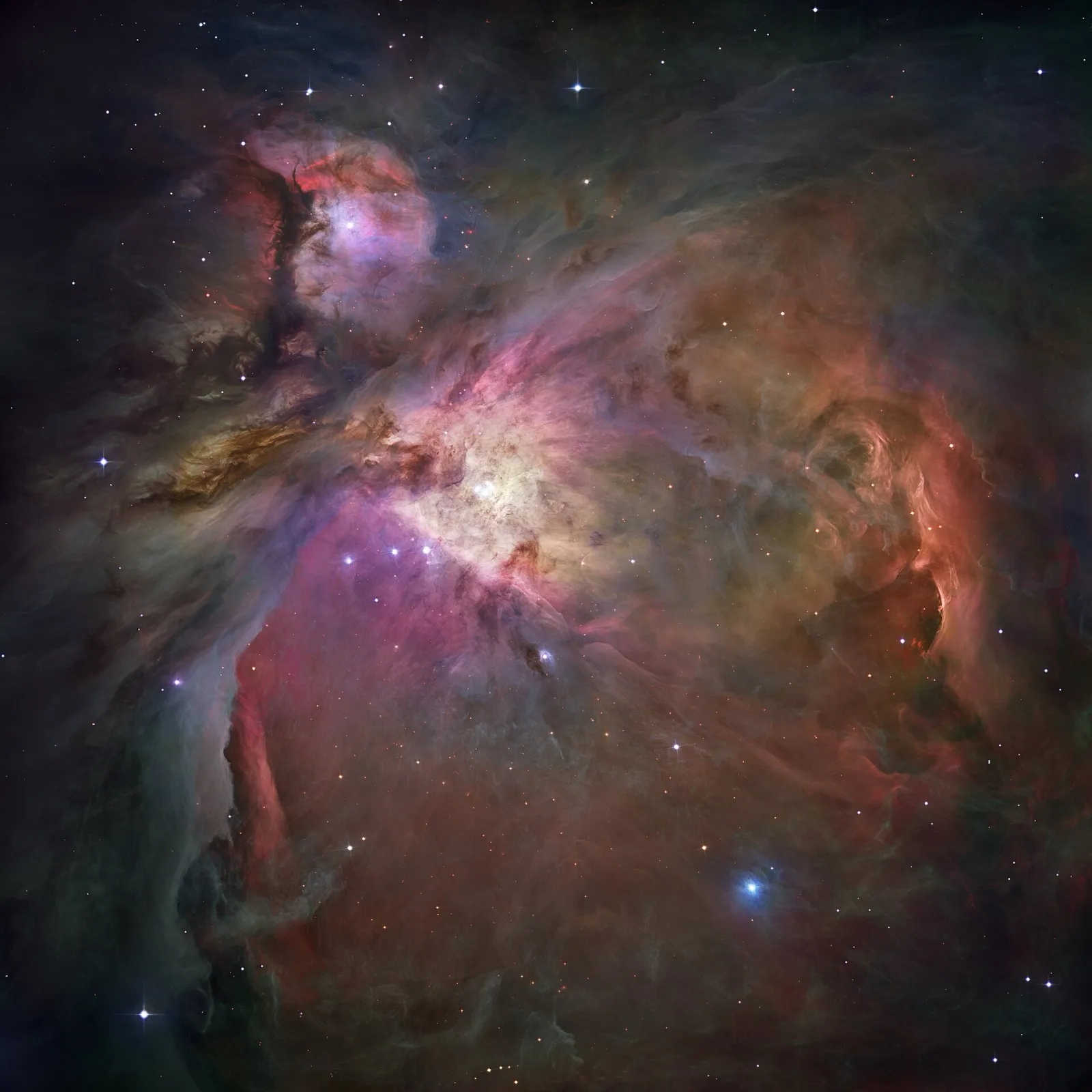 Orion NebulaM42 · star-forming nebula
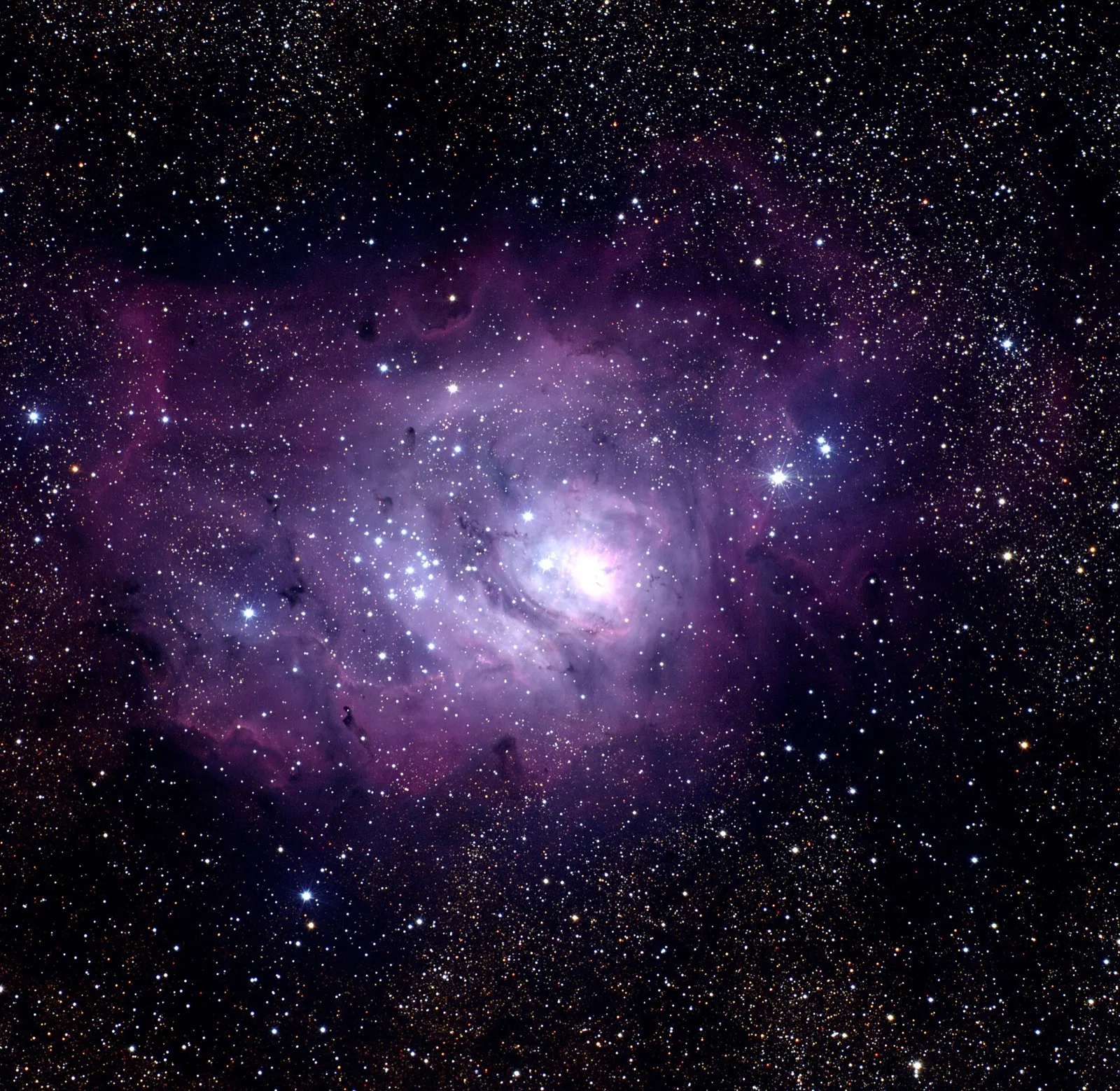 Lagoon NebulaM8 · star-forming nebula
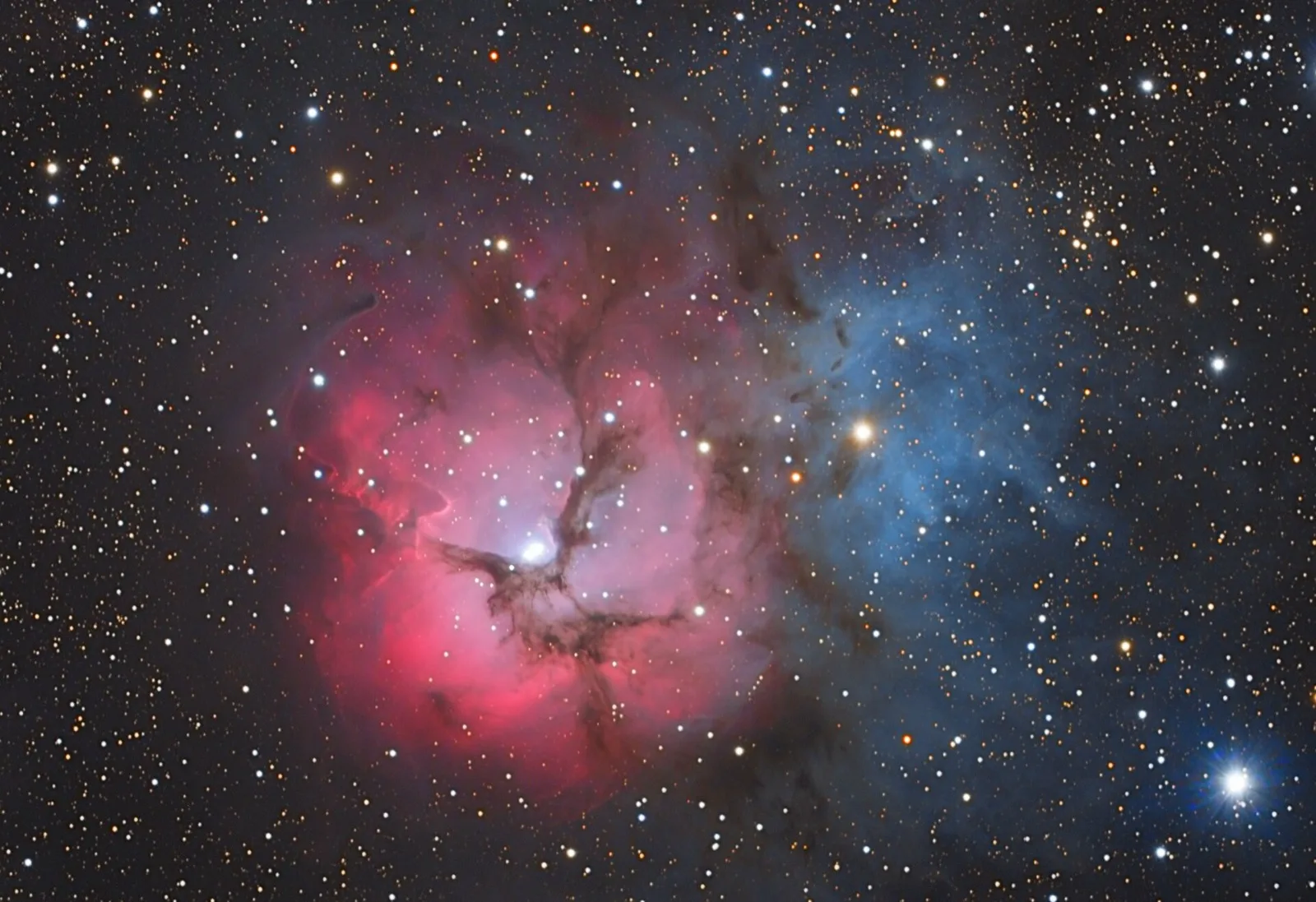 Trifid NebulaM20 · star-forming nebula
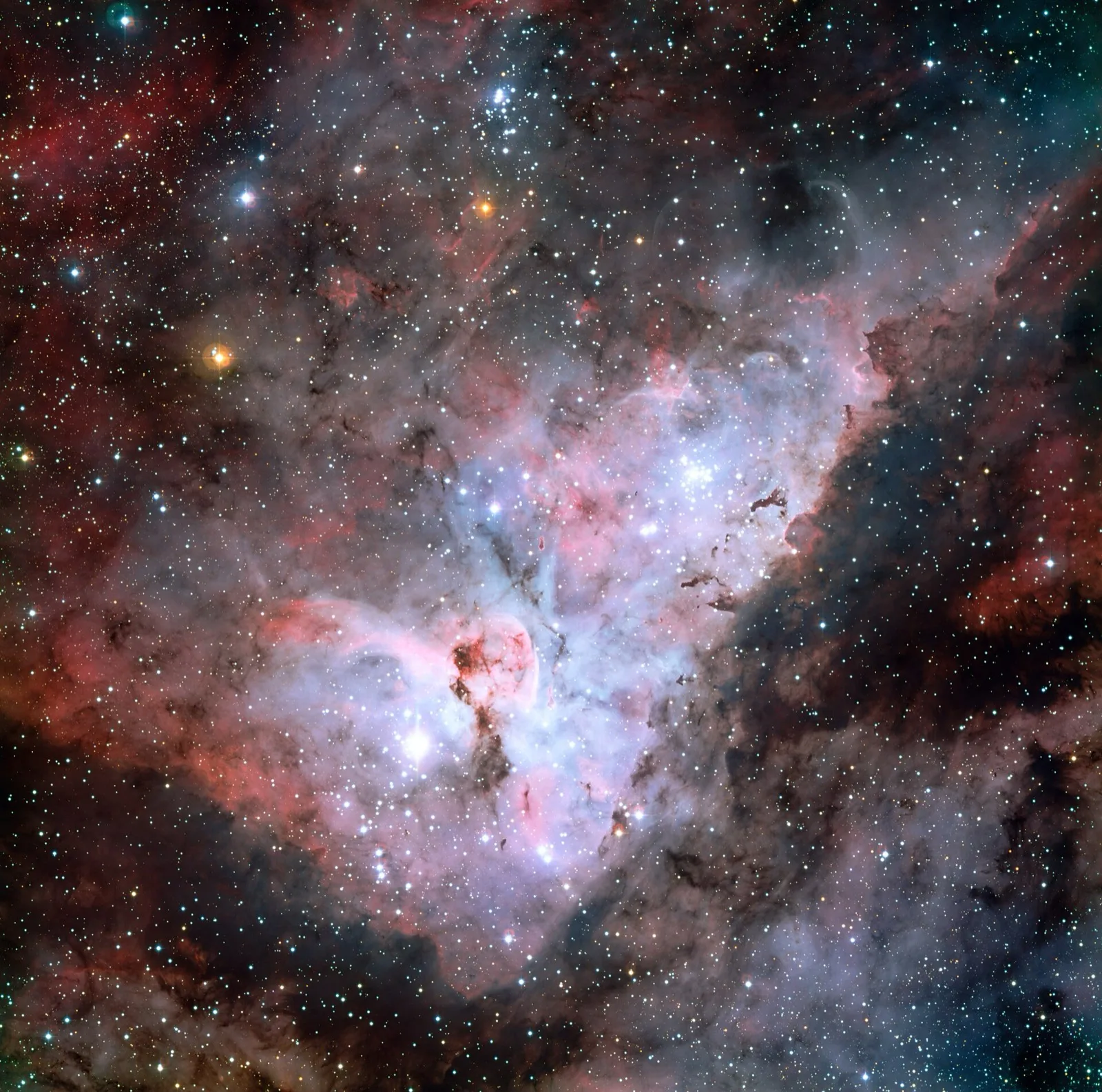 Carina NebulaNGC 3372 · star-forming nebula
Sources
- en.wikipedia.org
- science.nasa.gov
- en.wikipedia.org
- esawebb.org
- esahubble.org
- constellation-guide.com
- Positions: astronomy-engine (Don Cross).