 SKY
Sky catalog › Nebulae
Lagoon Nebula
M8, NGC 6523 · A star-forming nebula in Sagittarius
What is it?
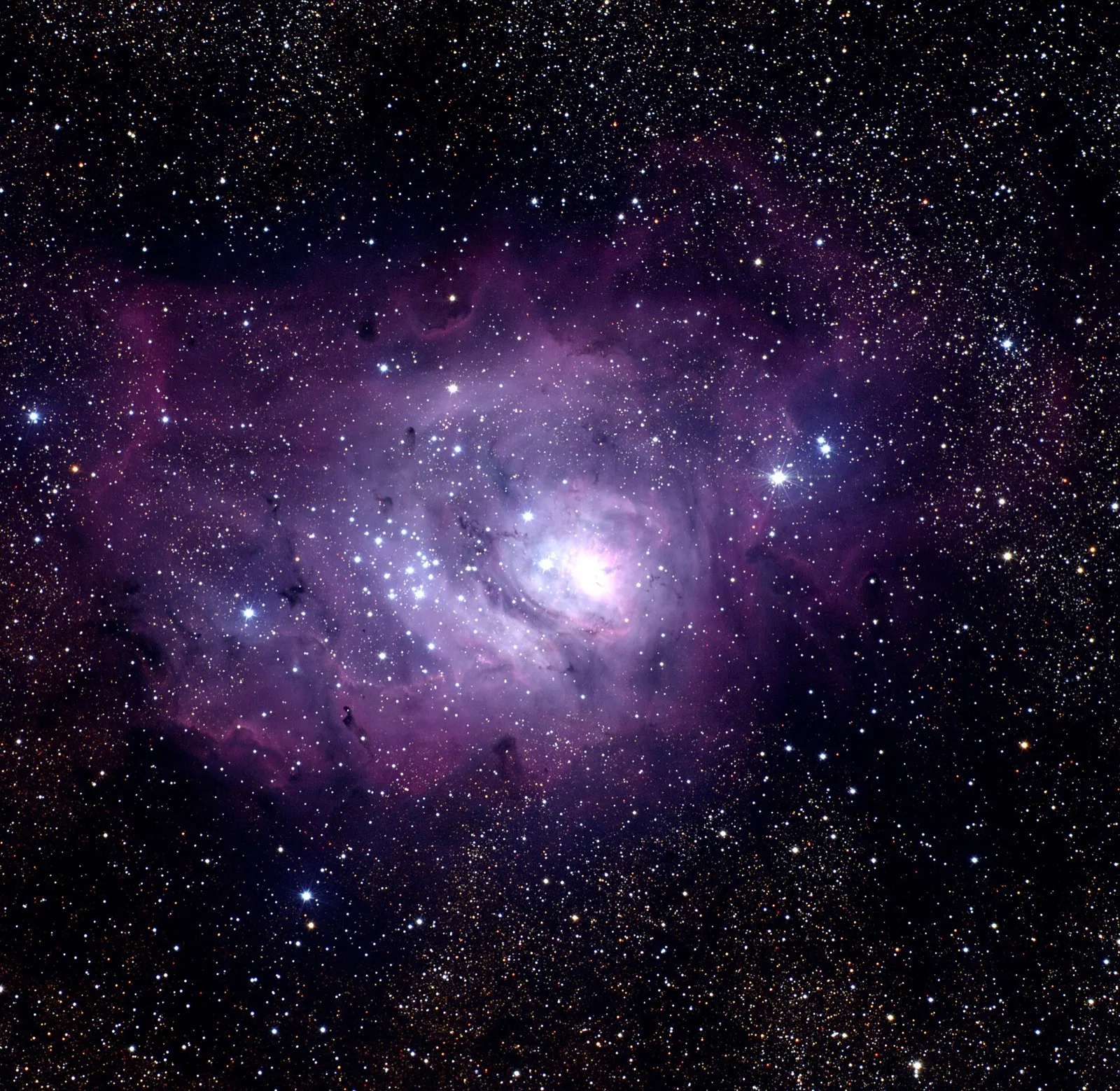
Lagoon Nebula is a star-forming nebula. A huge cloud of gas lit up by hot young stars born inside it.
Why the Lagoon Nebula is interesting
What you see: The glow is gas lit up by hot young stars inside it: their ultraviolet light ionizes the gas and makes it shine, inside a hazy maze of gas and dust where stars are still being born. esahubble.org
How it formed: Stars form here when clumps of gas and dust collapse. Dark blobs called Bok globules, about 10,000 times the Earth-Sun distance across, are such collapsing clouds and may become new stars. constellation-guide.com
To scale: In our sky the Lagoon looks about three times larger than the full Moon, even though it is thousands of light-years away. esahubble.org
Three things to know
- The Lagoon Nebula is a giant star nursery about 110 light-years long and 50 light-years tall.
- It is one of only two star-forming nebulae you can faintly see without a telescope from mid-northern latitudes; the other is the Orion Nebula.
- Its gas glows because hot young stars inside it blast it with ultraviolet light.
10 more fun facts
- Hubble spotted two "interstellar twisters" in the heart of the Lagoon Nebula, funnel-shaped clouds each about half a light-year long. esahubble.org
- In our sky the Lagoon Nebula spans about three times the width of the full Moon. esahubble.org
- Hubble celebrated its 28th birthday in April 2018 with a new portrait of the Lagoon Nebula's center, a region only about four light-years across. esahubble.org
- Dark blobs called Bok globules float in front of the Lagoon's glow. These collapsing clouds are about 10,000 times the Earth-Sun distance across and may become new stars. constellation-guide.com
- The star cluster NGC 6530 inside the Lagoon Nebula is only about 4 to 6 million years old, with roughly 2,700 likely member stars. constellation-guide.com
- In 2006 astronomers found four Herbig-Haro objects in the Lagoon's bright Hourglass region, direct evidence that stars are still forming there. en.wikipedia.org
- A 16,000-pixel-wide ESO picture of the Lagoon Nebula from 2014 was not planned: the VLT Survey Telescope caught it while mapping a much larger part of the Milky Way. eso.org
- Through a telescope the Lagoon Nebula usually looks gray, but long-exposure photos show it pink, because our eyes cannot see color well in dim light. en.wikipedia.org
- Charles Messier logged the Lagoon Nebula on May 23, 1764, and judged its star cluster to stretch about 30 arcminutes across. universetoday.com
- ESO's GigaGalaxy Zoom project released a 370-megapixel image of the Lagoon Nebula. eso.org
In the game these unlock one by one as you keep photographing the Lagoon Nebula.
At a glance
- Type
- Star-forming nebula
- Catalog
- M8, NGC 6523
- Constellation
- Sagittarius
- Distance
- about 4,100 to 5,200 light-years (estimates range from 4,000 to 6,000)
- Brightness
- magnitude 4.6
- Size in our sky
- 90 x 40 arcminutes
- Discovered
- Giovanni Battista Hodierna, 1654
- Position (J2000)
- RA 18h 04m, Dec -24.4°
Looking back in time
The light in this photo left the Lagoon Nebula 4,100 to 5,200 years ago, when the Great Pyramid of Giza was already standing (it was built about 4,500 years ago).
How to see it yourself
Too faint for most eyes, but binoculars show it from a dark site. A small telescope shows its shape.
Finding it: Find the Teapot shape of Sagittarius low in the south. From the tip of the Teapot's spout, sweep due north with binoculars until a large, bright glow appears; the smaller Trifid Nebula lies just north of it.
When to look: A summer object for mid-northern observers, best on August evenings, when it sits low over the southern horizon. From the Southern Hemisphere it climbs much higher.
What you will see: Under dark skies the naked eye can just make out a faint patch in the Milky Way. Binoculars show a cloudy patch with a brighter core and the stars of the cluster NGC 6530, and a small telescope at low power shows the cluster plus gray wisps of nebula.
Easy to confuse with:
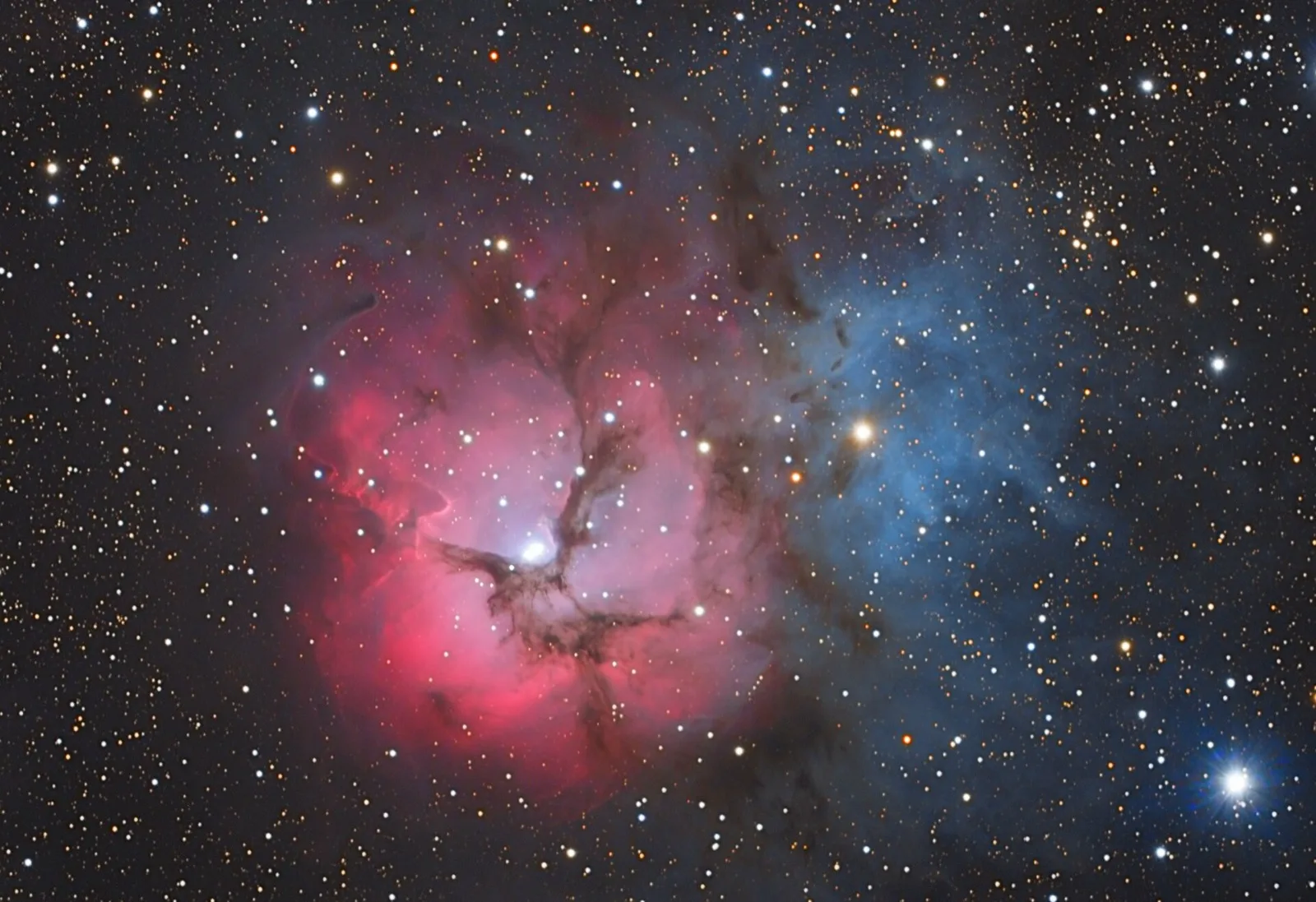
- Trifid Nebula (M20): The Trifid, just to the north, is smaller and fainter and is split by dark lanes, while the Lagoon is larger and brighter with a star cluster in its glow.
Best months: June is when it is highest around midnight. About two months later it is highest in the early evening, at around 8 to 9 PM.
Where on Earth: best from the Southern Hemisphere. North of latitude 56°N it never climbs more than 10° above the horizon.
How it is photographed: long exposures through filters, then the frames are stacked, stretched and combined into color.
Name and story
The name: The name comes from a dark lane across the glow that looks like a lagoon; Agnes Clerke may have been the first to use it, in her 1890 book The System of the Stars. Giovanni Battista Hodierna recorded the nebula before 1654, and Charles Messier observed it in May 1764, making it number 8 in his catalog.
Explored by: For Hubble's 28th anniversary in 2018, the telescope imaged the heart of the Lagoon in both visible and infrared light; the infrared view cuts through dust to show young stars hidden inside. Hubble had pictured parts of the Lagoon before, in 1996, 2010, 2011 and 2015.
Test yourself
After every photo of the Lagoon Nebula the game asks one of these. A right answer earns sky points for your observatory.
Why does the Lagoon look gray in a telescope but pink in photos?
- Telescope lenses block pink light
- The gas turns pink only in daytime
- Our eyes see little color in dim light (the answer)
Through binoculars or telescopes the faint nebula looks gray, because our eyes cannot see color well in dim light. A long-exposure photo gathers enough light to show the pink. en.wikipedia.org
What did Hubble spot in the heart of the Lagoon Nebula?
- A comet with an icy tail
- A planet with bright rings
- Two funnel-shaped 'twisters' (the answer)
Hubble found two rope-like 'interstellar twisters,' each about half a light-year long, in the busy heart of this star nursery. esahubble.org
Point a telescope at the Lagoon Nebula in the game: capture it in real time, then develop the frames like an astrophotographer.
Point a telescope at the Lagoon NebulaMore nebulae
 Orion NebulaM42 · star-forming nebula
 Trifid NebulaM20 · star-forming nebula
 Eagle NebulaM16 · star-forming nebula
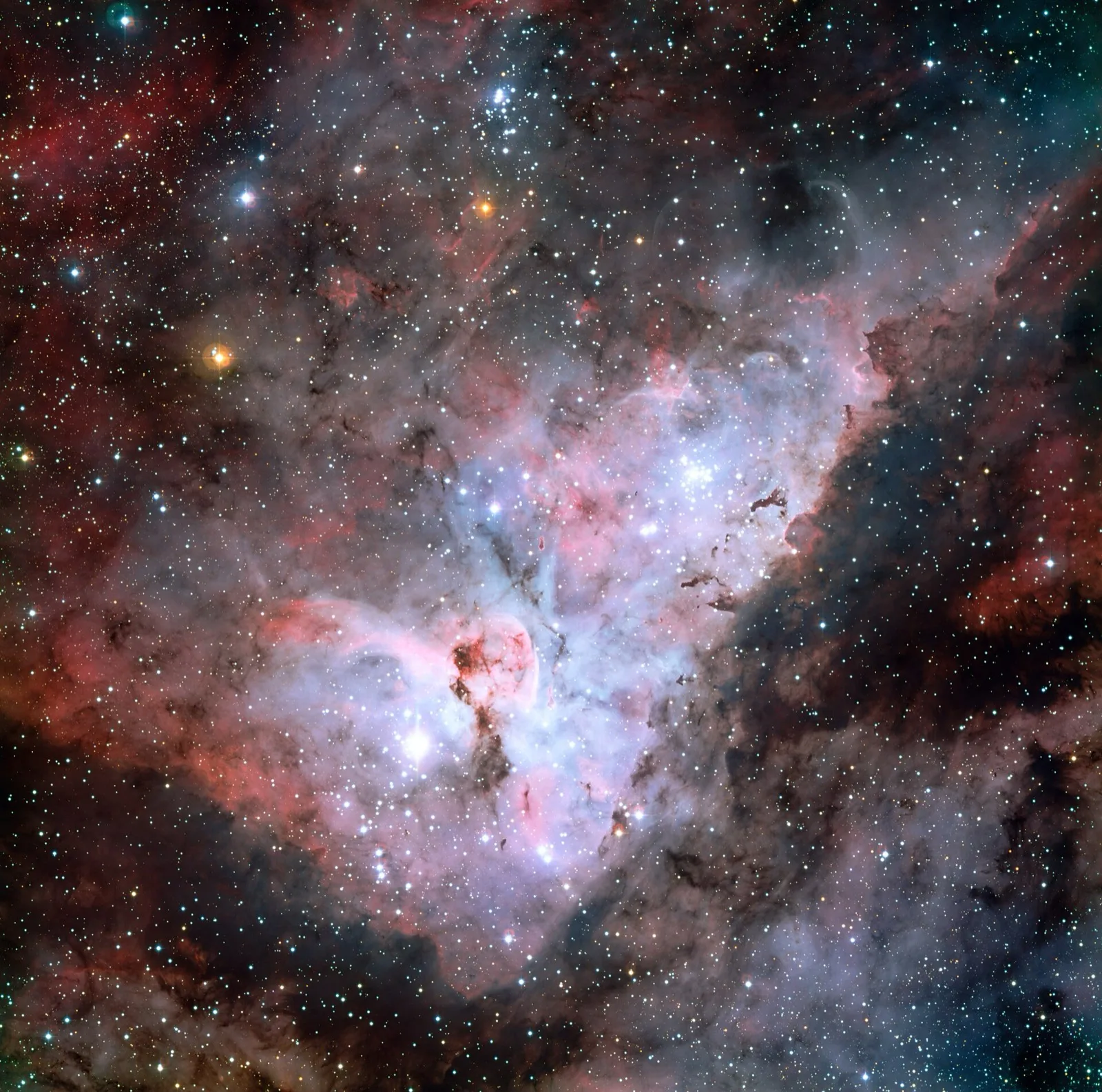 Carina NebulaNGC 3372 · star-forming nebula
Sources
- en.wikipedia.org
- science.nasa.gov
- esahubble.org
- constellation-guide.com
- eso.org
- universetoday.com
- Positions: astronomy-engine (Don Cross).