 SKY
Sky catalog › Star clusters
The Pleiades
M45 · An open star cluster in Taurus
What is it?
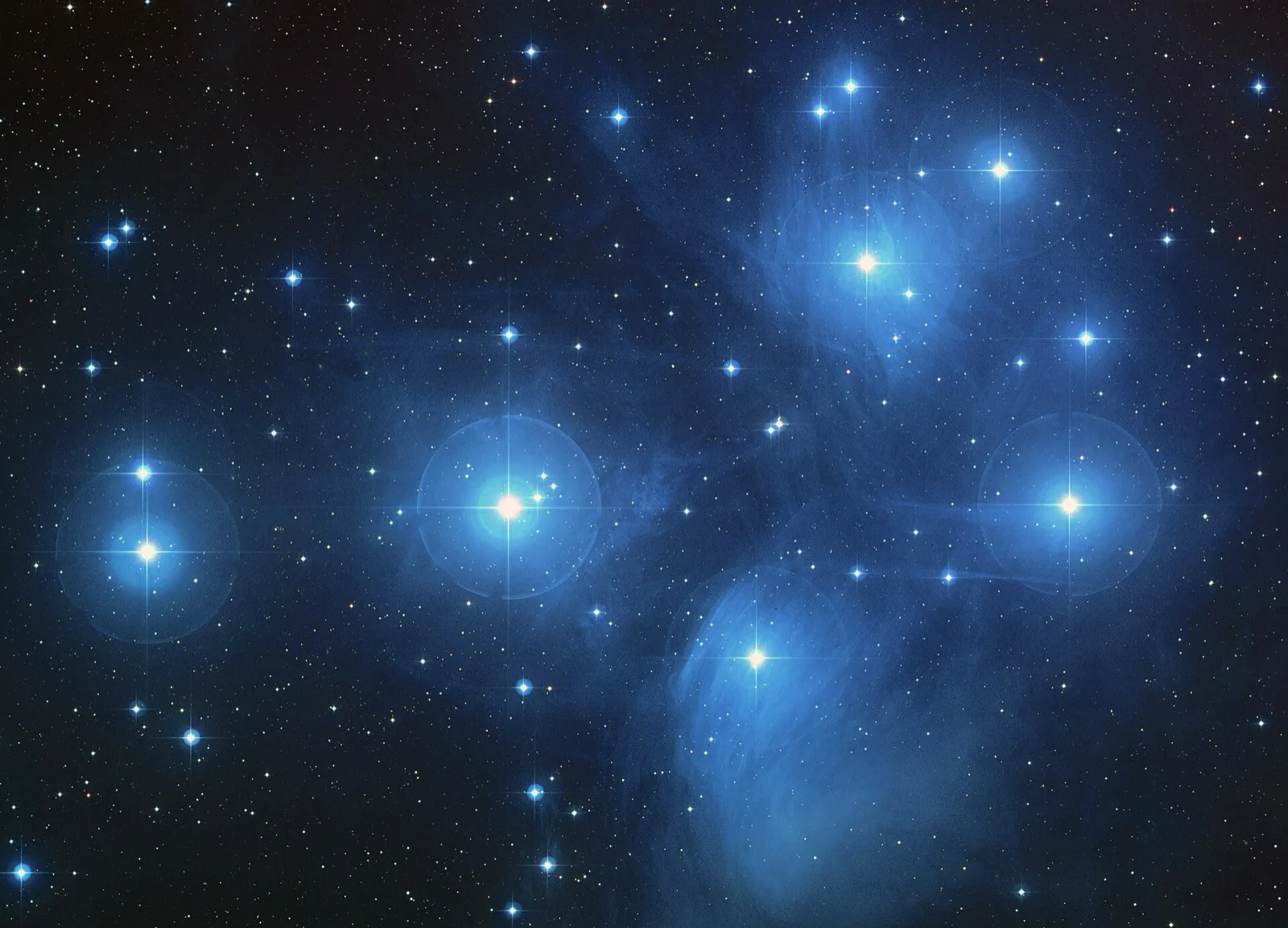
The Pleiades is an open star cluster. A family of young stars born together from the same cloud of gas.
Why the Pleiades is interesting
What you see: The blue-white dots are hot young stars. The blue haze around them is dust reflecting their light, from an unrelated cloud the cluster just happens to be drifting through. en.wikipedia.org
How it formed: Its stars formed within roughly the last 100 million years (estimates run from 75 to 150 million), probably from a compact group much like the Orion Nebula. The cluster is expected to drift apart in roughly 250 million years. en.wikipedia.org
To scale: All the stars of the Pleiades together have about 800 times the mass of the Sun, and most of that mass is in fainter, redder stars rather than the bright blue ones. en.wikipedia.org
Three things to know
- The Pleiades hold over 1,000 stars, but most people can see only six or seven of them without a telescope.
- In Japan the cluster is called Subaru, and the Subaru car logo shows its stars.
- Its stars are only about 125 million years old, babies compared with our 4.6-billion-year-old Sun.
12 more fun facts
- The blue glow around the Pleiades is not left over from their birth. The cluster just happens to be drifting through an unrelated cloud of dust at about 18 km (11 miles) per second. en.wikipedia.org
- Galileo was the first person to look at the Pleiades through a telescope, and his 1610 sketch of the cluster showed 36 stars. en.wikipedia.org
- The Nebra sky disc, a bronze disc from Germany made around 1600 BC, is thought to be the earliest known picture of the Pleiades. en.wikipedia.org
- A Hubble image of the dust near the star Merope shows starlight pushing the cloud apart: big grains stream toward the star, while smaller grains are held back and trail behind. science.nasa.gov
- In 2004 Hubble measured the Pleiades at about 440 light-years by watching three of its stars shift slightly as Earth moved to opposite sides of its orbit. science.nasa.gov
- The Hipparcos satellite once put the Pleiades about 10 percent closer than expected, starting a long debate. Hubble's measurement disagreed with Hipparcos by more than 40 light-years. science.nasa.gov
- The Pleiades will not stay together forever. Astronomers expect the cluster to drift apart in roughly 250 million years. en.wikipedia.org
- All the stars of the Pleiades together have about 800 times the mass of the Sun. en.wikipedia.org
- In 1767 John Michell worked out that the odds of so many bright stars bunching up this tightly by chance were about 1 in 500,000, an early sign that star clusters are real families. en.wikipedia.org
- Wilhelm Tempel found the faint nebula around the star Merope in 1859 with a small 4-inch (10 cm) telescope and described it as a faint stain like a breath on a mirror. skyatnightmagazine.com
- Brown dwarfs, objects too small to shine like true stars, may make up as many as a quarter of the cluster's members but less than 2 percent of its mass. en.wikipedia.org
- In New Zealand the cluster is called Matariki, and its first rising before dawn in late June or early July marks the Maori New Year, a public holiday since 2022. en.wikipedia.org
In the game these unlock one by one as you keep photographing the Pleiades.
At a glance
- Type
- Open star cluster
- Catalog
- M45
- Constellation
- Taurus
- Distance
- about 444 light-years
- Brightness
- magnitude 1.6
- Size in our sky
- about 2 degrees
- Position (J2000)
- RA 3h 47m, Dec +24.1°
Looking back in time
The light in this photo left the Pleiades about 444 years ago, when nobody had yet looked at the sky through a telescope: Galileo did that only in 1609.
How to see it yourself
Visible to the naked eye from a dark site. Binoculars show it well, and a small telescope shows more detail.
Finding it: Find Orion and follow the three stars of Orion's Belt upward to the orange star Aldebaran in Taurus. Keep going about the same distance again and you reach a small, tight dipper of blue-white stars.
When to look: The Pleiades are a classic sight of autumn and winter evenings. In December the cluster is well up for much of the night.
What you will see: To the naked eye it looks like a tiny misty dipper, and most people count about six stars. Binoculars or a telescope at low power show it best, since the nine brightest stars fit in a field just over one degree wide. High power shows only part of it, and the faint dust glow usually needs photography or very dark skies.
Easy to confuse with:
- Hyades: The Hyades form a larger, looser V shape around the orange star Aldebaran, while the Pleiades are a small, tight dipper of blue-white stars farther along the same line.
- Little Dipper: The Little Dipper is a big pattern stretching from the North Star, while the Pleiades dipper is only about 2 degrees across and sits in Taurus.
Best months: November is when it is highest around midnight. About two months later it is highest in the early evening, at around 8 to 9 PM.
Where on Earth: easy from the Northern Hemisphere. South of latitude 56°S it never climbs more than 10° above the horizon.
How it is photographed: long exposures through filters, then the frames are stacked, stretched and combined into color.
Name and story
The name: In Greek myth the Pleiades were the seven daughters of the Titan Atlas and the sea nymph Pleione, and their brightest stars carry names like Alcyone, Maia, Electra and Merope. The cluster has no known discoverer because people have watched it since prehistoric times. Charles Messier added it to his catalog as number 45 in 1771.
People and history: The Pleiades appear in the writings of Homer and Hesiod and are mentioned three times in the Bible. In Hindu astronomy they are Krittika, in Hawaii Makali'i, and to the Maori Matariki. Around 2330 BC the cluster marked the point where the Sun crossed into the northern sky in spring.
Record: The Pleiades are among the nearest star clusters to Earth and one of the easiest to see, visible from most of the planet even through heavy light pollution. The Nebra sky disc, made around 1600 BC, is considered the earliest likely depiction of the cluster.
Explored by: Hubble's Fine Guidance Sensors measured the cluster's distance in 2004, coming out at about 440 light-years and disagreeing with the Hipparcos satellite by more than 40 light-years. The team measured each star six months apart over two and a half years.
Test yourself
After every photo of the Pleiades the game asks one of these. A right answer earns sky points for your observatory.
What makes the soft blue glow around the stars of the Pleiades?
- Light from a galaxy far behind them
- Gas left over from their birth
- Dust reflecting their light (the answer)
The cluster is drifting through an unrelated dust cloud at about 18 km (11 miles) per second, and the dust reflects the blue light of its hot young stars. en.wikipedia.org
How many stars did Galileo draw in his 1610 sketch of the Pleiades?
- About 400 stars
- 7 stars
- 36 stars (the answer)
His telescope showed far more than the six or seven stars most people see by eye, yet still only a small part of the more than 1,000 stars in the cluster. en.wikipedia.org
Point a telescope at the Pleiades in the game: capture it in real time, then develop the frames like an astrophotographer.
Point a telescope at the PleiadesLearn more
- Magnitude: why brighter stars get smaller numbers
Why a star of magnitude 1 is brighter than one of magnitude 6, why the Sun is -26.7, and how far each step goes.
More star clusters
 Beehive ClusterM44 · open star cluster
 Double ClusterNGC 869 · open star cluster
 Jewel BoxNGC 4755 · open star cluster
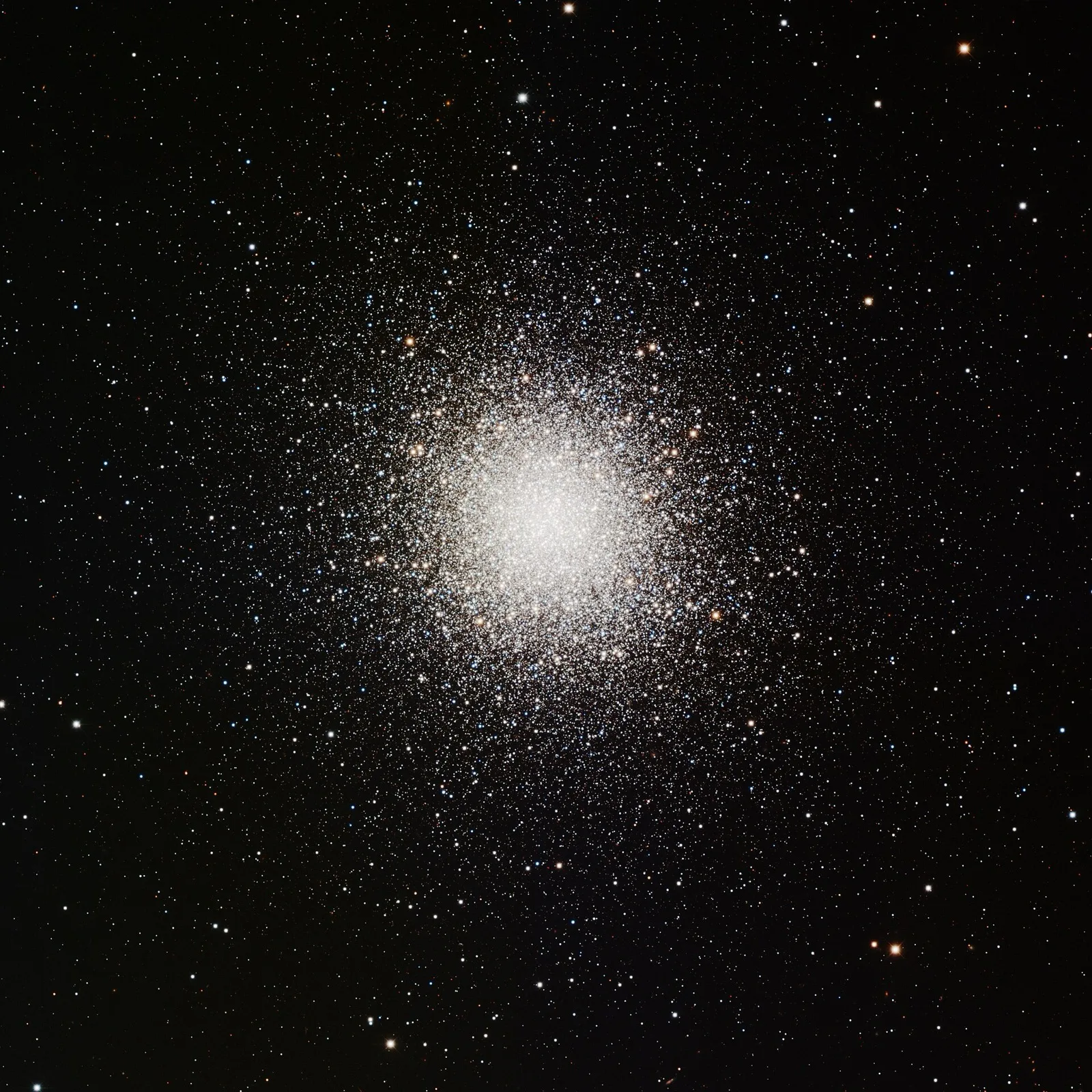 Hercules ClusterM13 · globular cluster
Sources
- en.wikipedia.org
- science.nasa.gov
- science.nasa.gov
- science.nasa.gov
- skyatnightmagazine.com
- en.wikipedia.org
- Positions: astronomy-engine (Don Cross).