 SKY
Sky catalog › Star clusters
Beehive Cluster
M44, NGC 2632 · An open star cluster in Cancer
What is it?
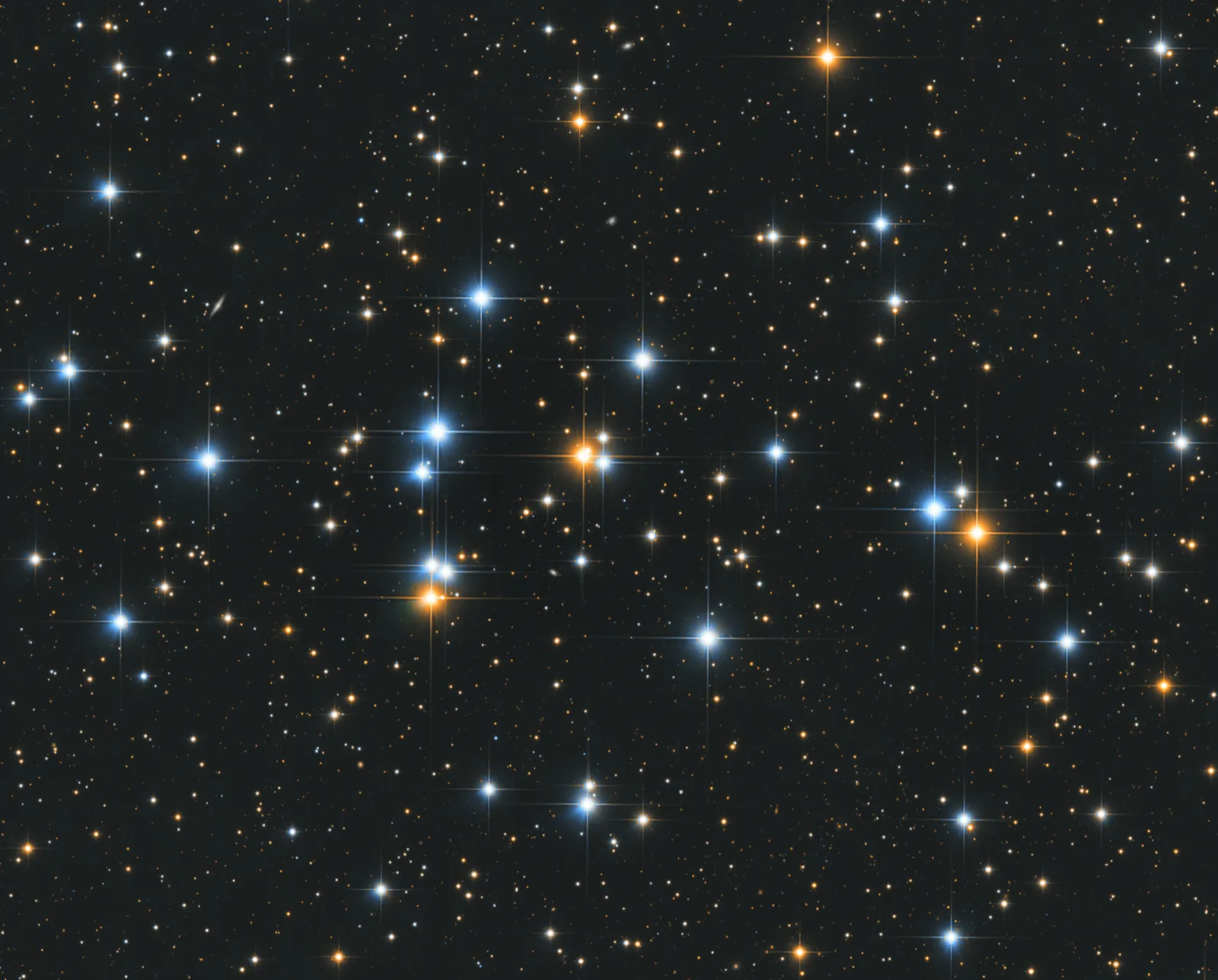
Beehive Cluster is an open star cluster. A family of young stars born together from the same cloud of gas.
Why the Beehive Cluster is interesting
What you see: Each dot is a star in one family of about 1,000. Even the brightest are only around magnitude 6, so to the naked eye they blend into one soft glowing patch. en.wikipedia.org
How it formed: Its stars were born together around 600 million years ago. The Hyades cluster in Taurus has nearly the same age and moves the same way through space, so the two may share an origin. en.wikipedia.org
To scale: The bright inner core of the Beehive is about 23 light-years across, so light itself needs about 23 years to cross it. en.wikipedia.org
Three things to know
- The Beehive covers about as much sky as three full Moons side by side.
- Galileo was the first to see it as more than a cloud, counting about 40 of its stars with his telescope.
- It holds about 1,000 stars that are around 600 to 700 million years old.
12 more fun facts
- In 2012 astronomers found two giant planets in the Beehive, the first planets ever discovered around Sun-like stars inside a star cluster. jpl.nasa.gov
- The Beehive's first two planets are hot Jupiters, gas giants that race around their stars in just a few days. They were nicknamed the first 'b's in the Beehive. jpl.nasa.gov
- The Beehive's stars are rich in heavy elements, which scientists think may act like a planet fertilizer and help giant planets form. jpl.nasa.gov
- In 2016 a second planet was found around the star Pr0211, making it the first system with more than one planet known in an open star cluster. en.wikipedia.org
- The Beehive and the Hyades cluster in Taurus share the same age and drift through space in the same direction, a hint that they may have been born together. en.wikipedia.org
- Eleven white dwarfs, the small burnt-out cores of dead stars, have been found among the Beehive's members. en.wikipedia.org
- About two-thirds of the Beehive's known members are red dwarfs, small cool stars far too faint to see without a telescope. en.wikipedia.org
- Even its brightest stars are only around magnitude 6, right at the edge of naked-eye sight. Together they blend into one soft glowing patch. en.wikipedia.org
- The Greek astronomer Hipparchus called it the Little Cloud around 130 BC, and the poet Aratus called it the Little Mist more than a century earlier. en.wikipedia.org
- Ptolemy listed seven fuzzy 'nebulae' in his star catalog. Only four were real, and the Beehive was one of them. en.wikipedia.org
- Hubble has pointed at the edges of the Beehive mainly to look past it, using the cluster's outskirts as a window onto far more distant galaxies. science.nasa.gov
- The whole cluster holds about 500 to 600 times the mass of the Sun, and its bright inner core is about 23 light-years across. en.wikipedia.org
In the game these unlock one by one as you keep photographing the Beehive Cluster.
At a glance
- Type
- Open star cluster
- Catalog
- M44, NGC 2632
- Constellation
- Cancer
- Distance
- about 600 light-years (estimates range from 520 to 610)
- Brightness
- magnitude 3.7
- Size in our sky
- about 1.5 degrees (95 arcminutes)
- Discovered
- Known since ancient times; Ptolemy described it as a "nebulous mass"
- Position (J2000)
- RA 8h 40m, Dec +20.0°
Looking back in time
The light in this photo left the Beehive Cluster about 600 years ago, when Ming China ruled from Beijing, where the Forbidden City had just been built (1406 to 1420).
How to see it yourself
Visible to the naked eye from a dark site. Binoculars show it well, and a small telescope shows more detail.
Finding it: It sits in the faint constellation Cancer, just above the spot where the three branches of Cancer's upside-down Y meet. Under brighter skies, draw a line from Pollux in Gemini to Regulus in Leo, find the middle, and look a little south and west.
When to look: The Beehive is a spring object for northern observers and stands highest in the evening sky around March. It is well placed on late winter and spring evenings.
What you will see: From a dark site the naked eye shows a small hazy patch. Binoculars turn it into a swarm of about 20 stars, and a small telescope at low power shows dozens more, mostly blue-white. It is about 1.5 degrees wide, so low magnification works best.
Easy to confuse with:
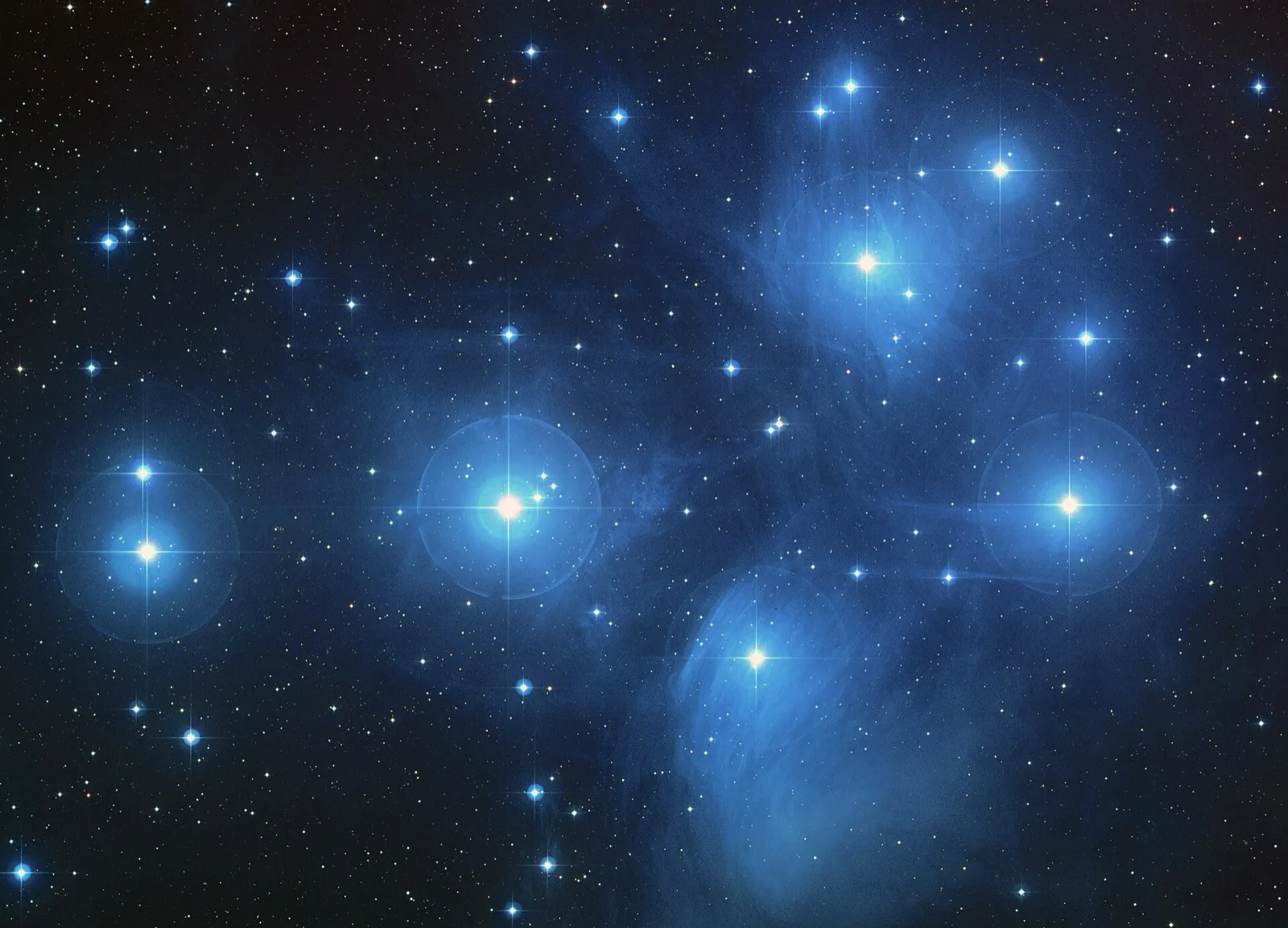
- Pleiades (M45): The Pleiades are brighter and form a tight dipper of stars easy to see even from town, while the Beehive is a dimmer, rounder haze in dark Cancer between Gemini and Leo.
- Messier 67: M67 is also in Cancer, but it is much smaller and fainter and needs binoculars or a telescope, while the Beehive is wide enough to fill a binocular view.
Best months: January is when it is highest around midnight. About two months later it is highest in the early evening, at around 8 to 9 PM.
Where on Earth: easy from the Northern Hemisphere. South of latitude 60°S it never climbs more than 10° above the horizon.
How it is photographed: long exposures through filters, then the frames are stacked, stretched and combined into color.
Name and story
The name: Its old name Praesepe is Latin for manger, cot or crib, while Beehive is its popular nickname today. People have seen it since ancient times, so it has no known discoverer. Galileo first split it into about 40 stars in 1609, and Charles Messier added it to his catalog as number 44 in 1769.
People and history: In ancient lore the two stars beside the cluster, Asellus Borealis and Asellus Australis, were two donkeys eating from the manger. In Chinese astronomy the cluster sits in the Ghost lunar mansion and was called Jishi, meaning cumulative corpses. Ptolemy described it as the nebulous mass in the breast of Cancer.
Record: The Beehive held the first planets ever found around Sun-like stars in a star cluster, announced in 2012. Those planets are also among the youngest known, which helps scientists learn how quickly giant planets move inward toward their stars.
Explored by: Ground-based telescopes found the first two Beehive planets in 2012, and a third followed in 2016. NASA's Kepler spacecraft, during its K2 mission, then found planets around several more cluster stars, including a two-planet system around K2-264.
Test yourself
After every photo of the Beehive Cluster the game asks one of these. A right answer earns sky points for your observatory.
Most of the Beehive's known stars are which kind?
- Burnt-out white dwarfs
- Huge, hot blue supergiants
- Small, cool red dwarfs (the answer)
About two-thirds of its known members are red dwarfs, too faint to see without a telescope. Only eleven white dwarfs have been found, the leftover cores of its heaviest stars. en.wikipedia.org
What first did the Beehive give astronomers in 2012?
- The first photo of a black hole
- The first comet seen in a telescope
- Planets around Sun-like stars in a cluster (the answer)
Two hot Jupiters, gas giants that circle their stars in just a few days, were found there. Its stars are rich in heavy elements, which may help giant planets form. jpl.nasa.gov
Point a telescope at the Beehive Cluster in the game: capture it in real time, then develop the frames like an astrophotographer.
Point a telescope at the Beehive ClusterMore star clusters
 The PleiadesM45 · open star cluster
 Double ClusterNGC 869 · open star cluster
 Jewel BoxNGC 4755 · open star cluster
 Hercules ClusterM13 · globular cluster
Sources
- en.wikipedia.org
- science.nasa.gov
- jpl.nasa.gov
- Positions: astronomy-engine (Don Cross).