 SKY
Sky catalog › Star clusters
Hercules Cluster
M13, NGC 6205 · A globular cluster in Hercules
What is it?
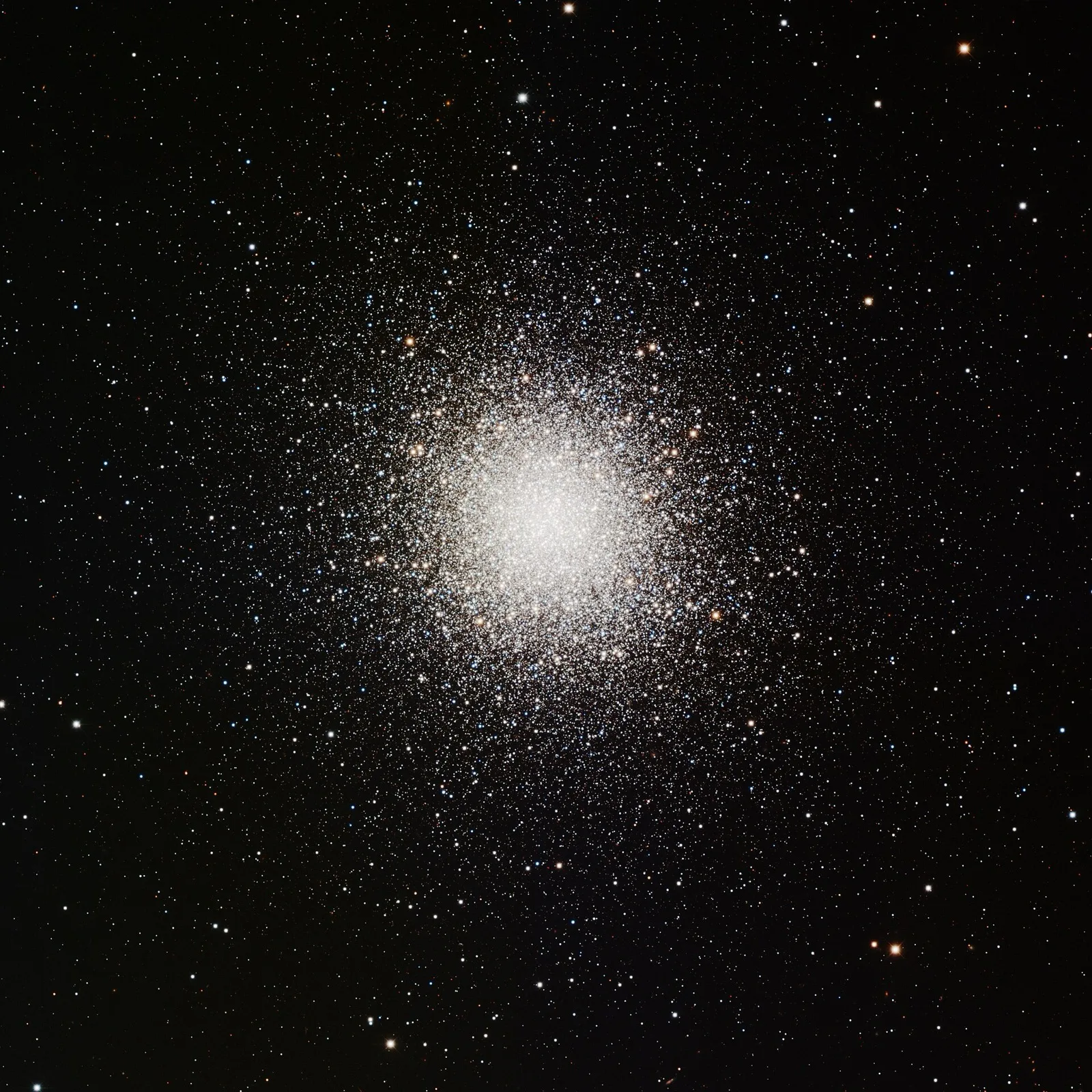
Hercules Cluster is a globular cluster. A tight ball of hundreds of thousands of very old stars.
Why the Hercules Cluster is interesting
What you see: The round glow is several hundred thousand stars, with estimates from about 300,000 to over half a million, packed into one ball about 145 light-years wide. en.wikipedia.org
How it formed: Its stars formed together about 11.65 billion years ago, by one estimate. They are packed so closely that they sometimes collide and produce new stars. en.wikipedia.org
To scale: A radio message sent toward M13 in 1974 needs about 25,000 years to get there, so any reply would take about 50,000 years to come back to us. earthsky.org
Three things to know
- M13 packs several hundred thousand stars into a ball about 145 light-years wide.
- In 1974 the Arecibo radio telescope beamed a message about humans toward M13.
- Near its center, stars are so crowded that they sometimes collide and form new stars.
12 more fun facts
- The Arecibo message aimed at M13 was only 1,679 binary digits, laid out as a grid of 73 rows by 23 columns, with pictures of DNA, a human figure and the dish that sent it. en.wikipedia.org
- Any reply to the 1974 Arecibo message would take about 50,000 years: about 25,000 years for the signal to reach M13 and another 25,000 for an answer to come back. earthsky.org
- With a large telescope at 200x or more, you may spot the "propeller" in M13: three dark lanes, caused by a lack of stars along those lines, that form a propeller shape. earthsky.org
- Bindon Stoney first noticed the propeller in the 1850s. Walter Scott Houston wrote about it in 1953, yet no reader reported seeing it until John Bortle did in 1980. earthsky.org
- Edmond Halley, of Halley's Comet fame, found M13 in 1714. When Charles Messier added it to his catalog in 1764, he believed it held no stars at all. science.nasa.gov
- M13 holds roughly 100 times as many stars as you can see with your unaided eye on the darkest night. earthsky.org
- Its stars are about 12 to 13 billion years old, nearly as old as the universe itself. earthsky.org
- The brightest star in M13, a red giant called V11, shines at only about magnitude 12, far too faint to see without a telescope. en.wikipedia.org
- In Kurt Vonnegut's novel The Sirens of Titan, the whole Solar System is said to move 43,000 miles closer to M13 every hour. en.wikipedia.org
- Astronomers are still finding new things in M13: three variable stars, numbered V63, V64 and V65, were discovered in 2021, 2022 and 2024. en.wikipedia.org
- A faint edge-on galaxy, NGC 6207, sits only about 28 arcminutes northeast of M13, less than the width of the full Moon away. en.wikipedia.org
- M13 weighs about 600,000 times as much as the Sun. en.wikipedia.org
In the game these unlock one by one as you keep photographing the Hercules Cluster.
At a glance
- Type
- Globular cluster
- Catalog
- M13, NGC 6205
- Constellation
- Hercules
- Distance
- about 25,000 light-years
- Brightness
- magnitude 5.8
- Size in our sky
- about 20 arcminutes
- Discovered
- Edmond Halley, 1714
- Position (J2000)
- RA 16h 42m, Dec +36.5°
Looking back in time
The light in this photo left the Hercules Cluster about 25,000 years ago, when the Earth was in the last Ice Age: mammoths roamed and people painted caves by firelight.
How to see it yourself
Too faint for most eyes, but binoculars show it from a dark site. A small telescope shows its shape.
Finding it: Find the Keystone, a lopsided square of four stars in Hercules, about one third of the way from Vega to Arcturus. M13 sits on the Keystone's western side between Eta and Zeta Herculis, about 2.5 degrees south of Eta.
When to look: From mid-northern latitudes M13 is up all night from May through July and stays up until after midnight from August through October. NASA notes it is easiest to spot in July.
What you will see: Under dark skies it is just visible to the naked eye as a faint fuzzy point. Binoculars show a bright round patch, and small telescopes show it readily; about 4 inches of aperture begins to resolve stars at its edges.
Easy to confuse with:
- Messier 92: M92, also in Hercules, lies farther north and away from the Keystone, and looks slightly fainter and about a third smaller than M13.
Best months: June is when it is highest around midnight. About two months later it is highest in the early evening, at around 8 to 9 PM.
Where on Earth: easy from the Northern Hemisphere. South of latitude 44°S it never climbs more than 10° above the horizon. From 54°N and farther north it never sets.
How it is photographed: long exposures through filters, then the frames are stacked, stretched and combined into color.
Name and story
The name: M13 is often called the Great Globular Cluster in Hercules, or simply the Hercules Cluster. Edmond Halley discovered it in 1714, and Charles Messier listed it as number 13 on June 1, 1764, in his catalog of objects that comet hunters should not confuse with comets.
People and history: M13 shows up in science fiction: Isaac Asimov's "Sucker Bait" is set on a world inside it, and the 1968 Doctor Who story The Wheel in Space involves it. The dome of St Anne's Church in Kew, England, dedicated in 1714, the year Halley found the cluster, depicts M13.
Record: NASA calls M13 one of the brightest star clusters visible from the Northern Hemisphere. In its core, stars are packed about 100 times more densely than in the Sun's neighborhood.
Explored by: Hubble has photographed M13 several times. One composite image was built from observations taken between 1999 and 2006 in visible and infrared light, and Hubble's Advanced Camera for Surveys took a sharp view of the crowded core, resolving stars that amateur photos show as a solid glow.
Test yourself
After every photo of the Hercules Cluster the game asks one of these. A right answer earns sky points for your observatory.
What sometimes happens to the stars crowded together in M13?
- They collide and make new stars (the answer)
- They freeze into solid planets
- They leave to build a new galaxy
M13 crowds several hundred thousand stars into a ball about 145 light-years wide, so close together that stars sometimes collide and produce new stars. en.wikipedia.org
What did the Arecibo radio telescope send toward M13 in 1974?
- A probe with a golden record
- A laser to measure its distance
- A message about humans (the answer)
The Arecibo message was 1,679 binary digits arranged as 73 rows by 23 columns, with pictures of DNA, a human figure and the dish that sent it. en.wikipedia.org
Point a telescope at the Hercules Cluster in the game: capture it in real time, then develop the frames like an astrophotographer.
Point a telescope at the Hercules ClusterLearn more
- The Messier catalog: 110 things that are not comets
Why a French comet hunter listed fuzzy objects to avoid, and how his list became the favorite checklist of amateur astronomers.
More star clusters
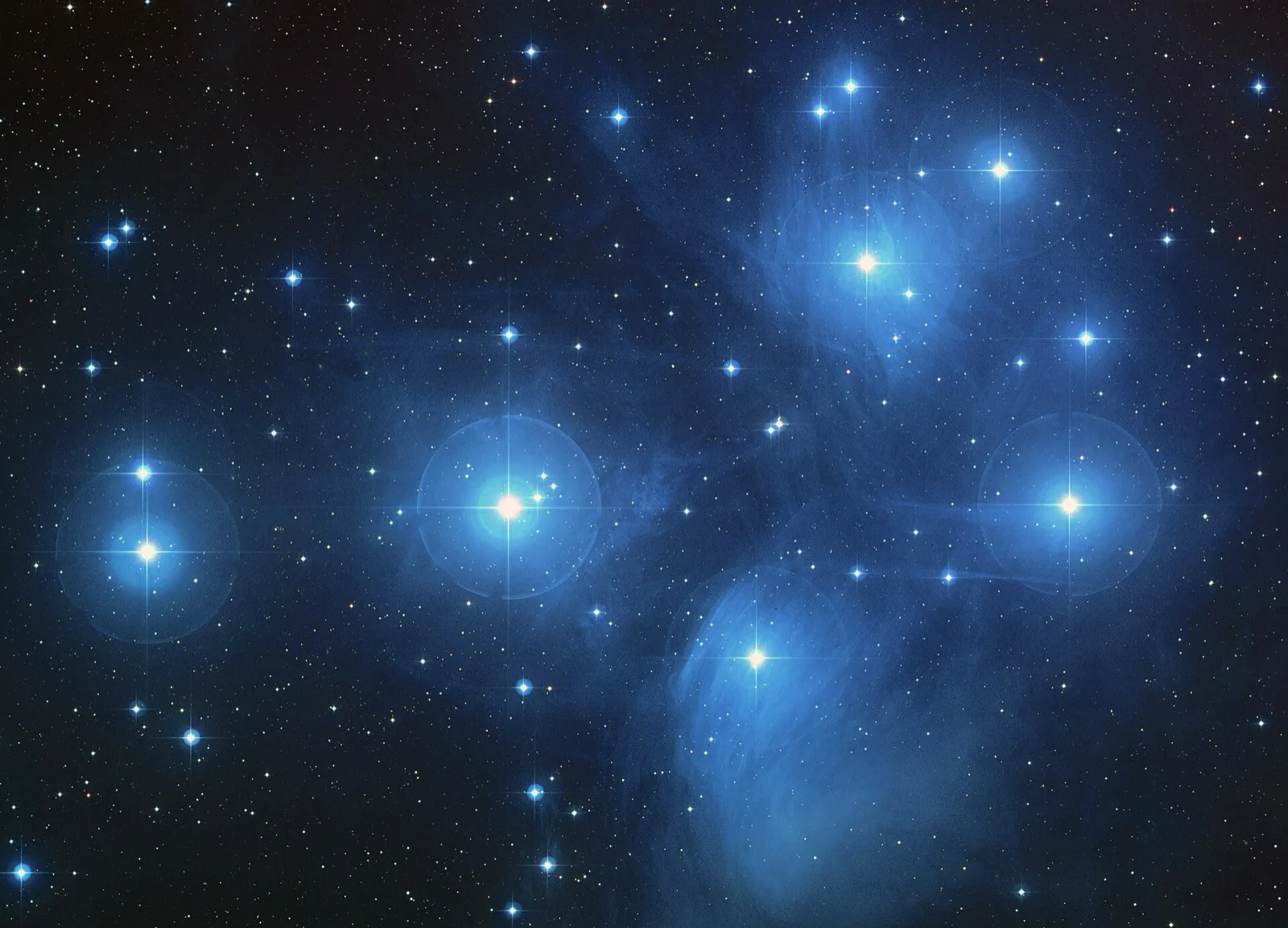 The PleiadesM45 · open star cluster
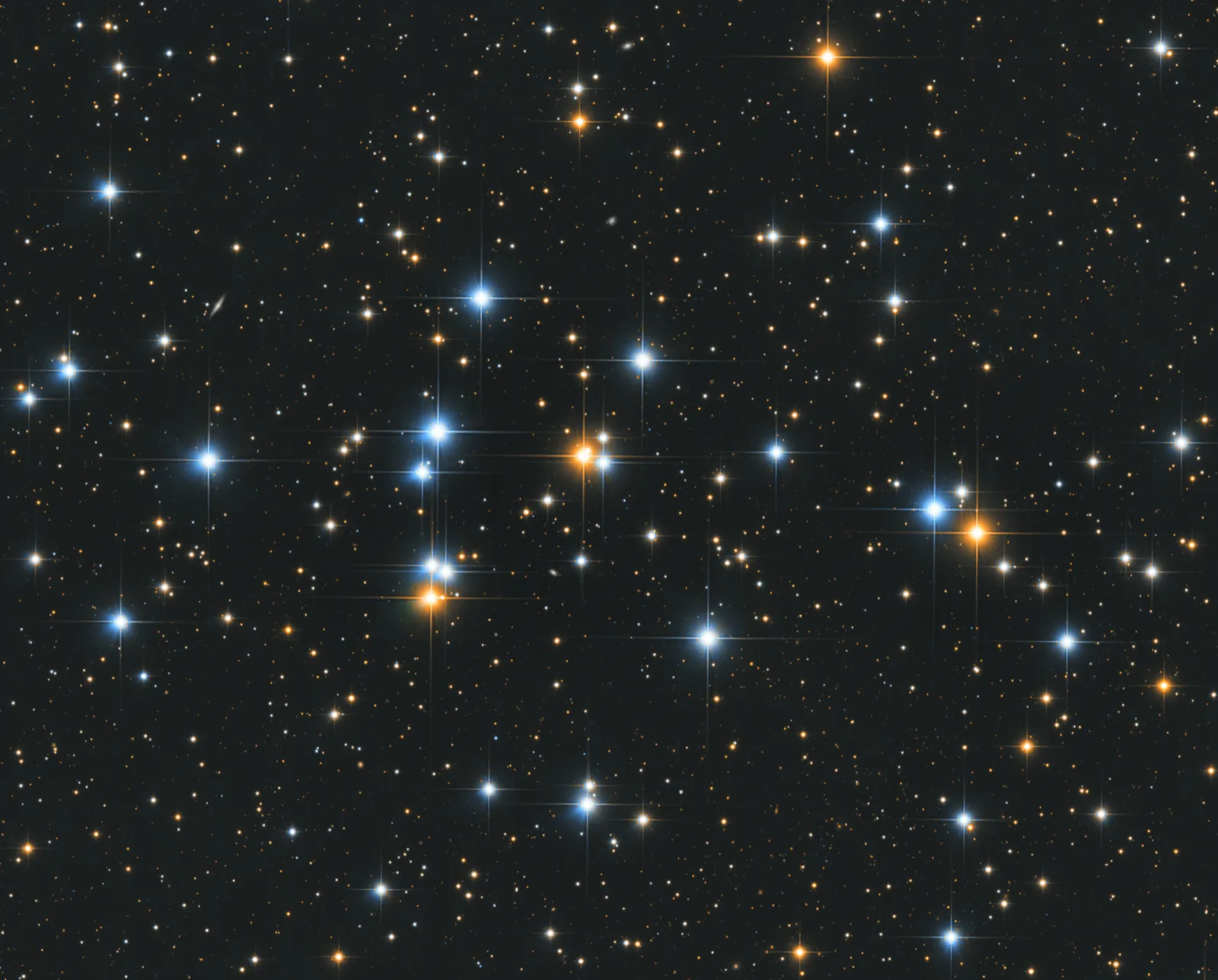 Beehive ClusterM44 · open star cluster
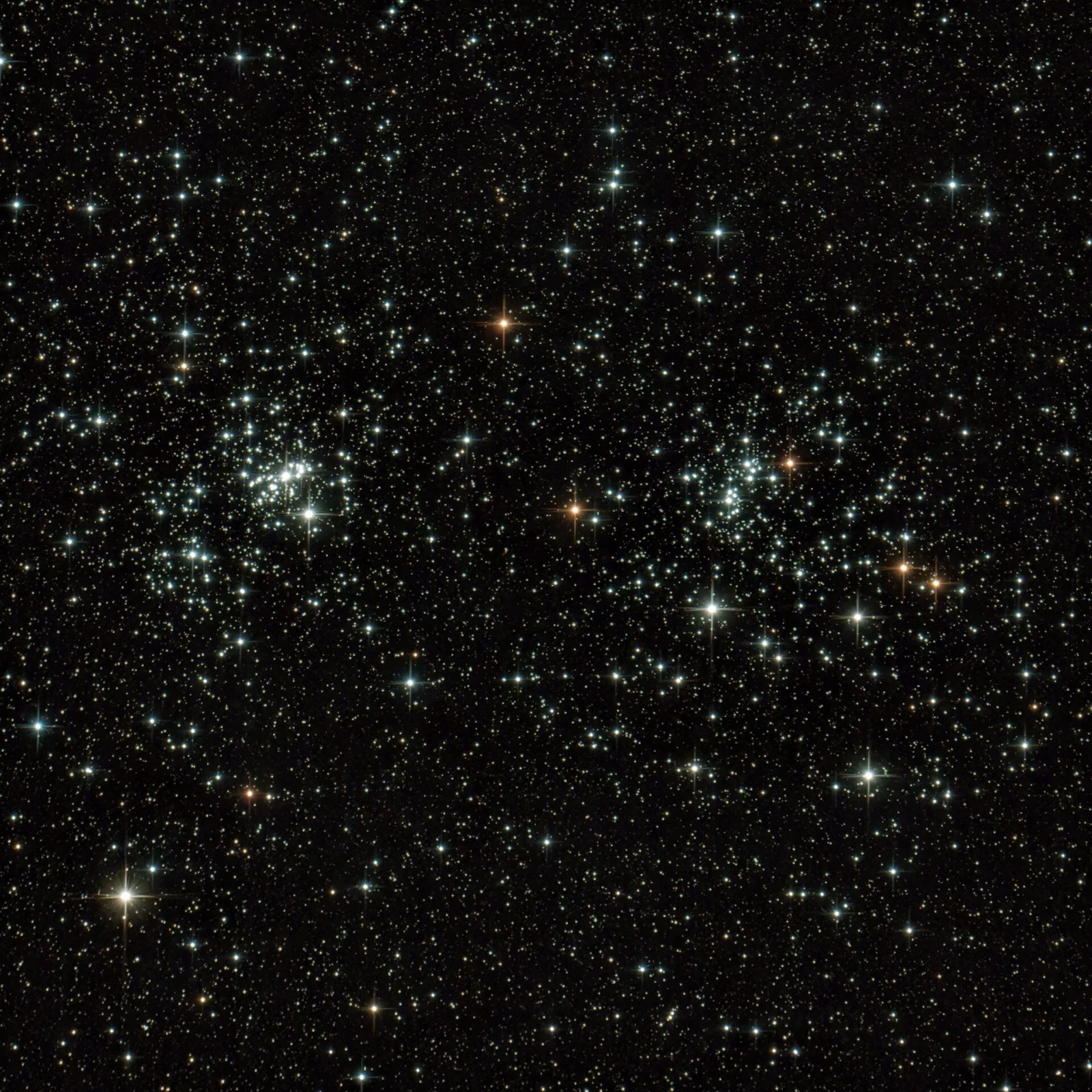 Double ClusterNGC 869 · open star cluster
 Jewel BoxNGC 4755 · open star cluster
Sources
- en.wikipedia.org
- science.nasa.gov
- en.wikipedia.org
- earthsky.org
- Positions: astronomy-engine (Don Cross).