 SKY
Sky catalog › Star clusters
Jewel Box
NGC 4755 · An open star cluster in Crux
What is it?
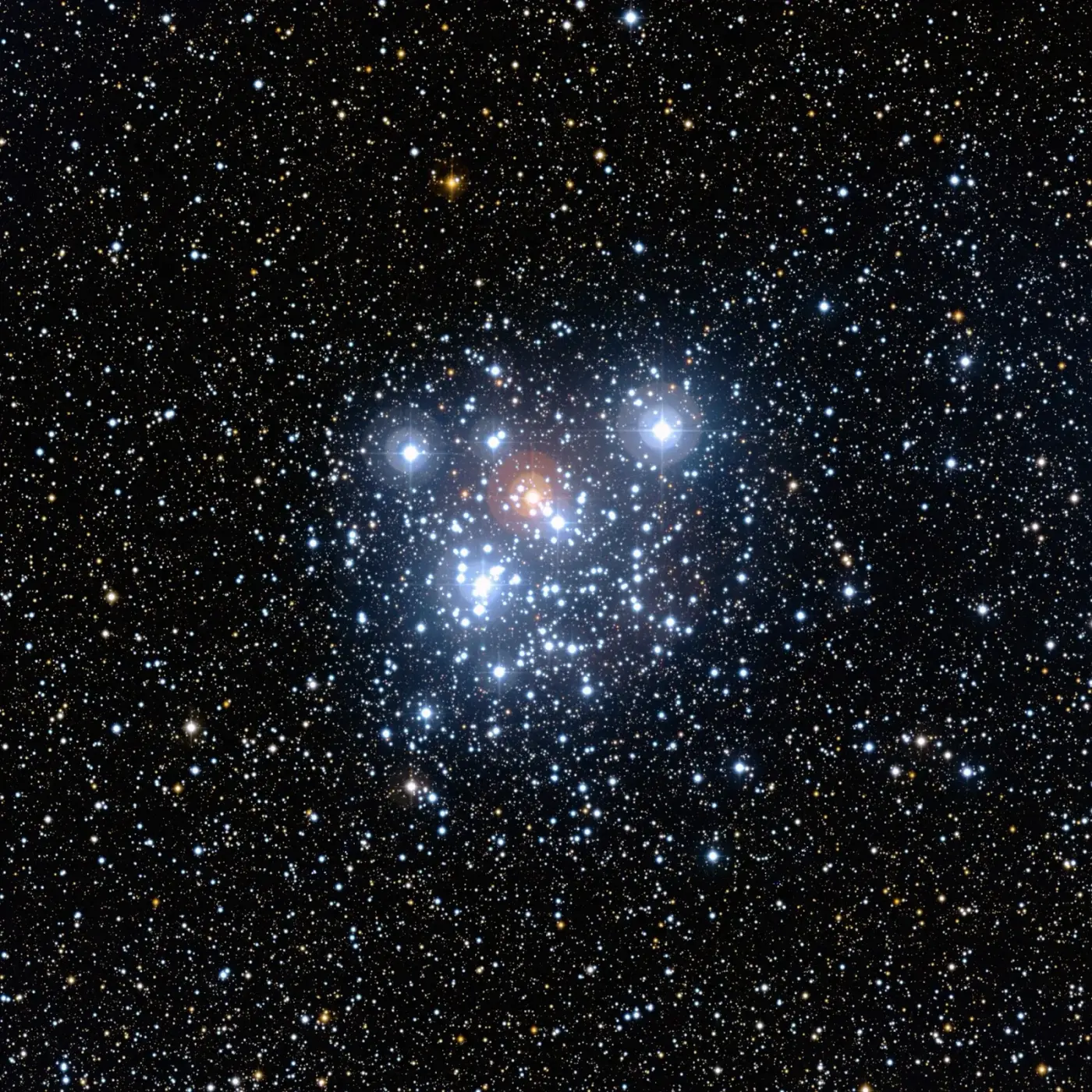
Jewel Box is an open star cluster. A family of young stars born together from the same cloud of gas.
Why the Jewel Box is interesting
What you see: Each dot is a star. The bright pale blue ones are supergiants, and a single ruby-red supergiant stands out among them. esahubble.org
How it formed: All its stars formed together from the same cloud of gas and dust, about 16 million years ago. That is why they share a similar age and makeup. eso.org
To scale: Its brighter stars are 15 to 20 times the mass of the Sun, while the dimmest ones in Hubble's image have less than half the Sun's mass. esahubble.org
Three things to know
- John Herschel named it the Jewel Box in the 1830s because its pale blue and orange stars reminded him of jewelry.
- Its stars are only about 14 to 16 million years old, very young for stars.
- Its brightest stars have 15 to 20 times the mass of the Sun.
12 more fun facts
- Hubble photographed the Jewel Box through seven filters, from far ultraviolet to near infrared, making the first complete picture of an open star cluster across that whole range. esahubble.org
- Among its pale blue supergiants shines one lone ruby-red supergiant that stands out clearly in Hubble's image. esahubble.org
- Three stars in the cluster's central bar are nicknamed the traffic lights, because each one glows a different color. en.wikipedia.org
- Lacaille first recognized it as a star cluster in 1751 to 1752 from the Cape of Good Hope, using a tiny telescope only 12 mm (about half an inch) wide. en.wikipedia.org
- Its brightest stars are arranged in the shape of a capital letter A, with the supergiant Kappa Crucis at one foot of the letter. en.wikipedia.org
- ESO's Very Large Telescope in Chile captured a razor-sharp image of the Jewel Box with only 5 seconds of total exposure, one of the best ever taken from the ground. eso.org
- The Hubble picture was one of the last taken by the Wide Field Planetary Camera 2 before astronauts removed the camera and brought it back to Earth. esahubble.org
- The cluster sits next to the Coalsack, a dark cloud of dust that blocks part of its light and makes its distance harder to measure. en.wikipedia.org
- John Herschel measured the positions of just over 100 of its stars between 1834 and 1838. en.wikipedia.org
- Many of the red-looking stars in photos of the Jewel Box are not in the cluster at all. They lie behind dust that scatters away their blue light. eso.org
- The faintest stars in Hubble's image have less than half the mass of the Sun, small neighbors to giants many times heavier. esahubble.org
- To the naked eye the Jewel Box looks like a single hazy star, and it is also known as the Kappa Crucis Cluster. en.wikipedia.org
In the game these unlock one by one as you keep photographing the Jewel Box.
At a glance
- Type
- Open star cluster
- Catalog
- NGC 4755
- Constellation
- Crux
- Distance
- about 6,400 to 6,500 light-years
- Brightness
- magnitude 4.2
- Size in our sky
- about 10 arcminutes
- Discovered
- Nicolas-Louis de Lacaille, 1751 to 1752
- Position (J2000)
- RA 12h 54m, Dec -60.4°
Looking back in time
The light in this photo left the Jewel Box about 6,400 years ago, when nobody could write yet (writing began about 5,200 years ago) and the first farming villages were growing.
How to see it yourself
Visible to the naked eye from a dark site. Binoculars show it well, and a small telescope shows more detail.
Finding it: Find the Southern Cross (Crux). The Jewel Box lies about 1 degree southeast of Mimosa (Beta Crucis), one of the four bright stars of the cross.
When to look: This is a far southern object. It is highest at midnight in early April, so southern autumn evenings (around April to June) are a great time to look. It is not visible from Europe and is too far south for most of the United States.
What you will see: To the naked eye it looks like a fuzzy fourth-magnitude star next to Mimosa. Binoculars show a small, tight knot of stars, and a small telescope reveals the A shape of bright blue-white stars with one orange-red star near the middle. It is one of the finest sights in the southern sky in any telescope.
Easy to confuse with:
- NGC 4852: NGC 4852 is a smaller, fainter cluster about 1 degree to the northeast, while the Jewel Box is brighter and shows a clear A shape with a red star.
Best months: April is when it is highest around midnight. About two months later it is highest in the early evening, at around 8 to 9 PM.
Where on Earth: best from the Southern Hemisphere. North of latitude 20°N it never climbs more than 10° above the horizon, so from the United States and Europe it is out of reach. South of 30°S it never sets.
How it is photographed: long exposures through filters, then the frames are stacked, stretched and combined into color.
Name and story
The name: John Herschel named it the Jewel Box in the 1830s and called it a superb piece of fancy jewelry. Nicolas Louis de Lacaille was the first to recognize it as a cluster, during his 1751 to 1752 survey of the southern sky, and it is also listed as NGC 4755 and Caldwell 94.
Record: Hubble's seven-filter image of the Jewel Box was the first comprehensive far-ultraviolet to near-infrared image ever made of an open star cluster in our galaxy.
Explored by: In 2009 ESO and ESA released views from three telescopes together: a sharp close-up from the Very Large Telescope, a wide field from the MPG/ESO 2.2-metre telescope at La Silla, and a Hubble image of the core in ultraviolet, visible and infrared light.
Test yourself
After every photo of the Jewel Box the game asks one of these. A right answer earns sky points for your observatory.
What are many of the red-looking stars in wide photos of the Jewel Box?
- Planets lit by the cluster
- Newborn stars still forming
- Far-off stars reddened by dust (the answer)
Many lie far behind the cluster, beyond dusty clouds of the Milky Way. Dust scatters away blue light, so those distant stars look red. eso.org
Who named the Jewel Box, after its colorful stars?
- John Herschel, in the 1830s (the answer)
- Edwin Hubble, in the 1920s
- Galileo Galilei, in 1610
John Herschel measured just over 100 of its stars and called it a superb piece of fancy jewelry, for its pale blue and orange stars. en.wikipedia.org
Point a telescope at the Jewel Box in the game: capture it in real time, then develop the frames like an astrophotographer.
Point a telescope at the Jewel BoxMore star clusters
 The PleiadesM45 · open star cluster
 Beehive ClusterM44 · open star cluster
 Double ClusterNGC 869 · open star cluster
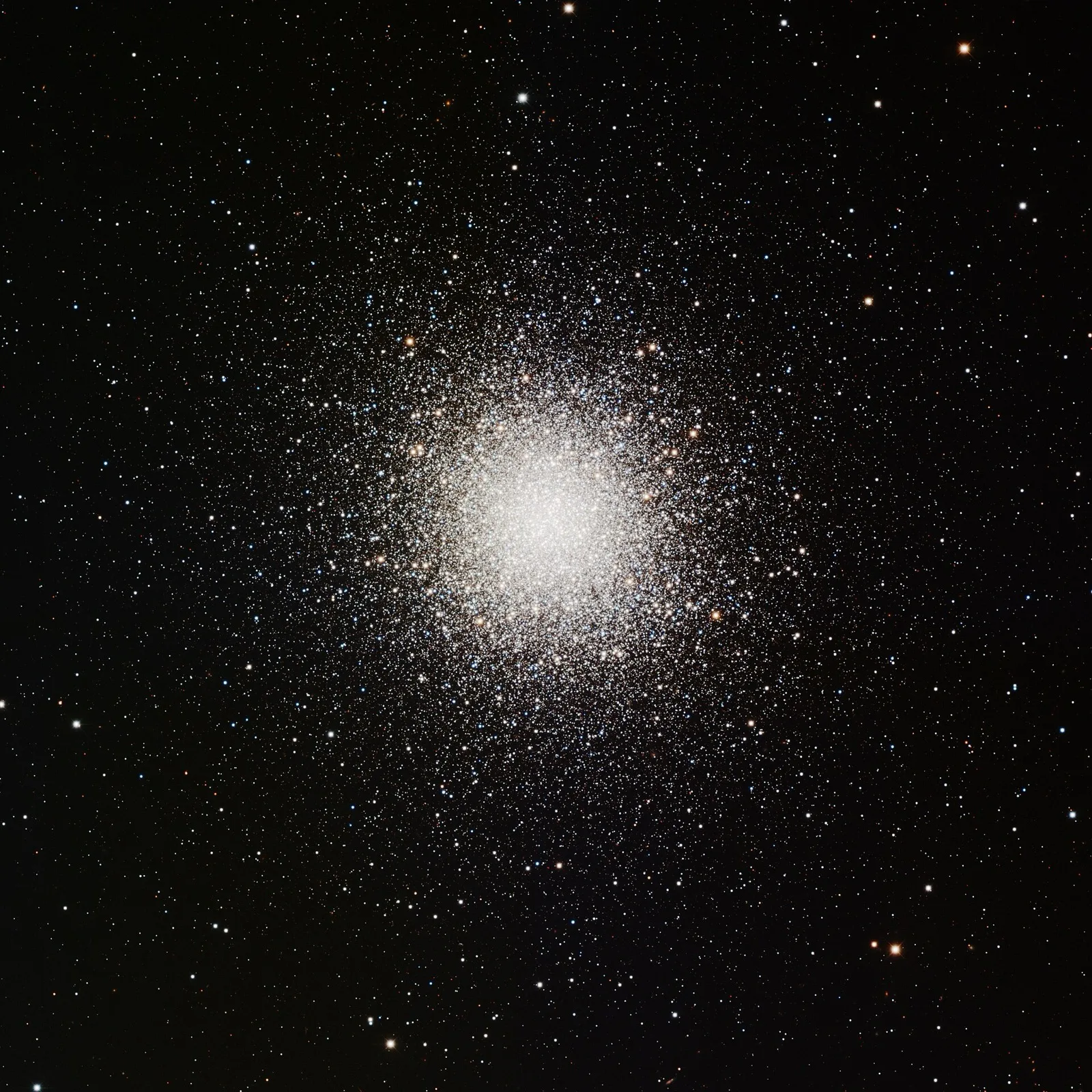 Hercules ClusterM13 · globular cluster
Sources
- en.wikipedia.org
- eso.org
- de.wikipedia.org
- esahubble.org
- deepskycorner.ch
- Positions: astronomy-engine (Don Cross).