 SKY
Sky catalog › Nebulae
Carina Nebula
NGC 3372 · A star-forming nebula in Carina
What is it?
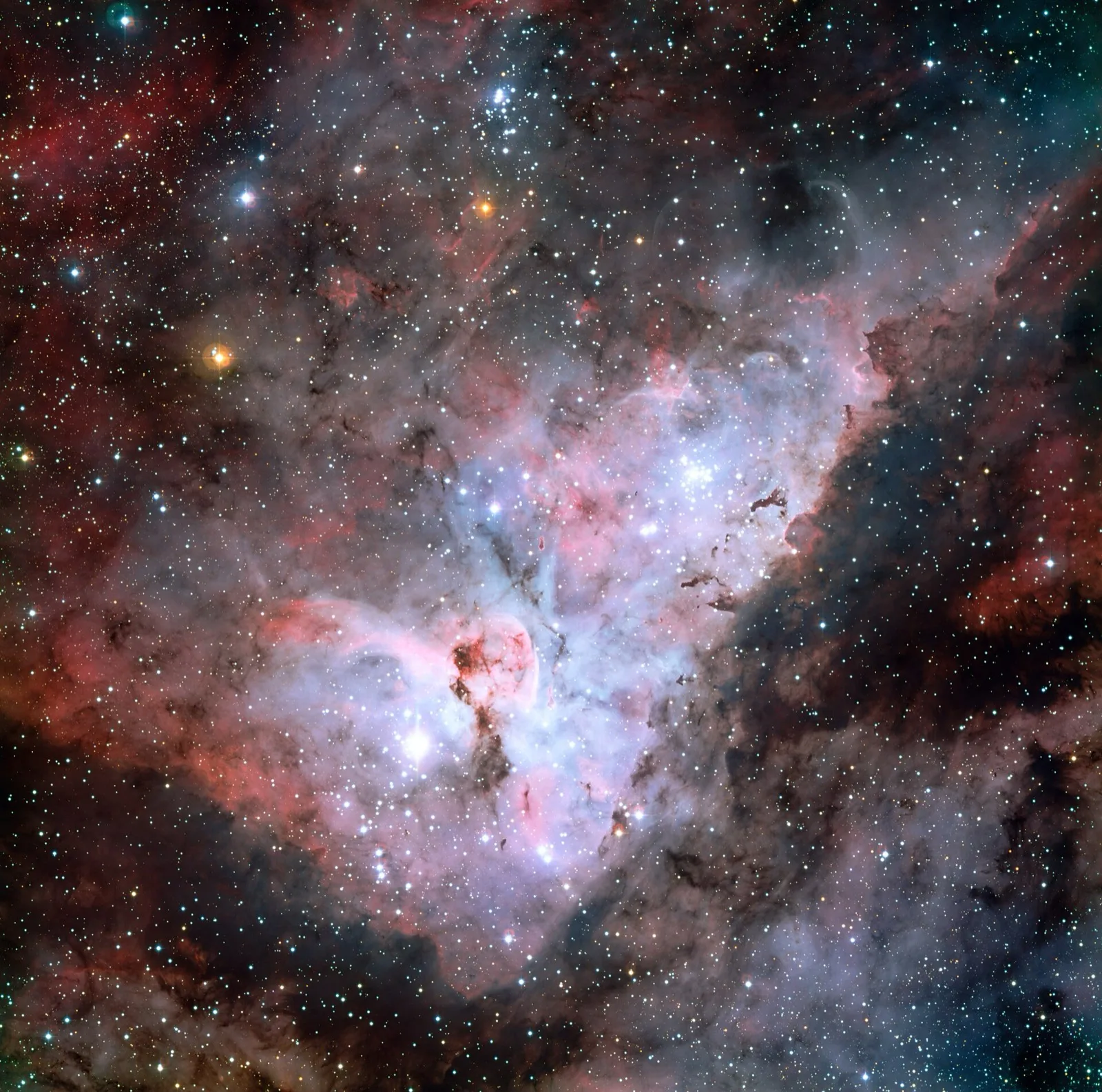
Carina Nebula is a star-forming nebula. A huge cloud of gas lit up by hot young stars born inside it.
Why the Carina Nebula is interesting
What you see: The glow is gas lit by many massive young stars, including hot O-type and Wolf-Rayet stars. The dark lanes and pillars, like Mystic Mountain, are clouds of dust and gas. en.wikipedia.org
How it formed: Ultraviolet light and winds from hot young stars are carving the cloud into cliffs and pillars. Where that pressure squeezes the gas, it collapses and forms new stars. esa.int
To scale: Its most famous star, Eta Carinae, holds about 100 to 150 times the Sun's mass and shines about four million times as brightly as the Sun. en.wikipedia.org
Three things to know
- The Carina Nebula is four times as large as the Orion Nebula and even brighter.
- Its giant star Eta Carinae blew out a huge cloud in the 1840s and briefly became the second-brightest star in the sky.
- The James Webb Space Telescope chose part of it, the Cosmic Cliffs, for one of its very first pictures.
12 more fun facts
- Chandra spotted more than 14,000 stars in the Carina Nebula during an X-ray survey that lasted about 1.2 million seconds, nearly two weeks. chandra.harvard.edu
- Chandra found six possible neutron stars in the Carina Nebula, the crushed cores that massive stars leave behind when they explode. chandra.harvard.edu
- Eta Carinae, the Carina Nebula's most famous star, has an estimated 100 to 150 times the mass of the Sun and shines about four million times as brightly. en.wikipedia.org
- In mid-infrared light, the Homunculus, the small cloud around Eta Carinae, is the brightest object in the whole sky. en.wikipedia.org
- The star cluster Trumpler 14 in the Carina Nebula is only about half a million years old, one of the youngest known, with about 2,000 stars identified. en.wikipedia.org
- Mystic Mountain, a pillar of gas and dust in Carina about three light-years tall, was photographed by Hubble in February 2010 for the telescope's 20th anniversary. en.wikipedia.org
- The Keyhole Nebula is a dark cloud about 7 light-years across, seen in silhouette against Carina's glow. Emma Converse compared its shape to a keyhole in 1873. constellation-guide.com
- The tallest peaks of Carina's Cosmic Cliffs are about 7 light-years high, and Webb revealed hundreds of stars hidden in them. esa.int
- The Carina Nebula spans roughly 460 light-years, making it one of the largest glowing clouds known. constellation-guide.com
- Nicolas-Louis de Lacaille logged the Carina Nebula twice in his catalog, as two separate entries. constellation-guide.com
- The Defiant Finger, a small dark knot in Carina holding at least 6 times the Sun's mass, may form stars before it evaporates in 200,000 to 1,000,000 years. en.wikipedia.org
- The star WR 25 in the Carina Nebula may be the most luminous star in our galaxy. en.wikipedia.org
In the game these unlock one by one as you keep photographing the Carina Nebula.
At a glance
- Type
- Star-forming nebula
- Catalog
- NGC 3372
- Constellation
- Carina
- Distance
- about 8,500 light-years
- Brightness
- magnitude 1
- Size in our sky
- about 2 degrees
- Discovered
- Nicolas-Louis de Lacaille, January 25, 1752
- Position (J2000)
- RA 10h 45m, Dec -59.9°
Looking back in time
The light in this photo left the Carina Nebula about 8,500 years ago, when nobody could write yet (writing began about 5,200 years ago) and the first farming villages were growing.
How to see it yourself
Visible to the naked eye from a dark site. Binoculars show it well, and a small telescope shows more detail.
Finding it: Look in the southern Milky Way near the Southern Cross and the larger False Cross. A line from Miaplacidus, the brightest star of the Diamond Cross, through the midpoint between Upsilon and Theta Carinae leads to the nebula.
When to look: This is a southern object: it stays below the horizon for observers north of about 30 degrees north latitude, so most of the United States never sees it. From the Southern Hemisphere it is best on evenings around March.
What you will see: To the naked eye it is a bright patch on the band of the Milky Way. Small binoculars begin to show dark rifts dividing the glow, and a telescope shows the dark Keyhole cloud silhouetted against the bright gas near Eta Carinae.
Best months: February is when it is highest around midnight. About two months later it is highest in the early evening, at around 8 to 9 PM.
Where on Earth: best from the Southern Hemisphere. North of latitude 20°N it never climbs more than 10° above the horizon, so from the United States and Europe it is out of reach. South of 30°S it never sets.
How it is photographed: long exposures through filters, then the frames are stacked, stretched and combined into color.
Name and story
The name: It takes its name from the constellation Carina, one of the pieces Lacaille made when he split the old constellation Argo Navis. Lacaille discovered the nebula on January 25, 1752, and 19th-century astronomers John Herschel and James Dunlop called it the Eta Carinae Nebula or Eta Argus Nebula.
People and history: The nebula's constellation was once part of Argo Navis, the ship of Jason and the Argonauts in Greek myth, which Lacaille later split into Carina, Puppis and Vela.
Record: Eta Carinae is the most massive star that can be studied in great detail. The Carina Nebula itself is one of the largest diffuse nebulae in our sky.
Explored by: Webb picked the Carina Nebula as one of five targets for its first science images in 2022. Hubble has pictured Mystic Mountain, the cluster Trumpler 14 and the Defiant Finger, Chandra mapped it in X-rays, and ESO's Very Large Telescope and VLT Survey Telescope have imaged it as well.
Test yourself
After every photo of the Carina Nebula the game asks one of these. A right answer earns sky points for your observatory.
What did the star Eta Carinae do in the 1840s?
- Became the sky's 2nd-brightest star (the answer)
- Collapsed into a black hole
- Vanished from the sky for good
In its Great Eruption it threw out a huge cloud and briefly outshone every star but Sirius. It is still shining today, wrapped in that dusty cloud. en.wikipedia.org
About how many stars did Chandra's X-ray survey spot in the Carina Nebula?
- About 1,500
- More than 14,000 (the answer)
- About 100
Chandra watched for about 1.2 million seconds, nearly two weeks. Young massive stars glow in X-rays, so they show up as bright points across the image. chandra.harvard.edu
Point a telescope at the Carina Nebula in the game: capture it in real time, then develop the frames like an astrophotographer.
Point a telescope at the Carina NebulaLearn more
- Color from three black and white pictures
Most astronomy cameras see only in black and white. Color images come from exposures through filters, combined into red, green and blue. Here is how, and what narrowband colors mean.
More nebulae
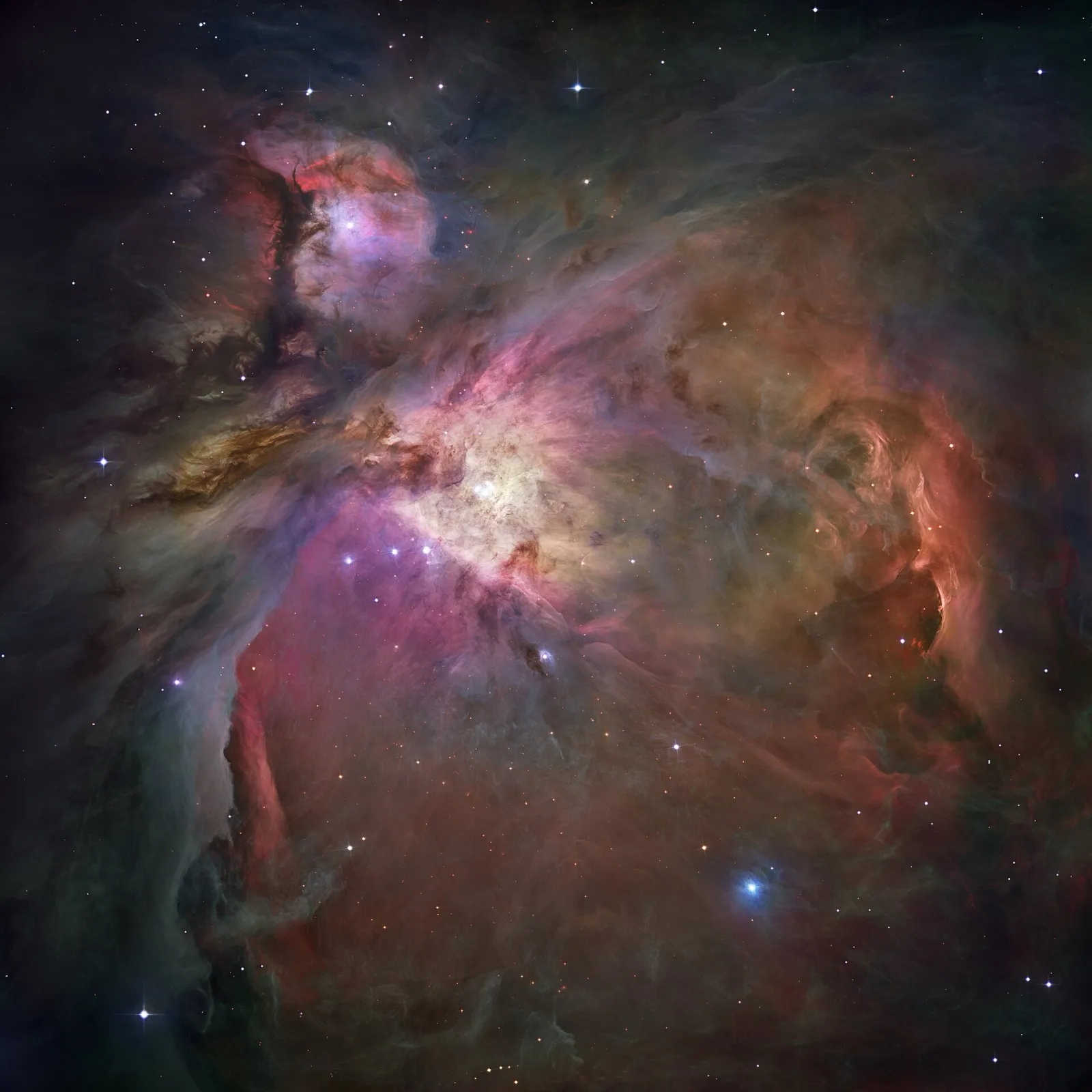 Orion NebulaM42 · star-forming nebula
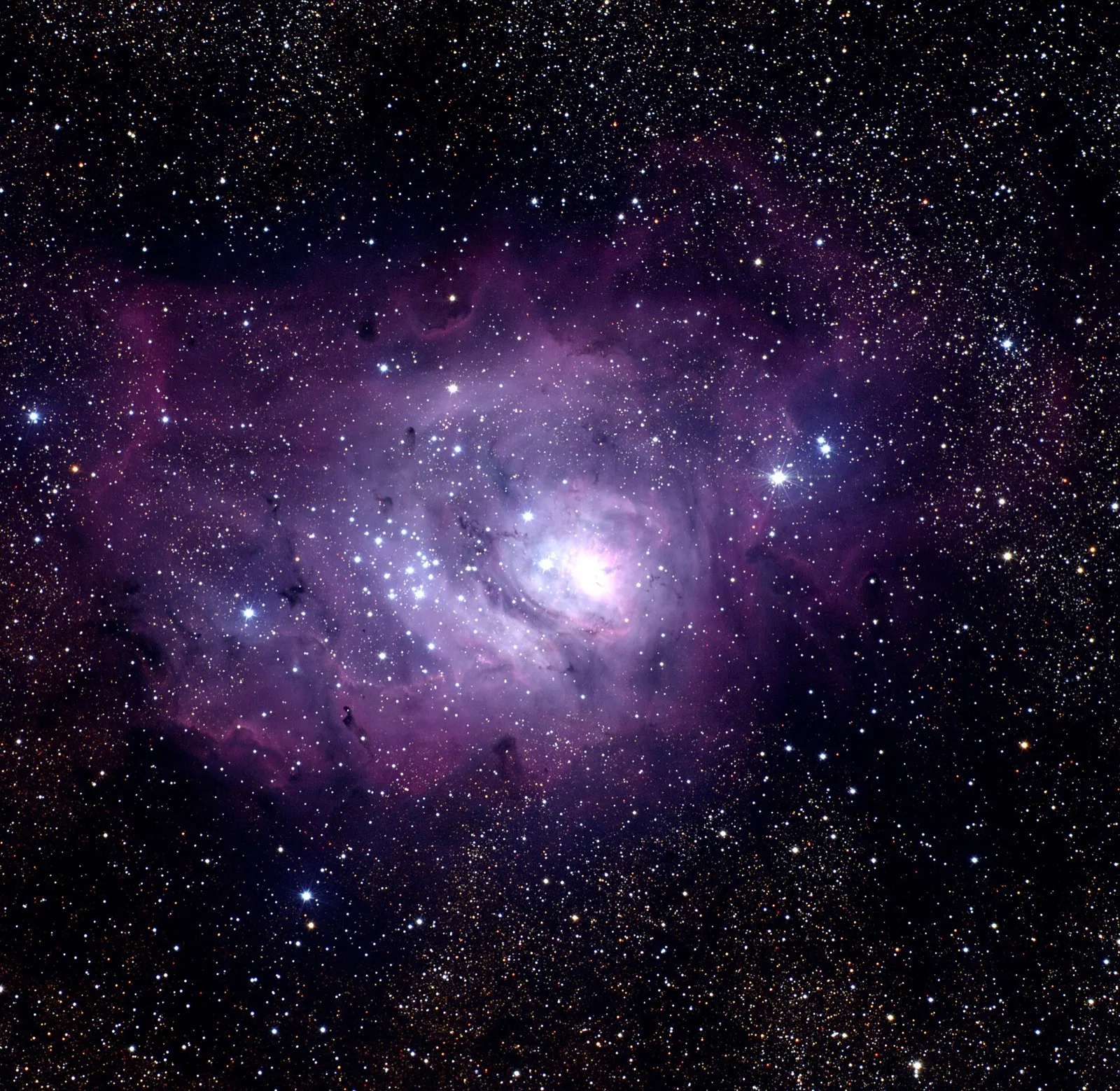 Lagoon NebulaM8 · star-forming nebula
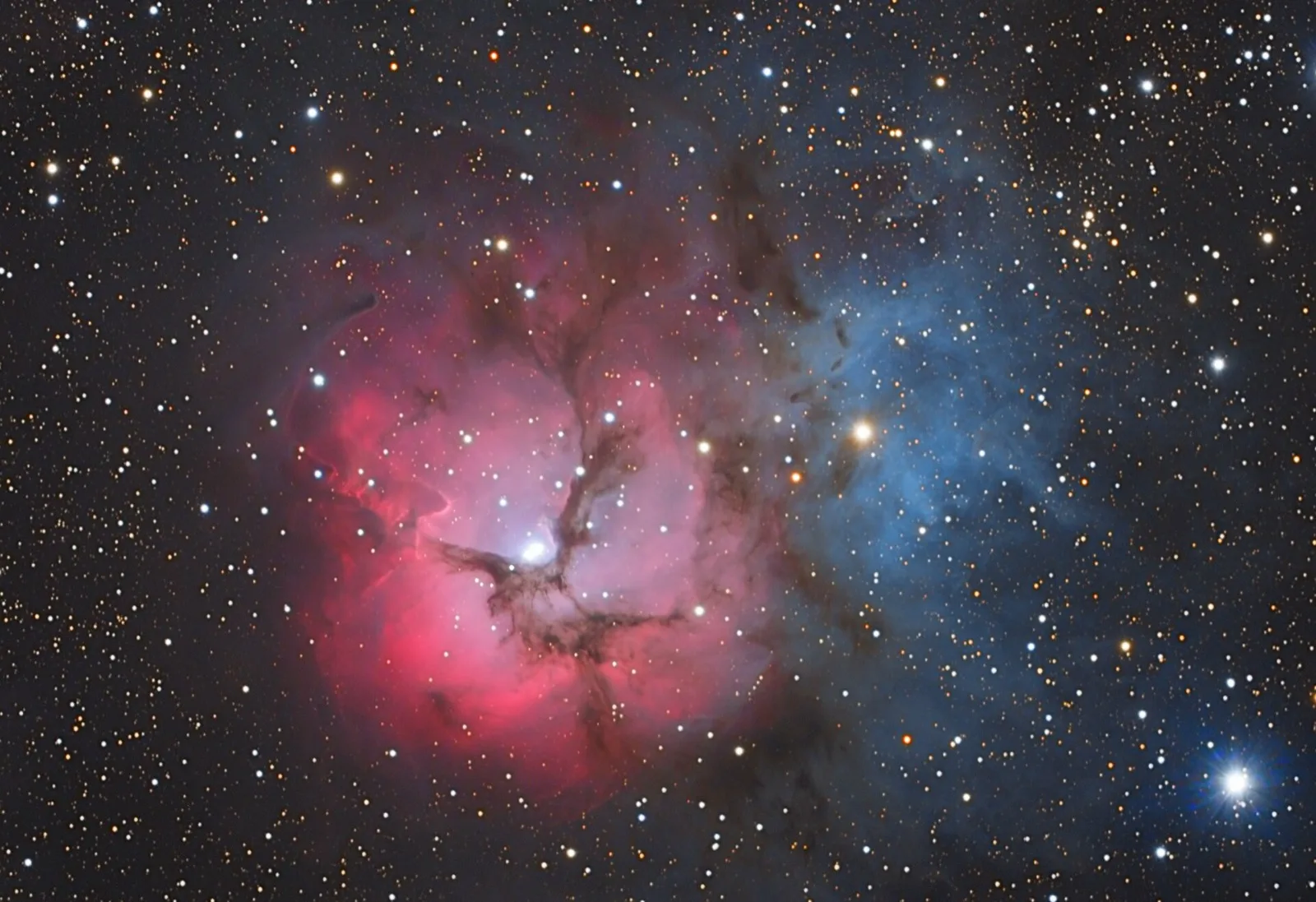 Trifid NebulaM20 · star-forming nebula
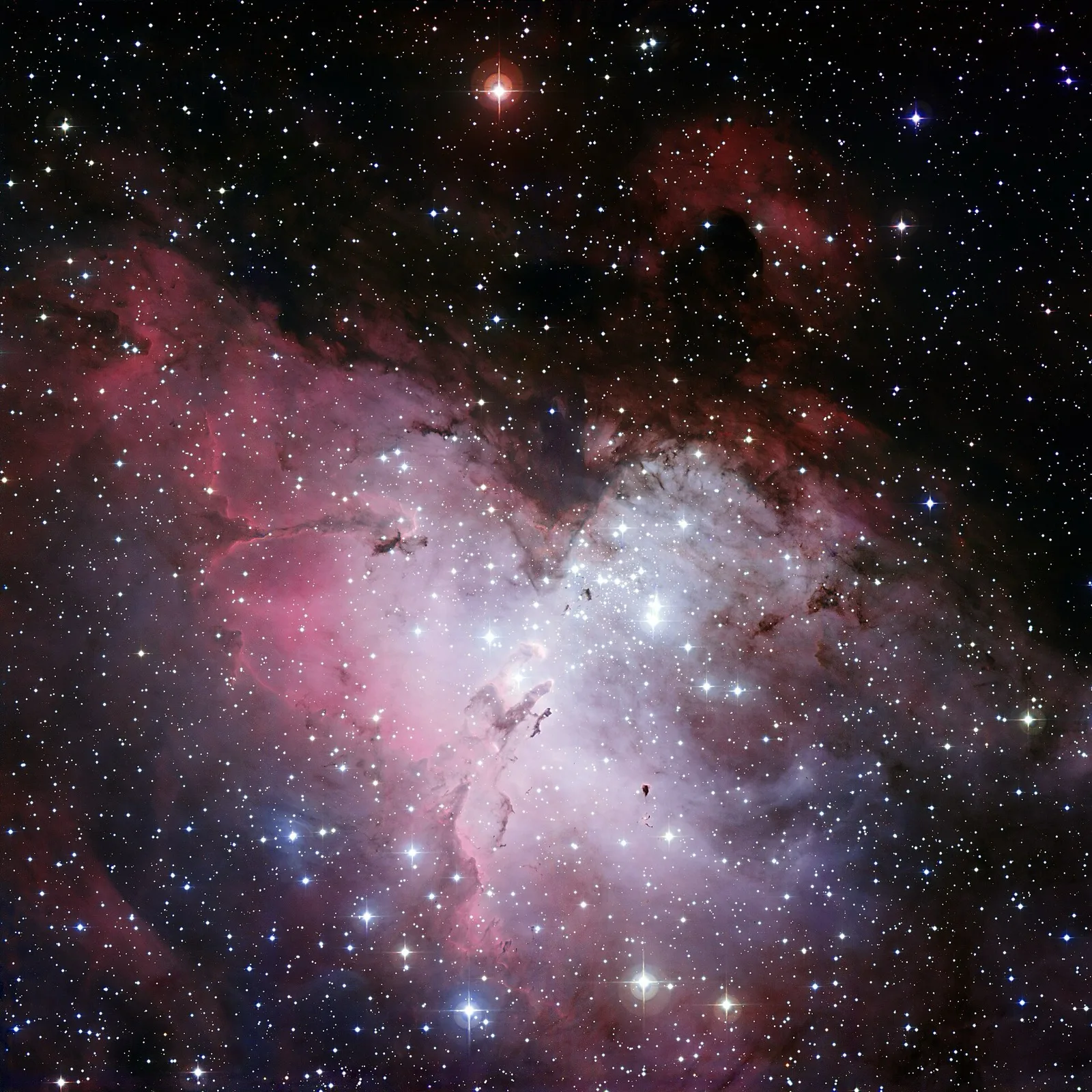 Eagle NebulaM16 · star-forming nebula
Sources
- en.wikipedia.org
- chandra.harvard.edu
- constellation-guide.com
- esa.int
- astronomy.com
- Positions: astronomy-engine (Don Cross).