 SKY
Sky catalog › Galaxies
Triangulum Galaxy
M33, NGC 598 · A galaxy in Triangulum
What is it?
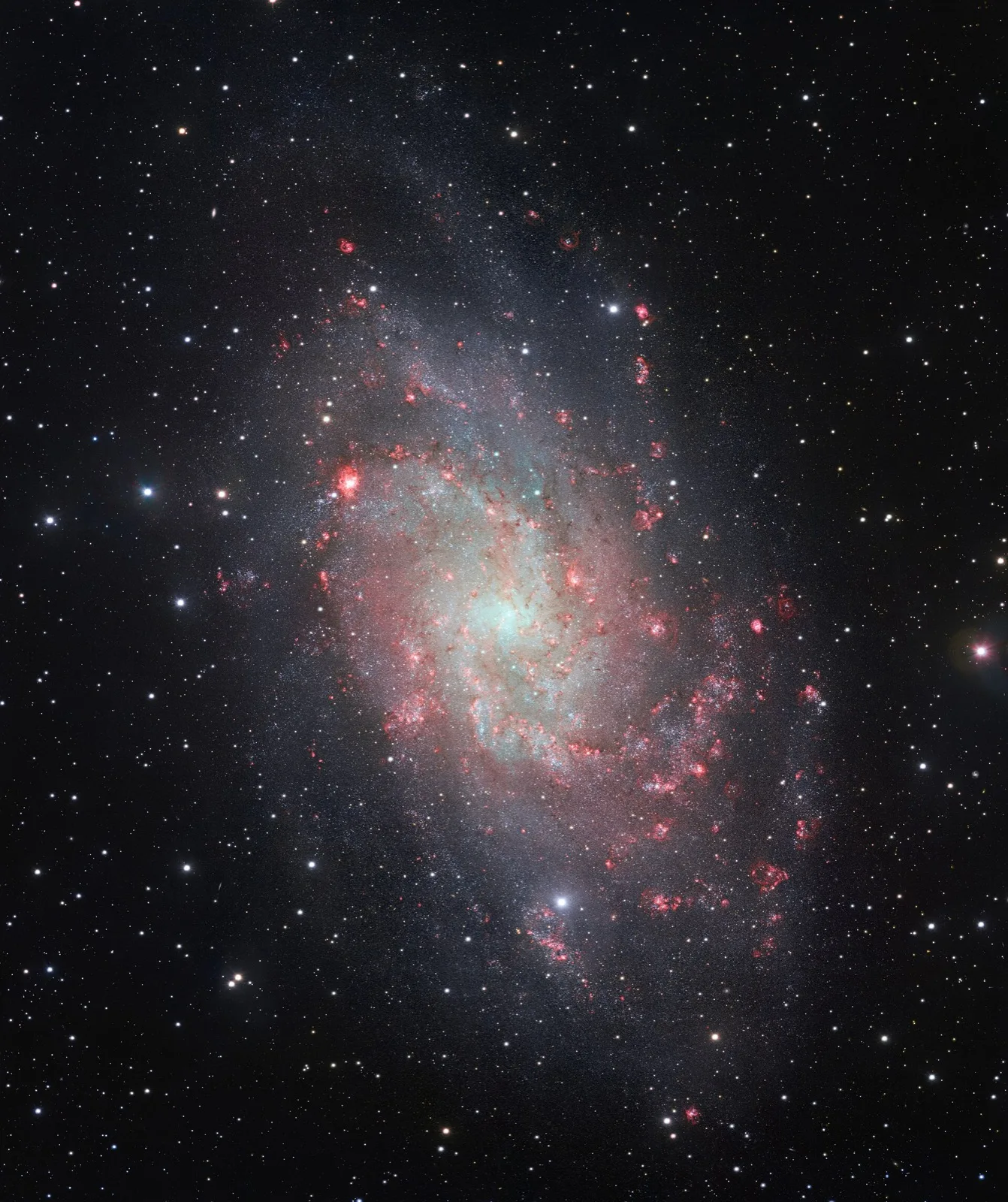
Triangulum Galaxy is a galaxy. A whole island of millions to trillions of stars, far outside our Milky Way.
Why the Triangulum Galaxy is interesting
What you see: The soft spiral is the blended light of roughly 30 to 40 billion stars. Brighter knots in its arms, such as NGC 604, are huge clouds where new stars are being born. en.wikipedia.org
How it formed: Invisible dark matter holds it together: about 50 billion Suns' worth in its inner region, against about 10 billion Suns of ordinary stars and gas. en.wikipedia.org
To scale: The Triangulum Galaxy is about 61,000 light-years across, so light needs about 61,000 years to cross it. en.wikipedia.org
Three things to know
- The Triangulum Galaxy is the third-largest galaxy in our Local Group, after Andromeda and our Milky Way.
- Under very dark skies some sharp-eyed people can see it without a telescope, which makes it one of the farthest things visible to the naked eye.
- In the 1920s Edwin Hubble used its flickering stars to prove it is a separate galaxy, not a cloud inside the Milky Way.
12 more fun facts
- NGC 604, a star nursery in the Triangulum Galaxy, spans almost 1,500 light-years, about 100 times wider than the Orion Nebula. science.nasa.gov
- NGC 604 holds more than 200 hot, massive young stars, while the Orion Nebula has just four. science.nasa.gov
- The Triangulum Galaxy has no giant black hole at its center. If one hides there, it weighs less than about 1,500 Suns. en.wikipedia.org
- A black hole called M33 X-7, about 15.7 times the mass of the Sun, eclipses its companion star every 3.5 days. en.wikipedia.org
- Triangulum holds roughly 30 to 40 billion stars, compared with about 400 billion in the Milky Way and about 1 trillion in Andromeda. en.wikipedia.org
- Giovanni Battista Hodierna probably noted the Triangulum Galaxy before 1654, more than a century before Messier cataloged it. en.wikipedia.org
- Streams of hydrogen gas link the Triangulum Galaxy to Andromeda, and it may be one of Andromeda's satellite galaxies. en.wikipedia.org
- Hubble surveys show star formation in Triangulum running about ten times higher than the average in Andromeda. science.nasa.gov
- Invisible dark matter outweighs everything else in Triangulum: about 50 billion Suns' worth in its inner region, versus about 10 billion Suns of ordinary matter. en.wikipedia.org
- In 2005 radio astronomers tracked water masers in Triangulum and found it moving at about 190 km (118 miles) per second relative to the Milky Way, heading toward Andromeda. en.wikipedia.org
- The Triangulum Galaxy is about 61,000 light-years across. en.wikipedia.org
- Triangulum and Andromeda are both moving toward the Milky Way, and Triangulum could get caught up if the two big galaxies collide billions of years from now. science.nasa.gov
In the game these unlock one by one as you keep photographing the Triangulum Galaxy.
At a glance
- Type
- Galaxy
- Catalog
- M33, NGC 598
- Constellation
- Triangulum
- Distance
- about 2.9 to 3 million light-years
- Brightness
- magnitude 5.72
- Size in our sky
- 70.8 x 41.7 arcminutes
- Discovered
- Charles Messier catalogued it in August 1764 (others may have seen it earlier)
- Position (J2000)
- RA 1h 34m, Dec +30.7°
Looking back in time
The light in this photo left the Triangulum Galaxy about 2.9 million years ago, when our early ancestors were walking upright in Africa; the oldest known stone tools are about 3.3 million years old.
How to see it yourself
Too faint for most eyes, but binoculars show it from a dark site. A small telescope shows its shape.
Finding it: Find the Andromeda Galaxy first, then draw a line from it through the star Mirach. Mirach sits roughly halfway, and M33 lies about 15 degrees from Andromeda, about one and a half fist-widths at arm's length.
When to look: Best on autumn evenings for mid-northern observers (NASA names November), on a dark, moonless night far from city lights.
What you will see: Only very sharp eyes under perfect dark skies catch it without optics. Binoculars show a faint, large blob, like a water spot on a window. A low-power, wide-field telescope works best and can hint at spiral arms.
Easy to confuse with:
- Andromeda Galaxy (M31): Andromeda is about eight times brighter and lies on the other side of Mirach, while M33 is a dim, nearly see-through glow.
Best months: October is when it is highest around midnight. About two months later it is highest in the early evening, at around 8 to 9 PM.
Where on Earth: easy from the Northern Hemisphere. South of latitude 49°S it never climbs more than 10° above the horizon. From 59°N and farther north it never sets.
This month: one of the best evening targets in the night sky in November 2026.
How it is photographed: long exposures through filters, then the frames are stacked, stretched and combined into color.
Name and story
The name: It is named for its constellation, Triangulum, the Triangle. Charles Messier recorded it on August 25 to 26, 1764 as object 33, and it is also NGC 598. It is sometimes informally called the Pinwheel Galaxy, a name catalogs usually give to M101.
Record: NGC 604 in the Triangulum Galaxy is the second most luminous star-forming cloud in the Local Group, shining about 45 million times brighter than the Sun.
Explored by: Hubble's mosaic of the Triangulum Galaxy was built from about 54 pointings and measures 34,372 by 19,345 pixels, the second-largest image Hubble has released after its Andromeda picture. It covers about 14,000 light-years around the core and resolves about 25 million individual stars.
Test yourself
After every photo of the Triangulum Galaxy the game asks one of these. A right answer earns sky points for your observatory.
How does the star nursery NGC 604 compare with the Orion Nebula?
- About 10 times smaller
- About the same size
- About 100 times wider (the answer)
NGC 604 spans almost 1,500 light-years and holds more than 200 hot, massive young stars, while the Orion Nebula is lit by just four. science.nasa.gov
What did Edwin Hubble use in the 1920s to show M33 lies far outside our galaxy?
- Its dark dust lane
- Its radio jets
- Its flickering stars (the answer)
In 1926 he showed that 35 of its flickering stars were Cepheids, whose rhythm reveals their distance. The distances placed M33 far outside the Milky Way. en.wikipedia.org
Point a telescope at the Triangulum Galaxy in the game: capture it in real time, then develop the frames like an astrophotographer.
Point a telescope at the Triangulum GalaxyLearn more
- Stacking: how many dim frames make one clear picture
Why astrophotographers take dozens of exposures of the same object and average them, and why the noise falls with the square root of the number of frames.
- Magnitude: why brighter stars get smaller numbers
Why a star of magnitude 1 is brighter than one of magnitude 6, why the Sun is -26.7, and how far each step goes.
More galaxies
 Andromeda GalaxyM31 · galaxy
 Large Magellanic CloudLMC · galaxy
 Small Magellanic CloudSMC · galaxy
 Bode's GalaxyM81 · galaxy
Sources
- en.wikipedia.org
- science.nasa.gov
- earthsky.org
- Positions: astronomy-engine (Don Cross).