 SKY
Sky catalog › Galaxies
Large Magellanic Cloud
A galaxy in Dorado and Mensa
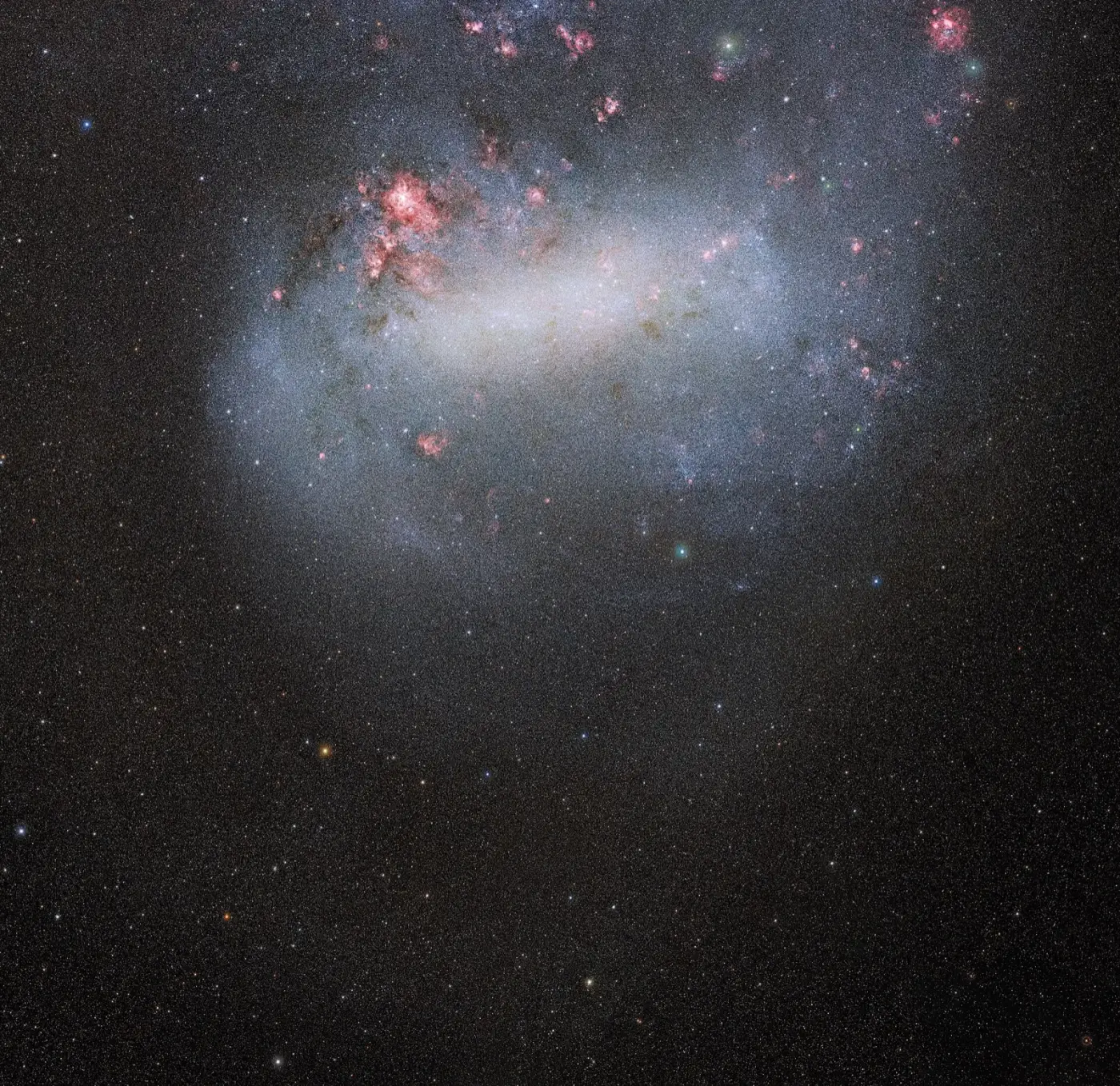
What is it?
Large Magellanic Cloud is a galaxy. A whole island of millions to trillions of stars, far outside our Milky Way.
Why the Large Magellanic Cloud is interesting
What you see: The soft, faint cloud is a whole dwarf galaxy, a satellite of our Milky Way, holding about 20 billion stars. en.wikipedia.org
How it formed: This dwarf galaxy has about one-hundredth of the Milky Way's mass and turns once every 250 million years. It is predicted to merge with the Milky Way in about 2.4 billion years. en.wikipedia.org
To scale: From a dark site it stretches about 10 degrees across the sky, about 20 times the width of the full Moon. en.wikipedia.org
Three things to know
- The Large Magellanic Cloud is a small satellite galaxy of our Milky Way, and in a dark sky it looks about 20 times wider than the Moon.
- In 1987 a star exploded in it: supernova 1987A, the closest supernova seen since the telescope was invented.
- In about 2.4 billion years it is expected to crash into and merge with the Milky Way.
12 more fun facts
- About 2 to 3 hours before the light of supernova 1987A arrived, detectors on Earth caught a burst of neutrinos from it; 25 were recorded in total. en.wikipedia.org
- In 2024 Webb found glowing argon in the debris of supernova 1987A, evidence that a neutron star was born in the blast. en.wikipedia.org
- The star that exploded as supernova 1987A was a blue supergiant named Sanduleak -69 202, which vanished after the explosion faded. en.wikipedia.org
- The Tarantula Nebula in the Large Magellanic Cloud is home to the hottest, most massive stars known. science.nasa.gov
- Webb's mosaic of the Tarantula Nebula spans about 340 light-years and shows tens of thousands of young stars that dust had hidden before. science.nasa.gov
- The Tarantula Nebula's chemistry resembles giant star nurseries from the universe's busiest star-making era, so it is the nearest detailed example of that time. science.nasa.gov
- A black hole of about 600,000 Suns sits at the Large Magellanic Cloud's center, and it is thought to have flung 21 fast-moving stars into the Milky Way's halo. en.wikipedia.org
- The Large Magellanic Cloud is about 32,200 light-years across and holds about 20 billion stars. en.wikipedia.org
- Hubble measurements from 2014 show the Large Magellanic Cloud turning once every 250 million years. en.wikipedia.org
- Amerigo Vespucci's letter of 1502 holds the first confirmed written record of the Magellanic Clouds, 17 years before Magellan's crew saw them. en.wikipedia.org
- Surveys of the Large Magellanic Cloud found roughly 60 globular clusters, 400 planetary nebulae and 700 open star clusters. en.wikipedia.org
- The Large Magellanic Cloud has about one-hundredth of the Milky Way's mass, and it is the fourth-largest galaxy in our Local Group. en.wikipedia.org
In the game these unlock one by one as you keep photographing the Large Magellanic Cloud.
At a glance
- Type
- Galaxy
- Constellation
- Dorado and Mensa
- Distance
- about 163,000 light-years
- Brightness
- magnitude 0.13
- Size in our sky
- about 10.75 x 9.17 degrees
- Discovered
- Known since prehistory in the south; first written mention by al-Sufi around 964; Magellan's crew saw it in 1519
- Position (J2000)
- RA 5h 24m, Dec -69.8°
Looking back in time
The light in this photo left the Large Magellanic Cloud about 163,000 years ago, when our own species was young and lived in Africa.
How to see it yourself
Visible to the naked eye from a dark site. Binoculars show it well, and a small telescope shows more detail.
Finding it: Look far south on a dark, moonless night for a large glowing patch that looks like a piece broken off the Milky Way, in Dorado and Mensa. The smaller Small Magellanic Cloud lies about 20 degrees to the west.
When to look: A southern object: it is visible from the Southern Hemisphere and as far north as about 20 degrees north latitude, so not from most of the United States. It is opposite the Sun around December 5, and south of about 28 degrees south it never sets.
What you will see: To the naked eye it is a big, soft cloud, fainter than many people expect. Binoculars are the best tool, showing star clusters, nebulae and the Tarantula Nebula as a distinct bright patch. It is too large to fit in most telescope views, so telescopes are for its individual clusters and nebulae.
Easy to confuse with:
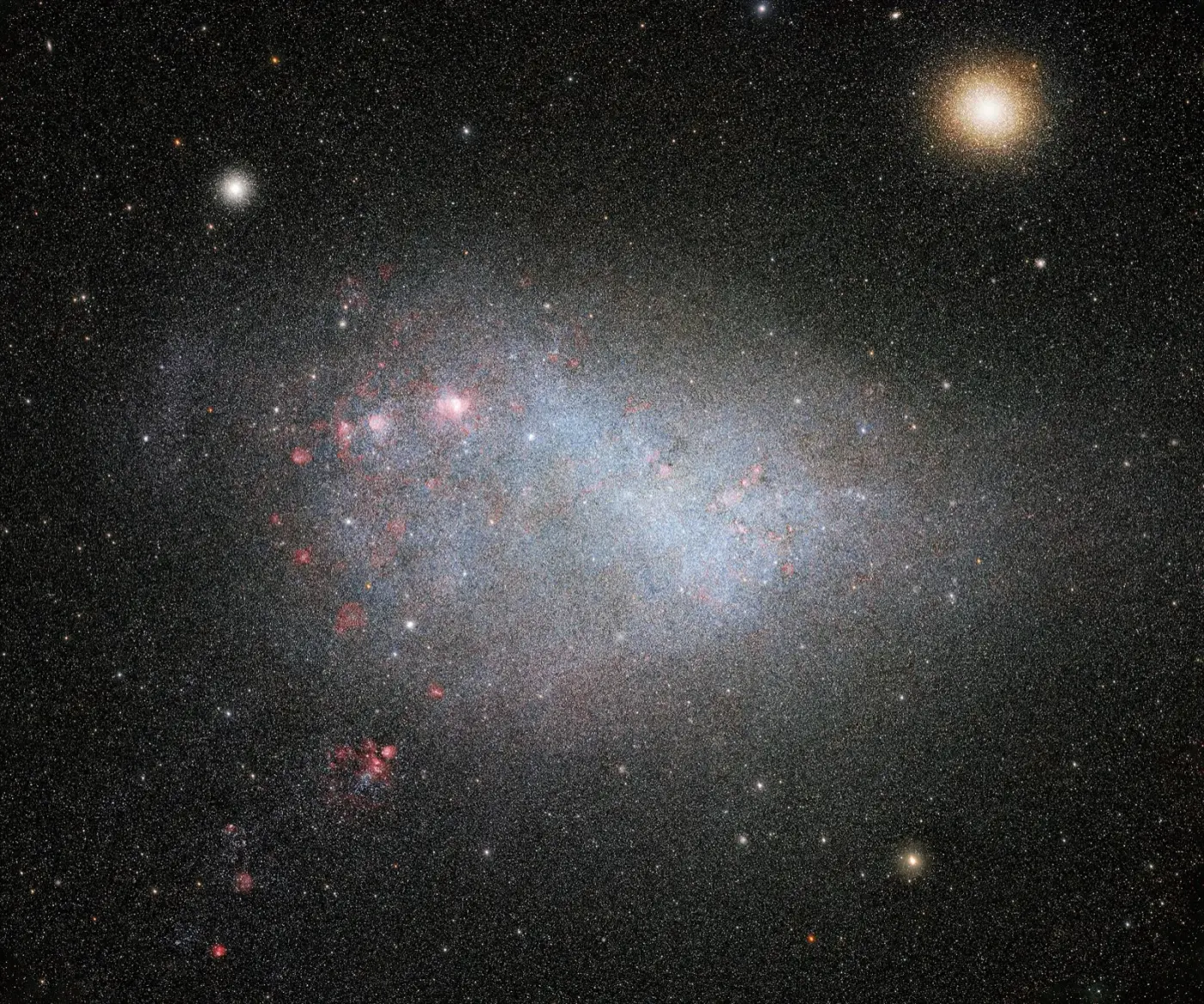
- Small Magellanic Cloud: The Small Magellanic Cloud is smaller and fainter, about 20 degrees west, with the bright globular cluster 47 Tucanae beside it.
Best months: December is when it is highest around midnight. About two months later it is highest in the early evening, at around 8 to 9 PM.
Where on Earth: best from the Southern Hemisphere. North of latitude 10°N it never climbs more than 10° above the horizon, so from the United States and Europe it is out of reach. South of 20°S it never sets.
How it is photographed: long exposures through filters, then the frames are stacked, stretched and combined into color.
Name and story
The name: It bears the name of Ferdinand Magellan, whose expedition sighted it in 1519, and its old Latin name is Nubecula Major. A reference by al-Sufi around 964 to the White Ox is now thought to be a misunderstanding.
People and history: Aboriginal Australians have many stories about the Clouds. In one Western Australian account the Large Cloud is an old man's camp and the Small Cloud an old woman's camp, teaching respect for elders. The Gundidjmara saw the Large Cloud as a giant crane, and Lower Murray people called the Clouds the Prolggi, meaning cranes.
Record: The Tarantula Nebula in the Large Magellanic Cloud is the largest and brightest star-forming region in the Local Group, the family of galaxies that includes the Milky Way.
Explored by: In 2022 Webb photographed the Tarantula Nebula with two cameras. NIRCam revealed tens of thousands of hidden young stars across about 340 light-years, and MIRI showed a very different view of the area around the central star cluster.
Test yourself
After every photo of the Large Magellanic Cloud the game asks one of these. A right answer earns sky points for your observatory.
What is expected to happen to the LMC in about 2.4 billion years?
- Burn out and slowly go dark
- Merge with the Milky Way (the answer)
- Escape into deep space
The LMC is a satellite of the Milky Way with only about one-hundredth of its mass, and it is predicted to merge with our galaxy in about 2.4 billion years. en.wikipedia.org
What reached Earth hours before the light of supernova 1987A?
- A shower of meteorites
- A burst of neutrinos (the answer)
- A wave of radio static
Neutrinos are released the moment the star's core collapses, while visible light comes out later, when the shock wave reaches the star's surface, about 2 to 3 hours on. en.wikipedia.org
Point a telescope at the Large Magellanic Cloud in the game: capture it in real time, then develop the frames like an astrophotographer.
Point a telescope at the Large Magellanic CloudLearn more
- A light-year, and why looking far means looking back
A light-year is a distance, not a time: how far light travels in a year. Here is how big it is, and why every look into space is a look into the past.
More galaxies
 Andromeda GalaxyM31 · galaxy
 Triangulum GalaxyM33 · galaxy
 Small Magellanic CloudSMC · galaxy
 Bode's GalaxyM81 · galaxy
Sources
- en.wikipedia.org
- en.wikipedia.org
- science.nasa.gov
- skyatnightmagazine.com
- aboriginalastronomy.blogspot.com
- Positions: astronomy-engine (Don Cross).