 SKY
Sky catalog › Galaxies
Small Magellanic Cloud
NGC 292 · A galaxy in Tucana and Hydrus
What is it?
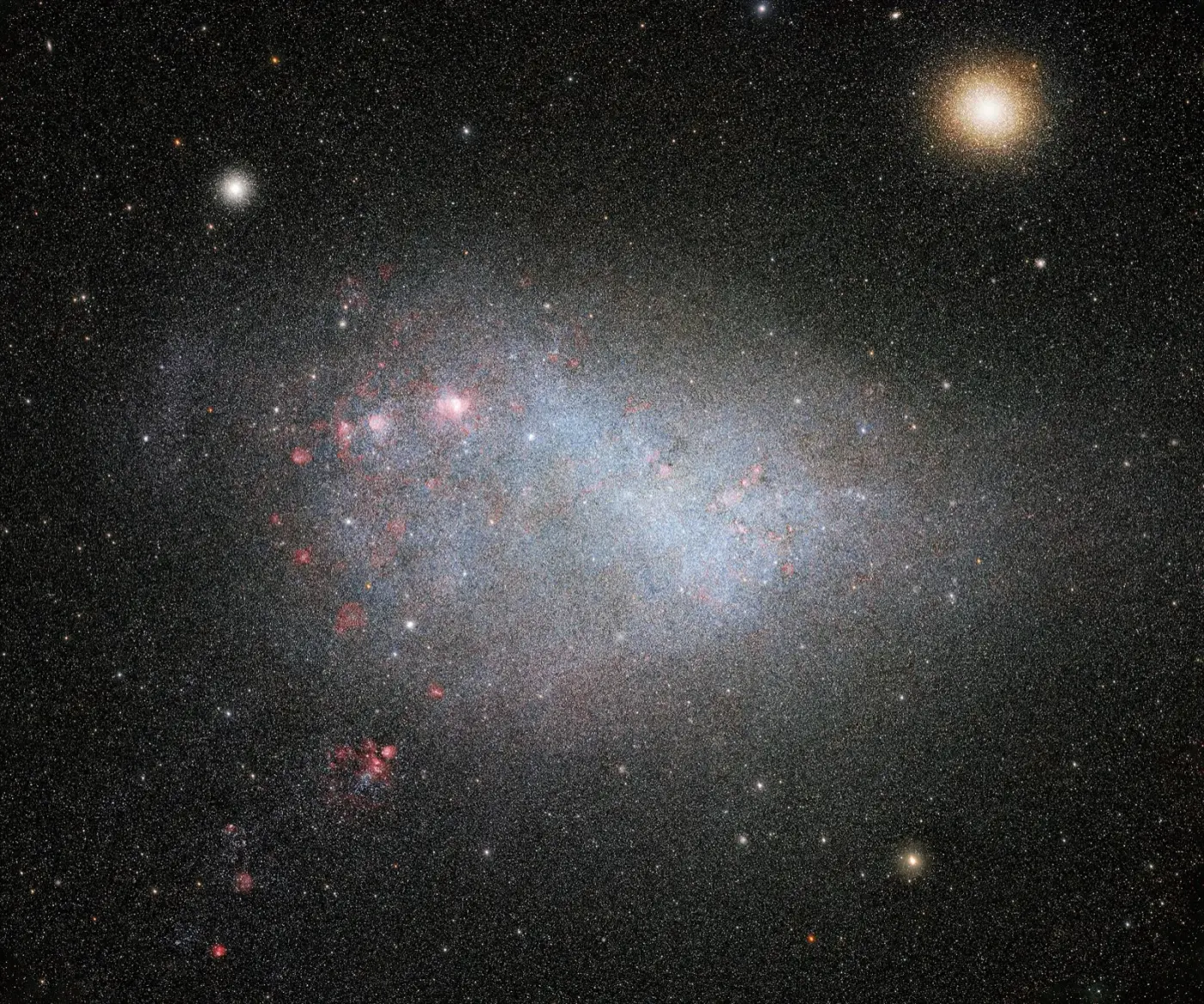
Small Magellanic Cloud is a galaxy. A whole island of millions to trillions of stars, far outside our Milky Way.
Why the Small Magellanic Cloud is interesting
What you see: The soft misty patch is a whole small galaxy holding several hundred million stars. It lies about 200,000 light-years away, so they blend into one glow. en.wikipedia.org
How it formed: It is being pulled apart. A 2025 study of 7,426 massive stars found stars on opposite sides moving in opposite directions, tugged by its bigger neighbor, the Large Magellanic Cloud. earthsky.org
To scale: The Small Magellanic Cloud looks about 8 times wider than the full Moon on average, so about eight full Moons could line up across it. en.wikipedia.org
Three things to know
- At about 200,000 light-years away, it is one of the most distant things you can see without a telescope.
- By studying its stars, Henrietta Swan Leavitt found a rule in 1908 that lets astronomers measure distances across the universe.
- A bridge of gas connects it to the Large Magellanic Cloud, and new stars are forming in that bridge.
12 more fun facts
- A 2025 study of 7,426 massive stars tracked by the Gaia spacecraft found stars on opposite sides of the Small Magellanic Cloud moving in opposite directions, as if the galaxy is being pulled apart. earthsky.org
- Young stars in the Small Magellanic Cloud show no sign of circling its center, so the galaxy may not be rotating at all. earthsky.org
- Webb found that planet-forming disks around young stars in the cluster NGC 346 last about ten times longer than astronomers expected. science.nasa.gov
- The star cluster NGC 346 has only about 10% of the heavy elements found in the Sun, so it is a stand-in for conditions in the early universe. science.nasa.gov
- The bright globular cluster 47 Tucanae looks like it sits next to the Small Magellanic Cloud, but it is more than 15 times closer to us. en.wikipedia.org
- In 1913 Ejnar Hertzsprung estimated the Small Magellanic Cloud was about 30,000 light-years away, a big underestimate that still proved the distance method worked. en.wikipedia.org
- The Small Magellanic Cloud looks about 8 times wider than the full Moon on average, covering about 14 square degrees of sky. en.wikipedia.org
- The Small Magellanic Cloud is about 18,900 light-years across and holds about 7 billion times the mass of the Sun. en.wikipedia.org
- The Small Magellanic Cloud is now a satellite of the Milky Way, but it was probably once a satellite of the Large Magellanic Cloud. en.wikipedia.org
- The two Magellanic Clouds share a common envelope of hydrogen gas, a sign they have been bound together by gravity for a long time. en.wikipedia.org
- A 2023 study found that the Small Magellanic Cloud may really be two separate structures, about 16,000 light-years apart, with different stars and gas. en.wikipedia.org
- The Small Magellanic Cloud has a central bar, and astronomers think it may once have been a barred spiral galaxy disrupted by the Milky Way. en.wikipedia.org
In the game these unlock one by one as you keep photographing the Small Magellanic Cloud.
At a glance
- Type
- Galaxy
- Catalog
- NGC 292
- Constellation
- Tucana and Hydrus
- Distance
- about 200,000 light-years
- Brightness
- magnitude 2.7
- Size in our sky
- about 5.3 x 3.1 degrees
- Discovered
- Known since prehistory in the south; described by Antonio Pigafetta on Magellan's voyage, 1519 to 1522
- Position (J2000)
- RA 0h 53m, Dec -72.8°
Looking back in time
The light in this photo left the Small Magellanic Cloud about 200,000 years ago, when our own species was young and lived in Africa.
How to see it yourself
Visible to the naked eye from a dark site. Binoculars show it well, and a small telescope shows more detail.
Finding it: Look in the far southern sky in the constellation Tucana, with part in Hydrus. The bright globular cluster 47 Tucanae sits right beside it, and the Large Magellanic Cloud lies about 20 degrees to the east.
When to look: A southern object: it is visible from the whole Southern Hemisphere and can be glimpsed low in the south from latitudes south of about 15 degrees north, so not from most of the United States. Choose a clear, moonless night away from city lights.
What you will see: To the naked eye it is a faint, hazy patch, like a detached piece of the Milky Way, with 47 Tucanae as a fuzzy star beside it. Binoculars are best for sweeping its clusters, and telescopes show individual star clusters such as NGC 362 on its northern edge.
Easy to confuse with:
- Large Magellanic Cloud: The Large Magellanic Cloud is bigger and brighter and lies about 20 degrees to the east.
- 47 Tucanae: 47 Tucanae looks like a small, round, fuzzy star right beside the Small Magellanic Cloud, while the galaxy itself is a much larger, fainter haze.
Best months: October is when it is highest around midnight. About two months later it is highest in the early evening, at around 8 to 9 PM.
Where on Earth: best from the Southern Hemisphere. North of latitude 7°N it never climbs more than 10° above the horizon, so from the United States and Europe it is out of reach. South of 17°S it never sets.
This month: one of the best evening targets in the night sky in November 2026.
How it is photographed: long exposures through filters, then the frames are stacked, stretched and combined into color.
Name and story
The name: It is named for Ferdinand Magellan; Antonio Pigafetta described the Clouds during Magellan's voyage around the world from 1519 to 1522. Johann Bayer named it Nubecula Minor in his 1603 star atlas Uranometria.
People and history: Aboriginal Australians tell many stories about the Clouds. In one Western Australian account the Small Cloud is an old woman's camp beside the old man's camp of the Large Cloud, a lesson in respecting elders and sharing food. The Gundidjmara saw the Small Cloud as the female partner of a giant crane.
Explored by: In 2024 Webb studied 10 young stars in the cluster NGC 346 and confirmed that their planet-forming disks survive far longer than expected. Hubble had found stars there in the mid-2000s that were 20 to 30 million years old but still seemed to have disks, when disks usually fade in 2 to 3 million years.
Test yourself
After every photo of the Small Magellanic Cloud the game asks one of these. A right answer earns sky points for your observatory.
What seems to be happening to the Small Magellanic Cloud?
- It is collapsing into a black hole
- It is spinning faster every year
- Its bigger neighbor is tearing it apart (the answer)
Stars on opposite sides move in opposite directions, and young stars show no sign of circling a center. Both fit a galaxy being stretched by the Large Magellanic Cloud. earthsky.org
What did Henrietta Leavitt find by studying its stars in 1908?
- A new moon circling Jupiter
- The first planet around another star
- A way to measure cosmic distances (the answer)
Its stars are all about the same distance away, so she could see that a pulsing star's period is tied to its true brightness. That rule turns pulses into distances. en.wikipedia.org
Point a telescope at the Small Magellanic Cloud in the game: capture it in real time, then develop the frames like an astrophotographer.
Point a telescope at the Small Magellanic CloudMore galaxies
 Andromeda GalaxyM31 · galaxy
 Triangulum GalaxyM33 · galaxy
 Large Magellanic CloudLMC · galaxy
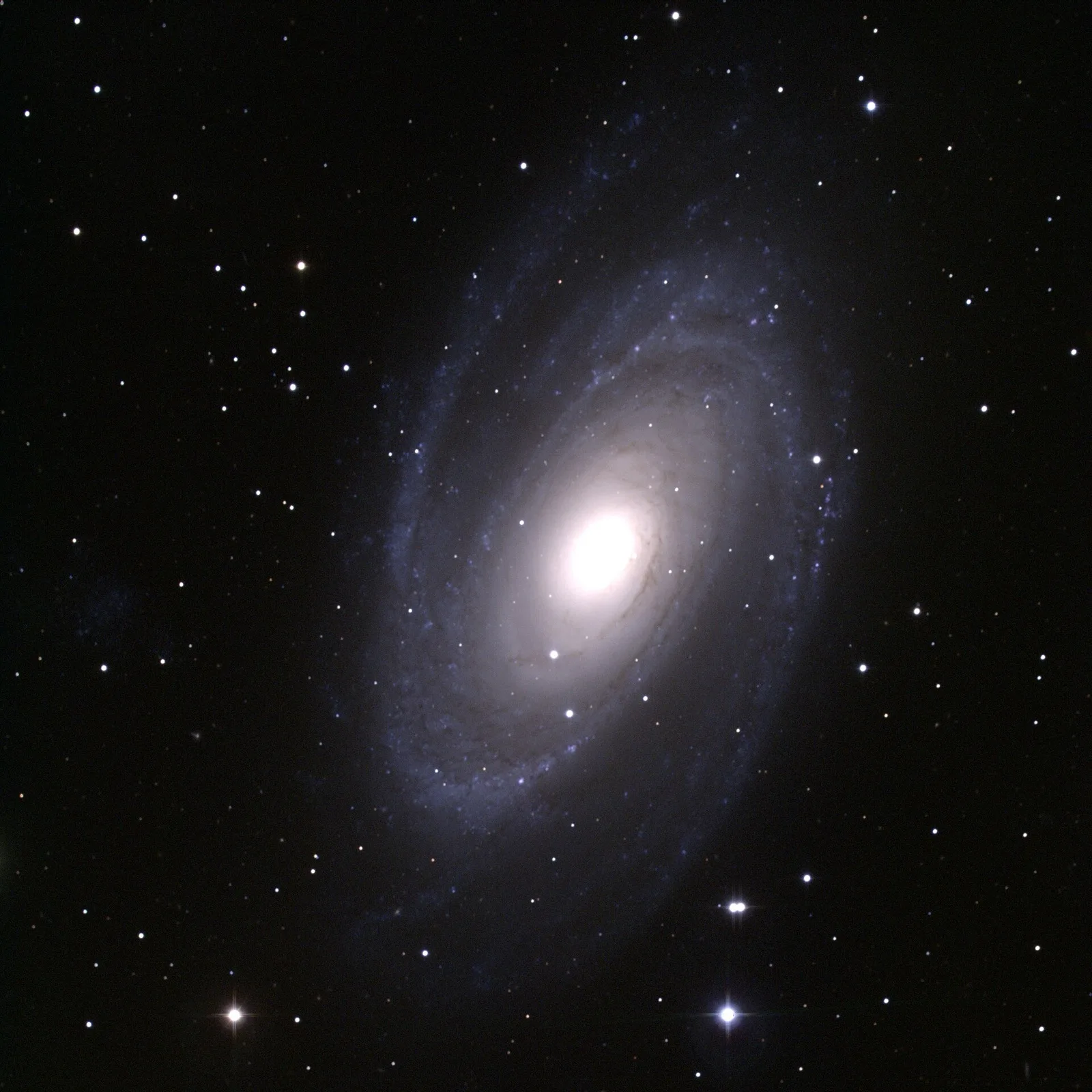 Bode's GalaxyM81 · galaxy
Sources
- en.wikipedia.org
- earthsky.org
- science.nasa.gov
- en.wikipedia.org
- skyatnightmagazine.com
- astronomy.com
- aboriginalastronomy.blogspot.com
- Positions: astronomy-engine (Don Cross).