 SKY
Sky catalog › Galaxies
Andromeda Galaxy
M31, NGC 224 · A galaxy in Andromeda
What is it?
Andromeda Galaxy is a galaxy. A whole island of millions to trillions of stars, far outside our Milky Way.
Why the Andromeda Galaxy is interesting
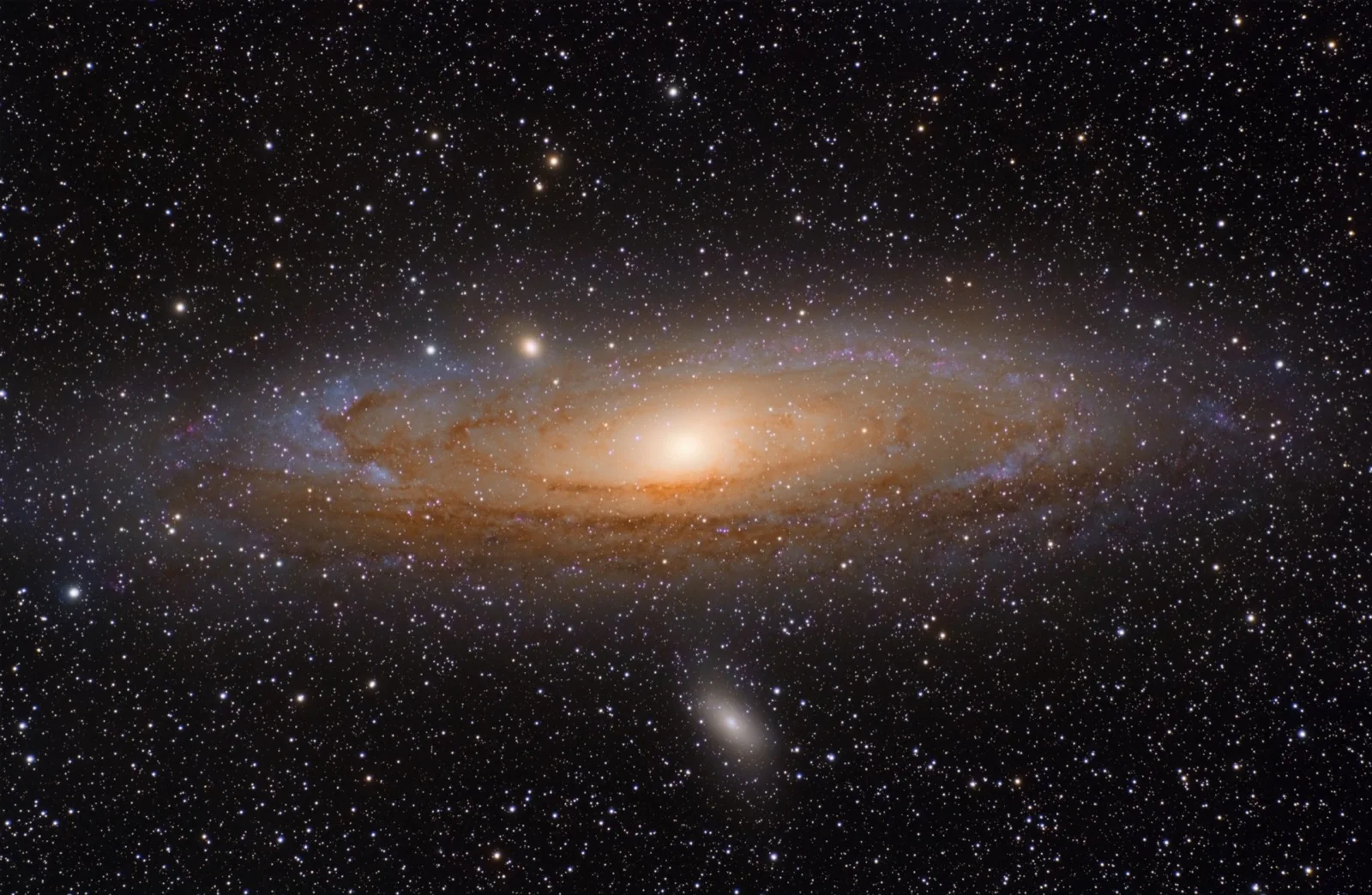
What you see: The long oval is a spiral disk of stars seen almost edge-on, tilted 77 degrees from our view. The bright middle is its crowded core, and the small round glow nearby is the satellite galaxy M32. science.nasa.gov
How it formed: Andromeda grew partly by merging with smaller satellite galaxies. M32 may be the leftover core of a galaxy that once collided with it. science.nasa.gov
To scale: Andromeda is so close that it spans about six times the width of the full Moon in our sky, though it is too faint for the eye to see all of it. science.nasa.gov
Three things to know
- The light you see from Andromeda left it about 2.5 million years ago.
- Andromeda contains about 1 trillion stars.
- Andromeda and our Milky Way are falling toward each other at about 110 km every second.
12 more fun facts
- Andromeda stretches about six times as wide as the full Moon across our sky. science.nasa.gov
- A 2025 study using Hubble and Gaia data ran 100,000 computer simulations and found only about a 50-50 chance that Andromeda and the Milky Way collide in the next 10 billion years. esahubble.org
- Persian astronomer al-Sufi's Book of Fixed Stars, written around 964, holds the earliest known description of any galaxy beyond our own. en.wikipedia.org
- In the 1920s Edwin Hubble found Cepheid variable stars in Andromeda on photos from the 100-inch Hooker telescope, which settled that it lies far outside the Milky Way. en.wikipedia.org
- Andromeda's center has a double nucleus: two bright clumps of stars about 4.9 light-years apart, and one of them holds the galaxy's supermassive black hole. en.wikipedia.org
- Andromeda gives off about 25% more light than the Milky Way, yet it makes only about one Sun's worth of new stars a year, while the Milky Way makes about 3 to 5. en.wikipedia.org
- Andromeda's globular cluster Mayall II, also called Globular One, holds several million stars and outshines every other known globular cluster in our Local Group. en.wikipedia.org
- Andromeda has more than 20 known dwarf satellite galaxies. The best known are M32 and M110. en.wikipedia.org
- Only one exploding star has ever been seen in Andromeda: S Andromedae in 1885, called Nova 1885 at the time. en.wikipedia.org
- Andromeda is tilted about 77 degrees to our line of sight, so we see its spiral disk almost edge-on. science.nasa.gov
- Andromeda's bright disk is about 152,000 light-years across, and a faint halo of stars spreads out even farther. en.wikipedia.org
- Andromeda holds about 460 globular star clusters, ancient balls packed with stars. en.wikipedia.org
In the game these unlock one by one as you keep photographing the Andromeda Galaxy.
At a glance
- Type
- Galaxy
- Catalog
- M31, NGC 224
- Constellation
- Andromeda
- Distance
- about 2.5 million light-years
- Brightness
- magnitude 3.44
- Size in our sky
- about 3.2 x 1 degrees
- Discovered
- Abd al-Rahman al-Sufi described it around 964 as a "small cloud"
- Position (J2000)
- RA 0h 43m, Dec +41.3°
Looking back in time
The light in this photo left the Andromeda Galaxy about 2.5 million years ago, when our early ancestors were walking upright in Africa; the oldest known stone tools are about 3.3 million years old.
How to see it yourself
Visible to the naked eye from a dark site. Binoculars show it well, and a small telescope shows more detail.
Finding it: Find the Great Square of Pegasus. From its corner star Alpheratz, step along Andromeda's chain of stars to Mirach, then draw a line from Mirach through the fainter star Mu Andromedae and keep going to reach the galaxy. You can also start from the W of Cassiopeia, whose brightest star Schedar points toward it.
When to look: Best on autumn evenings for mid-northern observers (NASA names November as the best month), on dark, moonless nights. It stays in the evening sky until early spring.
What you will see: To the naked eye under dark skies it is a large, faint, fuzzy oval, bigger than the full Moon but very subtle. Binoculars show it brighter, with a concentrated glowing center. A backyard telescope shows the bright core, but nothing like the colorful observatory photos.
Easy to confuse with:
- Triangulum Galaxy (M33): M33 lies on the other side of the star Mirach and is about eight times fainter, a dim, spread-out glow instead of Andromeda's long, bright oval.
Best months: October is when it is highest around midnight. About two months later it is highest in the early evening, at around 8 to 9 PM.
Where on Earth: easy from the Northern Hemisphere. South of latitude 39°S it never climbs more than 10° above the horizon. From 49°N and farther north it never sets.
This month: one of the best evening targets in the night sky in November 2026.
How it is photographed: long exposures through filters, then the frames are stacked, stretched and combined into color.
Name and story
The name: It is named after the constellation Andromeda, which honors the princess of Greek myth who became the wife of Perseus. Al-Sufi called it a small cloud around 964, Charles Messier listed it as number 31 in 1764, and it is also known as NGC 224.
People and history: Star charts from al-Sufi's time called it the Little Cloud. In 1745 Pierre Louis Maupertuis guessed it might be a separate island universe, and the debate over such spiral nebulae lasted until Edwin Hubble's measurements in the 1920s. Isaac Roberts took one of its first photographs on December 29, 1888.
Record: Andromeda is the largest galaxy in our Local Group, and under most conditions it is one of the most distant objects you can see without a telescope.
Explored by: Hubble has mapped Andromeda twice. The PHAT survey resolved more than 100 million stars, and a 2025 mosaic built from over 600 overlapping snapshots, taken across more than 10 years, has at least 2.5 billion pixels and about 200 million stars. Astronomers use those stars to rebuild Andromeda's history, including mergers with smaller galaxies.
Test yourself
After every photo of the Andromeda Galaxy the game asks one of these. A right answer earns sky points for your observatory.
What are the odds Andromeda and the Milky Way collide in 10 billion years?
- About 1 in a million
- About 50-50 (the answer)
- About 1 in 1,000
A 2025 study ran 100,000 simulations. Small errors in many measurements add up, and the pulls of M33 and the Large Magellanic Cloud push the result in opposite directions. esahubble.org
Who wrote the earliest known description of Andromeda, around 964?
- Persian astronomer al-Sufi (the answer)
- Charles Messier
- Edwin Hubble
Al-Sufi's Book of Fixed Stars described it as a small cloud. Messier listed it in 1764, and Hubble showed it lies far outside the Milky Way in the 1920s. en.wikipedia.org
Point a telescope at the Andromeda Galaxy in the game: capture it in real time, then develop the frames like an astrophotographer.
Point a telescope at the Andromeda GalaxyLearn more
- Stacking: how many dim frames make one clear picture
Why astrophotographers take dozens of exposures of the same object and average them, and why the noise falls with the square root of the number of frames.
- A light-year, and why looking far means looking back
A light-year is a distance, not a time: how far light travels in a year. Here is how big it is, and why every look into space is a look into the past.
More galaxies
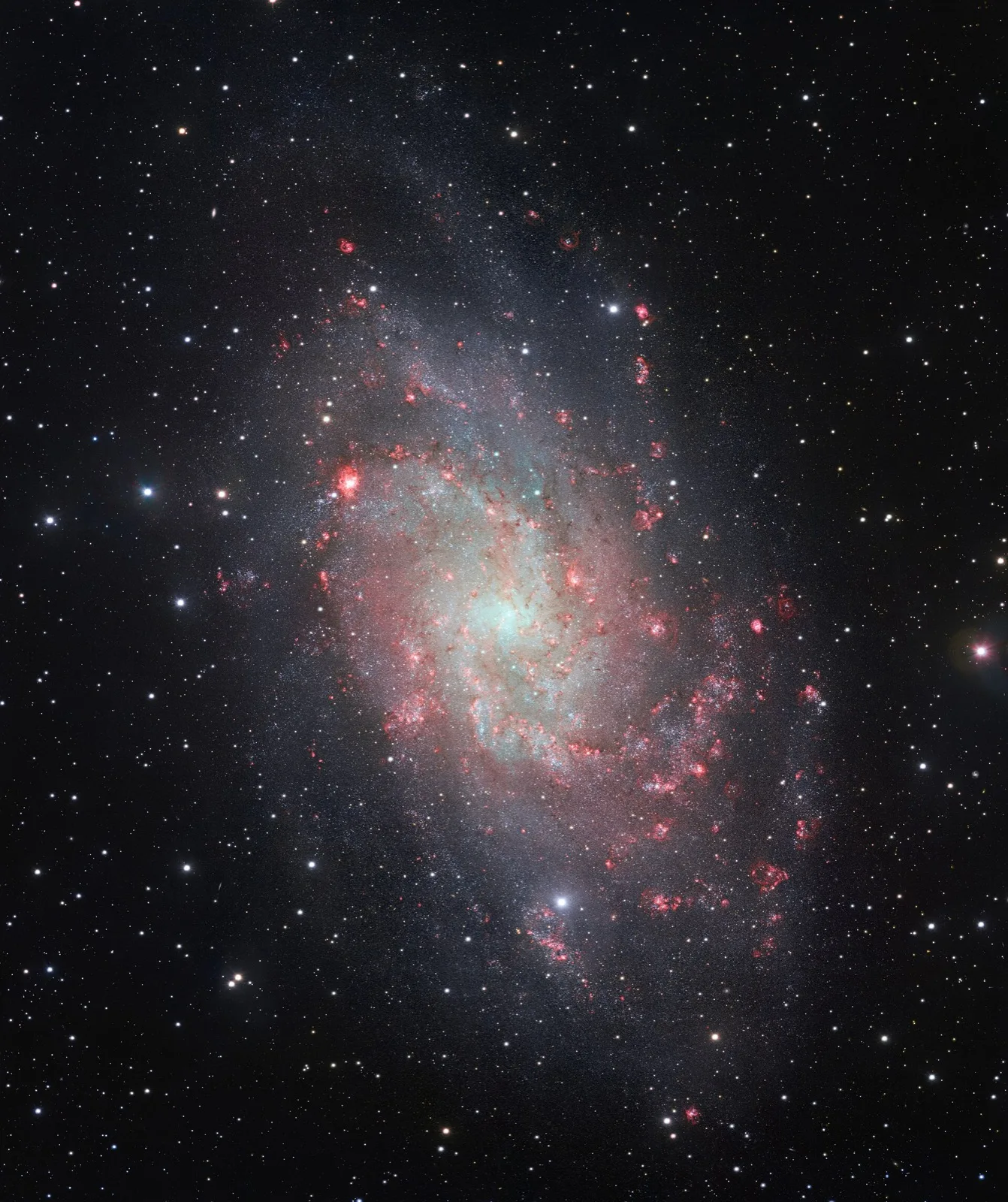 Triangulum GalaxyM33 · galaxy
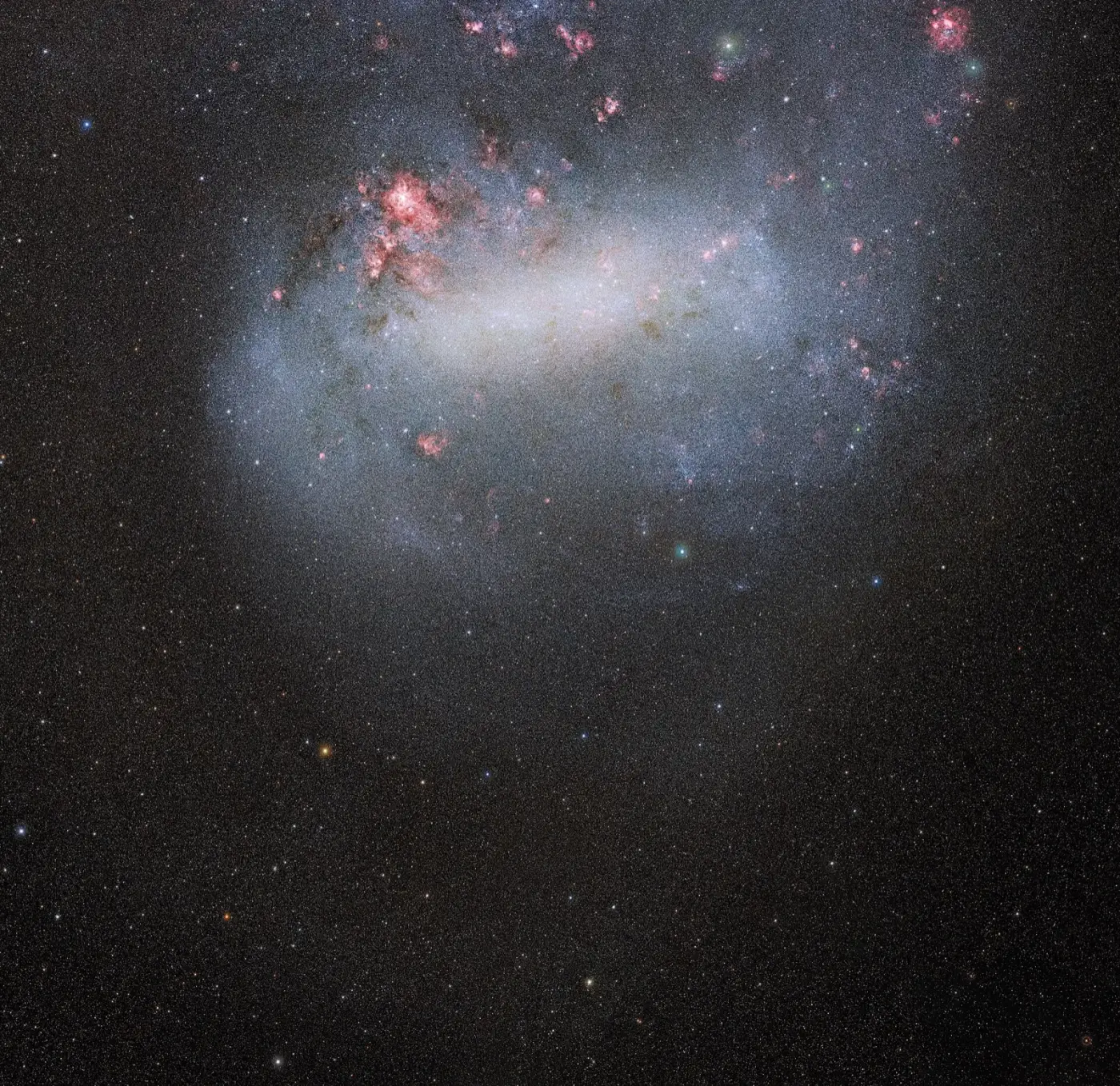 Large Magellanic CloudLMC · galaxy
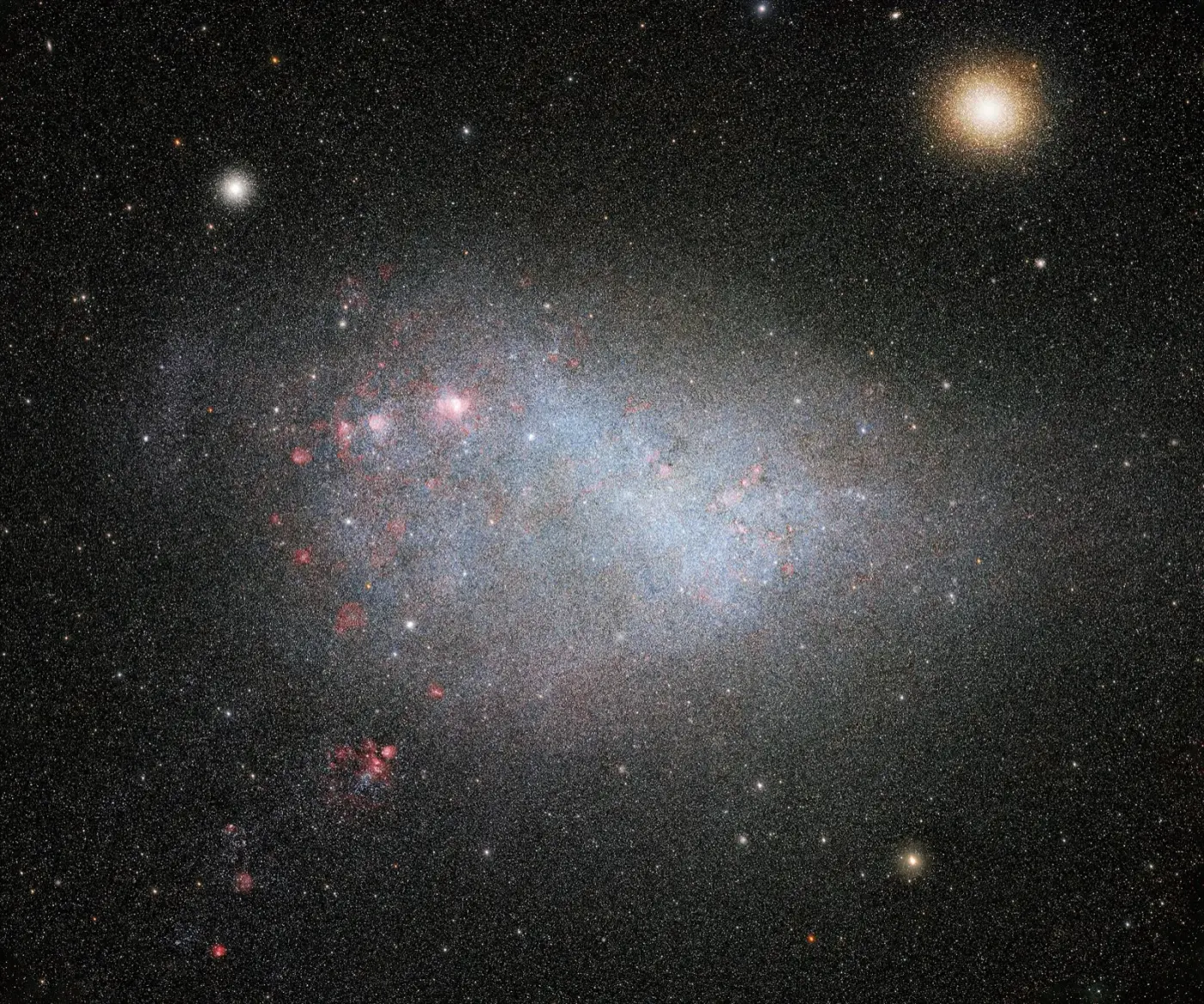 Small Magellanic CloudSMC · galaxy
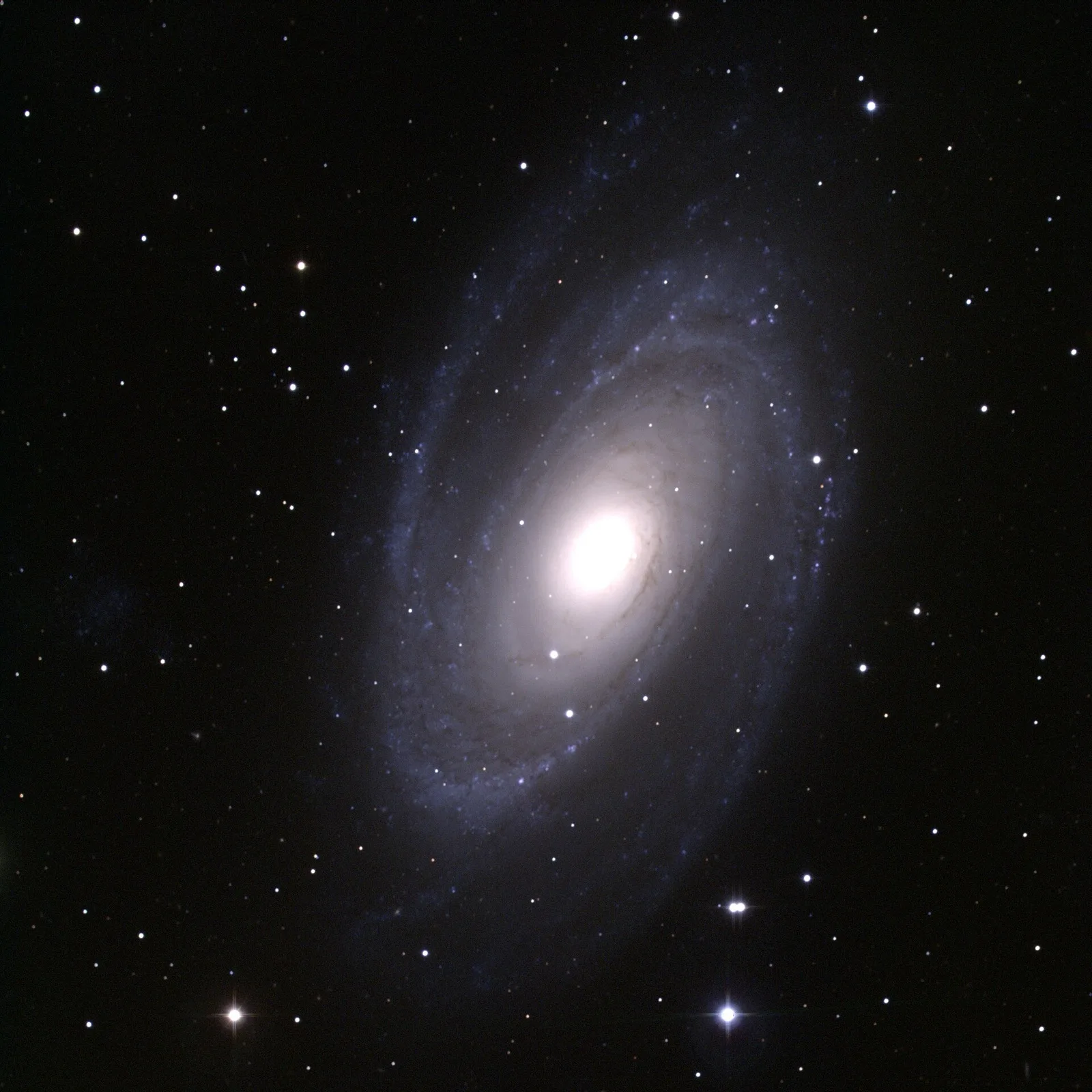 Bode's GalaxyM81 · galaxy
Sources
- en.wikipedia.org
- science.nasa.gov
- esahubble.org
- earthsky.org
- Positions: astronomy-engine (Don Cross).