 SKY
Sky catalog › Galaxies
Bode's Galaxy
M81, NGC 3031 · A galaxy in Ursa Major
What is it?
Bode's Galaxy is a galaxy. A whole island of millions to trillions of stars, far outside our Milky Way.
Why Bode's Galaxy is interesting
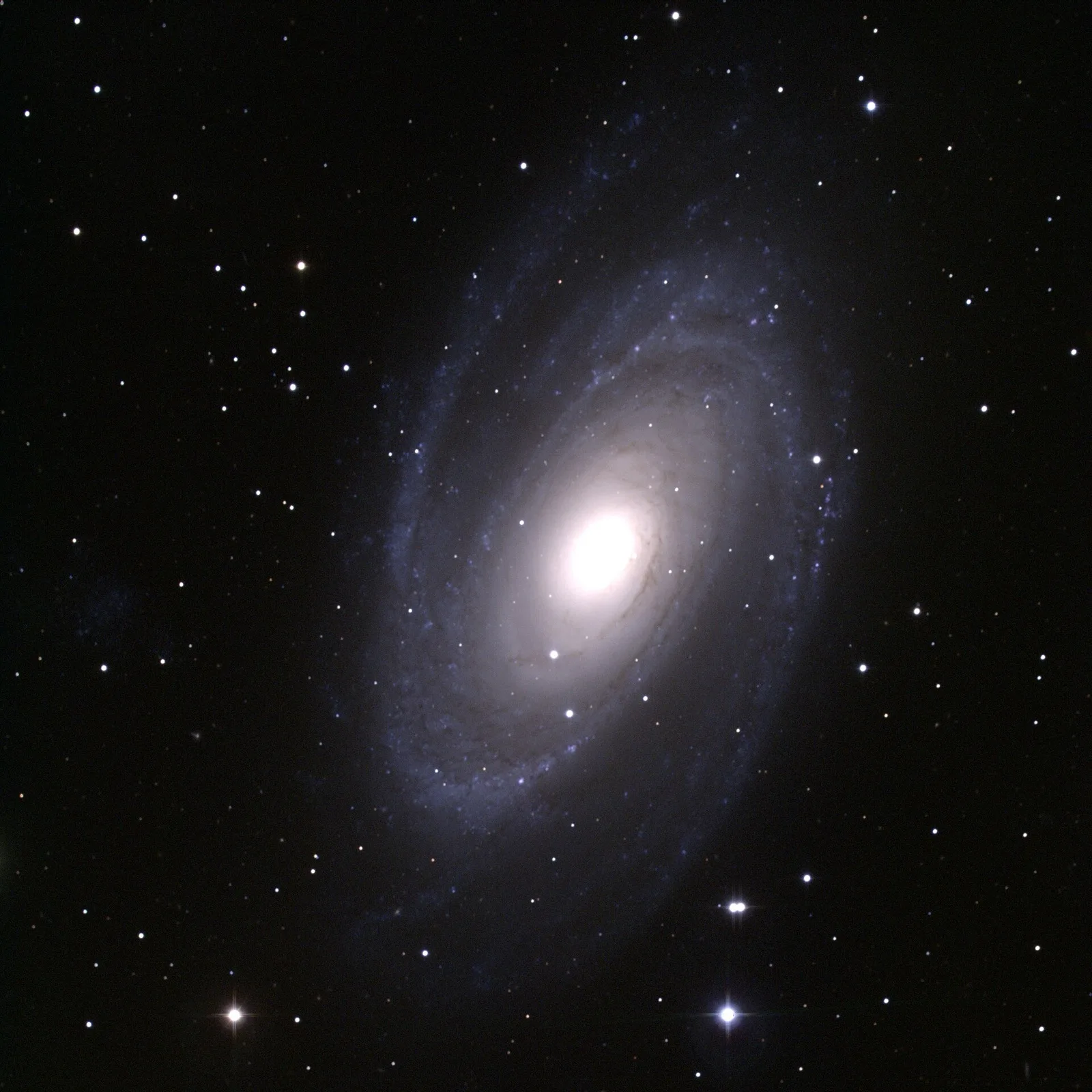
What you see: The bright center is a big bulge of much older, redder stars. The spiral arms hold young, hot bluish stars, and thin dark dust lanes wind into the nucleus. science.nasa.gov
How it formed: Its arms glow with young blue stars born in the past few million years, and they also hold stars from a burst of star formation that began about 600 million years ago. science.nasa.gov
To scale: Bode's Galaxy is about 96,000 light-years across, so light needs about 96,000 years to cross it. en.wikipedia.org
Three things to know
- Bode's Galaxy is one of the brightest galaxies in the night sky.
- A black hole about 70 million times the mass of the Sun sits at its center, about 15 times heavier than the one in our Milky Way.
- In binoculars it shares the view with its neighbor, the Cigar Galaxy (M82).
12 more fun facts
- Bode's Galaxy, the Cigar Galaxy and NGC 3077 have tugged hydrogen gas out of one another, leaving streamers of gas stretched between them. en.wikipedia.org
- Only one supernova has ever been seen in Bode's Galaxy: SN 1993J, found on March 28, 1993 by F. Garcia in Spain. en.wikipedia.org
- In 2022 astronomers reported that a repeating fast radio burst, a brief and powerful radio flash, may come from Bode's Galaxy. en.wikipedia.org
- Hubble shows that the central bulge of Bode's Galaxy, full of older reddish stars, is much bigger than the bulge of our Milky Way. science.nasa.gov
- A second, smaller black hole may circle the central black hole of Bode's Galaxy about once every 30 years. en.wikipedia.org
- The black hole at the center of Bode's Galaxy is actively feeding and shoots out a jet on just one side. en.wikipedia.org
- A whole population of stars in Bode's Galaxy was born in a burst of star formation that began about 600 million years ago. science.nasa.gov
- Bode's Galaxy is about 96,000 light-years across. en.wikipedia.org
- In 1994 astronomers used Cepheid variable stars to measure the distance to Bode's Galaxy at about 11.8 million light-years. en.wikipedia.org
- An estimated 210 globular star clusters, give or take 30, orbit Bode's Galaxy. en.wikipedia.org
- In infrared light most of the glow from Bode's Galaxy comes from dust in its spiral arms, where new stars are forming. en.wikipedia.org
- Young, hot blue stars in the arms of Bode's Galaxy make nearby hydrogen clouds glow with their ultraviolet light. science.nasa.gov
In the game these unlock one by one as you keep photographing Bode's Galaxy.
At a glance
- Type
- Galaxy
- Catalog
- M81, NGC 3031
- Constellation
- Ursa Major
- Distance
- about 11.6 to 12 million light-years
- Brightness
- magnitude 6.94
- Size in our sky
- 26.9 x 14.1 arcminutes
- Discovered
- Johann Elert Bode, December 31, 1774
- Position (J2000)
- RA 9h 56m, Dec +69.1°
Looking back in time
The light in this photo left Bode's Galaxy about 11.6 million years ago, when there were no humans at all: apes lived in the forests of Africa, Europe and Asia.
How to see it yourself
Too faint for most eyes, but binoculars show it from a dark site. A small telescope shows its shape.
Finding it: In the Big Dipper, draw a line from Phecda (the bowl's bottom corner near the handle) through Dubhe (the top corner of the bowl's far end) and extend it the same distance again, to a small right triangle of stars. M81 is a faint blur just southeast of that triangle, with M82 just north of it.
When to look: Best on spring evenings for mid-northern observers; NASA names April as the best month.
What you will see: Usually not visible to the naked eye. In 7x35 binoculars it is a small, dim, but unmistakable oval with a brighter center. A small telescope shows its core, and an 8-inch (20 cm) or larger telescope is needed to see structure.
Easy to confuse with:
- Cigar Galaxy (M82): M82 sits just north and looks like a thin, evenly dim gray splinter, while M81 is a wider oval with a bright center.
Best months: February is when it is highest around midnight. About two months later it is highest in the early evening, at around 8 to 9 PM.
Where on Earth: easy from the Northern Hemisphere. South of latitude 11°S it never climbs more than 10° above the horizon. From 21°N and farther north it never sets.
How it is photographed: long exposures through filters, then the frames are stacked, stretched and combined into color.
Name and story
The name: It is named for German astronomer Johann Elert Bode, who discovered it on December 31, 1774. Pierre Méchain and Charles Messier found it again in 1779 and it became M81; it is also NGC 3031.
Record: Bode's Galaxy is the largest galaxy in the M81 Group, a family of about 34 galaxies about 11.7 million light-years away.
Explored by: Hubble's visible and infrared portrait of Bode's Galaxy shows young blue stars in its arms, glowing hydrogen clouds and dust lanes winding into the nucleus. Close-ups reveal strings of star-forming regions along the arms and several globular clusters near the core.
Test yourself
After every photo of Bode's Galaxy the game asks one of these. A right answer earns sky points for your observatory.
How heavy is the black hole at the center of Bode's Galaxy?
- About 70 million Suns (the answer)
- About 70 trillion Suns
- About 70 Suns
A black hole of 70 million solar masses sits at its center. That is about 15 times the mass of the black hole at the heart of our Milky Way. science.nasa.gov
What was seen in Bode's Galaxy in March 1993?
- A comet hitting its core
- A star exploding (the answer)
- A planet passing a star
F. Garcia in Spain found the supernova SN 1993J on March 28, 1993. It is the only supernova ever seen in this galaxy. en.wikipedia.org
Point a telescope at Bode's Galaxy in the game: capture it in real time, then develop the frames like an astrophotographer.
Point a telescope at Bode's GalaxyLearn more
- Stretching: pulling faint light out of a black frame
Astronomy cameras record light linearly, so a raw galaxy image looks almost black. Here is how a stretch reveals the faint parts, and how too much ruins it.
More galaxies
 Andromeda GalaxyM31 · galaxy
 Triangulum GalaxyM33 · galaxy
 Large Magellanic CloudLMC · galaxy
 Small Magellanic CloudSMC · galaxy
Sources
- en.wikipedia.org
- science.nasa.gov
- astronomy.com
- Positions: astronomy-engine (Don Cross).