 SKY
Sky catalog › Nebulae
Witch's Broom (Western Veil Nebula)
NGC 6960 · A supernova remnant in Cygnus
What is it?
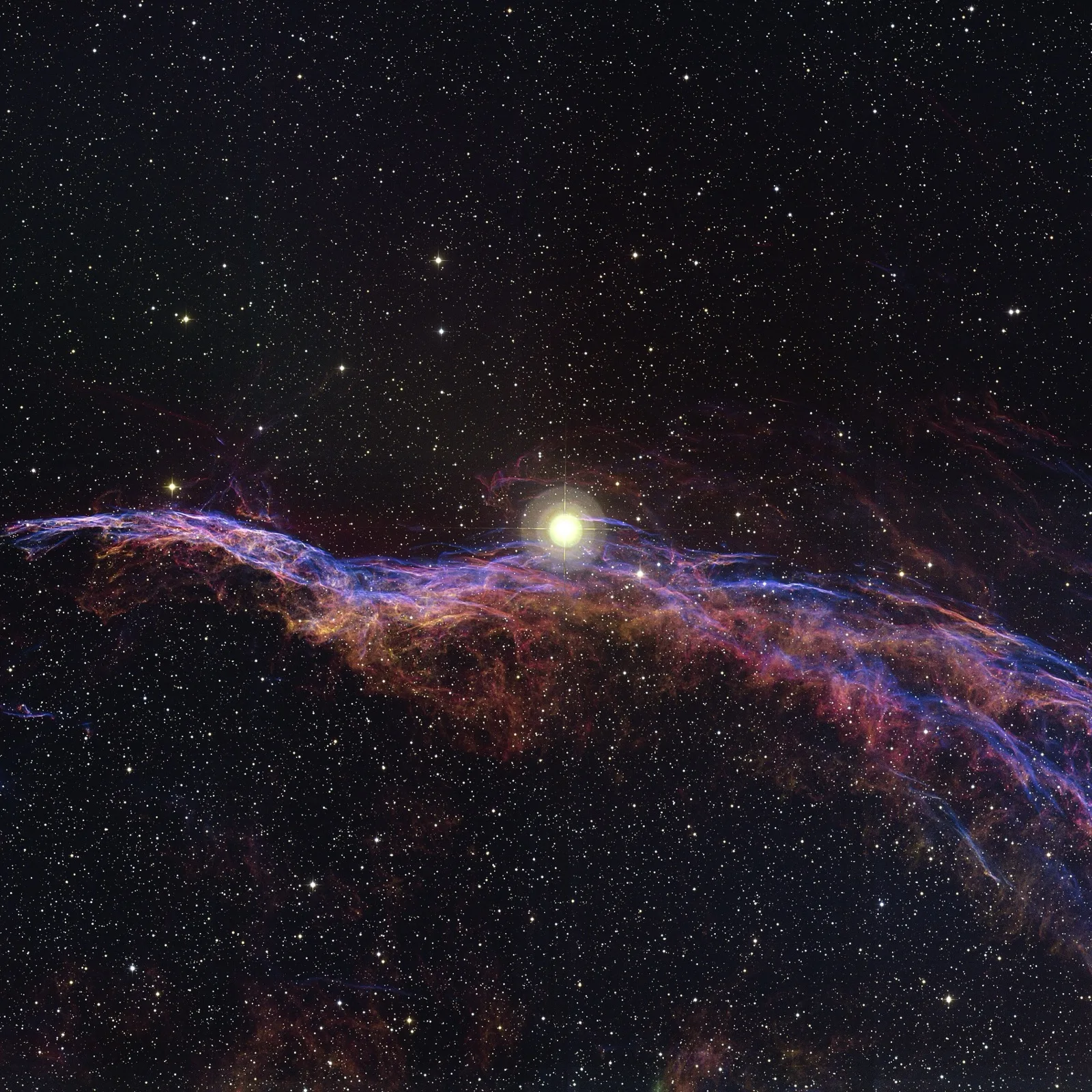
Witch's Broom (Western Veil Nebula) is a supernova remnant. The expanding wreckage of a star that exploded.
Why Witch's Broom (Western Veil Nebula) is interesting
What you see: The thin glowing threads are parts of a thin shell of gas, bright where we see it exactly edge-on. The bright star beside them, 52 Cygni, is much closer to us than the nebula. en.wikipedia.org
How it formed: A star once 20 times as massive as the Sun exploded several thousand years ago. Its blast wave is plowing into a wall of cool, denser gas, and the crash makes the gas emit light. science.nasa.gov
To scale: The whole Veil covers about 3 degrees of sky, about six times the width of the full Moon. en.wikipedia.org
Three things to know
- The Witch's Broom is part of the Veil Nebula, the leftovers of a star about 20 times the mass of the Sun that exploded thousands of years ago. Estimates range from several thousand to about 20,000 years.
- When the star exploded, it would have looked brighter than Venus and been visible in the daytime.
- Its thin glowing threads are shock waves seen edge-on, each about as thick as the distance from Earth to Pluto.
11 more fun facts
- The Witch's Broom runs right past 52 Cygni, a naked-eye star that lies in the foreground, much closer to us than the nebula. en.wikipedia.org
- Hubble compared its 1997 and 2015 pictures of the Witch's Broom and could see the gas filaments move outward over those 18 years. esahubble.org
- The blast wave in the Veil is still plowing through space at almost 1.5 million km/h (about 930,000 miles per hour). esahubble.org
- The whole Veil spans about 3 degrees of sky, around 6 times the width of the full Moon and 36 times its area. en.wikipedia.org
- The section of the Witch's Broom in Hubble's close-up is about 2 light-years across. science.nasa.gov
- NASA compares the Veil to a crumpled bed sheet seen from the side: wherever a ripple is seen edge-on, it looks brighter. science.nasa.gov
- In Hubble's colors, thin red hydrogen threads mark the shock front itself, while fluffier green and red gas was heated earlier and has spread out. esahubble.org
- Williamina Fleming found a fainter part of the Veil on a photograph in 1904, but it was named Pickering's Triangle after her observatory's director. en.wikipedia.org
- The Veil is part of the Cygnus Loop, a strong X-ray source whose hot gas averages about 2.9 million kelvin. en.wikipedia.org
- Distance estimates for the Veil once ranged from 1,200 to 5,800 light-years, until a 2018 measurement settled on about 2,400 light-years. en.wikipedia.org
- Nearly all the Veil's visible light comes from one green-blue color of glowing oxygen, which is why an OIII filter makes it so much easier to see. en.wikipedia.org
In the game these unlock one by one as you keep photographing Witch's Broom (Western Veil Nebula).
At a glance
- Type
- Supernova remnant
- Catalog
- NGC 6960
- Constellation
- Cygnus
- Distance
- about 2,400 light-years (estimates differ; NASA gives about 2,000)
- Brightness
- magnitude 7
- Size in our sky
- one arc of the Veil Nebula, which spans about 3 degrees
- Discovered
- William Herschel, September 5, 1784
- Position (J2000)
- RA 20h 46m, Dec +30.7°
Looking back in time
The light in this photo left Witch's Broom (Western Veil Nebula) about 2,400 years ago, when the Greek and Roman world watched this same sky; Greek thinkers worked out from the round shadow on the Moon during eclipses that the Earth is a ball.
How to see it yourself
Too faint for most eyes, but binoculars show it from a dark site. A small telescope shows its shape.
Finding it: Find Cygnus, the swan, and the star Epsilon Cygni (Gienah) in one of its wings. The Veil lies about 4 degrees south of Epsilon, and the 4th-magnitude star 52 Cygni sits right on the Witch's Broom, making it the easiest part to find.
When to look: Best on early autumn evenings from the Northern Hemisphere, or early spring evenings from the Southern Hemisphere.
What you will see: Not visible to the naked eye, and hard in binoculars even under very dark skies. In a 6-inch telescope at low power it is a faint haze under dark skies. An OIII or UHC filter improves the view greatly, and an 8-inch telescope with an OIII filter shows the lacy filaments seen in photographs.
Easy to confuse with:
- Eastern Veil (NGC 6992): The Eastern Veil is the brighter arc on the opposite side of the loop and has no bright star on it, while the Witch's Broom crosses 52 Cygni.
- Pickering's Triangle: Pickering's Triangle is a fainter, triangle-shaped patch of wisps between the two main arcs, near the loop's north central edge.
Best months: August is when it is highest around midnight. About two months later it is highest in the early evening, at around 8 to 9 PM.
Where on Earth: easy from the Northern Hemisphere. South of latitude 49°S it never climbs more than 10° above the horizon. From 59°N and farther north it never sets.
How it is photographed: long exposures through filters, then the frames are stacked, stretched and combined into color.
Name and story
The name: William Herschel discovered the Veil on September 5, 1784, and NGC 6960 is its western arc. It is nicknamed the Witch's Broom. It is also called the Western Veil and Caldwell 34, and the whole ring of gas is known as the Cygnus Loop.
People and history: In Joe Haldeman's science fiction novel Mindbridge, the Cygnus Loop, which includes the Witch's Broom, is the leftover of the home star of an immortal alien race.
Record: The Cygnus Loop, which includes the Witch's Broom, was the first source in our galaxy where astronomers detected the ultraviolet glow of oxygen that has lost five electrons, spotted by a spectrometer flown on a rocket.
Explored by: Hubble photographed parts of the Veil in 1994 and 1997, then made a six-image mosaic of the Witch's Broom in April 2015. Comparing the images showed the filaments moving over 18 years.
Test yourself
After every photo of Witch's Broom (Western Veil Nebula) the game asks one of these. A right answer earns sky points for your observatory.
Why do the threads of the Witch's Broom look so thin and bright?
- They are bolts of space lightning
- We see a rippled gas shell edge-on (the answer)
- They are rows of newborn stars
NASA compares the Veil to a crumpled bed sheet seen from the side: wherever a ripple lines up edge-on with us, and the shock meets denser gas, it looks like a bright thread. science.nasa.gov
What did Hubble see by comparing its 1997 and 2015 photos?
- The whole nebula faded from view
- The gas threads moved outward (the answer)
- A new star was born inside it
The blast wave is still moving at almost 1.5 million km/h (about 930,000 mph), so in 18 years Hubble could measure how far the nebula had spread. esahubble.org
Point a telescope at Witch's Broom (Western Veil Nebula) in the game: capture it in real time, then develop the frames like an astrophotographer.
Point a telescope at Witch's Broom (Western Veil Nebula)More nebulae
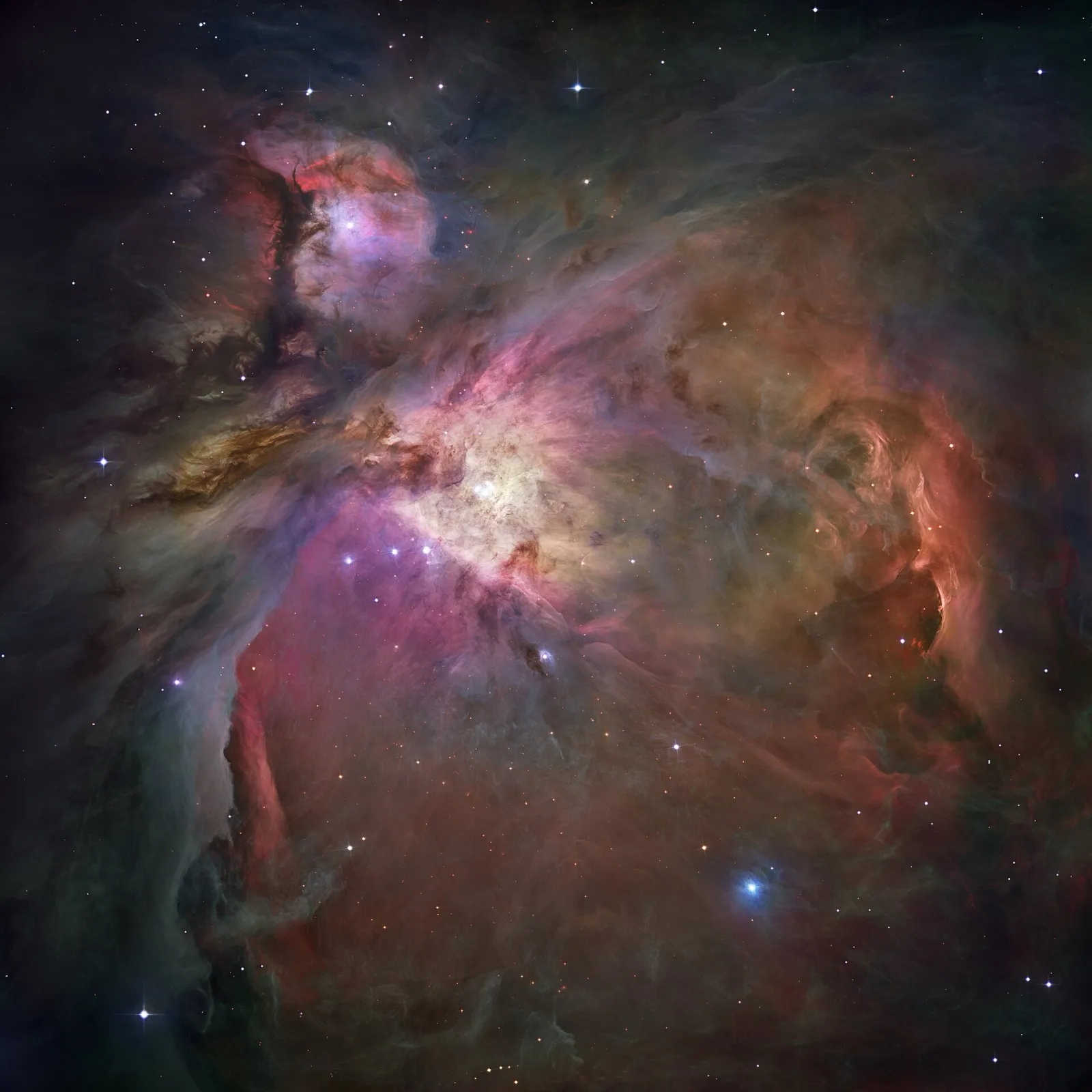 Orion NebulaM42 · star-forming nebula
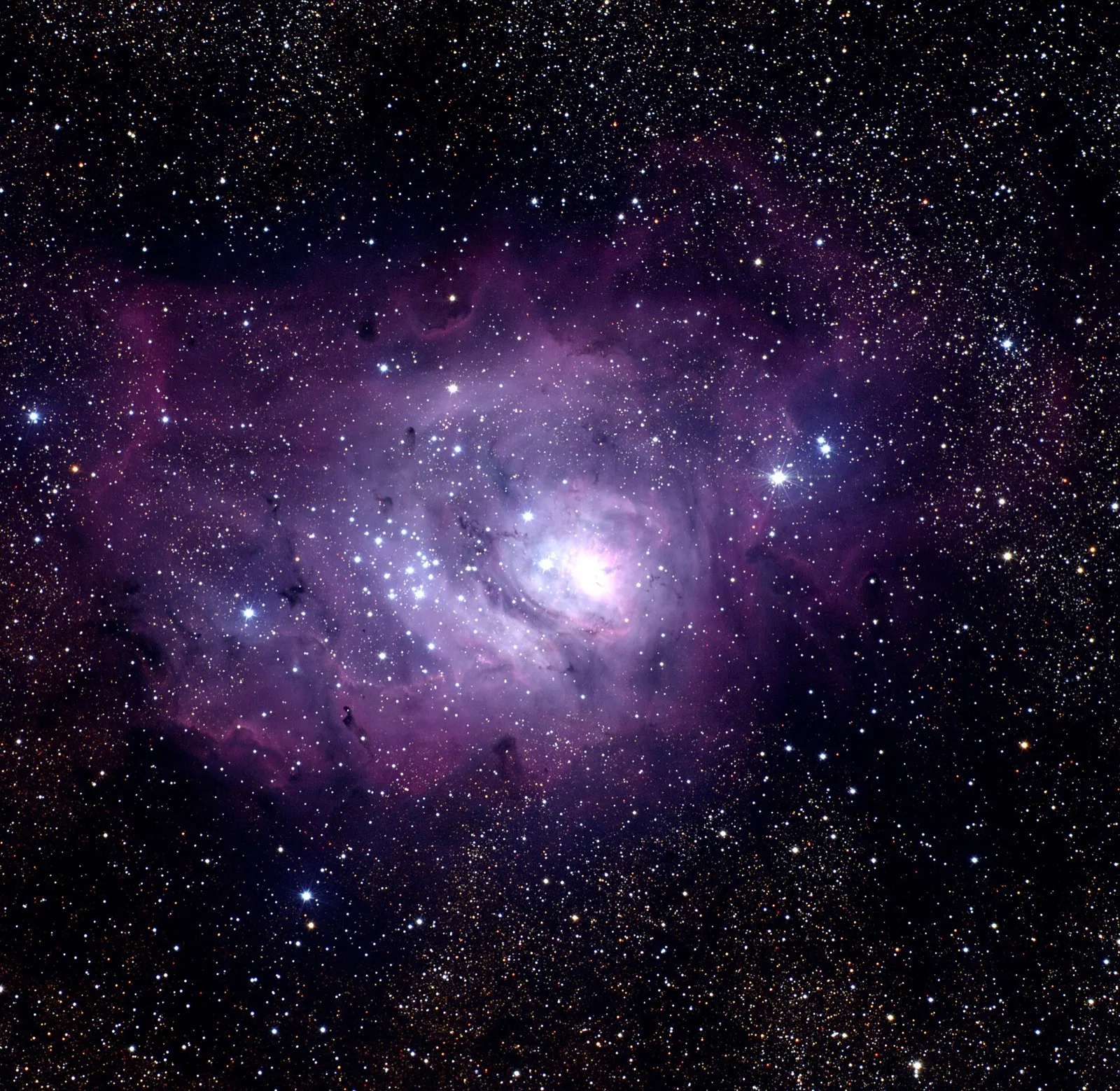 Lagoon NebulaM8 · star-forming nebula
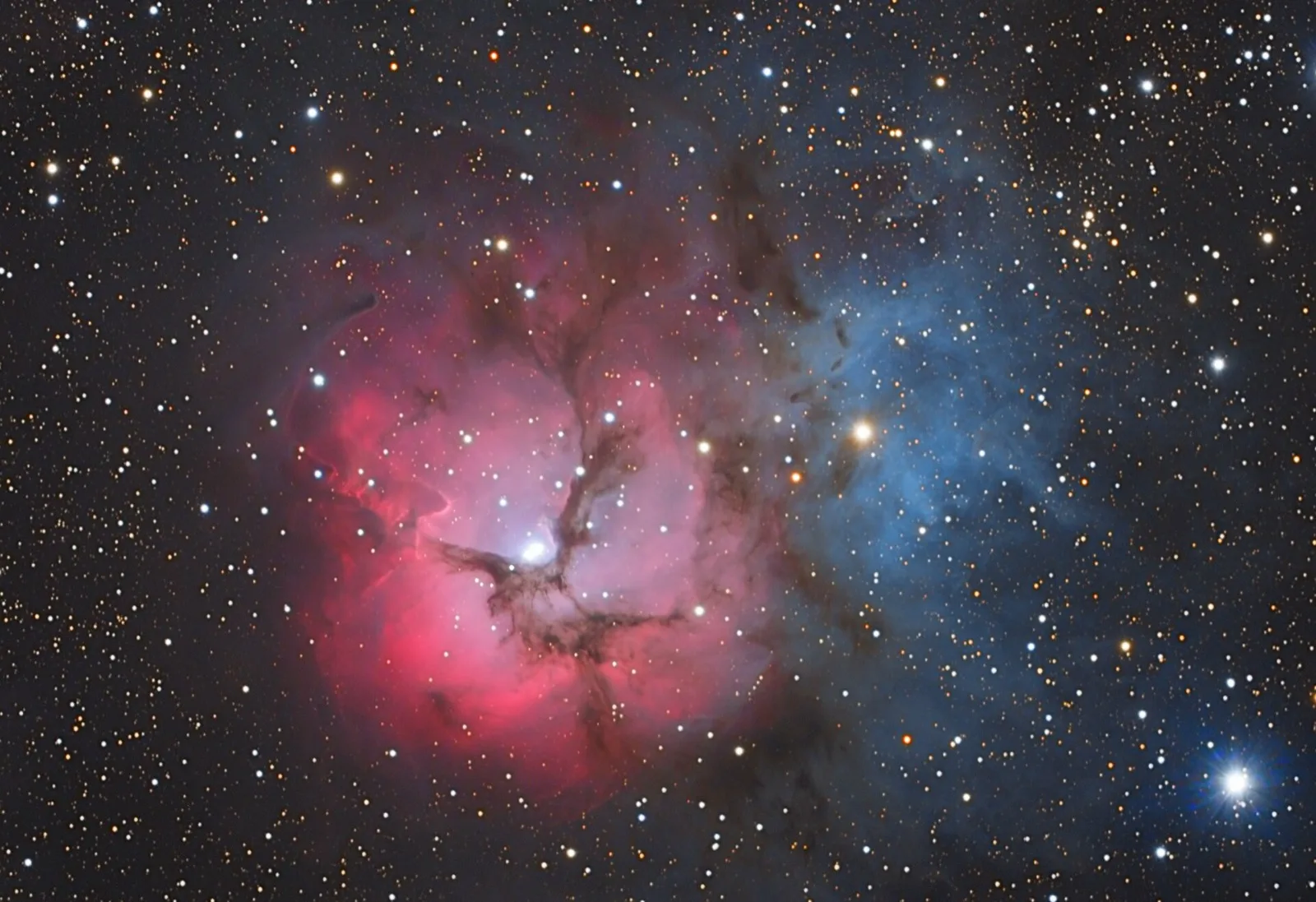 Trifid NebulaM20 · star-forming nebula
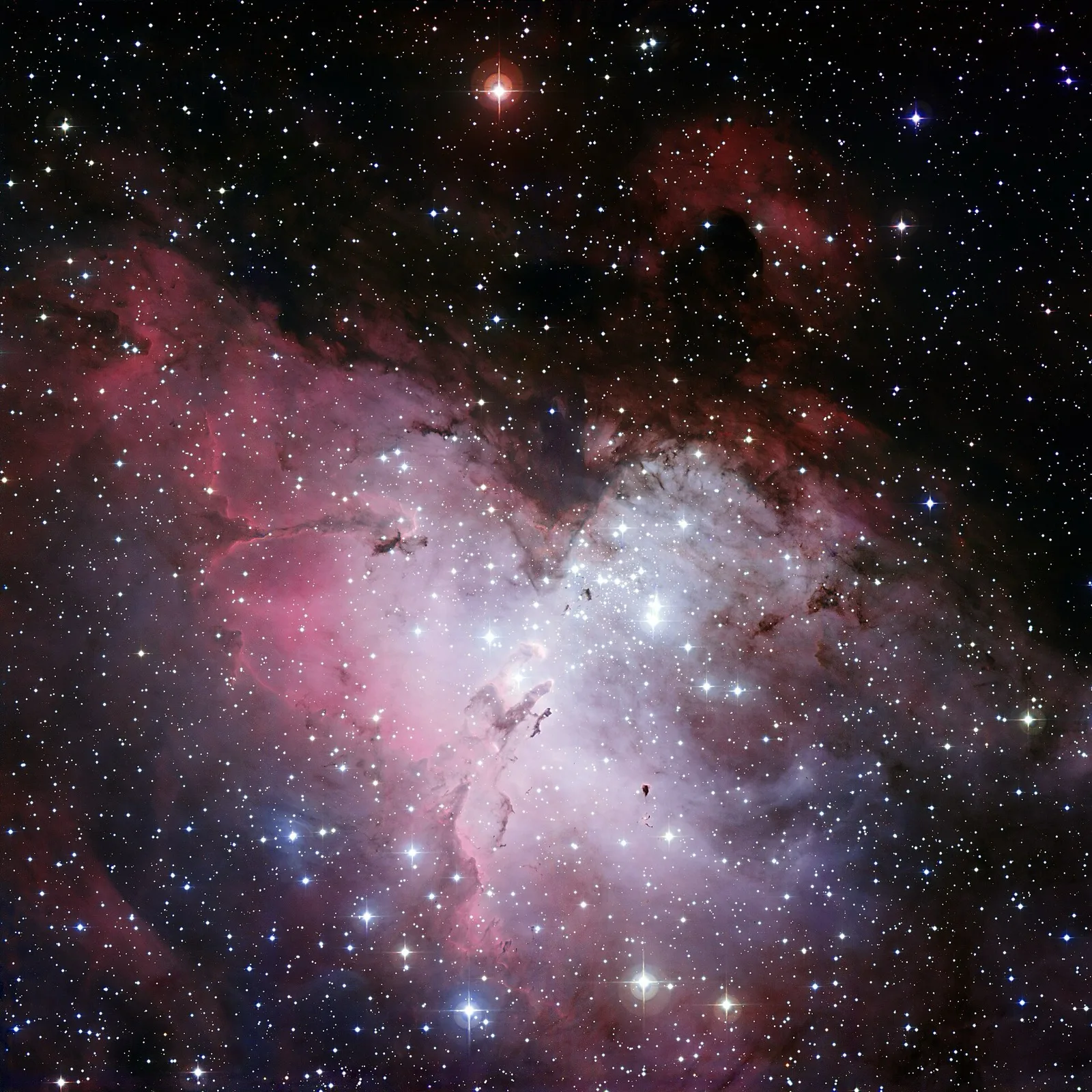 Eagle NebulaM16 · star-forming nebula
Sources
- en.wikipedia.org
- science.nasa.gov
- esahubble.org
- en.wikipedia.org
- observing.skyhound.com
- Positions: astronomy-engine (Don Cross).