 SKY
Sky catalog › Nebulae
Cat's Eye Nebula
NGC 6543 · A planetary nebula in Draco
What is it?
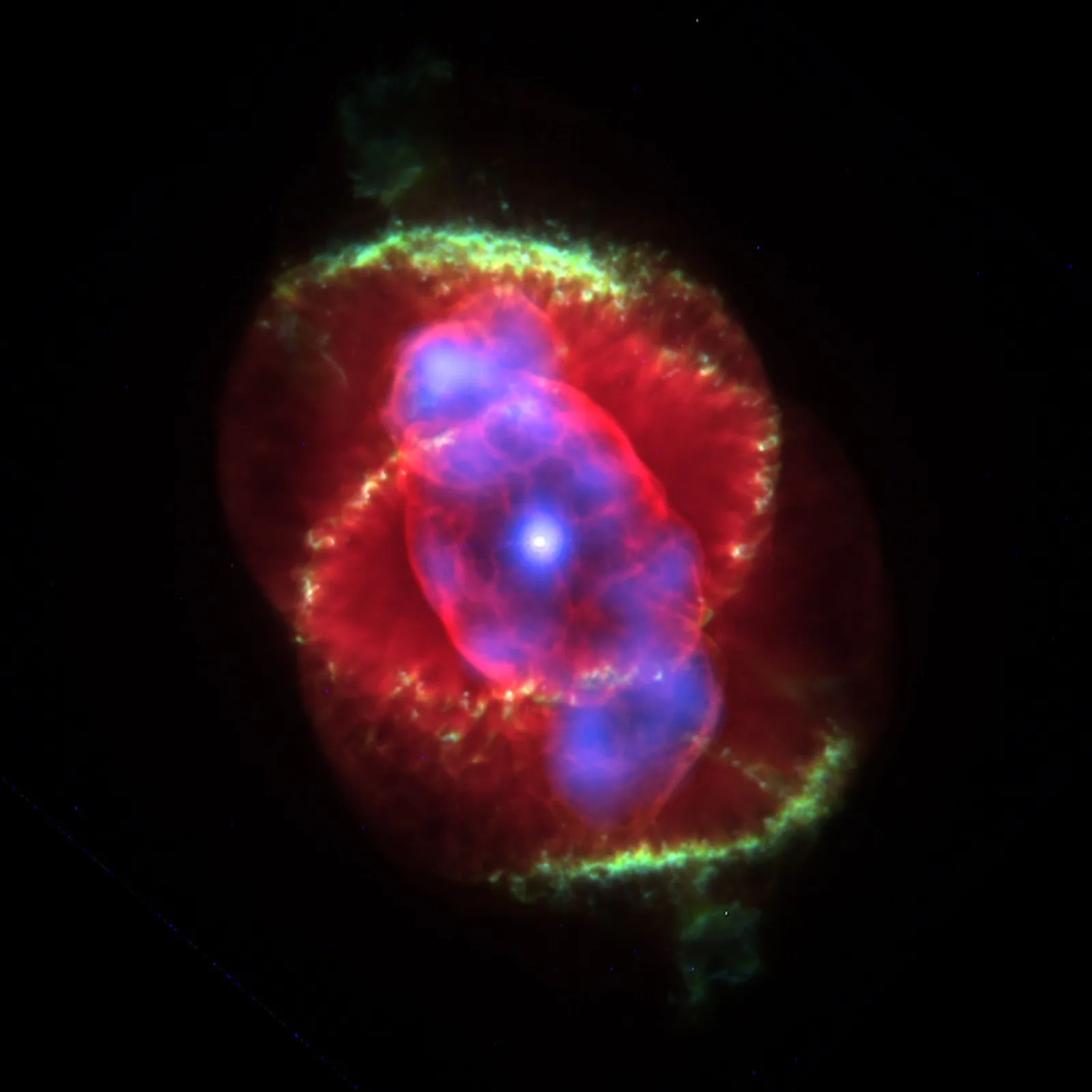
Cat's Eye Nebula is a planetary nebula. A shell of gas puffed off by a dying Sun-like star. It has nothing to do with planets: early telescopes made it look like a small planet disk.
Why Cat's Eye Nebula is interesting
What you see: The bright eye is shells, knots and jets of gas thrown off by a dying star. Around it lies a very faint halo, about 15 times wider than the bright core. en.wikipedia.org
How it formed: The dying star puffed off eleven or more shells, in pulses roughly every 1,500 years. About 1,000 years ago it changed how it shed gas, and the bright inner eye began to form. esahubble.org
To scale: Each dusty shell around the Cat's Eye holds about as much mass as all the planets of our Solar System put together. esahubble.org
Three things to know
- Hubble images show the Cat's Eye has knots, jets, bubbles and a series of rings around its dying central star.
- In 1864 William Huggins studied its light with a spectroscope and showed that planetary nebulae are made of glowing gas, not stars.
- It sits very close to the north pole of the ecliptic, the spot in the sky that the celestial north pole slowly circles over many thousands of years.
12 more fun facts
- The Cat's Eye has eleven or more shells around it, puffed off by the dying star in pulses roughly every 1,500 years. esahubble.org
- Each dusty shell around the Cat's Eye holds about as much mass as all the planets in our Solar System put together, but only about 1 percent of the Sun's mass. esahubble.org
- About 1,000 years ago the star changed how it was shedding gas, and the bright inner Cat's Eye began forming inside the older dusty shells. esahubble.org
- Chandra X-ray images show multi-million-degree gas around the central star, driven by a stellar wind blowing outward at about 4 million miles per hour. chandra.harvard.edu
- The central star has a surface of about 80,000 kelvin and shines about 10,000 times as brightly as the Sun. en.wikipedia.org
- The central star is throwing off about a tenth of Earth's mass every year in its fierce wind. en.wikipedia.org
- The star probably started life with about 5 times the Sun's mass and today has a little over 1 Sun's worth left. en.wikipedia.org
- Cold dust around the Cat's Eye sits at about 85 kelvin, roughly minus 307 degrees Fahrenheit. en.wikipedia.org
- A very faint halo surrounds the Cat's Eye, about 15 times wider on the sky than its bright core. en.wikipedia.org
- Hubble first revealed the Cat's Eye's tangled inner structures in 1994. esahubble.org
- After studying many planetary nebulae, astronomers found rings like the Cat's Eye's around at least one third of them, so these rings seem to be common. esahubble.org
- The Cat's Eye is only about 1,000 years old by one estimate based on how fast it is expanding, and astronomers think that is an upper limit. en.wikipedia.org
In the game these unlock one by one as you keep photographing Cat's Eye Nebula.
At a glance
- Type
- Planetary nebula
- Catalog
- NGC 6543
- Constellation
- Draco
- Distance
- about 3,300 light-years (estimates differ by up to about 900 light-years)
- Brightness
- magnitude 8.1
- Size in our sky
- bright core about 20 arcseconds; faint halo about 5 arcminutes
- Discovered
- William Herschel, February 15, 1786
- Position (J2000)
- RA 17h 59m, Dec +66.6°
Looking back in time
The light in this photo left Cat's Eye Nebula about 3,300 years ago, when Egypt was ruled by pharaohs (Ramesses II reigned about 3,250 years ago).
How to see it yourself
Needs a telescope and a dark sky. Photos show far more than the eye can see.
Finding it: It is in Draco, the dragon, high in the northern sky. Look about halfway between the stars Delta and Zeta Draconis, about 5 degrees east-northeast of Zeta.
When to look: Best in summer from the Northern Hemisphere, June through August. It is so far north that it never sets from latitudes above about 24 degrees north.
What you will see: Not visible to the naked eye. A small telescope shows a tiny, bright, bluish-green oval that takes high magnification well, and the central star is fairly easy to see. At 200x or more in larger telescopes, hints of its intricate shape may appear.
Easy to confuse with:
- A star: At low power it looks like a slightly blurry blue-green star, but at high power it shows a small oval disk that a real star never shows.
Best months: June is when it is highest around midnight. About two months later it is highest in the early evening, at around 8 to 9 PM.
Where on Earth: easy from the Northern Hemisphere. South of latitude 13°S it never climbs more than 10° above the horizon. From 23°N and farther north it never sets.
How it is photographed: long exposures through filters, then the frames are stacked, stretched and combined into color.
Name and story
The name: William Herschel discovered it on February 15, 1786. It is also known as NGC 6543 and Caldwell 6, and it has sometimes been called the Snail Nebula or the Sunflower Nebula.
Record: The Cat's Eye has one of the highest surface brightnesses of any object in the Caldwell catalog, so its light is packed into a small, bright disk that is easy to pick up in a telescope despite its tiny size.
Explored by: Hubble photographed the Cat's Eye in 1994 with its Wide Field and Planetary Camera 2 and again in 2002 with its Advanced Camera for Surveys, which revealed concentric shells, fast jets of gas and shock-made knots.
Test yourself
After every photo of Cat's Eye Nebula the game asks one of these. A right answer earns sky points for your observatory.
How hot is the surface of the Cat's Eye's central star?
- About 8,000 kelvin
- About 80,000 kelvin (the answer)
- About 800 kelvin
It is the bare, hot core of a dying star, and it shines about 10,000 times as brightly as the Sun. en.wikipedia.org
What did William Huggins learn by splitting the Cat's Eye's light in 1864?
- They are far-off galaxies
- Planetary nebulae are glowing gas (the answer)
- They are crowds of faint stars
His spectroscope showed only a few bright lines instead of a smooth spread of colors, which proved the nebula was made of gas, not stars. en.wikipedia.org
Point a telescope at Cat's Eye Nebula in the game: capture it in real time, then develop the frames like an astrophotographer.
Point a telescope at Cat's Eye NebulaMore nebulae
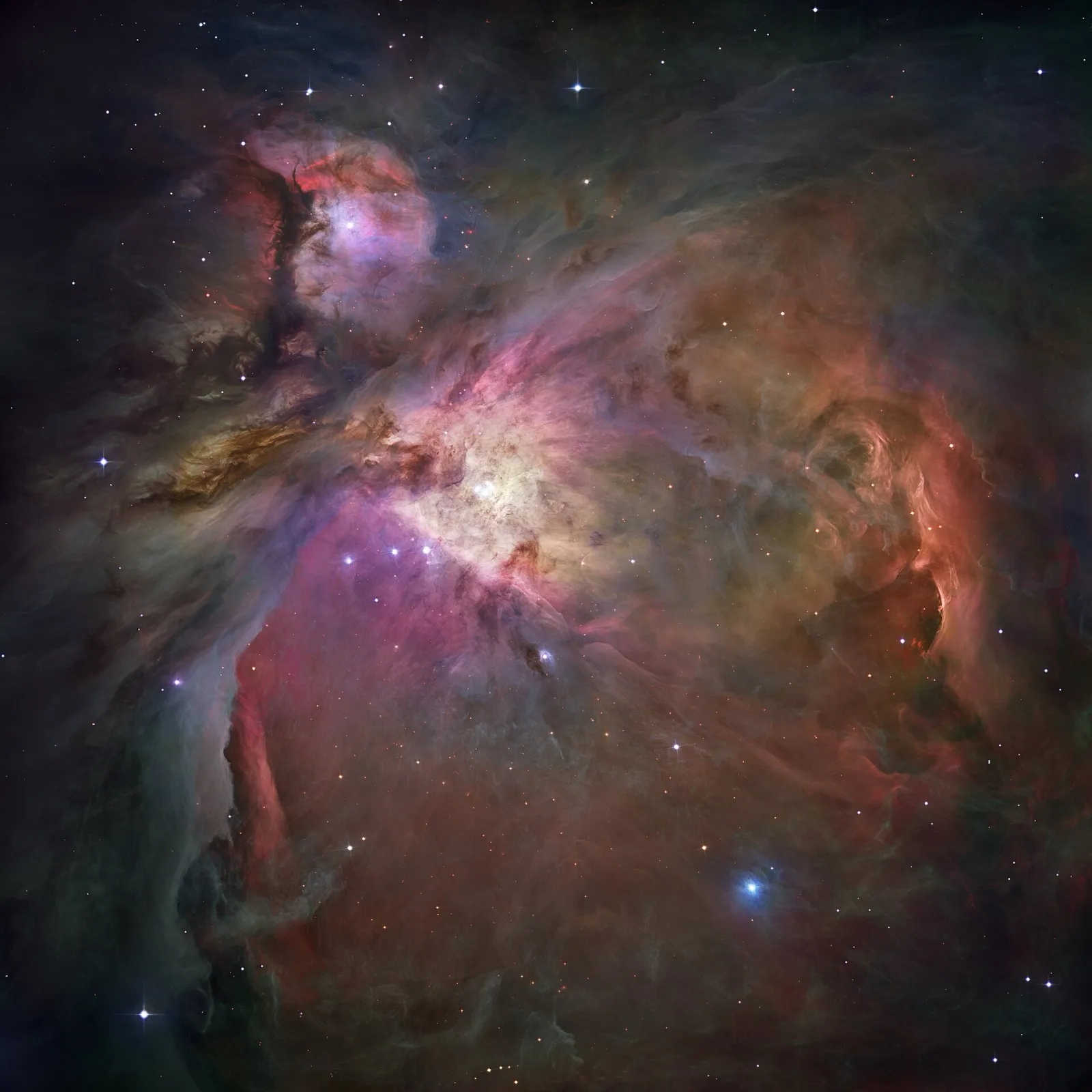 Orion NebulaM42 · star-forming nebula
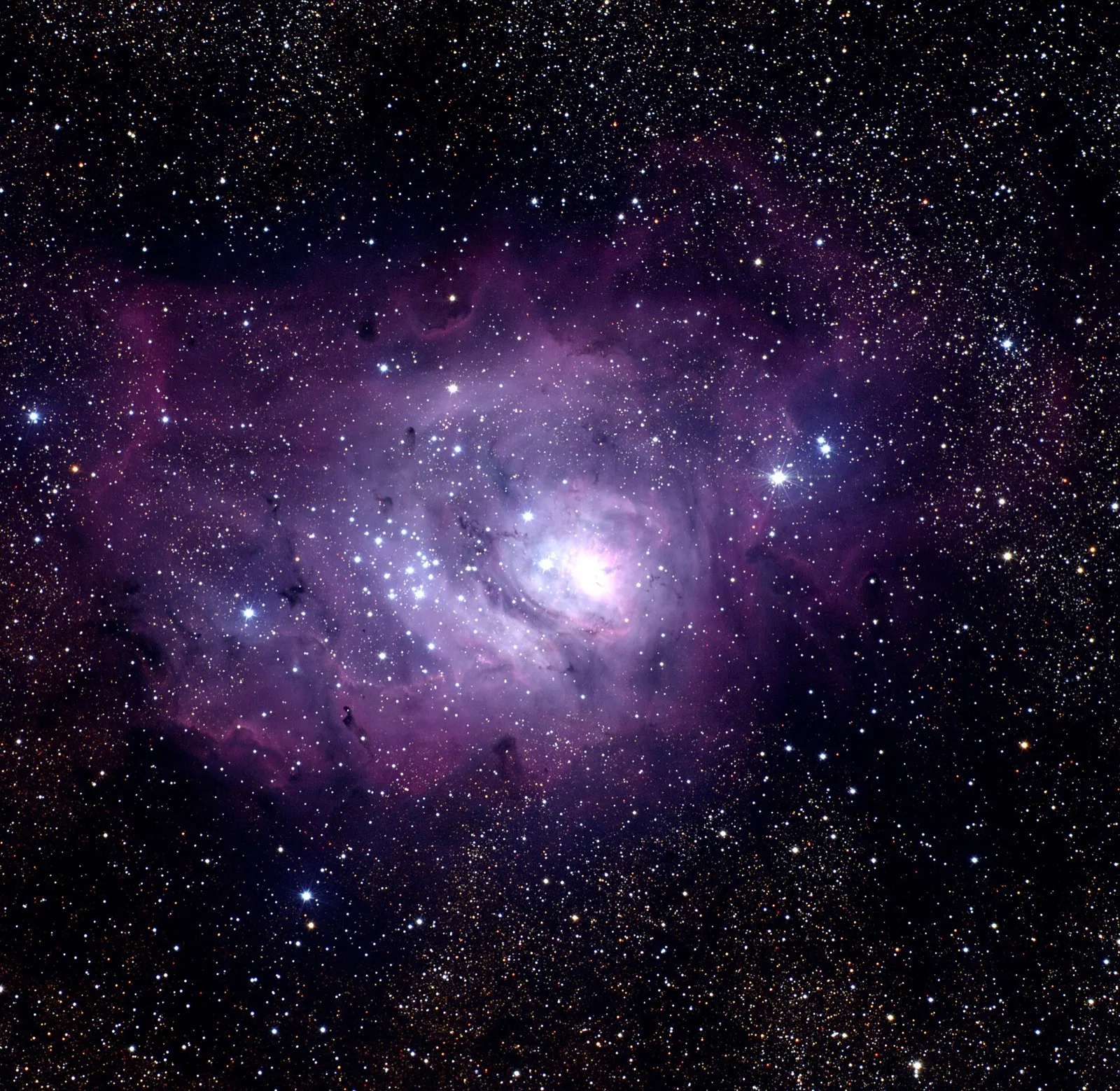 Lagoon NebulaM8 · star-forming nebula
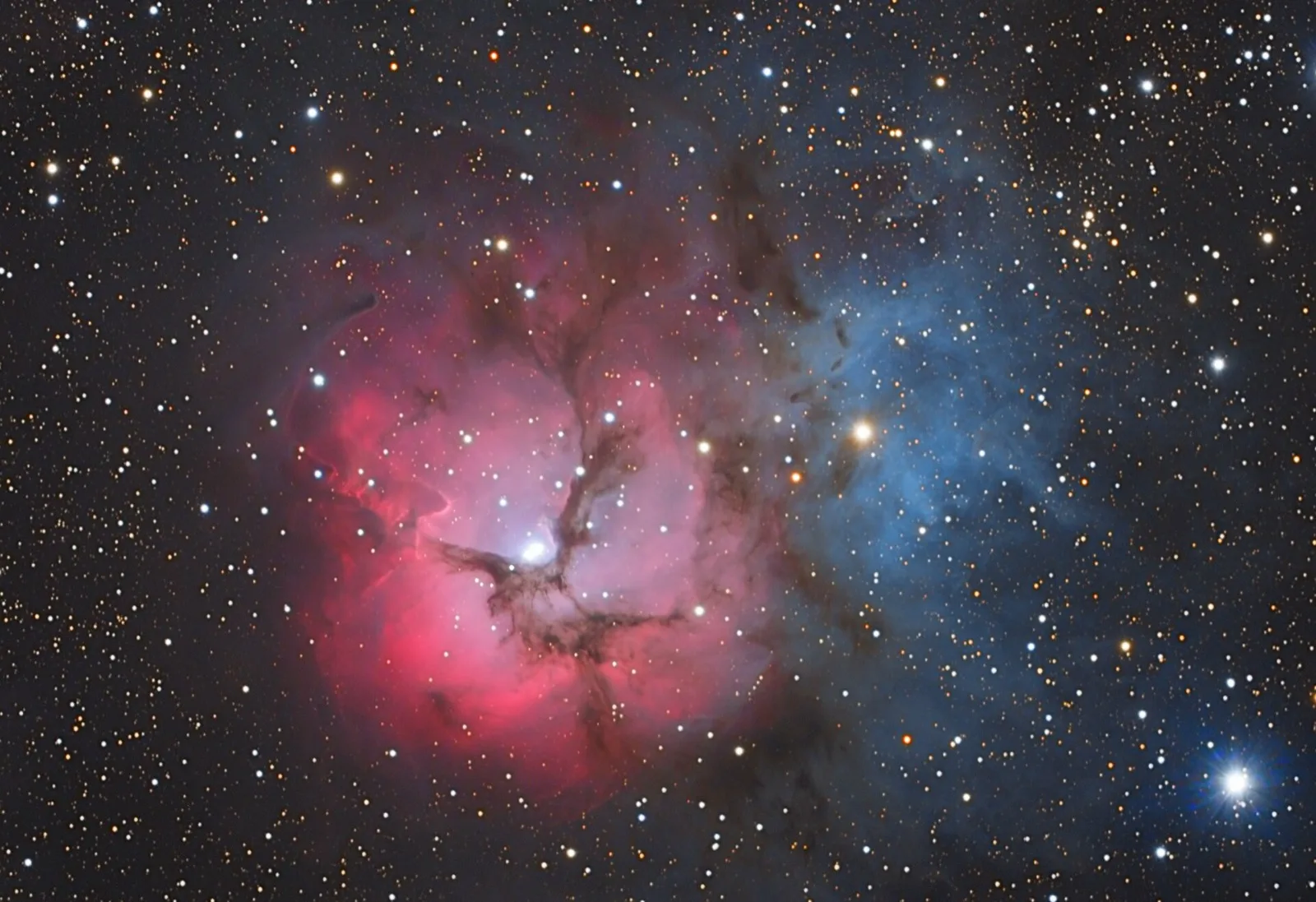 Trifid NebulaM20 · star-forming nebula
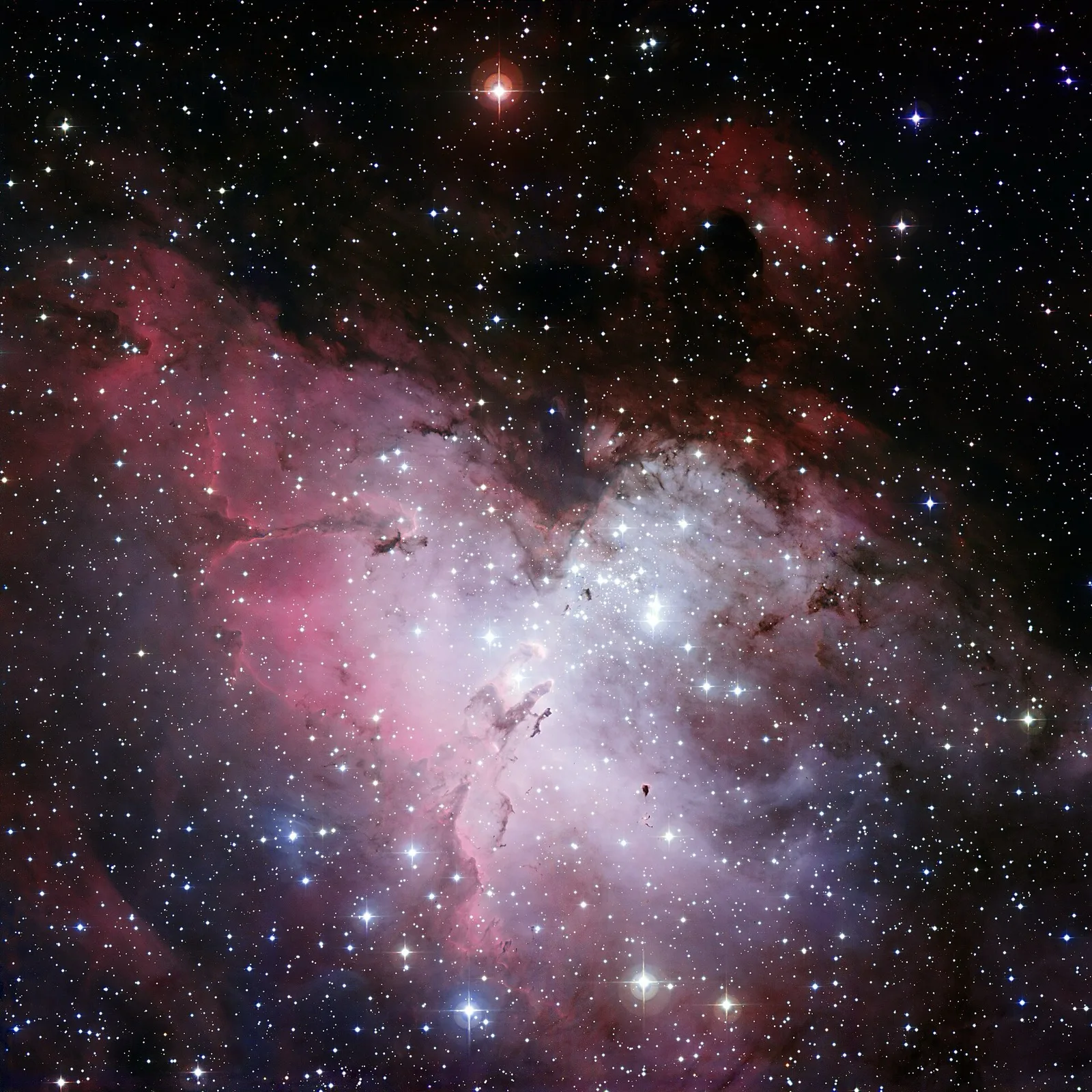 Eagle NebulaM16 · star-forming nebula
Sources
- en.wikipedia.org
- science.nasa.gov
- esahubble.org
- chandra.harvard.edu
- astronomy.com
- astronomynow.com
- Positions: astronomy-engine (Don Cross).