 SKY
Sky catalog › Star clusters
Omega Centauri
NGC 5139 · A globular cluster in Centaurus
What is it?
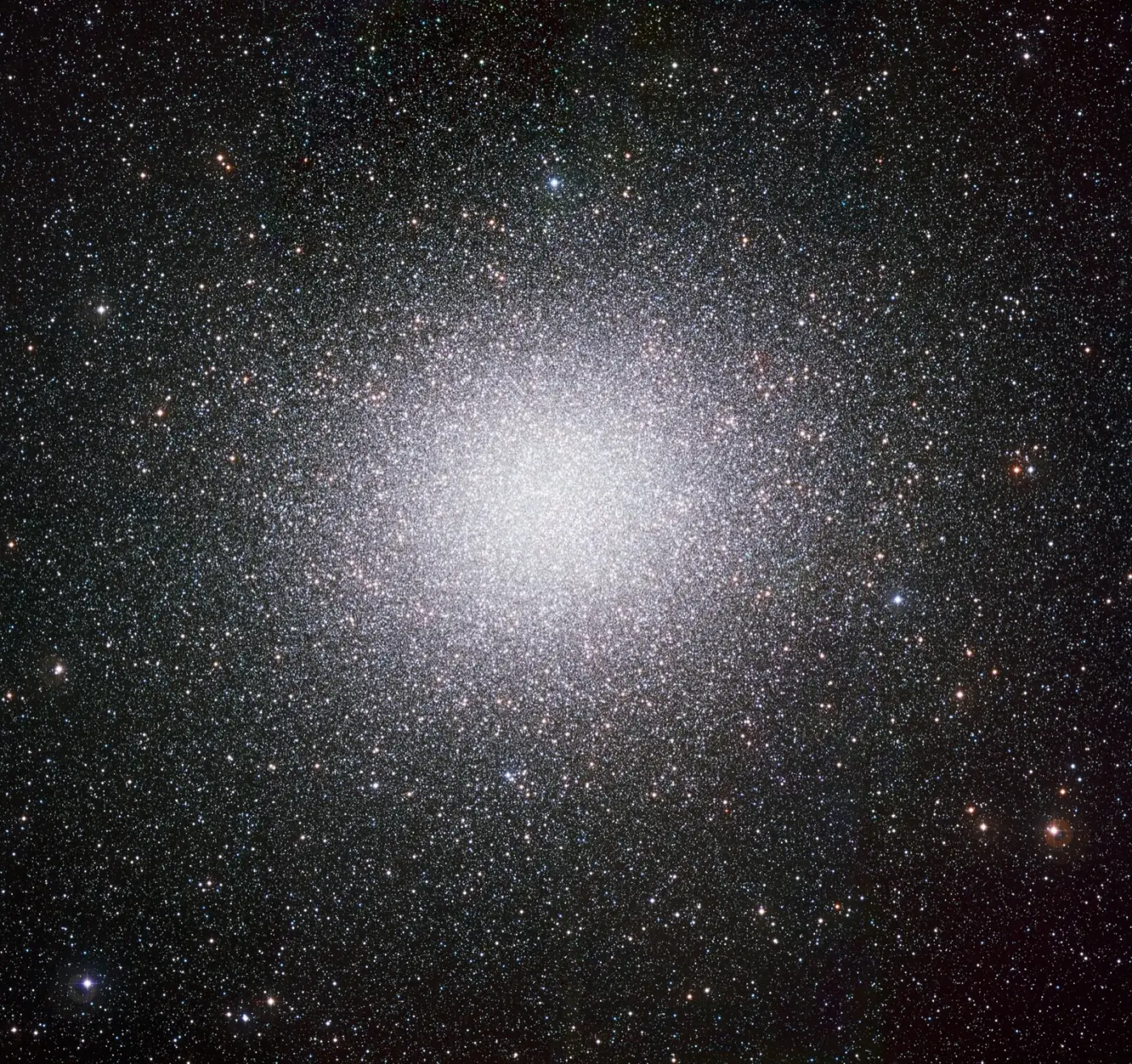
Omega Centauri is a globular cluster. A tight ball of hundreds of thousands of very old stars.
Why Omega Centauri is interesting
What you see: Each speck is a star, and the bright middle is where about 10 million of them crowd together. Deep in the core, neighboring stars are only about 0.1 light-year apart. en.wikipedia.org
How it formed: Its stars differ in age and chemical makeup, so it did not form all at once. Astronomers think it is the leftover core of a small galaxy that the Milky Way pulled apart. en.wikipedia.org
To scale: From a dark country site, Omega Centauri looks almost as wide as the full Moon in the sky. esahubble.org
Three things to know
- Omega Centauri holds about 10 million stars, the biggest star ball that circles our Milky Way.
- It looks so much like a single star to the eye that Ptolemy listed it as a star, which is why it has a star name.
- It may be the leftover heart of a small galaxy that the Milky Way pulled apart.
12 more fun facts
- In 2024, astronomers using more than 500 Hubble images taken over two decades found seven stars near the center moving so fast that a black hole of at least 8,200 Suns seems needed to hold them. science.nasa.gov
- Omega Centauri's likely black hole is about 17,700 light-years away, closer to us than the giant black hole at the center of the Milky Way, about 26,000 light-years away. science.nasa.gov
- For the black hole study, astronomers measured the motions of 1.4 million stars in Omega Centauri, the largest catalog of its kind for any star cluster. esahubble.org
- From a dark country site, Omega Centauri looks almost as wide as the full Moon. esahubble.org
- Omega Centauri is about 10 times as massive as other large globular clusters, almost as massive as a small galaxy. esahubble.org
- It spins faster than a typical globular cluster and is noticeably flattened rather than perfectly round. esahubble.org
- Kapteyn's Star, a small star only about 13 light-years from the Sun, is thought to have come from Omega Centauri. en.wikipedia.org
- Deep in its core, neighboring stars are only about 0.1 light-year apart on average. en.wikipedia.org
- Its stars do not all share the same age and chemical makeup, which suggests the cluster did not form all at once. en.wikipedia.org
- Among all the globular clusters in our Local Group of galaxies, only Mayall II in the Andromeda Galaxy is brighter and more massive than Omega Centauri. en.wikipedia.org
- Astronomers argued about its center for years: a 2008 study suggested a black hole of about 40,000 Suns, while later work said any black hole could be no heavier than 12,000. en.wikipedia.org
- ESO's VLT Survey Telescope caught about 300,000 of its stars in a single image, taken with the 268-megapixel OmegaCAM camera. eso.org
In the game these unlock one by one as you keep photographing Omega Centauri.
At a glance
- Type
- Globular cluster
- Catalog
- NGC 5139
- Constellation
- Centaurus
- Distance
- about 15,800 to 17,100 light-years
- Brightness
- magnitude 3.9
- Size in our sky
- about 36 arcminutes
- Discovered
- Listed as a star by Ptolemy around 150 AD; Edmond Halley saw it was not a star in 1677
- Position (J2000)
- RA 13h 27m, Dec -47.5°
Looking back in time
The light in this photo left Omega Centauri 15,800 to 17,100 years ago, when the Earth was in the last Ice Age: mammoths roamed and people painted caves by firelight.
How to see it yourself
Visible to the naked eye from a dark site. Binoculars show it well, and a small telescope shows more detail.
Finding it: Follow the arc of the Big Dipper's handle to Arcturus, then continue to Spica in Virgo. Omega Centauri crosses due south about 35 degrees below Spica, roughly three and a half fists held at arm's length.
When to look: Best on evenings from late April through June. Around mid-May it is highest due south around 11 p.m. local time, and by mid-June around 10 p.m. It can be seen only from about 40 degrees north latitude or farther south, which includes the southern half of the US.
What you will see: To the naked eye it looks like a faint, fuzzy star, and from a dark rural site it appears almost as wide as the full Moon. Even a small telescope shows a glittering ball of stars that grows very dense toward the center.
Best months: April is when it is highest around midnight. About two months later it is highest in the early evening, at around 8 to 9 PM.
Where on Earth: best from the Southern Hemisphere. North of latitude 33°N it never climbs more than 10° above the horizon. South of 43°S it never sets.
How it is photographed: long exposures through filters, then the frames are stacked, stretched and combined into color.
Name and story
The name: Ptolemy listed it as a single star around 150 AD, and in 1603 Johann Bayer gave it the Greek letter omega in his star atlas Uranometria, as if it were a star. That is why a giant star cluster still carries a star's name. Lacaille later put it in his 1755 list of nebulae.
People and history: In his Almagest, written around 150 AD, Ptolemy placed it as a star on the back of the centaur. Edmond Halley observed it in 1677 from the island of Saint Helena and in 1716 published it among six "luminous spots or patches" in the sky.
Record: Omega Centauri is the largest, most massive and brightest known globular cluster in the Milky Way, with about 10 million stars and roughly 4 million times the mass of the Sun.
Explored by: Hubble has watched Omega Centauri for more than 20 years. In 2024 a team used over 500 of those images to track stars racing around its center and found strong evidence for an intermediate-mass black hole, a rare kind between small stellar black holes and the giants in galaxy centers.
Test yourself
After every photo of Omega Centauri the game asks one of these. A right answer earns sky points for your observatory.
Why might Omega Centauri be the core of a lost galaxy?
- Its stars differ in age and makeup (the answer)
- It has long, curving spiral arms
- It is the closest star ball to Earth
Its mix of star ages and chemistry shows it did not form all at once, which fits the leftover heart of a small galaxy the Milky Way pulled apart. en.wikipedia.org
What did Hubble find strong evidence for in Omega Centauri in 2024?
- An Earth-like planet with water
- A star hotter than any known
- A middle-weight black hole (the answer)
Seven stars near the center move so fast that a black hole of at least 8,200 Suns seems needed to hold them, a rare size between small and giant black holes. science.nasa.gov
Point a telescope at Omega Centauri in the game: capture it in real time, then develop the frames like an astrophotographer.
Point a telescope at Omega CentauriMore star clusters
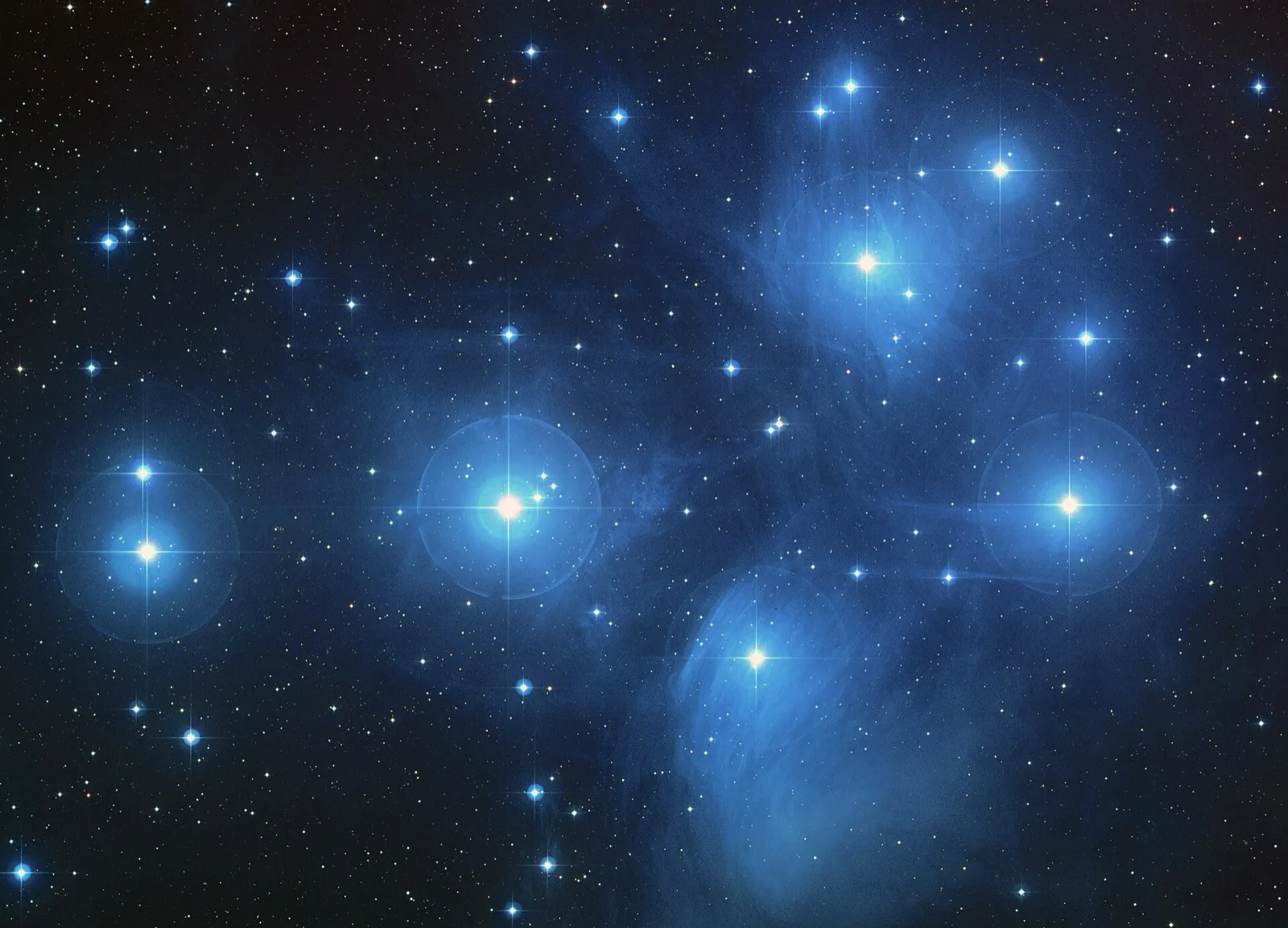 The PleiadesM45 · open star cluster
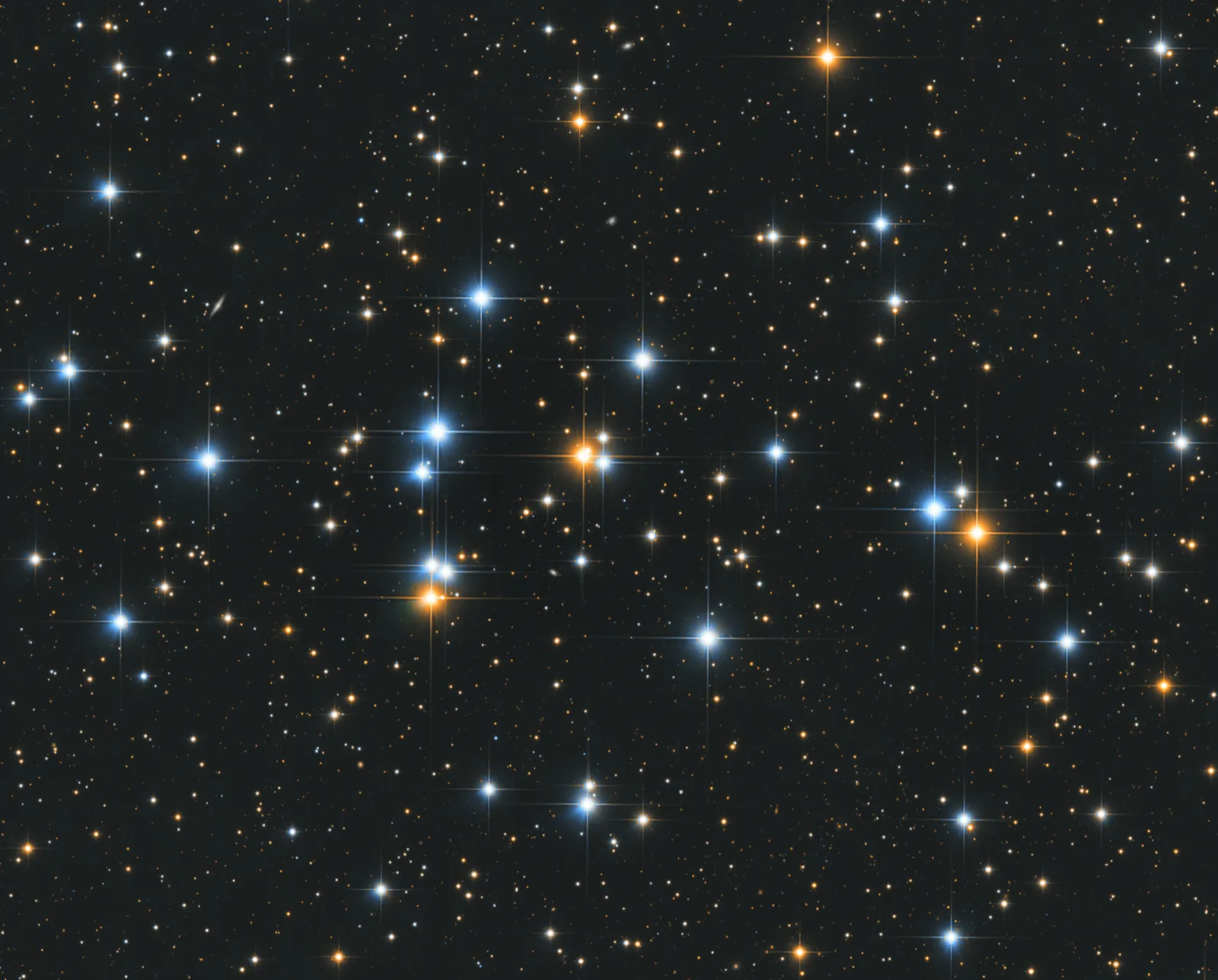 Beehive ClusterM44 · open star cluster
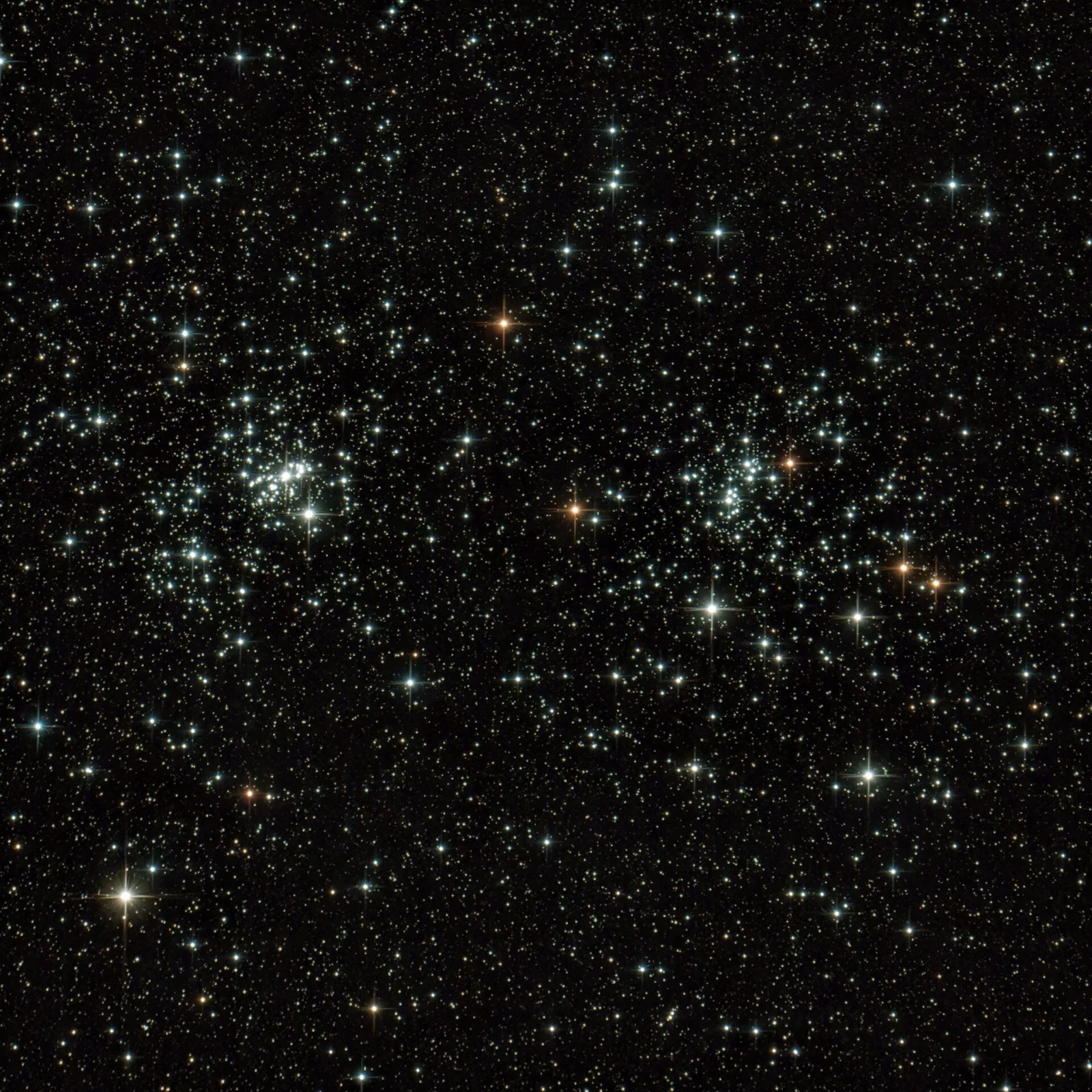 Double ClusterNGC 869 · open star cluster
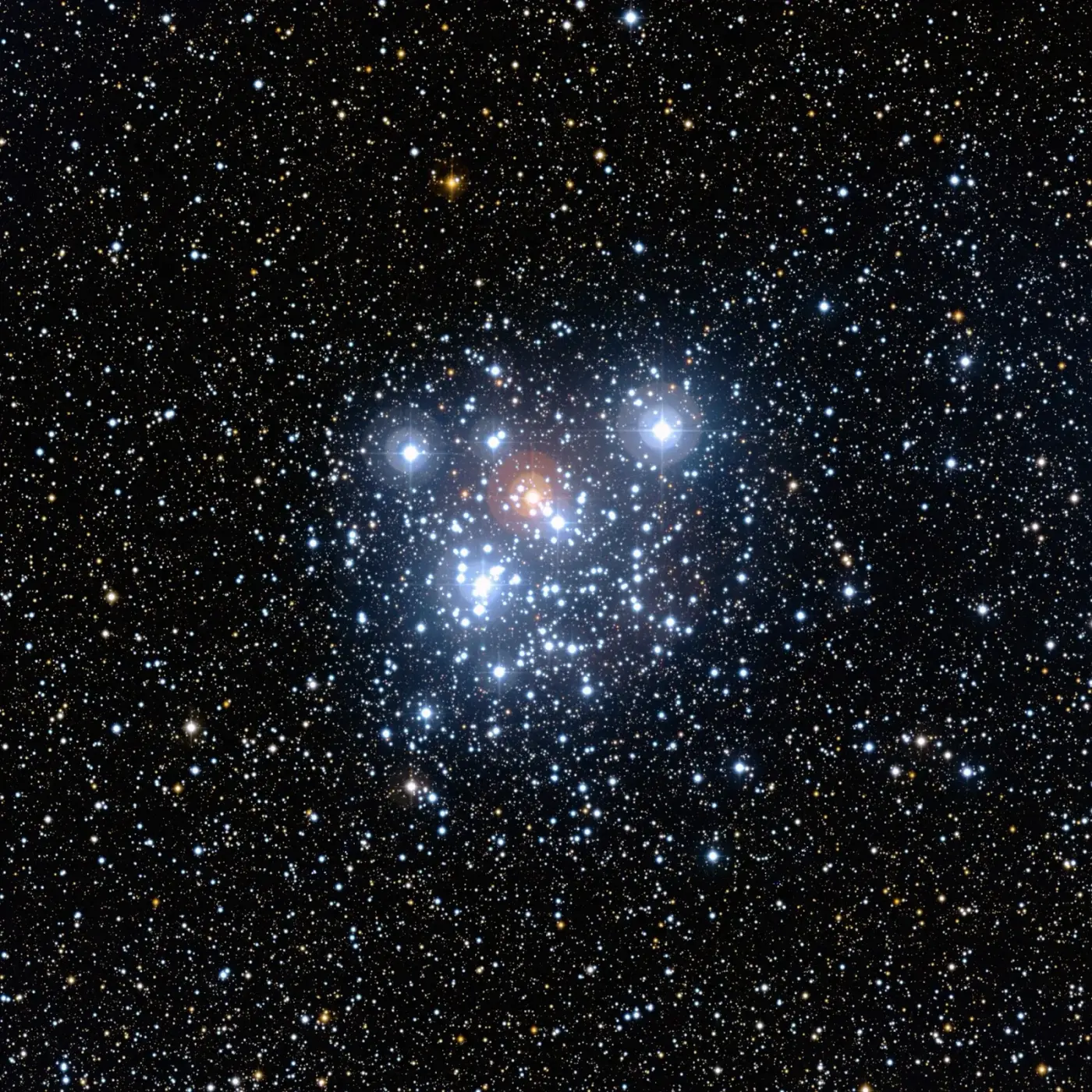 Jewel BoxNGC 4755 · open star cluster
Sources
- en.wikipedia.org
- science.nasa.gov
- esahubble.org
- eso.org
- earthsky.org
- Positions: astronomy-engine (Don Cross).