 SKY
Sky catalog › Galaxies
Centaurus A
NGC 5128 · A galaxy in Centaurus
What is it?
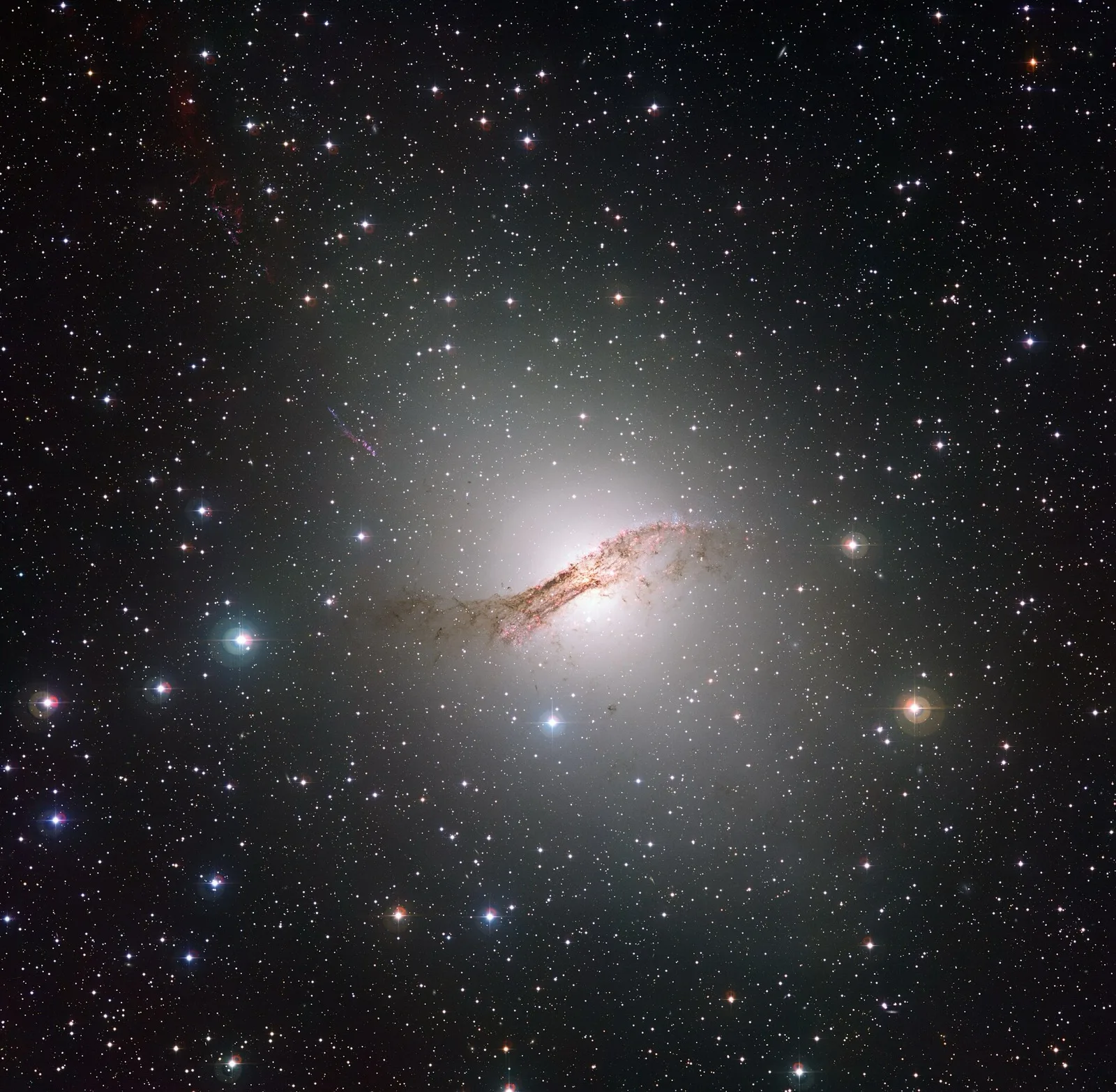
Centaurus A is a galaxy. A whole island of millions to trillions of stars, far outside our Milky Way.
Why Centaurus A is interesting
What you see: The glowing ball is a huge crowd of stars, and the dark band across it is dust, probably left over from a smaller spiral galaxy that it swallowed. en.wikipedia.org
How it formed: A black hole of about 55 million Suns at its center powers jets of matter. Its radio jets stretch more than a million light-years into space. en.wikipedia.org
To scale: Its giant radio lobes span about 16 times the width of the full Moon in our sky, though our eyes cannot see them. cfa.harvard.edu
Three things to know
- Centaurus A is the closest radio galaxy to Earth.
- A black hole of about 55 million Suns at its center shoots out jets, and its radio jets stretch more than a million light-years.
- Its dark band of dust is probably left over from a big galaxy swallowing a smaller spiral galaxy.
12 more fun facts
- The radio lobes of Centaurus A span about 16 times the width of the full Moon in our sky. cfa.harvard.edu
- In 2021 the Event Horizon Telescope imaged the base of the jet in Centaurus A about 16 times sharper than ever before, and found its edges glowing brighter than its middle. cfa.harvard.edu
- Chandra's X-ray view of Centaurus A shows a jet about 13,000 light-years long, with a shorter counterjet pointing the other way. chandra.harvard.edu
- Radio measurements taken a decade apart show the inner jet of Centaurus A moving at about half the speed of light. en.wikipedia.org
- In 2010 the Pierre Auger Observatory linked Centaurus A to some of the highest-energy cosmic rays ever detected. en.wikipedia.org
- In 2009 the H.E.S.S. telescopes detected very high energy gamma rays coming from Centaurus A. en.wikipedia.org
- Supernova SN 1986G exploded inside the dark dust lane of Centaurus A in 1986. en.wikipedia.org
- More than 100 star-forming regions are scattered through the dusty disk of Centaurus A. en.wikipedia.org
- A deep ESO image of Centaurus A with more than 50 hours of exposure led to the discovery of more than 200 new variable stars there. eso.org
- Faint reddish filaments line up with the jets of Centaurus A, about 30,000 and 65,000 light-years from its center, and their origin is still debated. eso.org
- Chandra has found hundreds of point-like X-ray sources in Centaurus A, many of them pairs where a stellar black hole orbits a companion star. chandra.harvard.edu
- In 1847 John Herschel described Centaurus A as split into two halves by its dark band. en.wikipedia.org
In the game these unlock one by one as you keep photographing Centaurus A.
At a glance
- Type
- Galaxy
- Catalog
- NGC 5128
- Constellation
- Centaurus
- Distance
- about 11 to 13 million light-years (estimates differ)
- Brightness
- magnitude 6.84
- Size in our sky
- 25.7 x 20.0 arcminutes
- Discovered
- James Dunlop, April 29, 1826
- Position (J2000)
- RA 13h 25m, Dec -43.0°
Looking back in time
The light in this photo left Centaurus A 11 million to 13 million years ago, when there were no humans at all: apes lived in the forests of Africa, Europe and Asia.
How to see it yourself
Too faint for most eyes, but binoculars show it from a dark site. A small telescope shows its shape.
Finding it: In Centaurus, it lies about 4 degrees north of the naked-eye globular cluster Omega Centauri. Another route is to aim about 4.5 degrees due west of the 3.5-magnitude star Mu Centauri.
When to look: A southern object, best seen from the Southern Hemisphere; from low northern latitudes it stays near the southern horizon.
What you will see: Some observers say they have glimpsed it with the naked eye under exceptionally dark skies, but finderscopes and large binoculars show its bright glow and dust lane much more easily. A small telescope shows a round glow cut in half by a wide dark lane, and a 14-inch or larger telescope shows a thin wedge of light in the lane.
Best months: April is when it is highest around midnight. About two months later it is highest in the early evening, at around 8 to 9 PM.
Where on Earth: best from the Southern Hemisphere. North of latitude 37°N it never climbs more than 10° above the horizon. South of 47°S it never sets.
How it is photographed: long exposures through filters, many hours in total, which is why the game sends it to a big observatory mirror. then the frames are stacked, stretched and combined into color.
Name and story
The name: James Dunlop first documented it in 1826 from New South Wales, Australia, and it is NGC 5128. The name Centaurus A comes from its status as the first major radio source found in the constellation Centaurus.
Record: Centaurus A is the nearest galaxy to Earth with a supermassive black hole actively powering a jet.
Explored by: Chandra watched Centaurus A for 199 hours across six pointings in 2007, more than seven days of continuous observing. The resulting deep X-ray image shows its jet, a shorter counterjet, dust lanes and hundreds of point-like X-ray sources.
Test yourself
After every photo of Centaurus A the game asks one of these. A right answer earns sky points for your observatory.
How fast does the inner jet of Centaurus A travel?
- About twice the speed of light
- About half the speed of light (the answer)
- About as fast as a jet plane
Radio measurements taken a decade apart show the inner jet moving at about half the speed of light, far faster than any plane yet below light speed. en.wikipedia.org
Who first documented Centaurus A, in 1826?
- Charles Messier
- James Dunlop (the answer)
- Galileo Galilei
Dunlop recorded it from New South Wales, Australia, in 1826. Its name came later: it was the first major radio source found in the constellation Centaurus. eso.org
Point a telescope at Centaurus A in the game: capture it in real time, then develop the frames like an astrophotographer.
Point a telescope at Centaurus AMore galaxies
 Andromeda GalaxyM31 · galaxy
 Triangulum GalaxyM33 · galaxy
 Large Magellanic CloudLMC · galaxy
 Small Magellanic CloudSMC · galaxy
Sources
- en.wikipedia.org
- cfa.harvard.edu
- chandra.harvard.edu
- eso.org
- astronomy.com
- Positions: astronomy-engine (Don Cross).