 SKY
Sky catalog › Nebulae
Tarantula Nebula
NGC 2070 · A star-forming nebula in Dorado
What is it?
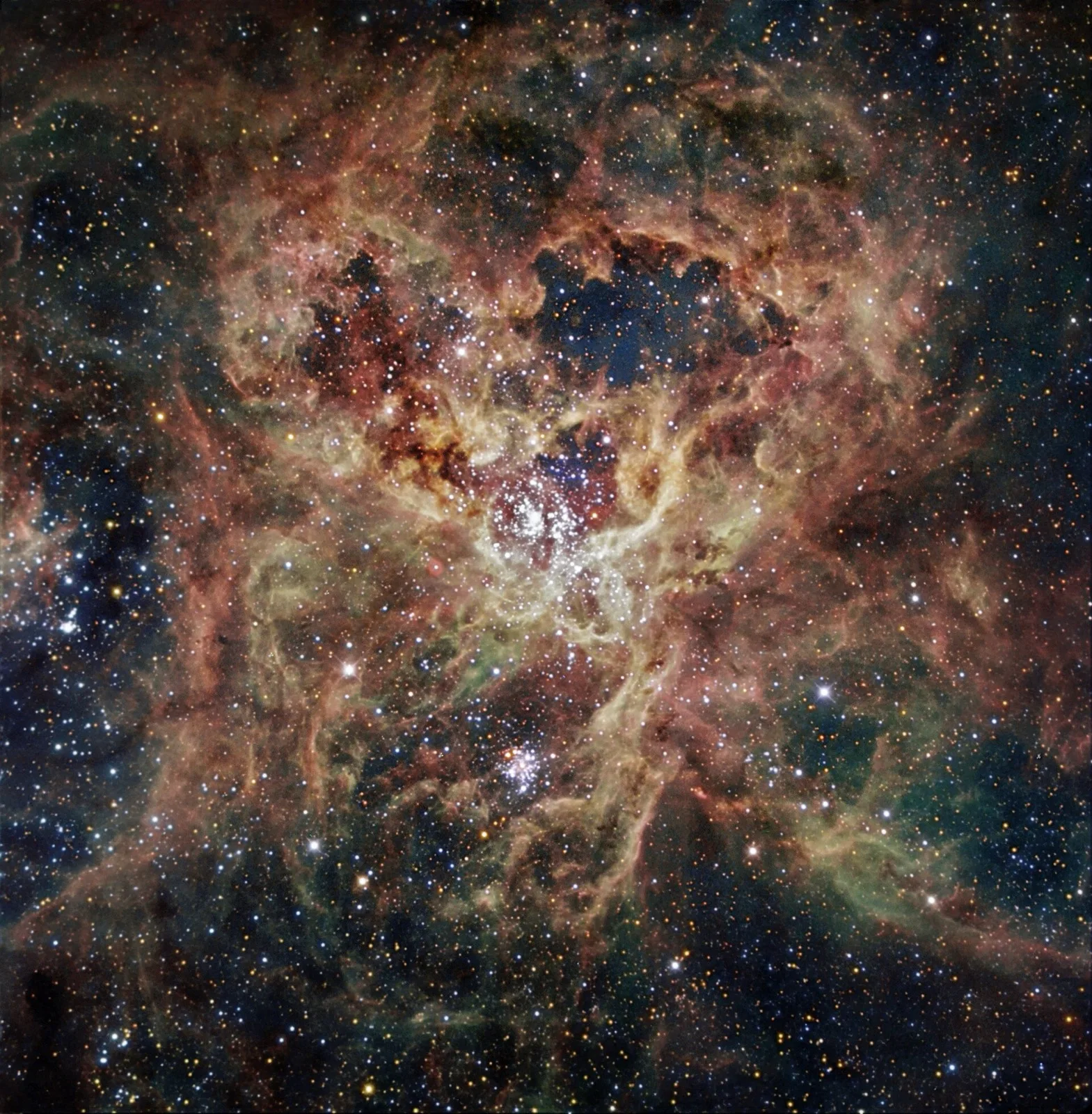
Tarantula Nebula is a star-forming nebula. A huge cloud of gas lit up by hot young stars born inside it.
Why the Tarantula Nebula is interesting
What you see: The glowing strands and dusty tendrils, which look like a tarantula's legs, are gas lit up by R136, a dense star cluster at its heart that makes most of the energy we see. en.wikipedia.org
How it formed: The Tarantula has been churning out stars at a furious pace for millions of years. Its central cluster, NGC 2070, holds roughly 500,000 stars only 2 to 3 million years old. esahubble.org
To scale: Placed as close as the Orion Nebula, the Tarantula would stretch about 25 degrees across our sky, the width of about 50 full Moons side by side. astronomy.com
Three things to know
- The Tarantula is so bright that if it were as close as the Orion Nebula, it would cast shadows on Earth.
- It is the busiest star-making region in our whole Local Group of galaxies.
- It is named for its glowing gas filaments, which stretch out like the legs of a tarantula.
12 more fun facts
- The Tarantula Nebula holds R136a1, the most massive and most luminous star known. Estimates of its mass differ, from roughly 200 to more than 300 times the Sun's. en.wikipedia.org
- If the star R136a1 replaced the Sun, it would outshine the Sun by about as much as the Sun outshines the full Moon, and Earth's year would shrink to about three weeks. eso.org
- R136a1, a star in the Tarantula Nebula, is only about a million years old, yet it has already shed roughly a fifth of its starting mass. eso.org
- Supernova 1987A exploded on the outskirts of the Tarantula Nebula. It was the closest supernova seen since Kepler's Supernova in 1604. en.wikipedia.org
- Underground detectors caught 25 neutrinos from Supernova 1987A, near the Tarantula Nebula, in a burst lasting less than 13 seconds. en.wikipedia.org
- Hubble's 2012 mosaic of the Tarantula Nebula is roughly 650 light-years across and shows several million stars. esahubble.org
- The Tarantula's central cluster, NGC 2070, holds roughly 500,000 stars and is only 2 to 3 million years old. esahubble.org
- The Tarantula's chemistry resembles giant star-forming regions from "cosmic noon," when the universe was only a few billion years old, making it the nearest example of that era. esawebb.org
- In 2022 the Webb telescope revealed thousands of never-before-seen young stars in the Tarantula Nebula. esawebb.org
- A black hole called VFTS 243, at least 9 times the Sun's mass, orbits a 25-solar-mass blue star in the Tarantula Nebula without giving off strong X-rays. en.wikipedia.org
- Placed as close as the Orion Nebula, the Tarantula would stretch about 25 degrees across the sky, the width of about 50 full Moons side by side. astronomy.com
- The Tarantula's dense core, R136, is about 16 light-years wide and contains 72 stars, many of them among the most massive and hottest known. astronomy.com
In the game these unlock one by one as you keep photographing the Tarantula Nebula.
At a glance
- Type
- Star-forming nebula
- Catalog
- NGC 2070
- Constellation
- Dorado
- Distance
- about 160,000 light-years (in the Large Magellanic Cloud)
- Brightness
- magnitude 8
- Size in our sky
- 40 x 25 arcminutes
- Discovered
- Nicolas-Louis de Lacaille, 1751 to 1753
- Position (J2000)
- RA 5h 39m, Dec -69.1°
Looking back in time
The light in this photo left the Tarantula Nebula about 160,000 years ago, when our own species was young and lived in Africa.
How to see it yourself
Needs a telescope and a dark sky. Photos show far more than the eye can see.
Finding it: First find the Large Magellanic Cloud, a small satellite galaxy of the Milky Way that appears as a hazy patch in the far southern sky. The Tarantula is the bright knot near its southeast corner, as seen from Earth.
When to look: A far-southern object at about 69 degrees south declination, so it never rises from the continental United States or Europe. From the Southern Hemisphere, its constellation Dorado is highest in the evening sky during the northern winter months, which is southern summer.
What you will see: It is visually about 4th magnitude, a small glowing knot in the Large Magellanic Cloud, and it is best seen with binoculars and telescopes. The region is about the size of the full Moon, and a 4-inch telescope shows loops and filaments around the bright central knot R136.
Best months: December is when it is highest around midnight. About two months later it is highest in the early evening, at around 8 to 9 PM.
Where on Earth: best from the Southern Hemisphere. North of latitude 11°N it never climbs more than 10° above the horizon, so from the United States and Europe it is out of reach. South of 21°S it never sets.
How it is photographed: long exposures through filters, then the frames are stacked, stretched and combined into color.
Name and story
The name: Johann Bode listed it in 1801 as number 30 in the constellation Dorado, which gave it the name 30 Doradus. Nicolas-Louis de Lacaille first recorded it in 1751 to 1753 from the Cape of Good Hope, as a diffuse nebula. The nickname Tarantula came into use in the mid-20th century.
Record: The Tarantula is the largest and brightest star-forming region in the Local Group of galaxies, and it is home to the hottest and most massive stars known.
Explored by: Webb studied the Tarantula in 2022 with its NIRCam camera and other instruments, revealing thousands of young stars. Its NIRSpec spectrograph caught a very young star just beginning to emerge from its dusty pillar.
Test yourself
After every photo of the Tarantula Nebula the game asks one of these. A right answer earns sky points for your observatory.
If the Tarantula were as close as the Orion Nebula, what would it do?
- Look like one faint star
- Cast visible shadows on Earth (the answer)
- Turn our whole night sky green
The Tarantula is the most active starburst region known in our Local Group, lit by the packed cluster R136. Only its distance of about 160,000 light-years keeps it small in our sky. en.wikipedia.org
What record does R136a1, a star in the Tarantula, hold?
- Coldest star ever found in space
- Most massive star known (the answer)
- Oldest star ever found
Estimates of R136a1's mass run from roughly 200 to more than 300 times the Sun's, which makes it the most massive and most luminous star known. en.wikipedia.org
Point a telescope at the Tarantula Nebula in the game: capture it in real time, then develop the frames like an astrophotographer.
Point a telescope at the Tarantula NebulaMore nebulae
 Orion NebulaM42 · star-forming nebula
 Lagoon NebulaM8 · star-forming nebula
 Trifid NebulaM20 · star-forming nebula
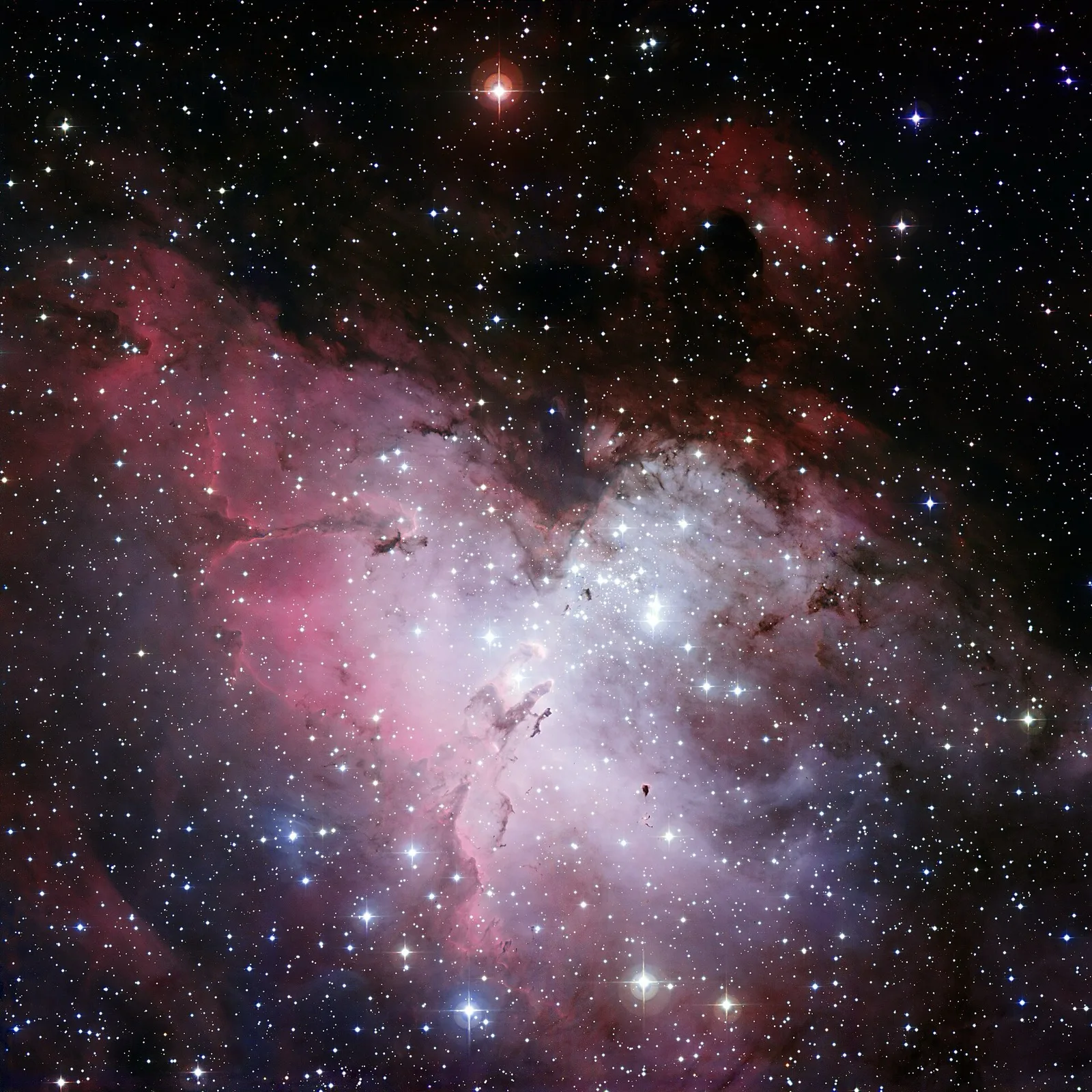 Eagle NebulaM16 · star-forming nebula
Sources
- en.wikipedia.org
- en.wikipedia.org
- en.wikipedia.org
- eso.org
- en.wikipedia.org
- esahubble.org
- esawebb.org
- astronomy.com
- jb.man.ac.uk
- Positions: astronomy-engine (Don Cross).