 SKY
Sky catalog › Star clusters
47 Tucanae
NGC 104 · A globular cluster in Tucana
What is it?
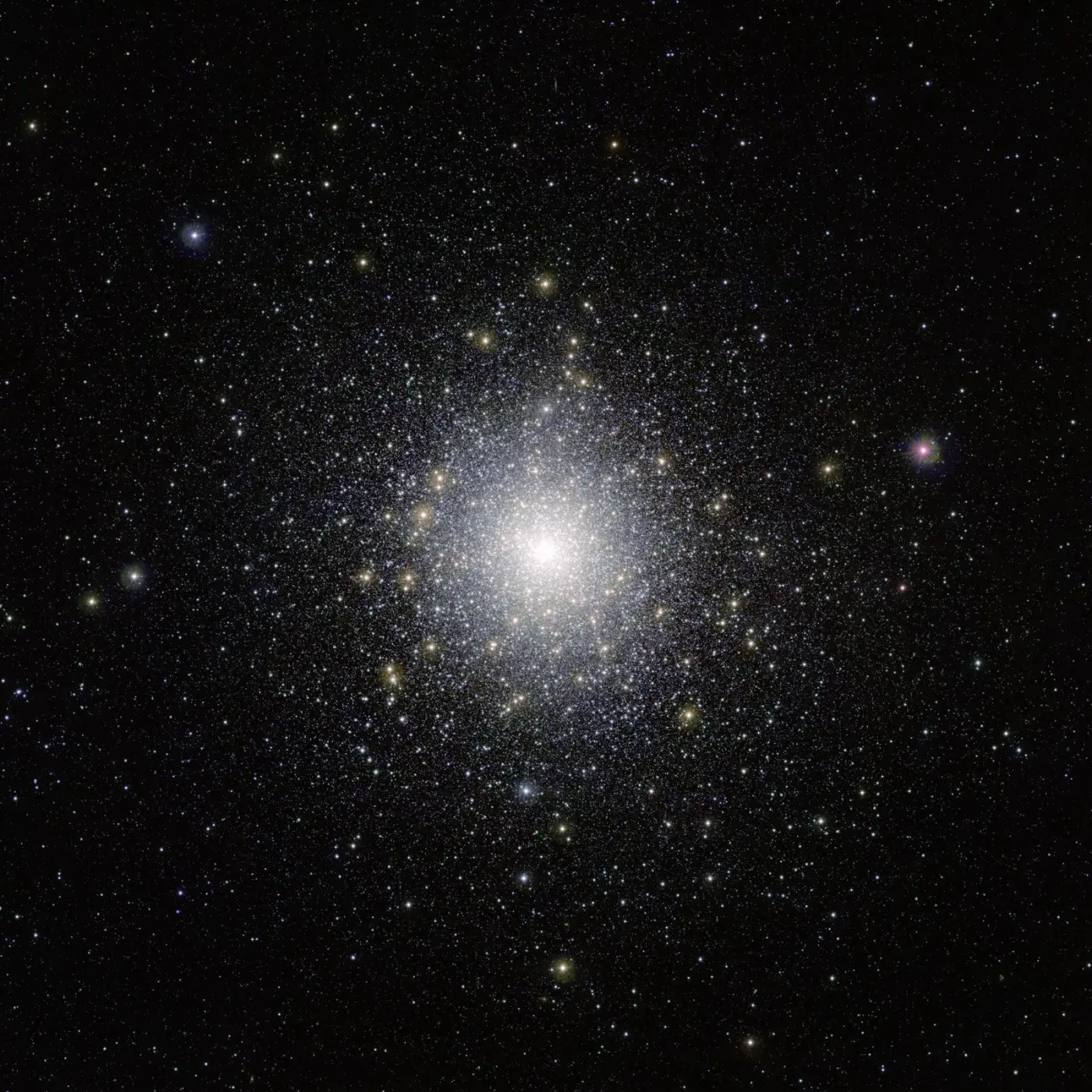
47 Tucanae is a globular cluster. A tight ball of hundreds of thousands of very old stars.
Why 47 Tucanae is interesting
What you see: The glow is millions of stars packed into one huge ball. They crowd into a small, very bright, dense core, which is why the middle blurs into one blaze of light. en.wikipedia.org
How it formed: Its stars are about 13 billion years old, which is unusually old. Over time the heavier stars have settled toward the center; in 2015 it was the first cluster where this was seen. en.wikipedia.org
To scale: 47 Tucanae is about 120 light-years across, so light needs about 120 years to cross from one side to the other. en.wikipedia.org
Three things to know
- 47 Tucanae is the second-brightest globular cluster in the sky, after Omega Centauri.
- Its stars are about 13 billion years old.
- When Lacaille first saw it, he thought it was the head of a bright comet.
12 more fun facts
- 47 Tucanae sits right beside the Small Magellanic Cloud in our sky, but that galaxy is more than 15 times farther away, about 200,000 light-years. en.wikipedia.org
- Hubble watched about 34,000 of its stars for 8.3 days, hoping to catch planets passing in front of them. About 17 were expected, but none turned up. arxiv.org
- 47 Tucanae has 35 known millisecond pulsars, dead stars that spin extremely fast; only the cluster Terzan 5 is known to have more. en.wikipedia.org
- Thanks to its pulsars, 47 Tucanae was the first globular cluster ever detected in gamma rays, by NASA's Fermi telescope. en.wikipedia.org
- Chandra found more than 100 X-ray sources in a patch of the core only about one fifteenth the width of the full Moon. chandra.harvard.edu
- Nearly all of its X-ray sources are pairs of stars in which a Sun-like star circles a white dwarf or a neutron star. chandra.harvard.edu
- Its brightest star in visible light, nicknamed the "Bright Star", is a hot blue giant about 1,100 times as luminous as the Sun but with only about half the Sun's mass. en.wikipedia.org
- In 2015, 47 Tucanae became the first cluster where astronomers saw mass segregation, the heavier stars settling toward the center. en.wikipedia.org
- From 18 degrees north latitude and farther north, 47 Tucanae never rises, so it cannot be seen from the continental United States. freestarcharts.com
- Under ideal skies, 47 Tucanae looks about as big as the full Moon. astronomy.com
- Lacaille made it the very first entry, Lac I-1, in his catalog of southern sky objects, recorded from South Africa in 1751 to 1752. en.wikipedia.org
- A 2024 study found a faint radio source at its core that could be a black hole; an earlier 2017 black hole claim did not hold up under more data. en.wikipedia.org
In the game these unlock one by one as you keep photographing 47 Tucanae.
At a glance
- Type
- Globular cluster
- Catalog
- NGC 104
- Constellation
- Tucana
- Distance
- about 14,500 light-years
- Brightness
- magnitude 4.09
- Size in our sky
- about 44 arcminutes
- Discovered
- Nicolas-Louis de Lacaille, 1751 to 1752
- Position (J2000)
- RA 0h 24m, Dec -72.1°
Looking back in time
The light in this photo left 47 Tucanae about 14,500 years ago, when the Earth was in the last Ice Age: mammoths roamed and people painted caves by firelight.
How to see it yourself
Visible to the naked eye from a dark site. Binoculars show it well, and a small telescope shows more detail.
Finding it: Look in Tucana, about 18 degrees from the south celestial pole. It sits about 2.5 degrees west of the Small Magellanic Cloud, the misty patch near the bright star Achernar.
When to look: This is a far southern object. From most of the Southern Hemisphere it never sets, so it can be seen on any clear night of the year. From 18 degrees north latitude or farther north it never rises.
What you will see: To the naked eye it looks like a slightly fuzzy star, like the head of a comet without a tail. Binoculars show a bright core inside a soft pearly halo, a 4-inch telescope shows a compact core, and an 8-inch turns it into a glittering swarm of stars.
Easy to confuse with:
- NGC 362: NGC 362 is another globular cluster on the opposite edge of the Small Magellanic Cloud, but it is much fainter, at magnitude 6.4 compared with about 4 for 47 Tucanae.
Best months: September is when it is highest around midnight. About two months later it is highest in the early evening, at around 8 to 9 PM.
Where on Earth: best from the Southern Hemisphere. North of latitude 8°N it never climbs more than 10° above the horizon, so from the United States and Europe it is out of reach. South of 18°S it never sets.
This month: one of the best evening targets in the night sky in November 2026.
How it is photographed: long exposures through filters, then the frames are stacked, stretched and combined into color.
Name and story
The name: Nicolas-Louis de Lacaille recorded it from South Africa in 1751 to 1752. The name comes from Johann Elert Bode's 1801 catalog, which numbered Lacaille's objects by constellation; it became number 47 in Tucana, the Toucan. It is also NGC 104 and Caldwell 106.
Record: 47 Tucanae is the second-brightest globular cluster in the sky after Omega Centauri. It has the second-largest known group of millisecond pulsars of any globular cluster, after Terzan 5, and was the first globular cluster seen in gamma rays.
Explored by: In March 2000 the Chandra X-ray Observatory watched 47 Tucanae for 21 hours and found more than 100 X-ray sources in its core, more than ten times what earlier X-ray satellites had found. Most turned out to be pairs of stars in which a normal star circles a white dwarf or a neutron star.
Test yourself
After every photo of 47 Tucanae the game asks one of these. A right answer earns sky points for your observatory.
About how old are the stars of 47 Tucanae?
- About 14 million years
- About 13 billion years (the answer)
- About 4,000 years
Plotting the colors and brightnesses of its stars on a chart points to an age of about 13 billion years, which is unusually old. en.wikipedia.org
What did Lacaille first think 47 Tucanae was?
- A distant city fire
- A new planet
- The head of a bright comet (the answer)
To the naked eye it looks like a slightly fuzzy star, much like a comet's head without a tail. Lacaille recorded it from South Africa in 1751 to 1752. en.wikipedia.org
Point a telescope at 47 Tucanae in the game: capture it in real time, then develop the frames like an astrophotographer.
Point a telescope at 47 TucanaeMore star clusters
 The PleiadesM45 · open star cluster
 Beehive ClusterM44 · open star cluster
 Double ClusterNGC 869 · open star cluster
 Jewel BoxNGC 4755 · open star cluster
Sources
- en.wikipedia.org
- arxiv.org
- chandra.harvard.edu
- freestarcharts.com
- astronomy.com
- earthsky.org
- Positions: astronomy-engine (Don Cross).