 SKY
Sky catalog › Galaxies
Messier 94
M94, NGC 4736 · A galaxy in Canes Venatici
What is it?
Messier 94 is a galaxy. A whole island of millions to trillions of stars, far outside our Milky Way.
Why Messier 94 is interesting
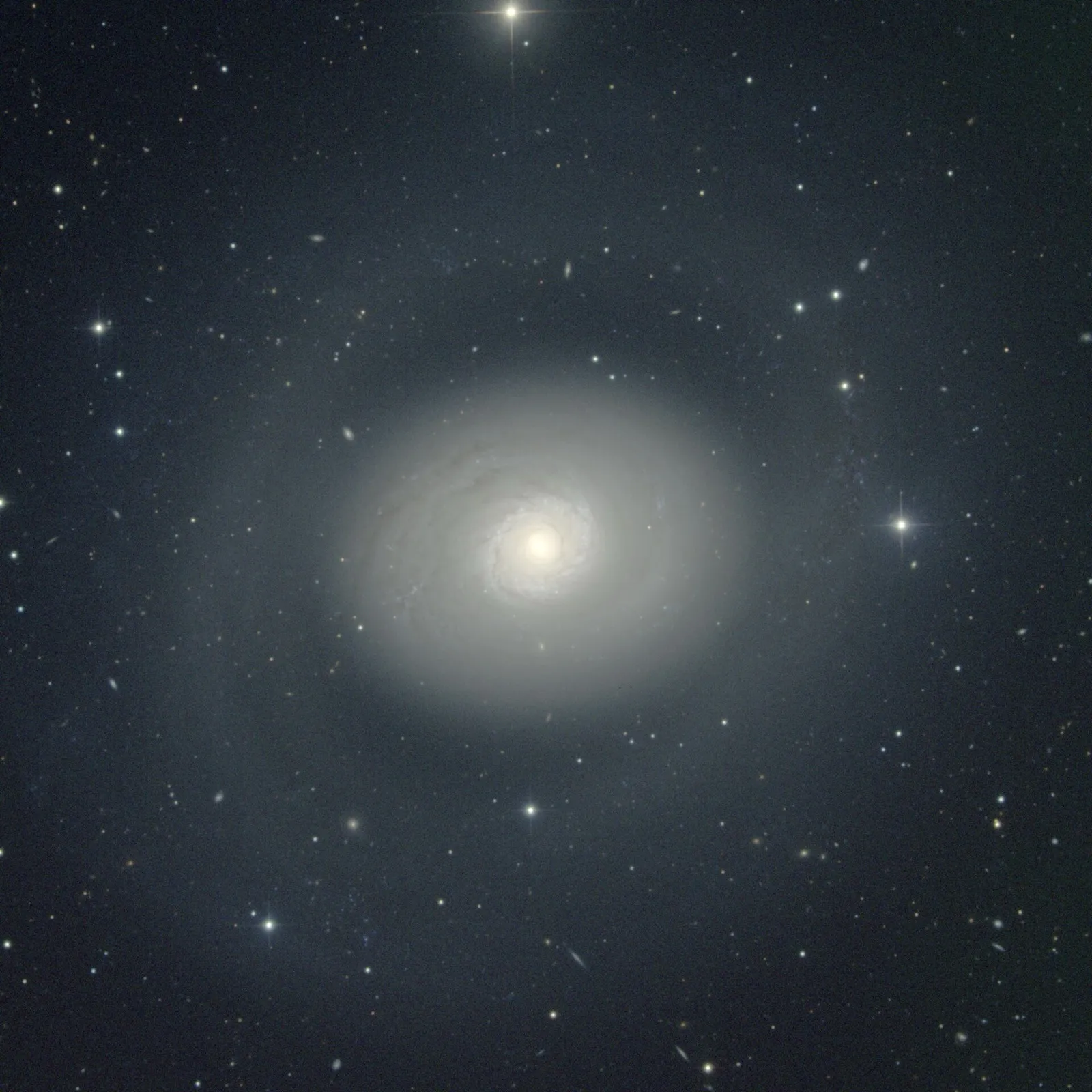
What you see: The bright center is a ring of young stars about 5,400 light-years across. A much fainter glow farther out is made of loose spiral arms. en.wikipedia.org
How it formed: A pressure wave rippling outward from the center probably squeezed gas and dust into dense clouds, which collapsed into the new stars of its bright ring. esahubble.org
To scale: In 2025 the Webb telescope weighed the black hole at M94's center at about 16 million times the mass of the Sun. en.wikipedia.org
Three things to know
- M94 has a bright inner ring, called a starburst ring, where new stars are being born at a high rate.
- Faint outer spiral arms found only recently tripled the galaxy's known size.
- A 2008 study suggested M94 has little or no dark matter, which would be very unusual, but other research groups have not confirmed it.
12 more fun facts
- The stars in M94's bright blue ring are young by cosmic standards: likely all less than 10 million years old. science.nasa.gov
- M94's ring of new stars was probably made by a pressure wave rippling outward from the center, squeezing gas and dust into dense clouds that collapse into stars. esahubble.org
- Its bright inner ring measures about 5,400 light-years across, while a much fainter outer ring spans about 45,000 light-years. en.wikipedia.org
- M94's faint outer "ring" turned out not to be a closed ring at all: in mid-infrared and ultraviolet light, a 2009 study found it is really a set of spiral arms. en.wikipedia.org
- In 2025 astronomers used the Webb telescope to weigh M94's central black hole at about 16 million times the mass of the Sun. en.wikipedia.org
- M94 has no true bar across its center. Instead, its middle is an oval of stars, making it a textbook example of what astronomers call a pseudobulge. en.wikipedia.org
- Pierre Méchain discovered M94 in 1781, and Charles Messier added it to his catalog just two days later. en.wikipedia.org
- M94 leads a loose family of 16 to 24 galaxies called the M94 Group, but only a few of them are actually held to it by gravity. Most are drifting apart with the expansion of the universe. en.wikipedia.org
- Its spiral arms are wrapped so tightly that small telescopes often show M94 as a featureless oval, like an elliptical galaxy. The arms begin to show in telescopes of 16 inches or more. astronomy.com
- In Hubble's close-up, M94's pale pink core is crossed by spiraling arms of dark dust, with a bright patch of reddish stars near the center. science.nasa.gov
- Hubble's famous picture of M94 shows a blurry vertical strip running through it. That is simply a stretch of sky where Hubble collected no data. science.nasa.gov
- Three different methods put M94 at about 15, 16 and 17 million light-years away, all within each other's error ranges. en.wikipedia.org
In the game these unlock one by one as you keep photographing Messier 94.
At a glance
- Type
- Galaxy
- Catalog
- M94, NGC 4736
- Constellation
- Canes Venatici
- Distance
- about 16 million light-years
- Brightness
- magnitude 8.2
- Size in our sky
- 11.2 x 9.1 arcminutes
- Discovered
- Pierre Méchain, 1781
- Position (J2000)
- RA 12h 51m, Dec +41.1°
Looking back in time
The light in this photo left Messier 94 about 16 million years ago, when there were no humans at all: apes lived in the forests of Africa, Europe and Asia.
How to see it yourself
Needs a telescope and a dark sky. Photos show far more than the eye can see.
Finding it: Start at Cor Caroli, the brightest star in Canes Venatici, below the handle of the Big Dipper. M94 lies about 3 degrees to its northwest, and about 3 degrees east of the star Chara, a little north of the line joining Cor Caroli and Chara.
When to look: Spring evenings, with May the best month, when Canes Venatici is high overhead for northern observers.
What you will see: Not visible to the naked eye. Binoculars show a small, faint blur of grayish light. A small telescope shows a bright, compact oval glow with a very bright center, and an 11-inch scope can show the core inside a small disk with a faint halo around it.
Easy to confuse with:
- Sunflower Galaxy (M63): M63 is a longer, thinner oval and slightly fainter, while M94 looks rounder with a very bright, concentrated core.
Best months: April is when it is highest around midnight. About two months later it is highest in the early evening, at around 8 to 9 PM.
Where on Earth: easy from the Northern Hemisphere. South of latitude 39°S it never climbs more than 10° above the horizon. From 49°N and farther north it never sets.
How it is photographed: long exposures through filters, then the frames are stacked, stretched and combined into color.
Name and story
The name: Pierre Méchain discovered it in 1781, and Charles Messier listed it as number 94 two days later. It is nicknamed the Cat's Eye Galaxy and the Croc's Eye (Crocodile Eye) Galaxy, and it is also called NGC 4736.
Explored by: Hubble photographed the starburst ring in M94's core in visible and infrared light. Because Hubble saw only a small part of the galaxy, NASA pairs its close-up with a wider ground-based view from the Digitized Sky Survey.
Test yourself
After every photo of Messier 94 the game asks one of these. A right answer earns sky points for your observatory.
How old are the stars in M94's bright blue ring?
- Over 5 billion years
- Likely under 10 million years (the answer)
- About 13 billion years
The ring is a starburst, a place where stars are forming fast right now, so its stars are young by cosmic standards, likely all under 10 million years old. science.nasa.gov
What is the blurry vertical strip in Hubble's famous picture of M94?
- A passing comet's tail
- A jet from its black hole
- A patch where Hubble got no data (the answer)
Hubble saw only part of the galaxy, so NASA filled the gap with a wider ground-based view. The strip is simply sky Hubble did not record. science.nasa.gov
Point a telescope at Messier 94 in the game: capture it in real time, then develop the frames like an astrophotographer.
Point a telescope at Messier 94More galaxies
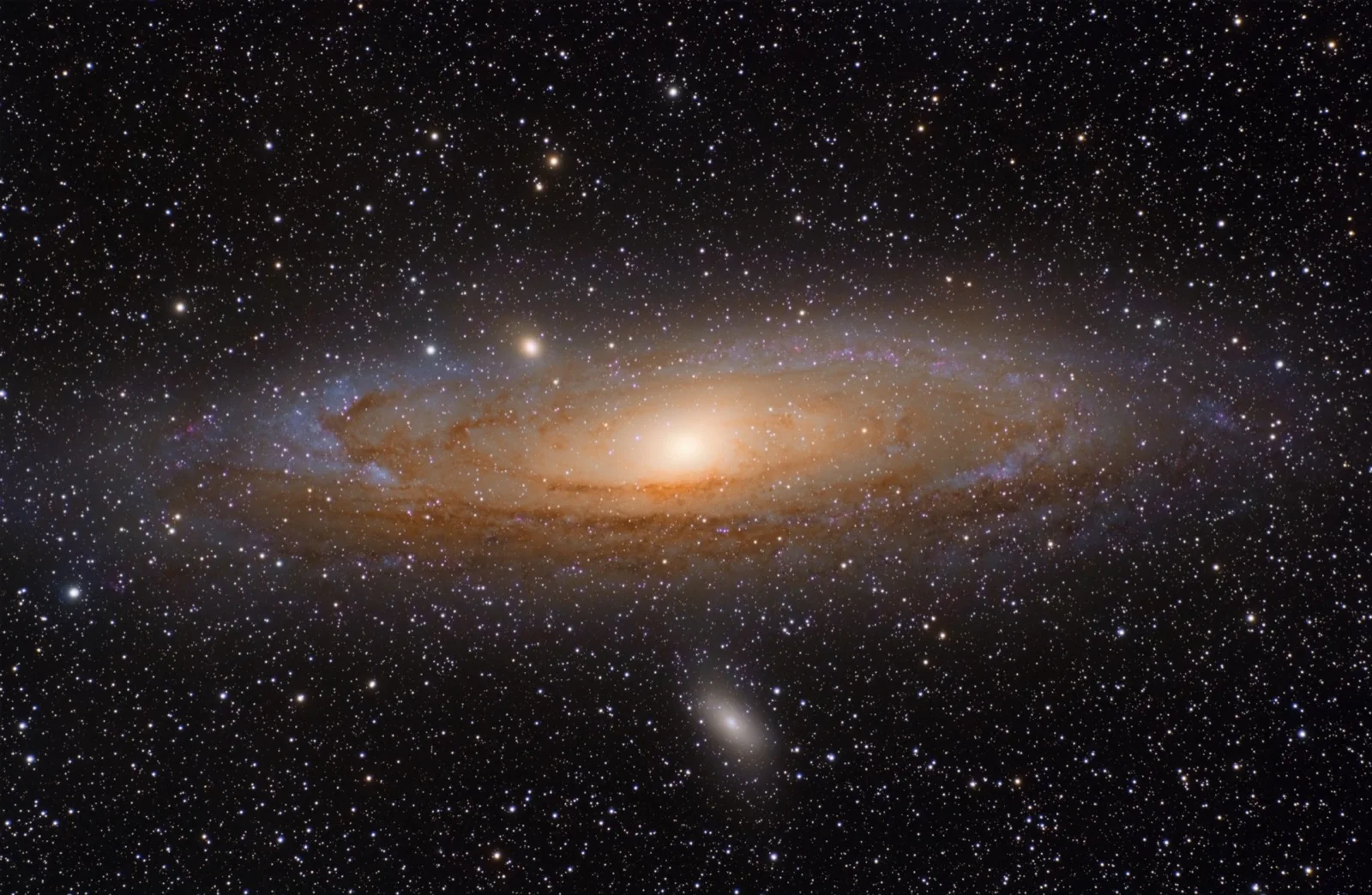 Andromeda GalaxyM31 · galaxy
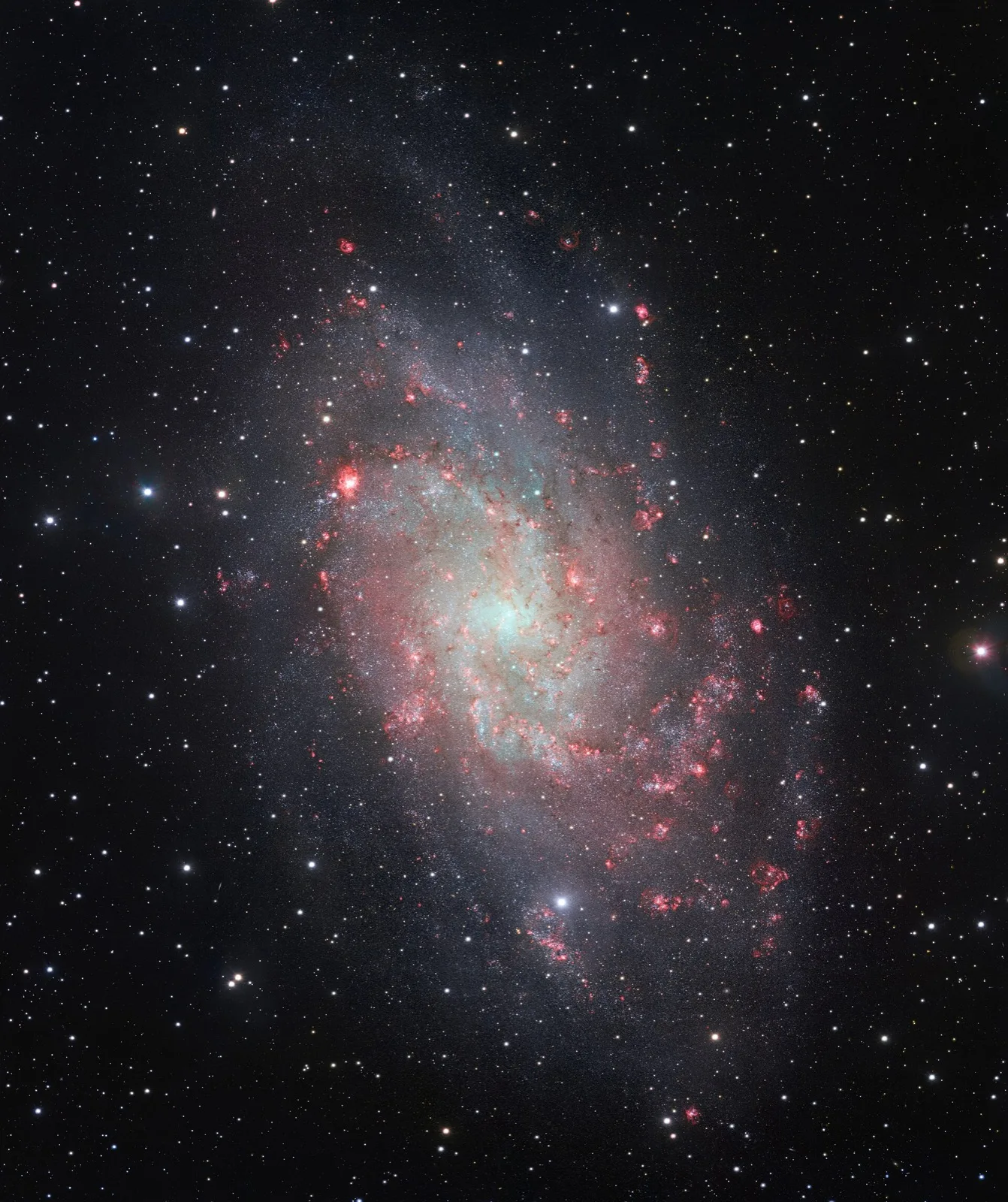 Triangulum GalaxyM33 · galaxy
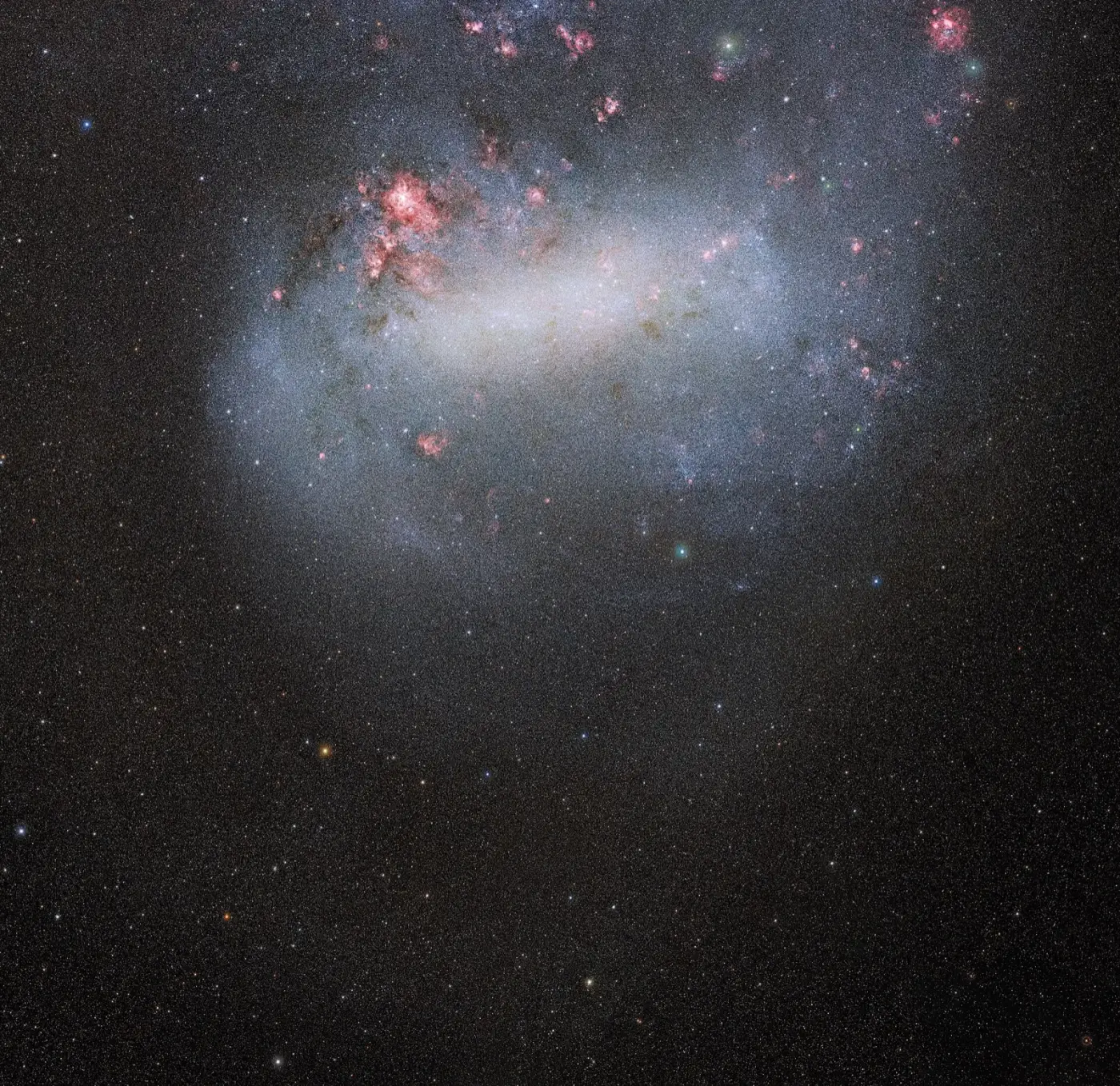 Large Magellanic CloudLMC · galaxy
 Small Magellanic CloudSMC · galaxy
Sources
- en.wikipedia.org
- science.nasa.gov
- science.nasa.gov
- esahubble.org
- astronomy.com
- astronomy.com
- Positions: astronomy-engine (Don Cross).