 SKY
Sky catalog › Galaxies
Virgo A (Messier 87)
M87, NGC 4486 · A galaxy in Virgo
What is it?
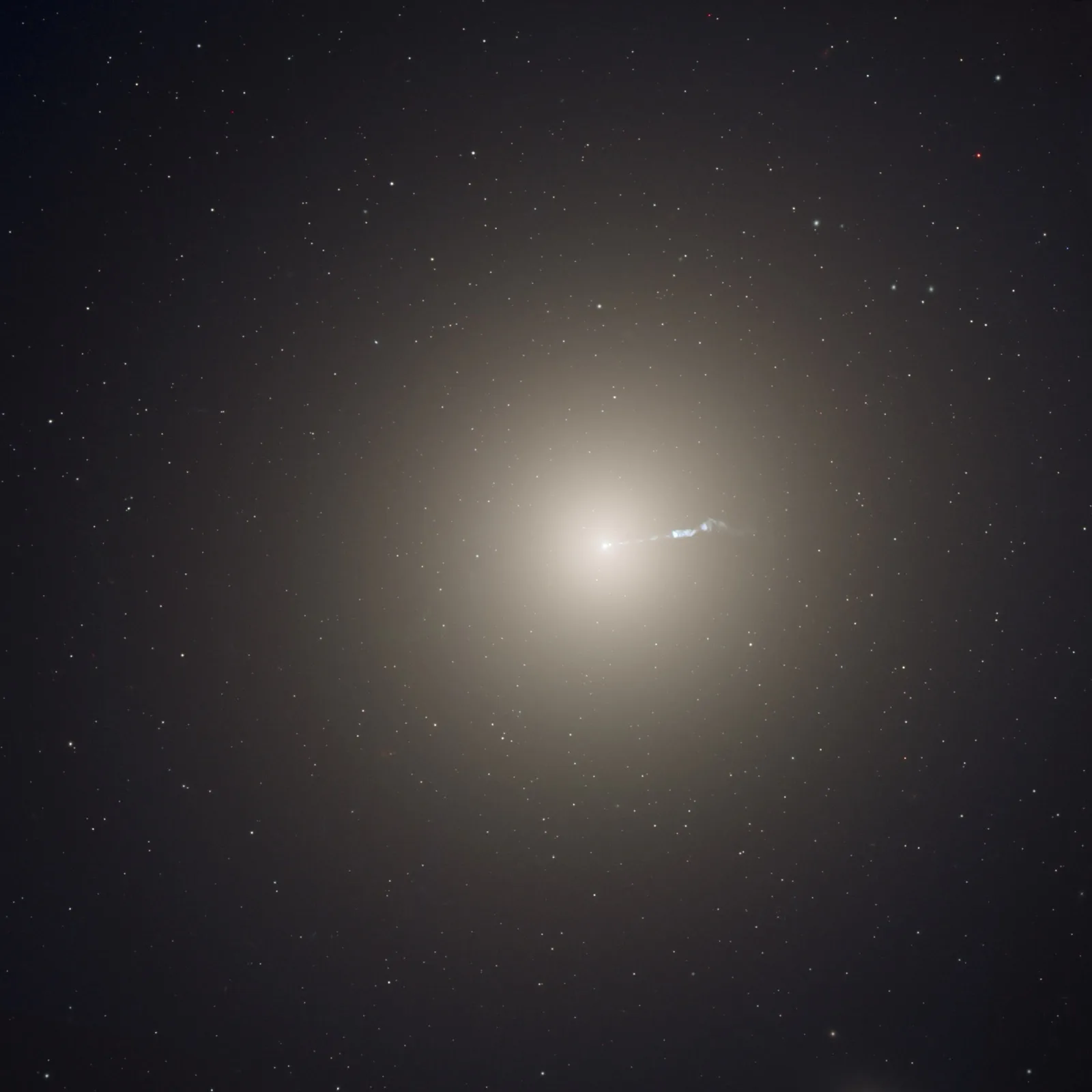
Virgo A (Messier 87) is a galaxy. A whole island of millions to trillions of stars, far outside our Milky Way.
Why Virgo A (Messier 87) is interesting
What you see: The round glow is the light of several trillion stars. The faint specks around it are some of its roughly 15,000 globular star clusters. science.nasa.gov
How it formed: Giant elliptical galaxies like M87 are believed to form when smaller galaxies merge. M87 swallowed a medium-sized spiral galaxy over the last billion years. en.wikipedia.org
To scale: The edge of no return around M87's black hole has a radius of about 120 times the Earth-Sun distance, about 18 billion km (11 billion miles). en.wikipedia.org
Three things to know
- In 2019 the Event Horizon Telescope released the first image of a black hole, and it was the one at the center of M87.
- That black hole is about 6.5 billion times the mass of the Sun, and it shoots out a jet of particles moving close to the speed of light.
- M87 has about 15,000 globular star clusters, while our Milky Way has only about 150 to 200.
12 more fun facts
- Chandra caught a blob in M87's jet that seemed to move 6.3 times faster than light. It is an illusion: the jet points nearly toward us, and its particles really move at over 99 percent of light speed. chandra.harvard.edu
- M87's jet of matter stretches about 5,000 light-years out from the galaxy's heart. astronomy.com
- In 1918 Heber Curtis photographed M87 and noticed a "curious straight ray" joined to the center by a thin line. It was the first sighting of the jet. en.wikipedia.org
- In 1991 Barbara Wilson became the first amateur to see M87's jet with her own eye, using a 20-inch telescope at the Texas Star Party. astronomy.com
- M87 holds several trillion stars. Our Milky Way has a few hundred billion. science.nasa.gov
- The glowing ring in the famous black hole image is about a hundred million times smaller than the jet that Chandra sees shooting away from it in X-rays. chandra.harvard.edu
- The edge of no return around M87's black hole is about 120 times as far across, from center to edge, as the distance from Earth to the Sun. en.wikipedia.org
- In 2021 the Event Horizon Telescope released a second picture of M87's black hole, this time in polarized light, which traces the magnetic fields around it. en.wikipedia.org
- M87 is about 132,000 light-years across, and its faint outer halo reaches out roughly 490,000 light-years from the center. en.wikipedia.org
- M87 is one of the brightest radio sources in the sky. Radio astronomers knew it as Virgo A, and linked that signal to the galaxy in 1947. en.wikipedia.org
- A rocket flight in 1966 found M87 glowing in X-rays, making it Virgo X-1, the first X-ray source discovered in Virgo. en.wikipedia.org
- Almost a hundred ultra-compact dwarf galaxies, tiny but packed with stars, have been found swarming around M87. en.wikipedia.org
In the game these unlock one by one as you keep photographing Virgo A (Messier 87).
At a glance
- Type
- Galaxy
- Catalog
- M87, NGC 4486
- Constellation
- Virgo
- Distance
- about 53 to 54 million light-years
- Brightness
- magnitude 8.6
- Size in our sky
- 7.2 x 6.8 arcminutes
- Discovered
- Charles Messier, 1781
- Position (J2000)
- RA 12h 31m, Dec +12.4°
Looking back in time
The light in this photo left Virgo A (Messier 87) about 53 million years ago, when early mammals were spreading across the world; the dinosaurs had died out about 66 million years ago.
How to see it yourself
Needs a telescope and a dark sky. Photos show far more than the eye can see.
Finding it: M87 sits in the crowded Virgo Cluster region between Denebola (the tail of Leo) and the stars of Virgo. It has no bright stars right next to it, so a common route is to start at the 5th-magnitude star Rho Virginis and move about 3.5 degrees northwest.
When to look: Spring evenings, best around May, when Virgo is well up in the south after dark for northern observers.
What you will see: Not visible to the naked eye. In a small telescope it looks like a round glowing ball, a bit like an out-of-focus 9th-magnitude star, with a brighter center and a soft fuzzy edge. The famous jet is far too faint for backyard scopes except in rare cases with very large ones.
Easy to confuse with:
- Messier 89: M89 is another round elliptical galaxy a little more than a degree east of M87, but it is smaller and fainter.
- Messier 84 and Messier 86: These two elliptical galaxies sit side by side as a matched pair at the start of Markarian's Chain, while M87 is a single bigger, brighter glow on its own.
Best months: March is when it is highest around midnight. About two months later it is highest in the early evening, at around 8 to 9 PM.
Where on Earth: easy from the Northern Hemisphere. South of latitude 68°S it never climbs more than 10° above the horizon.
How it is photographed: long exposures through filters, then the frames are stacked, stretched and combined into color.
Name and story
The name: Charles Messier found it in 1781 and listed it as number 87, describing it as a nebula. Radio astronomers call it Virgo A, and X-ray astronomers once called it Virgo X-1. Its black hole is nicknamed Pōwehi.
People and history: After the first black hole image in 2019, University of Hawaiʻi at Hilo language professor Larry Kimura gave M87's black hole the Hawaiian name Pōwehi, meaning "embellished dark source of unending creation." The name comes from the Kumulipo, a 2,102-line chant about the creation of the Hawaiian universe. Two telescopes on Maunakea helped make the image.
Record: M87 is a supergiant elliptical galaxy and one of the most massive galaxies in our part of the universe, with a mass of about 2 trillion Suns. Its central black hole, about 6.5 billion times the Sun's mass, was the first ever photographed.
Explored by: In April 2017, eight telescopes at six sites around the world linked up as the Event Horizon Telescope to image M87's black hole, and the picture was released on April 10, 2019. Hawaiʻi's James Clerk Maxwell Telescope and Submillimeter Array on Maunakea played a key part.
Test yourself
After every photo of Virgo A (Messier 87) the game asks one of these. A right answer earns sky points for your observatory.
How fast do particles in M87's jet really move?
- About 6 times light speed
- Over 99 percent of light speed (the answer)
- About as fast as a jet plane
One blob seemed to move 6.3 times faster than light, but that is an illusion caused by the jet pointing nearly toward us. chandra.harvard.edu
What made M87 famous in 2019?
- The first planet found in it
- A star crashing into Earth
- The first image of a black hole (the answer)
Eight telescopes at six sites linked up in 2017 as the Event Horizon Telescope and imaged the black hole at M87's center. The picture came out on April 10, 2019. hawaii.edu
Point a telescope at Virgo A (Messier 87) in the game: capture it in real time, then develop the frames like an astrophotographer.
Point a telescope at Virgo A (Messier 87)More galaxies
 Andromeda GalaxyM31 · galaxy
 Triangulum GalaxyM33 · galaxy
 Large Magellanic CloudLMC · galaxy
 Small Magellanic CloudSMC · galaxy
Sources
- en.wikipedia.org
- science.nasa.gov
- chandra.harvard.edu
- astronomy.com
- astronomy.com
- hawaii.edu
- Positions: astronomy-engine (Don Cross).