 SKY
Sky catalog › Galaxies
Southern Pinwheel Galaxy
M83, NGC 5236 · A galaxy in Hydra
What is it?
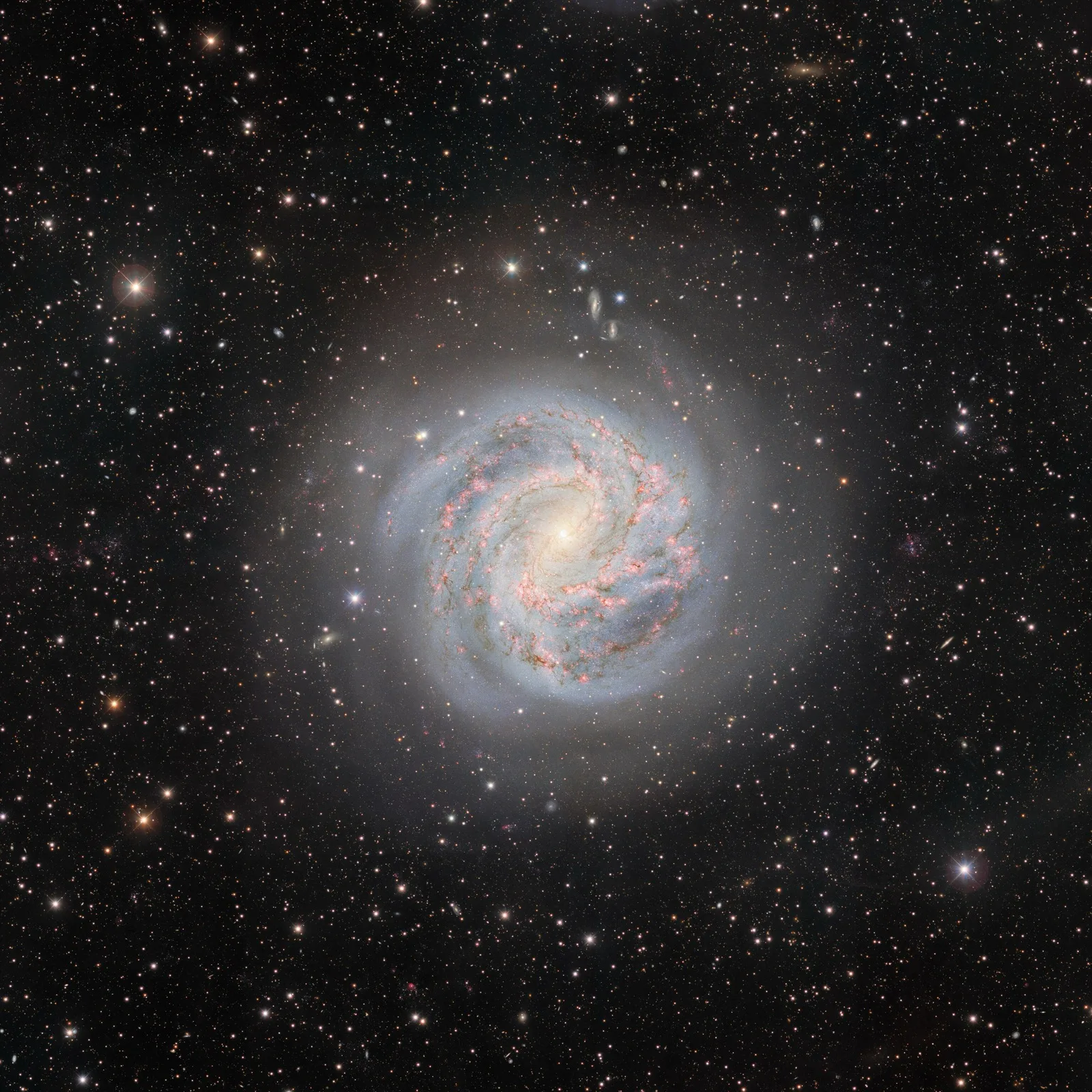
Southern Pinwheel Galaxy is a galaxy. A whole island of millions to trillions of stars, far outside our Milky Way.
Why the Southern Pinwheel Galaxy is interesting
What you see: The pink patches along its arms are hydrogen clouds, glowing from the ultraviolet light of young star clusters only a few million years old. science.nasa.gov
How it formed: Over the past billion years, a gravity tug between M83 and the small nearby galaxy NGC 5253 has set off a burst of star formation in both of them. astronomy.com
To scale: ESO says M83 spans over 40,000 light-years, about 40 percent the size of our Milky Way, so light needs over 40,000 years to cross it. eso.org
Three things to know
- M83 is one of the closest and brightest barred spiral galaxies in the sky, and you can spot it with binoculars.
- Its nickname comes from how much it looks like the Pinwheel Galaxy (M101) in the northern sky.
- Astronomers have seen six supernovae, exploding stars, go off in M83.
12 more fun facts
- Nicolas-Louis de Lacaille discovered M83 in 1752 using a tiny refractor with a lens only about half an inch (1.3 cm) wide. astronomy.com
- A single Hubble picture of M83's core, taken in 2009, revealed the remains of about 60 exploded stars, five times more than astronomers had known in that region. esahubble.org
- Another Hubble view of M83 shows bubbles in its gas blown by nearly 300 supernovas. science.nasa.gov
- In 2025 the Webb telescope found strongly energized neon gas in M83's core, a possible sign of a hidden, growing black hole. Astronomers had thought they had ruled one out, and it is not yet confirmed. esawebb.org
- At magnitude 7.5, M83 ranks as about the eighth-brightest galaxy in the whole sky. astronomy.com
- Its newest stars form in clusters only a few million years old along the edges of its dark dust lanes. Their ultraviolet light makes the nearby hydrogen clouds glow pink. science.nasa.gov
- Over the past billion years, a tug of gravity between M83 and the small nearby galaxy NGC 5253 has set off a burst of star formation in both of them. astronomy.com
- ESO describes M83 as spanning over 40,000 light-years, about 40 percent the size of our Milky Way, with the same kind of spiral arms and central bar of stars. eso.org
- Because we see it almost face-on, its spiral arms can be glimpsed in a telescope as small as 6 inches. astronomy.com
- M83 is the second-brightest member of a family of more than a dozen galaxies called the Centaurus A/M83 group. Only Centaurus A outshines it. astronomy.com
- In 2008 NASA's GALEX ultraviolet telescope found many newborn stars far out in M83's outskirts, about 20 kiloparsecs from the center, where astronomers thought there was too little material to make stars. en.wikipedia.org
- M83 passes straight overhead for people in northern Argentina, yet it still climbs more than 15 degrees above the horizon as far north as latitude 45 degrees. en.wikipedia.org
In the game these unlock one by one as you keep photographing the Southern Pinwheel Galaxy.
At a glance
- Type
- Galaxy
- Catalog
- M83, NGC 5236
- Constellation
- Hydra
- Distance
- about 15 million light-years
- Brightness
- magnitude 7.6
- Size in our sky
- 12.9 x 11.5 arcminutes
- Discovered
- Nicolas-Louis de Lacaille, February 17, 1752
- Position (J2000)
- RA 13h 37m, Dec -29.9°
Looking back in time
The light in this photo left the Southern Pinwheel Galaxy about 15 million years ago, when there were no humans at all: apes lived in the forests of Africa, Europe and Asia.
How to see it yourself
Needs a telescope and a dark sky. Photos show far more than the eye can see.
Finding it: It lies in Hydra near the border with Centaurus. Look about 3.7 degrees north-northwest of the 4th-magnitude star 1 Centauri, or about 9 degrees northwest of the brighter star Menkent (Theta Centauri).
When to look: Spring evenings, best around June. From mid-northern latitudes it stays low in the south, so pick a night with a clear southern horizon. From the Southern Hemisphere it climbs high and is much easier.
What you will see: Not a naked-eye object. Binoculars show a small, hazy patch with a brighter middle, easy to sweep up from a dark site. A 6-inch telescope can start to show its spiral arms and the bar across its small round core.
Easy to confuse with:
- Pinwheel Galaxy (M101): M101 sits high in the northern sky near the Big Dipper's handle, while M83 hangs low in the south in Hydra and looks smaller and brighter.
Best months: April is when it is highest around midnight. About two months later it is highest in the early evening, at around 8 to 9 PM.
Where on Earth: best from the Southern Hemisphere. North of latitude 50°N it never climbs more than 10° above the horizon.
How it is photographed: long exposures through filters, then the frames are stacked, stretched and combined into color.
Name and story
The name: Nicolas-Louis de Lacaille discovered it on February 17, 1752, from the Cape of Good Hope in South Africa, and Charles Messier added it to his catalog in March 1781 as number 83. Its nickname, the Southern Pinwheel, comes from its likeness to the Pinwheel Galaxy, M101, in the northern sky.
Record: When ESO released its infrared portrait of M83 in 2010, the six supernovae seen there over the past century were a record matched by only one other galaxy. ESO also counts it among the brightest nearby galaxies, visible even in binoculars.
Explored by: In August 2009, just months after astronauts installed Hubble's Wide Field Camera 3, the telescope photographed M83's core in five filters from ultraviolet to infrared. The picture shows bright blue star clusters 1 million to 10 million years old along an arc near the center, and a bar of stars, gas and dust across the core.
Test yourself
After every photo of the Southern Pinwheel Galaxy the game asks one of these. A right answer earns sky points for your observatory.
What blew the bubbles Hubble sees in M83's gas?
- Winds from passing planets
- Comets crashing into its arms
- Nearly 300 exploding stars (the answer)
When massive stars explode as supernovas, their blasts push the surrounding gas outward into bubbles, and Hubble's view of M83 shows those of nearly 300. science.nasa.gov
How wide was the lens Lacaille used to find M83 in 1752?
- About 3 feet (1 m)
- About 8 feet (2.4 m)
- About half an inch (1.3 cm) (the answer)
At magnitude 7.5, M83 is about the eighth-brightest galaxy in the whole sky, bright enough for even a tiny refractor to pick up. astronomy.com
Point a telescope at the Southern Pinwheel Galaxy in the game: capture it in real time, then develop the frames like an astrophotographer.
Point a telescope at the Southern Pinwheel GalaxyMore galaxies
 Andromeda GalaxyM31 · galaxy
 Triangulum GalaxyM33 · galaxy
 Large Magellanic CloudLMC · galaxy
 Small Magellanic CloudSMC · galaxy
Sources
- en.wikipedia.org
- science.nasa.gov
- astronomy.com
- esahubble.org
- esawebb.org
- eso.org
- stardate.org
- Positions: astronomy-engine (Don Cross).