 SKY
Sky catalog › Galaxies
Cigar Galaxy
M82, NGC 3034 · A galaxy in Ursa Major
What is it?
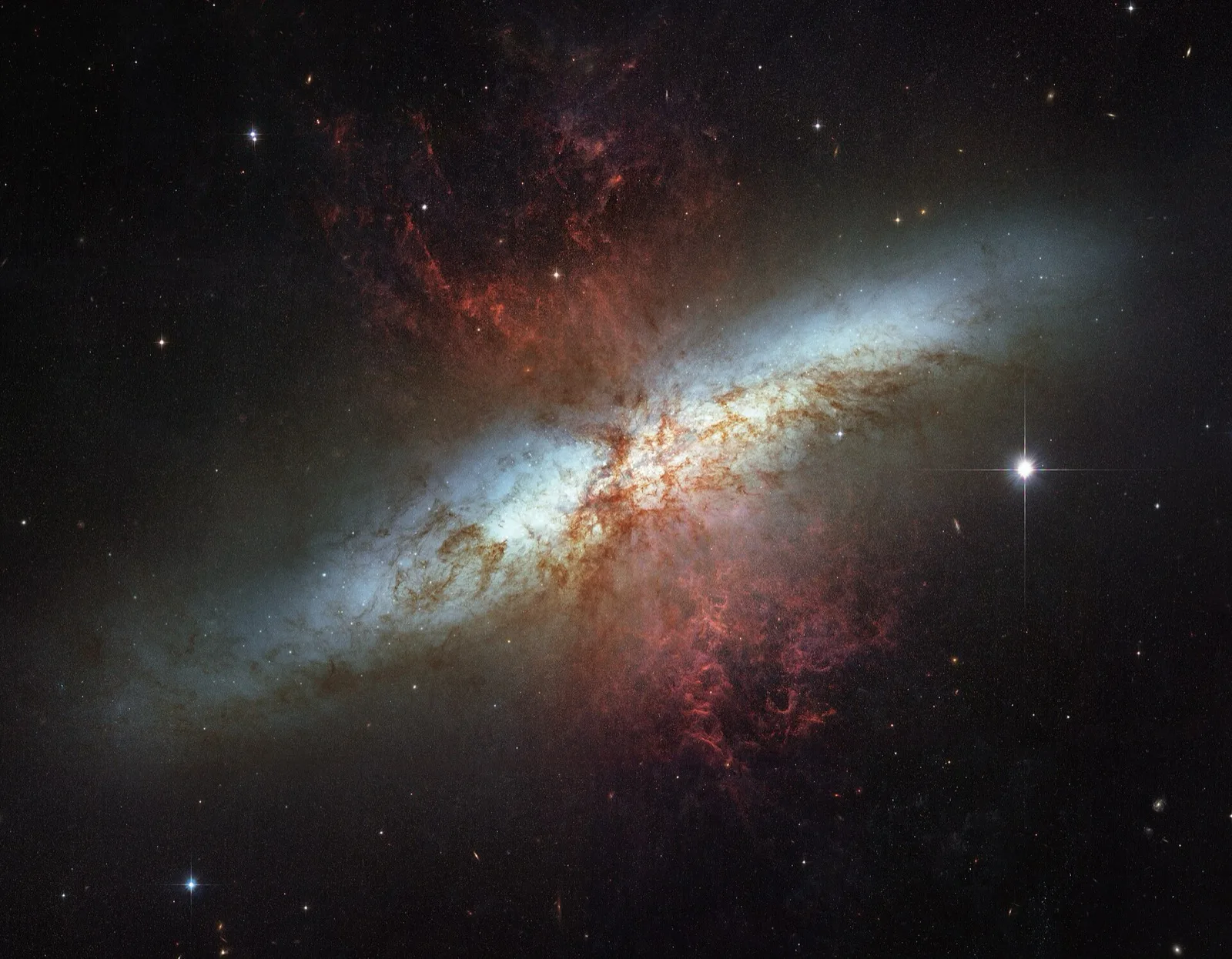
Cigar Galaxy is a galaxy. A whole island of millions to trillions of stars, far outside our Milky Way.
Why the Cigar Galaxy is interesting
What you see: The long bright streak is a disk of stars seen almost edge-on, tilted about 80 degrees. Wispy plumes above and below are gas blown out by a superwind from its busy core. en.wikipedia.org
How it formed: The pull of its big neighbor, Bode's Galaxy (M81), set off a burst of star birth. Near its center, new stars now form 10 times faster than in our whole Milky Way. en.wikipedia.org
To scale: The Cigar Galaxy gives off about five times more light than the whole Milky Way. en.wikipedia.org
Three things to know
- Near its center, new stars are being born 10 times faster than in our whole Milky Way.
- Its burst of star birth was set off by the pull of its big neighbor, Bode's Galaxy (M81).
- In January 2014 astronomers spotted an exploding star, supernova SN 2014J, in the Cigar Galaxy.
12 more fun facts
- Hubble found 197 young, massive star clusters packed into the Cigar Galaxy's core, each averaging about 200,000 times the mass of the Sun. en.wikipedia.org
- The Cigar Galaxy blows a superwind of gas out of its disk, powered by supernovae that go off near its center about once every ten years. en.wikipedia.org
- Webb's 2024 infrared images show clumpy, smoke-like filaments of tiny dust grains rising above and below the Cigar Galaxy, tracing the wind from its core. science.nasa.gov
- In November 2023 a burst of gamma rays was traced to a magnetar in the Cigar Galaxy, the first event of its kind detected outside the Milky Way. en.wikipedia.org
- In 2010 astronomers at Jodrell Bank found a strange radio source in the Cigar Galaxy that seemed to move at about four times the speed of light, an illusion that fast jets can create. en.wikipedia.org
- For a long time the Cigar Galaxy was thought to be irregular, but in 2005 infrared images revealed two hidden spiral arms. en.wikipedia.org
- The Cigar Galaxy gives off about five times more light than the whole Milky Way. en.wikipedia.org
- M82 X-2, a spinning dead star in the Cigar Galaxy, was the brightest pulsar known as of 2014. en.wikipedia.org
- Chandra caught flickering X-rays about 600 light-years from the Cigar Galaxy's center, possibly from a middle-weight black hole of about 200 to 5,000 Suns. en.wikipedia.org
- The Cigar Galaxy's starburst will likely fade within a few tens of millions of years, because it is using up the gas it needs to make new stars. science.nasa.gov
- We see the Cigar Galaxy tilted about 80 degrees, almost edge-on, which is one reason its spiral arms stayed hidden so long. en.wikipedia.org
- The Cigar Galaxy is about 40,800 light-years across, the second-largest galaxy in the M81 Group. en.wikipedia.org
In the game these unlock one by one as you keep photographing the Cigar Galaxy.
At a glance
- Type
- Galaxy
- Catalog
- M82, NGC 3034
- Constellation
- Ursa Major
- Distance
- about 11.4 to 12.4 million light-years
- Brightness
- magnitude 8.41
- Size in our sky
- 11.2 x 4.3 arcminutes
- Discovered
- Johann Elert Bode, 1774
- Position (J2000)
- RA 9h 56m, Dec +69.7°
Looking back in time
The light in this photo left the Cigar Galaxy 11.4 million to 12.4 million years ago, when there were no humans at all: apes lived in the forests of Africa, Europe and Asia.
How to see it yourself
Needs a telescope and a dark sky. Photos show far more than the eye can see.
Finding it: In the Big Dipper, draw a line from Phecda through Dubhe and extend it the same distance again, to a small right triangle of stars. M81 is just southeast of that triangle, and M82 lies just north of M81.
When to look: Best on spring evenings for mid-northern observers; NASA names April as the best month.
What you will see: Not a naked-eye object. In binoculars it is a dim, grayish splinter in the same field as M81, and under dark skies 7x35 binoculars can show its cigar shape. Larger telescopes are needed to see detail in its core.
Easy to confuse with:
- Bode's Galaxy (M81): M81, just to the south, is a wider oval with a bright center, while M82 is a narrow streak that looks evenly dim from end to end.
Best months: February is when it is highest around midnight. About two months later it is highest in the early evening, at around 8 to 9 PM.
Where on Earth: easy from the Northern Hemisphere. South of latitude 10°S it never climbs more than 10° above the horizon. From 20°N and farther north it never sets.
How it is photographed: long exposures through filters, then the frames are stacked, stretched and combined into color.
Name and story
The name: Johann Elert Bode discovered it in 1774, together with M81. Pierre Méchain found it again in 1779 and Charles Messier added it to his catalog as M82; it is also NGC 3034. The nickname Cigar Galaxy describes its long, narrow look, because we see it almost edge-on.
Record: Supernova SN 2014J in the Cigar Galaxy was the closest Type Ia supernova seen since SN 1972E. The 2023 magnetar flare in M82 was the first such event spotted outside the Milky Way.
Explored by: Hubble photographed the Cigar Galaxy in 2006, and in 2024 Webb's NIRCam camera looked into its starburst core. Webb resolved individual points of light that help astronomers count its star clusters, and it showed green specks of concentrated iron, mostly from supernova remnants.
Test yourself
After every photo of the Cigar Galaxy the game asks one of these. A right answer earns sky points for your observatory.
What powers the superwind blowing gas out of the Cigar Galaxy?
- Exploding stars near its center (the answer)
- Wind from our own Sun
- Its spinning spiral arms
Supernovae go off near its center about once every ten years. Their combined blasts drive the gas out above and below the disk. en.wikipedia.org
What lit up in the Cigar Galaxy in January 2014?
- A comet passing in front
- A new moon around M81
- An exploding star, SN 2014J (the answer)
SN 2014J was a supernova, the closest of its kind (Type Ia) seen since 1972, so astronomers could study it in unusual detail. en.wikipedia.org
Point a telescope at the Cigar Galaxy in the game: capture it in real time, then develop the frames like an astrophotographer.
Point a telescope at the Cigar GalaxyMore galaxies
 Andromeda GalaxyM31 · galaxy
 Triangulum GalaxyM33 · galaxy
 Large Magellanic CloudLMC · galaxy
 Small Magellanic CloudSMC · galaxy
Sources
- en.wikipedia.org
- science.nasa.gov
- science.nasa.gov
- astronomy.com
- Positions: astronomy-engine (Don Cross).