 SKY
Sky catalog › Galaxies
Messier 77
M77, NGC 1068 · A galaxy in Cetus
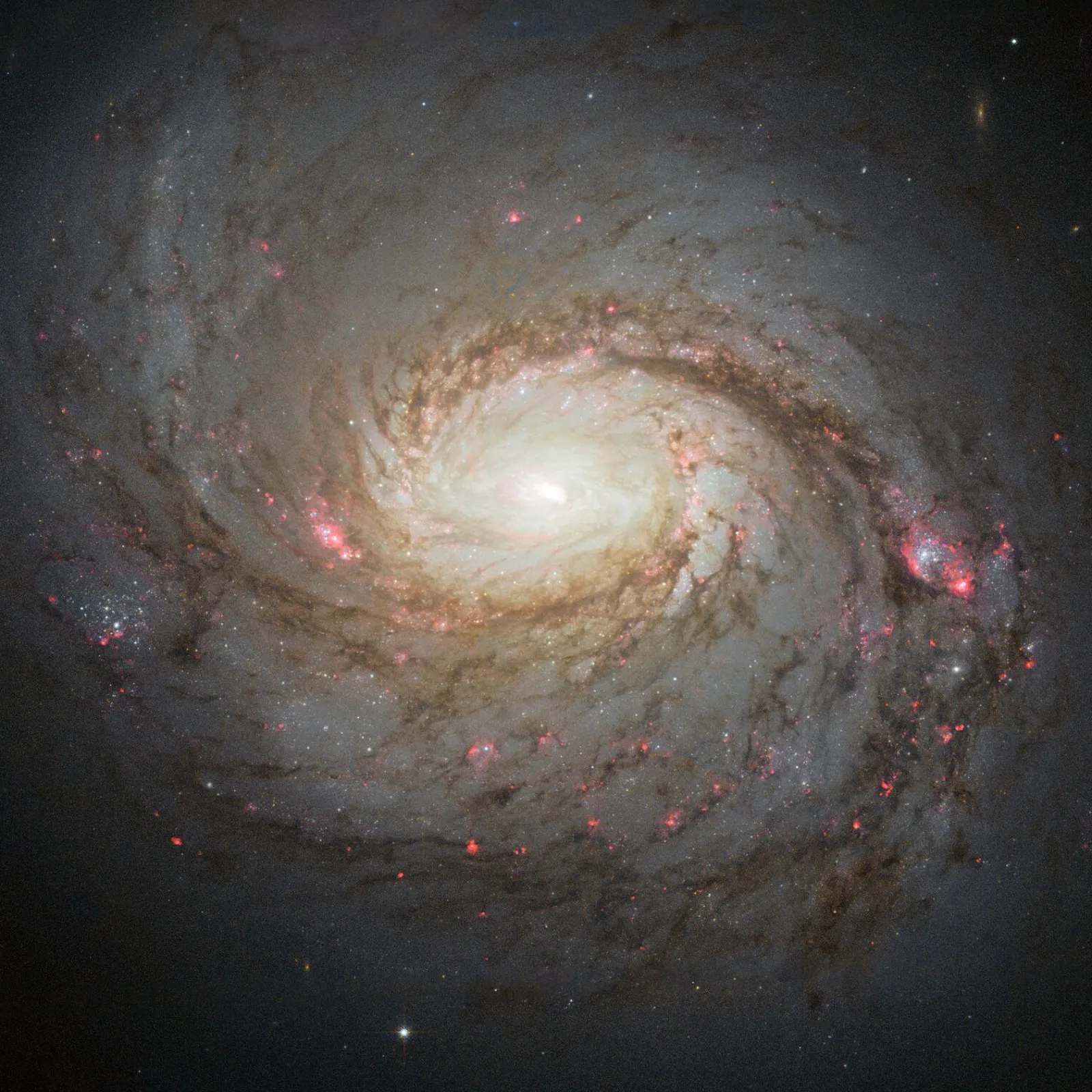
What is it?
Messier 77 is a galaxy. A whole island of millions to trillions of stars, far outside our Milky Way.
Why Messier 77 is interesting
What you see: The bright center is an intensely active core, most likely a supermassive black hole at work. The red and blue streaks mark pockets of new stars along the spiral arms. science.nasa.gov
How it formed: Gas and dust spiral toward the central black hole and release huge amounts of energy. A thick ring of dust around it, heated to as much as about 1,200 °C (2,200 °F), hides the black hole itself. eso.org
To scale: With its faint outer spiral arms, M77 stretches about 170,000 light-years, so light needs about 170,000 years to cross it. astronomy.com
Three things to know
- M77 has a very bright, active center powered by a supermassive black hole that is pulling in matter; it is one of the best-studied galaxies of this kind, called Seyfert galaxies.
- In 2022 the IceCube neutrino observatory reported ghostly particles called neutrinos coming from the heart of M77.
- Both Charles Messier and William Herschel thought it was a star cluster; only much later did astronomers learn it is a whole galaxy.
12 more fun facts
- In 2022 ESO linked all four of its giant 8.2-meter telescopes to map the thick ring of dust hiding M77's black hole. The dust ranges from about room temperature to roughly 1,200 °C (2,200 °F). eso.org
- M77 helped test a 30-year-old idea: that all active galaxy cores share the same build, a black hole wrapped in a thick dusty ring, and only look different because of the angle we see them from. eso.org
- The ALMA radio telescope imaged a doughnut of dust and gas about 20 light-years wide wrapped around the black hole at the heart of M77. astronomy.com
- IceCube data from 2011 to 2020 showed about 79 extra high-energy neutrinos arriving from M77's direction, at least ten times more than its possible gamma-ray glow at similar energies. arxiv.org
- M77's bright inner disk is about as big as our Milky Way, and a faint outer skirt of spiral arms stretches its full size to about 170,000 light-years. astronomy.com
- M77 weighs roughly a trillion times the mass of the Sun, making it one of the biggest galaxies in Messier's catalog. en.wikipedia.org
- M77 sits less than one arcminute south of the celestial equator, the sky's version of Earth's equator. en.wikipedia.org
- Hubble's ultraviolet images of M77's core show its brightness flickering, a sign that a hidden source in the nucleus, most likely a supermassive black hole, is pouring out energy. science.nasa.gov
- Only one supernova has ever been seen in M77: SN 2018ivc, found by the DLT40 survey on November 24, 2018. en.wikipedia.org
- In 1848 Lord Rosse described M77 as a "blue" spiral nebula, long before anyone knew it was a separate galaxy. astronomy.com
- M77 is the largest member of a small group of galaxies that includes the spiral NGC 1055 and five small irregular galaxies. en.wikipedia.org
- The brightest star-forming regions in M77 can be seen in telescopes as small as 4 inches. astronomy.com
In the game these unlock one by one as you keep photographing Messier 77.
At a glance
- Type
- Galaxy
- Catalog
- M77, NGC 1068
- Constellation
- Cetus
- Distance
- about 35 to 45 million light-years (estimates differ)
- Brightness
- magnitude 8.9
- Size in our sky
- 7.1 x 6.0 arcminutes
- Discovered
- Pierre Méchain, 1780
- Position (J2000)
- RA 2h 43m, Dec -0.0°
Looking back in time
The light in this photo left Messier 77 35 million to 45 million years ago, when there were no humans or great apes, and the dinosaurs had already been gone for more than 20 million years.
How to see it yourself
Needs a telescope and a dark sky. Photos show far more than the eye can see.
Finding it: Find Delta Ceti, a 4th-magnitude star in the head of Cetus the Whale, and move about 1 degree southeast. M77 sits just west of a 10th-magnitude star.
When to look: Autumn and early winter evenings, from October to December, with December a good month, when Cetus is well up in the south for northern observers. Because it lies on the celestial equator, it is visible from both hemispheres.
What you will see: Not visible to the naked eye. A small telescope shows a small oval glow with a bright, almost star-like center, which is why early observers mistook it for a star cluster. Moderate telescopes at 150x and higher bring out the brighter inner region, and larger scopes are needed for the faint outer arms.
Easy to confuse with:
- NGC 1055: NGC 1055 is a nearby spiral seen edge-on as a thin streak, while M77 is a rounder glow with a much brighter center.
Best months: November is when it is highest around midnight. About two months later it is highest in the early evening, at around 8 to 9 PM.
Where on Earth: close to the celestial equator, so it can be seen from almost everywhere on Earth.
How it is photographed: long exposures through filters, then the frames are stacked, stretched and combined into color.
Name and story
The name: Pierre Méchain discovered M77 in 1780 and passed it to Charles Messier, who cataloged it as number 77. It is also known as NGC 1068, Cetus A and the Squid Galaxy. It is the prototype of the type 2 Seyfert galaxies, a class named after the astronomer Carl Seyfert.
Record: In 2003 M77 became the first galaxy beyond our own to be studied by long-baseline interferometry in thermal infrared light, using ESO's Very Large Telescope Interferometer in Chile. That first look found a warm dusty structure about 10 light-years across around its black hole.
Explored by: In 2022 the MATISSE instrument on ESO's Very Large Telescope Interferometer in Chile combined infrared light from all four 8.2-meter telescopes to make a thermal map of the dust at M77's core. The team, led by Violeta Gámez Rosas of Leiden University, also used data from the ALMA and VLBA radio telescopes.
Test yourself
After every photo of Messier 77 the game asks one of these. A right answer earns sky points for your observatory.
What hides the black hole at the heart of M77?
- A cloud of comets
- A bright star in front of it
- A thick ring of dust and gas (the answer)
In 2022 ESO linked four giant telescopes to map this dusty ring. It fits the idea that all active galaxy cores look different only because of the angle we see the ring from. eso.org
What did Messier and his fellow astronomers mistake M77 for?
- A double star
- A new planet
- A star cluster or a nebula (the answer)
Its very bright core fooled them. Today M77 is known as a prime example of a Seyfert galaxy, a spiral galaxy with an intensely active center. science.nasa.gov
Point a telescope at Messier 77 in the game: capture it in real time, then develop the frames like an astrophotographer.
Point a telescope at Messier 77More galaxies
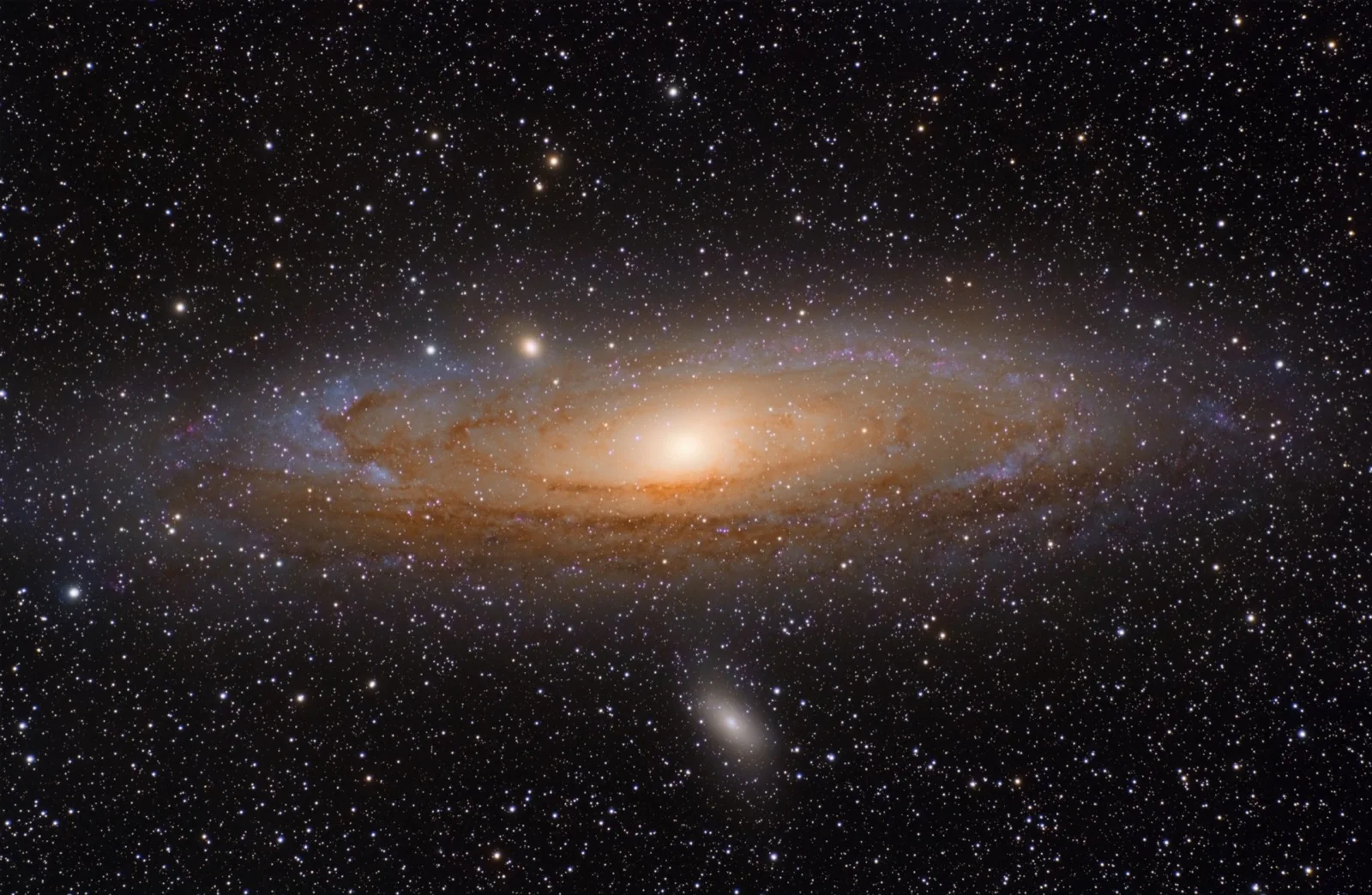 Andromeda GalaxyM31 · galaxy
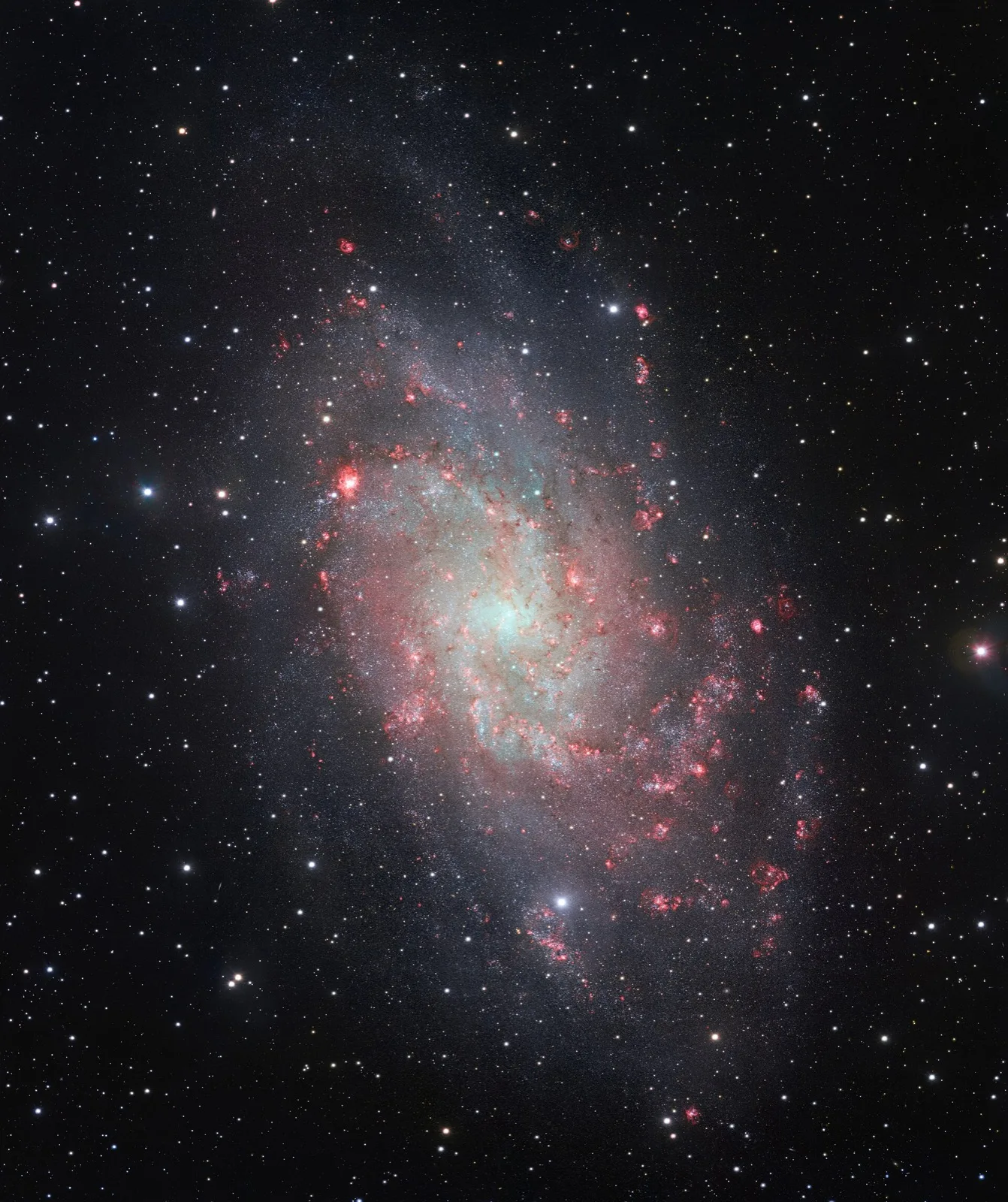 Triangulum GalaxyM33 · galaxy
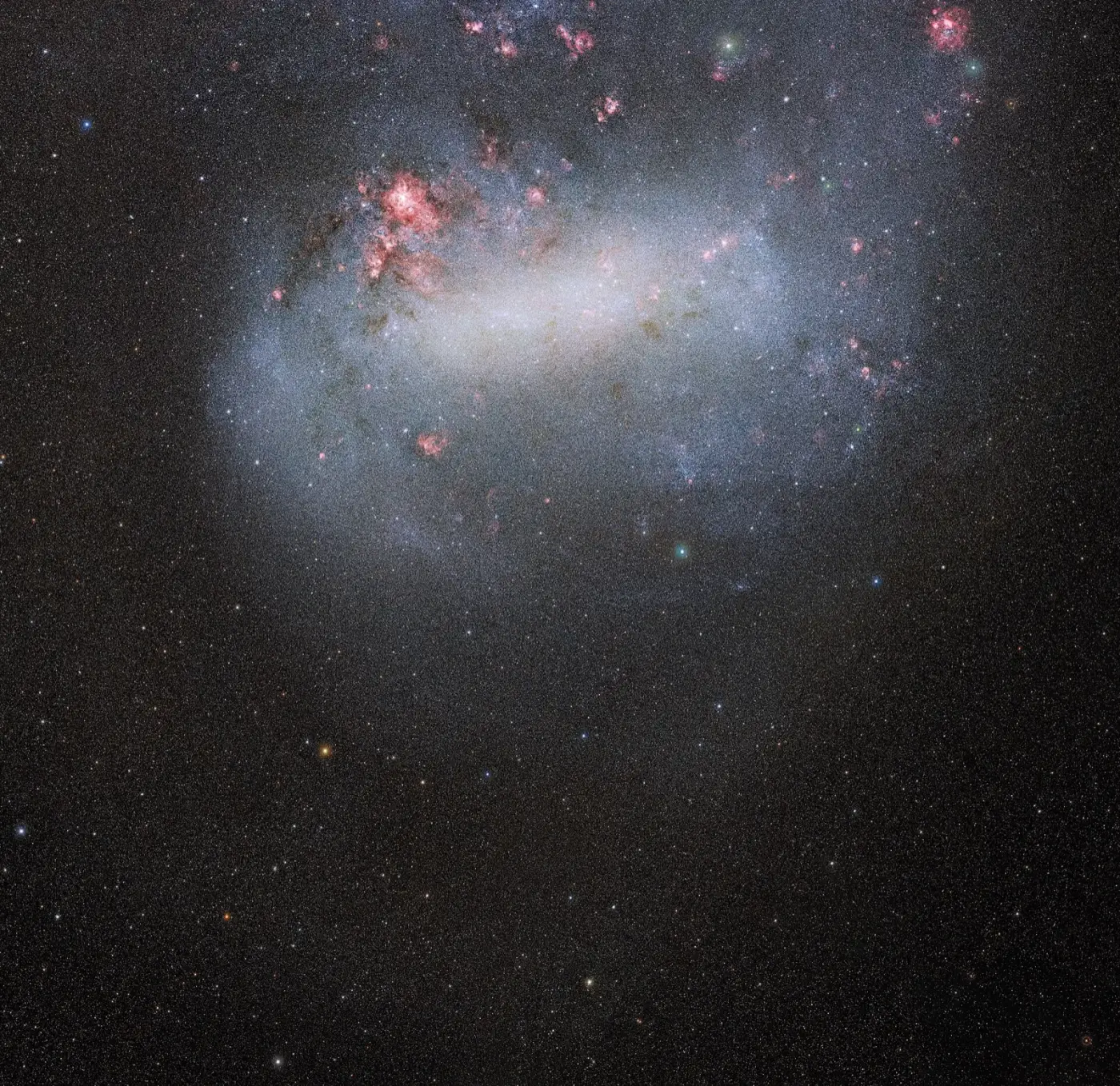 Large Magellanic CloudLMC · galaxy
 Small Magellanic CloudSMC · galaxy
Sources
- en.wikipedia.org
- science.nasa.gov
- eso.org
- astronomy.com
- arxiv.org
- eso.org
- Positions: astronomy-engine (Don Cross).