 SKY
Sky catalog › Nebulae
Little Dumbbell Nebula
M76, NGC 650 and NGC 651 · A planetary nebula in Perseus
What is it?
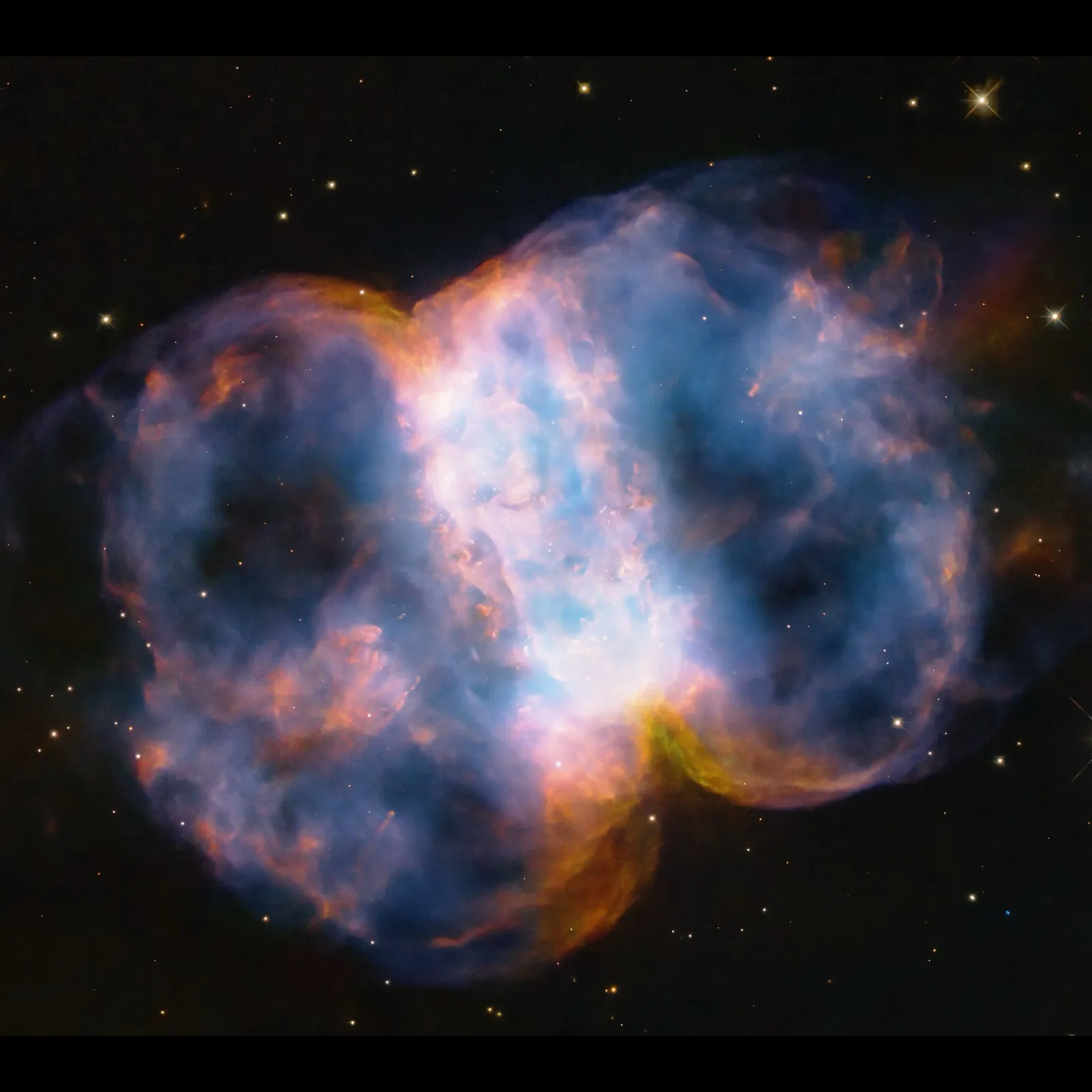
Little Dumbbell Nebula is a planetary nebula. A shell of gas puffed off by a dying Sun-like star. It has nothing to do with planets: early telescopes made it look like a small planet disk.
Why the Little Dumbbell Nebula is interesting
What you see: The bright bar in the middle is a ring of gas seen edge-on, and the two lobes billow out from its openings. Red light comes from nitrogen, blue from oxygen. esahubble.org
How it formed: It is a shell of glowing gas thrown off by a dying red giant star. The ring was probably shaped by a companion star that once circled it. esahubble.org
To scale: Its gas races outward at about 2 million miles per hour, fast enough to travel from Earth to the Moon in a little over seven minutes. esahubble.org
Three things to know
- M76 is the glowing gas thrown off by a dying star, and it gets its name from looking like a smaller version of the Dumbbell Nebula (M27).
- Astronomers once thought it was two separate clouds touching each other, so it has two catalog numbers, NGC 650 and NGC 651.
- It is one of only four planetary nebulae in Messier's catalog, and one of the harder Messier objects to spot in a small telescope.
10 more fun facts
- Gas in M76's lobes is racing outward at about 2 million miles per hour, fast enough to go from Earth to the Moon in just over seven minutes. esahubble.org
- M76 will fade away in about 15,000 years. esahubble.org
- The bright bar across M76's middle is really a ring of gas seen edge-on, and two lobes of hot gas billow out from its top and bottom. esahubble.org
- M76's ring may have been shaped by a companion star that we cannot see, and that companion may later have been swallowed by the dying star. esahubble.org
- Hubble celebrated its 34th birthday in April 2024 with a picture of M76, its lobes glowing in blue oxygen and red nitrogen. esahubble.org
- Pierre Mechain discovered M76 on September 5, 1780, and described it as small and faint, with no stars. astronomy.com
- In 1891 Isaac Roberts suggested that M76 is a ring like the Ring Nebula, simply seen from the side. en.wikipedia.org
- Not until 1918 did Heber Curtis classify M76 as a planetary nebula. en.wikipedia.org
- Compared with the big Dumbbell Nebula, M76 is about three magnitudes fainter and three times smaller on the sky. astronomy.com
- M76's central star is hot and blue but only about magnitude 16, beyond the reach of most backyard telescopes, though cameras can catch it. britastro.org
In the game these unlock one by one as you keep photographing the Little Dumbbell Nebula.
At a glance
- Type
- Planetary nebula
- Catalog
- M76, NGC 650 and NGC 651
- Constellation
- Perseus
- Distance
- about 2,500 to 3,400 light-years (estimates differ)
- Brightness
- magnitude 10.1
- Size in our sky
- 2.7 x 1.8 arcminutes
- Discovered
- Pierre Méchain, 1780
- Position (J2000)
- RA 1h 42m, Dec +51.6°
Looking back in time
The light in this photo left the Little Dumbbell Nebula 2,500 to 3,400 years ago, when the Greek and Roman world watched this same sky; Greek thinkers worked out from the round shadow on the Moon during eclipses that the Earth is a ball.
How to see it yourself
Needs a telescope and a dark sky. Photos show far more than the eye can see.
Finding it: It is in Perseus near the border with Andromeda. Find 4th-magnitude, yellowish Phi Persei; M76 is less than 1 degree north-northwest of it, best found at moderate magnification.
When to look: Best on autumn and winter evenings from mid-northern latitudes; NASA suggests December.
What you will see: Not visible to the naked eye; large binoculars from a dark site may just show it. In a small telescope it is a small, faint glow, sometimes a little rectangle split by a narrow dark lane. Telescopes of 8 inches or more show its double-lobed shape.
Easy to confuse with:
- Dumbbell Nebula (M27): M27 is a big, bright summer object in Vulpecula, while M76 is a small, faint autumn object in Perseus.
Best months: October is when it is highest around midnight. About two months later it is highest in the early evening, at around 8 to 9 PM.
Where on Earth: easy from the Northern Hemisphere. South of latitude 28°S it never climbs more than 10° above the horizon. From 38°N and farther north it never sets.
This month: one of the best evening targets in the night sky in November 2026.
How it is photographed: long exposures through filters, many hours in total, which is why the game sends it to a big observatory mirror. then the frames are stacked, stretched and combined into color.
Name and story
The name: It is called the Little Dumbbell because it looks like a smaller version of the Dumbbell Nebula, M27. It is also known as the Cork Nebula and the Barbell Nebula. Pierre Mechain discovered it in 1780, and Charles Messier listed it as number 76.
Record: M76's central star, now collapsing into a white dwarf, is one of the hottest known stellar remnants, at about 120,000 degrees Celsius (about 216,000 degrees Fahrenheit), some 24 times hotter than the surface of the Sun.
Explored by: Hubble photographed M76 for its 34th anniversary in 2024, showing both lobes glowing in red nitrogen and blue oxygen around a white dot of a central star. An earlier Hubble image, made with Wide Field and Planetary Camera 2 and Wide Field Camera 3, showed only one half of the nebula.
Test yourself
After every photo of the Little Dumbbell Nebula the game asks one of these. A right answer earns sky points for your observatory.
What is the bright bar across the middle of M76?
- A ring of gas seen from the side (the answer)
- Two stars crashing into each other
- A dust cloud passing in front
Seen edge-on, a ring of gas looks like a straight bar, just as a coin looks like a line from its side. Lobes of hot gas billow out from its openings. esahubble.org
Why does M76 have two catalog numbers, NGC 650 and 651?
- It was once thought to be two clouds (the answer)
- Two people found it the same night
- It has two dying central stars
Its two bright halves looked like separate clouds touching each other, so each got a number. In 1918 Heber Curtis classified it as one planetary nebula. en.wikipedia.org
Point a telescope at the Little Dumbbell Nebula in the game: capture it in real time, then develop the frames like an astrophotographer.
Point a telescope at the Little Dumbbell NebulaMore nebulae
 Orion NebulaM42 · star-forming nebula
 Lagoon NebulaM8 · star-forming nebula
 Trifid NebulaM20 · star-forming nebula
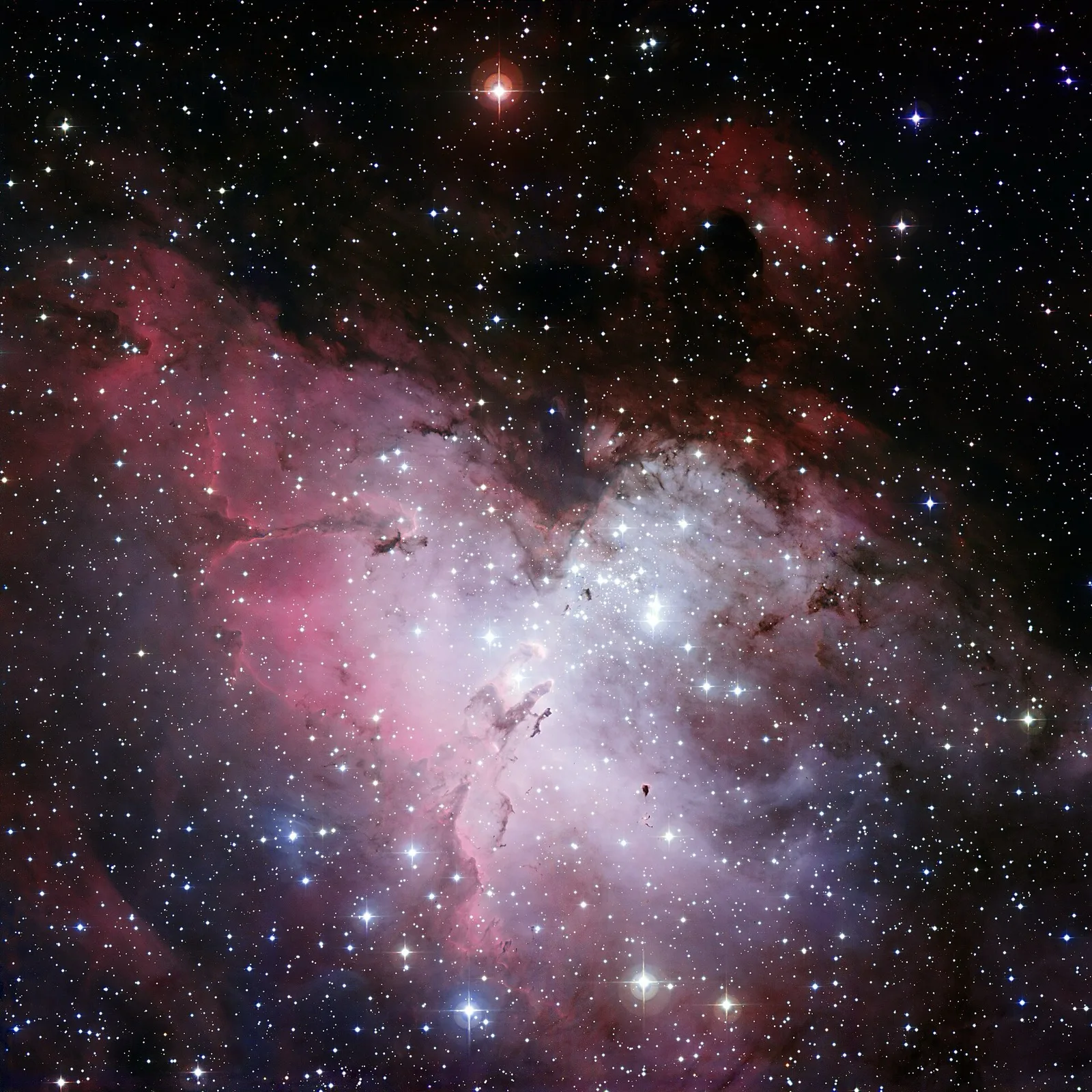 Eagle NebulaM16 · star-forming nebula
Sources
- en.wikipedia.org
- science.nasa.gov
- esahubble.org
- astronomy.com
- britastro.org
- Positions: astronomy-engine (Don Cross).