 SKY
Sky catalog › Galaxies
Phantom Galaxy
M74, NGC 628 · A galaxy in Pisces
What is it?
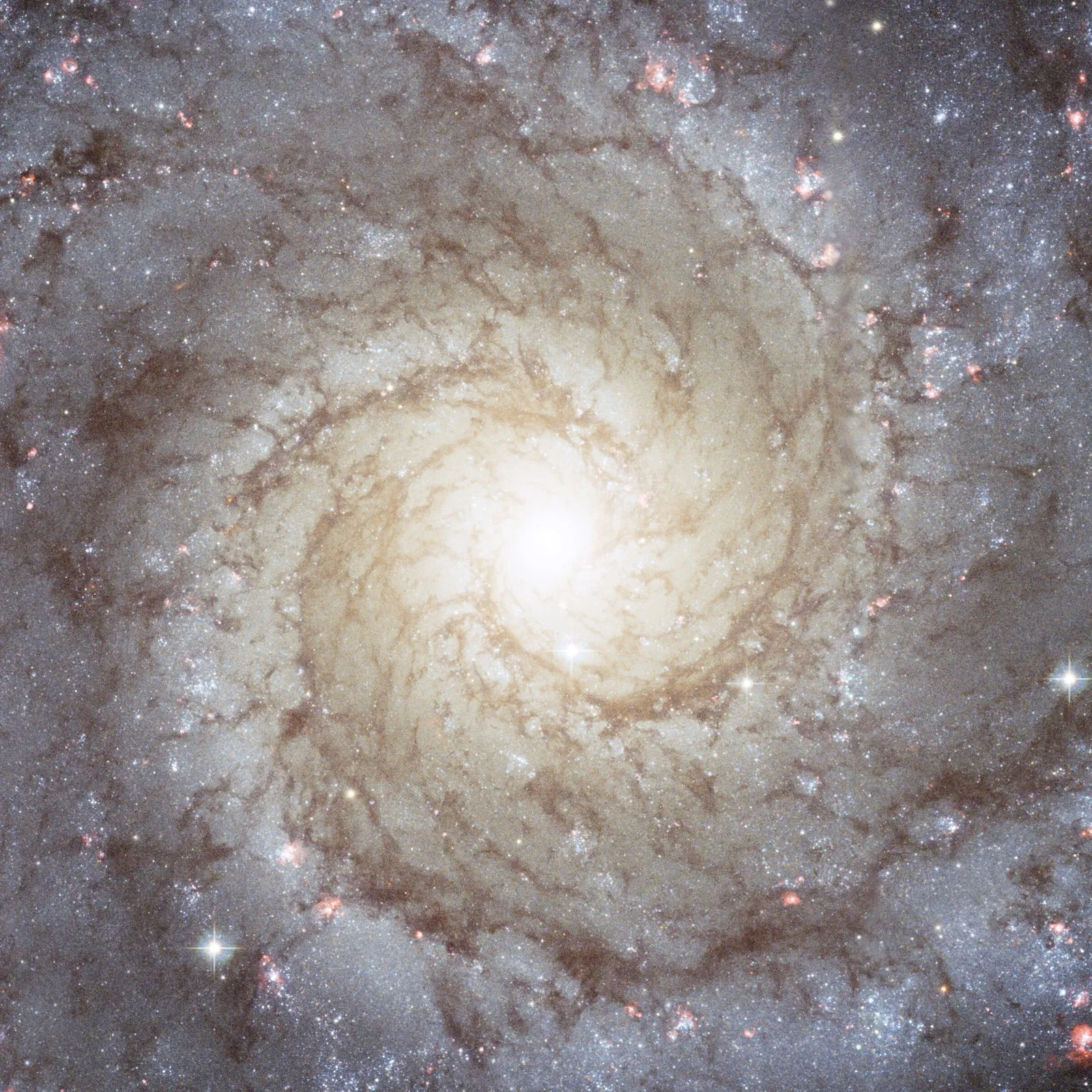
Phantom Galaxy is a galaxy. A whole island of millions to trillions of stars, far outside our Milky Way.
Why the Phantom Galaxy is interesting
What you see: The two curving arms are lined with clusters of young blue stars and pink glowing clouds of hydrogen, where new stars are being born. science.nasa.gov
How it formed: Dust and gas pile up in long threads along its two spiral arms. Where the gas is densest, new stars can form. spitzer.caltech.edu
To scale: M74 is about 85,300 light-years across, so light needs about 85,300 years to cross it. We see it almost perfectly face-on. en.wikipedia.org
Three things to know
- M74 is a textbook 'grand design' spiral: two clear, curving arms wind out from its center.
- Its light is spread so thinly that it is one of the hardest Messier objects for backyard stargazers to see.
- Three supernovae, exploding stars, have been seen in M74, in 2002, 2003 and 2013.
12 more fun facts
- In 2005 NASA's Chandra X-ray telescope caught an X-ray source in M74 that brightens and dims about every two hours. It may be a rare middle-sized black hole of around 10,000 Suns. en.wikipedia.org
- Webb's 2022 infrared portrait of M74 showed delicate threads of gas and dust winding through its arms, and a clear view of the dense star cluster at its very center. esa.int
- M74 holds about 100 billion stars, making it a little smaller than our Milky Way. sci.esa.int
- Supernova SN 2002ap, found in M74 by Yoji Hirose on January 29, 2002, became the brightest supernova of that year. en.wikipedia.org
- After supernova SN 2003gd faded in M74, astronomer Ben Sugerman found a light echo: its flash bouncing off dust clouds and reaching us later. en.wikipedia.org
- M74 is about 85,300 light-years across, and we see it almost perfectly face-on. en.wikipedia.org
- On the sky M74 is about 10 arcminutes wide, roughly a third the width of the full Moon. spitzer.caltech.edu
- In Spitzer's infrared view, dust in M74 glows red in long threads along the spiral arms, marking where gas is densest and new stars can form. spitzer.caltech.edu
- Hubble's famous 2007 picture of M74 was stitched from images taken in 2003 and 2005, with one small missing patch filled in using data from ground-based telescopes. sci.esa.int
- M74's arms are lined with clusters of young blue stars and pink glowing clouds of hydrogen where new stars are being born. science.nasa.gov
- M74 is the brightest member of a small family of 5 to 7 galaxies called the M74 Group. en.wikipedia.org
- Webb studied M74 as one of 19 nearby star-forming galaxies charted in infrared by the international PHANGS team. esa.int
In the game these unlock one by one as you keep photographing the Phantom Galaxy.
At a glance
- Type
- Galaxy
- Catalog
- M74, NGC 628
- Constellation
- Pisces
- Distance
- about 32 million light-years
- Brightness
- magnitude 9.4
- Size in our sky
- 10.5 x 9.5 arcminutes
- Discovered
- Pierre Méchain, 1780
- Position (J2000)
- RA 1h 37m, Dec +15.8°
Looking back in time
The light in this photo left the Phantom Galaxy about 32 million years ago, when there were no humans or great apes, and the dinosaurs had already been gone for more than 20 million years.
How to see it yourself
Needs a telescope and a dark sky. Photos show far more than the eye can see.
Finding it: M74 lies in Pisces about 1.5 degrees east-northeast of the star Eta Piscium. Center Eta Piscium at low power and nudge the telescope a short way east-northeast.
When to look: Autumn evenings, with November the best month, when Pisces is well up in the south for northern observers.
What you will see: Not visible to the naked eye. Its light is spread so thinly that even in a small telescope it is only a faint, diffuse patch. It is best seen from a dark site at low magnification, using averted vision (looking slightly to one side) after your eyes have fully adjusted to the dark.
Best months: October is when it is highest around midnight. About two months later it is highest in the early evening, at around 8 to 9 PM.
Where on Earth: easy from the Northern Hemisphere. South of latitude 64°S it never climbs more than 10° above the horizon.
This month: one of the best evening targets in the night sky in November 2026.
How it is photographed: long exposures through filters, many hours in total, which is why the game sends it to a big observatory mirror. then the frames are stacked, stretched and combined into color.
Name and story
The name: ESA/Hubble describes M74 as having the lowest surface brightness of any object in Messier's catalog, which is why it got the nickname Phantom Galaxy: amateurs find it hard to spot. Pierre Méchain discovered it in 1780, and weeks later Charles Messier added it to his catalog.
Record: Supernova SN 2002ap in M74 reached magnitude 12.3 and was the brightest supernova of 2002. Some sources rank M74 as having the second-lowest surface brightness of all Messier objects, after the Pinwheel Galaxy, M101.
Explored by: In August 2022 ESA published a Webb image of M74 taken with its Mid-InfraRed Instrument, part of the PHANGS project charting 19 nearby star-forming galaxies in infrared. Hubble had already revealed its bright star-forming regions, and ground-based radio telescopes such as ALMA add more data.
Test yourself
After every photo of the Phantom Galaxy the game asks one of these. A right answer earns sky points for your observatory.
Why is M74 nicknamed the Phantom Galaxy?
- Its faint glow is very hard to spot (the answer)
- It shows up only in X-ray light
- It vanished from old star maps
Its light is spread so thinly that ESA/Hubble calls its surface brightness the lowest in Messier's catalog, so backyard observers often miss it. sci.esa.int
What did astronomers spot after supernova SN 2003gd faded?
- A new planet taking shape
- A light echo off dust clouds (the answer)
- A second Sun beside it
Some of the blast's light bounced off dust clouds and took a longer path to us, so it arrived later as an echo after the supernova itself had faded. en.wikipedia.org
Point a telescope at the Phantom Galaxy in the game: capture it in real time, then develop the frames like an astrophotographer.
Point a telescope at the Phantom GalaxyMore galaxies
 Andromeda GalaxyM31 · galaxy
 Triangulum GalaxyM33 · galaxy
 Large Magellanic CloudLMC · galaxy
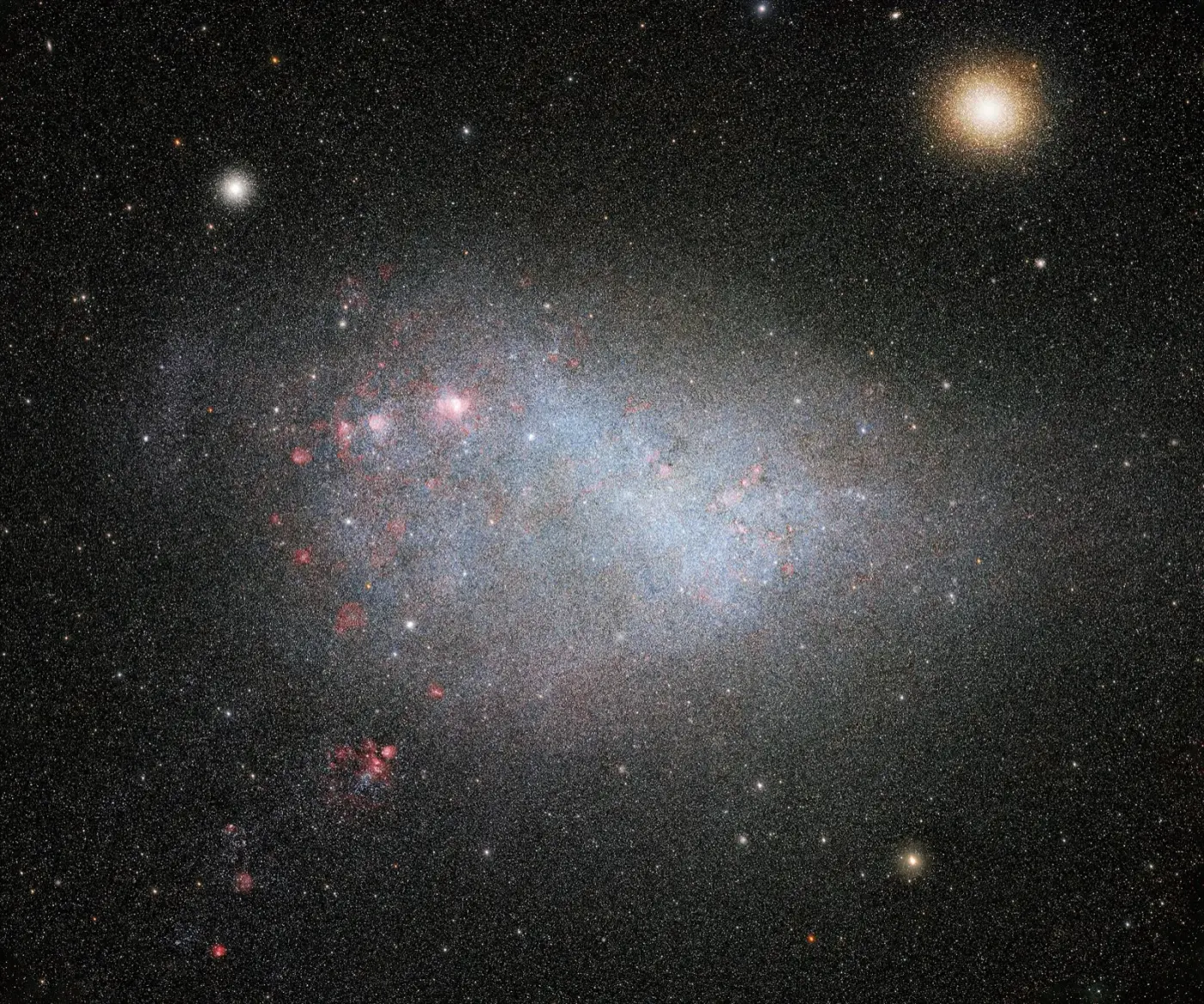 Small Magellanic CloudSMC · galaxy
Sources
- en.wikipedia.org
- science.nasa.gov
- esa.int
- sci.esa.int
- spitzer.caltech.edu
- Positions: astronomy-engine (Don Cross).