 SKY
Sky catalog › Star clusters
Ptolemy Cluster
M7, NGC 6475 · An open star cluster in Scorpius
What is it?
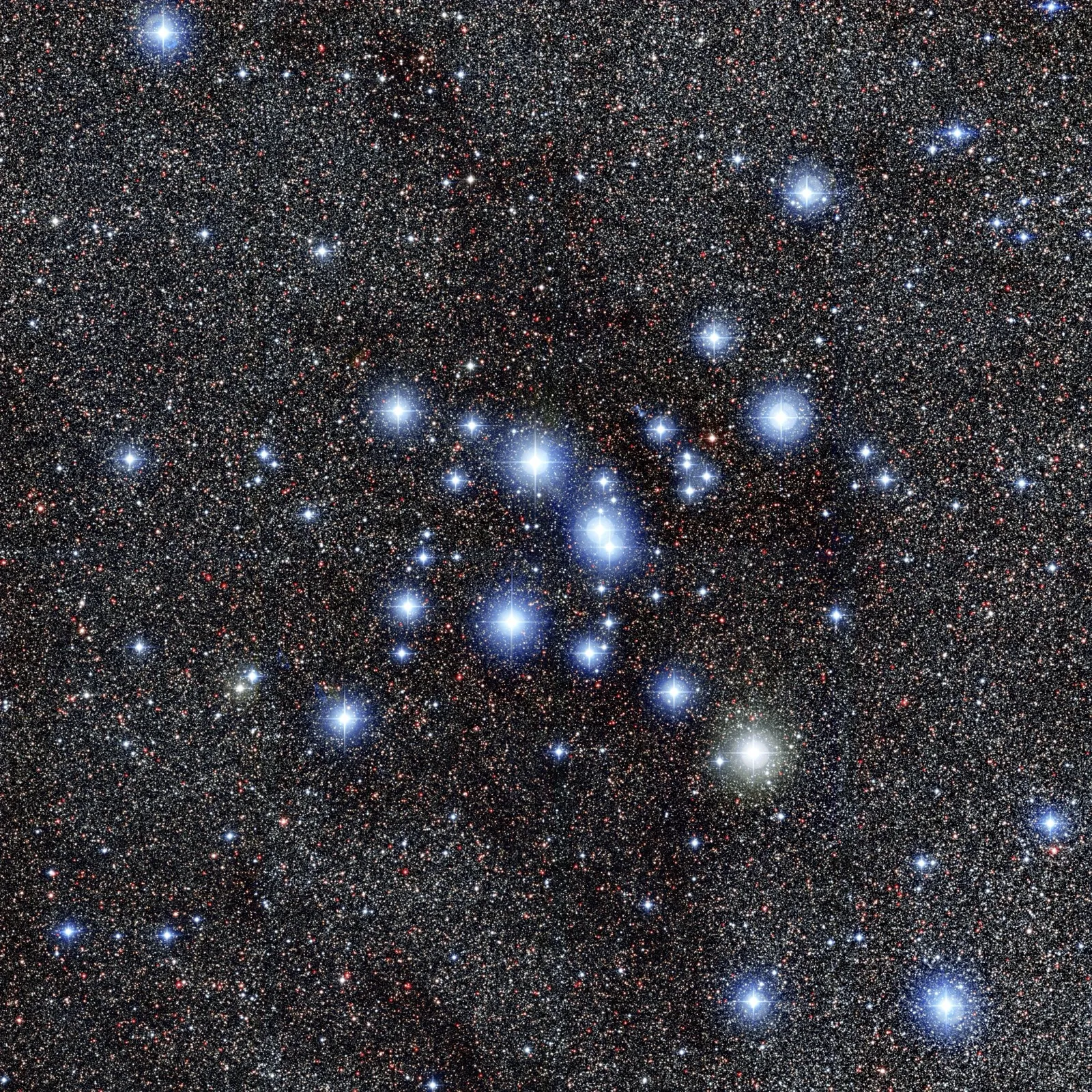
Ptolemy Cluster is an open star cluster. A family of young stars born together from the same cloud of gas.
Why the Ptolemy Cluster is interesting
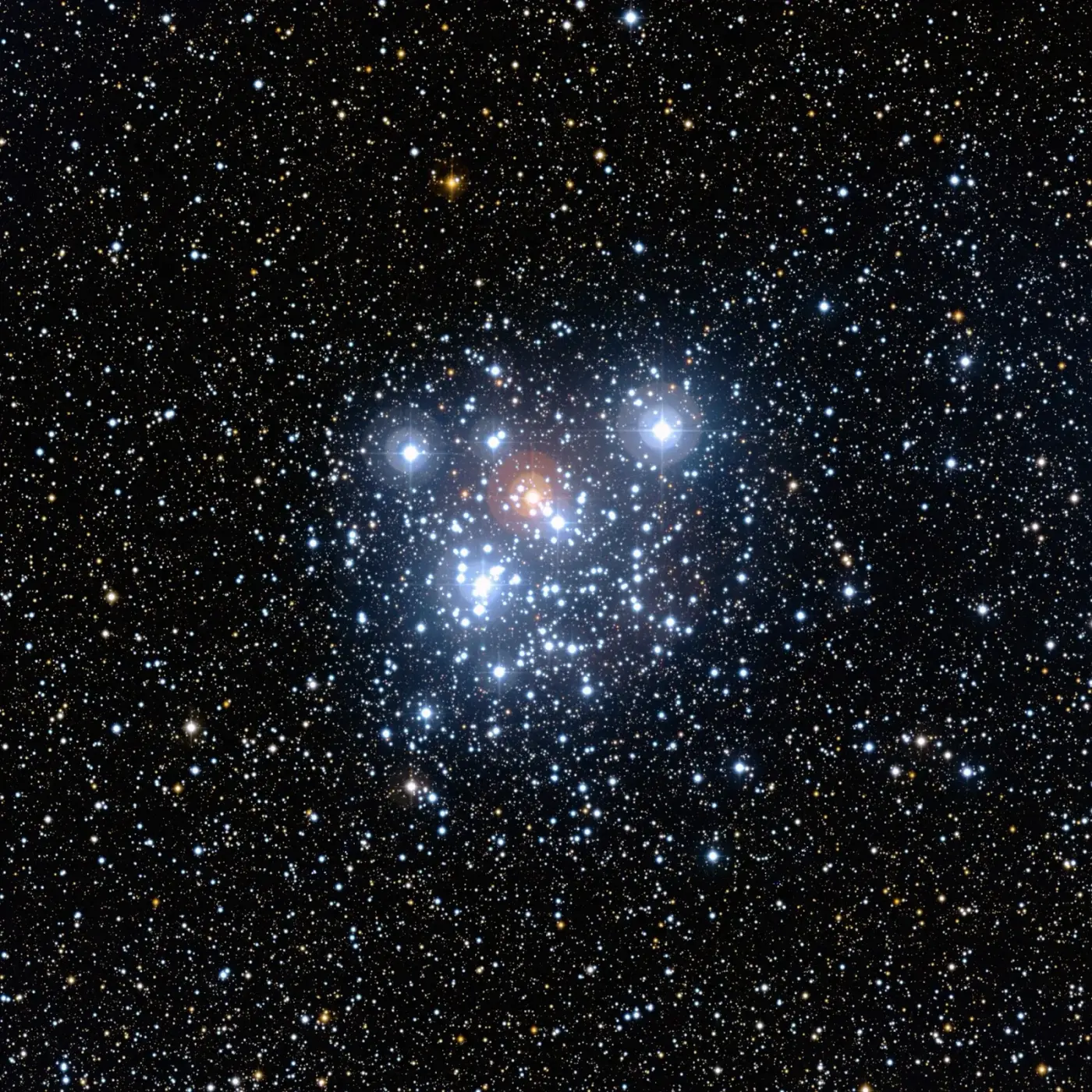
What you see: The bright, scattered stars are the cluster itself. Behind them lie hundreds of thousands of fainter stars and dark dust streaks, because we are looking toward the center of the Milky Way. eso.org
How it formed: Its stars were born at almost the same time and place, about 200 million years ago. Its many faint stars will slowly drift apart until the cluster can no longer be recognized. eso.org
To scale: M7 fills a region of space about 25 light-years across, so even light needs about 25 years to cross it. eso.org
Three things to know
- M7 has been known since ancient times: the Greek-Roman astronomer Ptolemy described it around 130 AD, which is why it is called Ptolemy's Cluster.
- It is the southernmost object in Messier's catalog, and you can see it with the naked eye near the stinger of Scorpius.
- In 2006 the Pluto-bound New Horizons spacecraft took the first test picture with its long-range camera, and the target was M7.
12 more fun facts
- Behind M7 lie hundreds of thousands of fainter stars, because we are looking toward the crowded center of the Milky Way. eso.org
- The dark streaks of dust behind M7 are not left over from its birth. They just happen to line up with the cluster, since the galaxy has turned almost once since M7 formed. eso.org
- The most massive stars of M7, up to a tenth of its members, are expected to end their lives as supernova explosions. eso.org
- M7 will not last forever. Its many fainter stars will slowly drift apart until the cluster can no longer be recognized. eso.org
- At about 200 million years old, M7 counts as a typical middle-aged open cluster. eso.org
- Giovanni Battista Hodierna counted 30 stars in M7 with his telescope, sometime before 1654. en.wikipedia.org
- The stars of M7 together have about 735 times the mass of the Sun. en.wikipedia.org
- Every star in M7 brighter than about magnitude 8 has already swollen into a giant, a sign that the cluster is no longer young. en.wikipedia.org
- Only about 80 stars stand out in the main part of M7, but more than 1,000 likely members are spread across several degrees of sky. en.wikipedia.org
- John Herschel described M7 in the 1800s as a coarsely scattered cluster of stars. eso.org
- The cluster spans a region of space about 25 light-years across. eso.org
- M7's stars have a mix of elements very similar to the Sun's. en.wikipedia.org
In the game these unlock one by one as you keep photographing the Ptolemy Cluster.
At a glance
- Type
- Open star cluster
- Catalog
- M7, NGC 6475
- Constellation
- Scorpius
- Distance
- about 980 light-years
- Brightness
- magnitude 3.3
- Size in our sky
- about 80 arcminutes (about 1.3 degrees)
- Discovered
- Ptolemy, around 130 AD
- Position (J2000)
- RA 17h 54m, Dec -34.8°
Looking back in time
The light in this photo left the Ptolemy Cluster about 980 years ago, when the Maya were building great stone cities in Central America.
How to see it yourself
Visible to the naked eye from a dark site. Binoculars show it well, and a small telescope shows more detail.
Finding it: Find the J-shaped tail of Scorpius and its two stinger stars, Shaula and Lesath. Draw a line from Lesath through Shaula and continue a few degrees to reach M7, a bright patch between Scorpius and Sagittarius.
When to look: M7 is a summer object for northern observers and stands highest around 10 p.m. in July. From the northern U.S. and Canada it stays low in the south, while from southern latitudes it rides high and is easy.
What you will see: With a magnitude of 3.3, M7 is easy to see with the naked eye as a hazy spot on a dark, moonless night. Binoculars show it best: a large, loose spray of bright stars set against the rich Milky Way and its dark dust lanes. It is so wide, more than twice the width of the full Moon, that a telescope should be used at its lowest power.
Easy to confuse with:
- Butterfly Cluster (M6): M6 is smaller, fainter and more compact, about 3 degrees northwest, while M7 is the bigger, brighter and looser cluster closer to the stinger.
Best months: June is when it is highest around midnight. About two months later it is highest in the early evening, at around 8 to 9 PM.
Where on Earth: best from the Southern Hemisphere. North of latitude 45°N it never climbs more than 10° above the horizon. South of 55°S it never sets.
How it is photographed: long exposures through filters, then the frames are stacked, stretched and combined into color.
Name and story
The name: It is often called Ptolemy's Cluster because the astronomer Ptolemy described it around 130 AD as a nebula following the sting of Scorpius. Charles Messier added it to his catalog in 1764 as the seventh entry, and it is also known as NGC 6475.
Record: At a declination of about 35 degrees south, M7 is the southernmost object in Messier's catalog.
Explored by: On August 29, 2006, NASA's New Horizons spacecraft, on its way to Pluto, used M7 as the target of the first-light image from its LORRI telescope. Lists of the cluster's member stars today rely on precise measurements from ESA's Gaia mission.
Test yourself
After every photo of the Ptolemy Cluster the game asks one of these. A right answer earns sky points for your observatory.
Why are so many faint stars and dark streaks seen behind M7?
- We look toward our galaxy's center (the answer)
- They are dust left over from M7's birth
- They are M7's own baby stars
M7 lies in the direction of the Milky Way's crowded center, so a rich field of distant stars fills the view. The dust streaks only line up by chance. eso.org
Which spacecraft aimed its first test picture at M7 in 2006?
- Voyager 1, leaving the planets
- New Horizons, on its way to Pluto (the answer)
- Apollo 11, bound for the Moon
On August 29, 2006, the Pluto-bound New Horizons used M7 for the first-light image of its long-range LORRI telescope. en.wikipedia.org
Point a telescope at the Ptolemy Cluster in the game: capture it in real time, then develop the frames like an astrophotographer.
Point a telescope at the Ptolemy ClusterMore star clusters
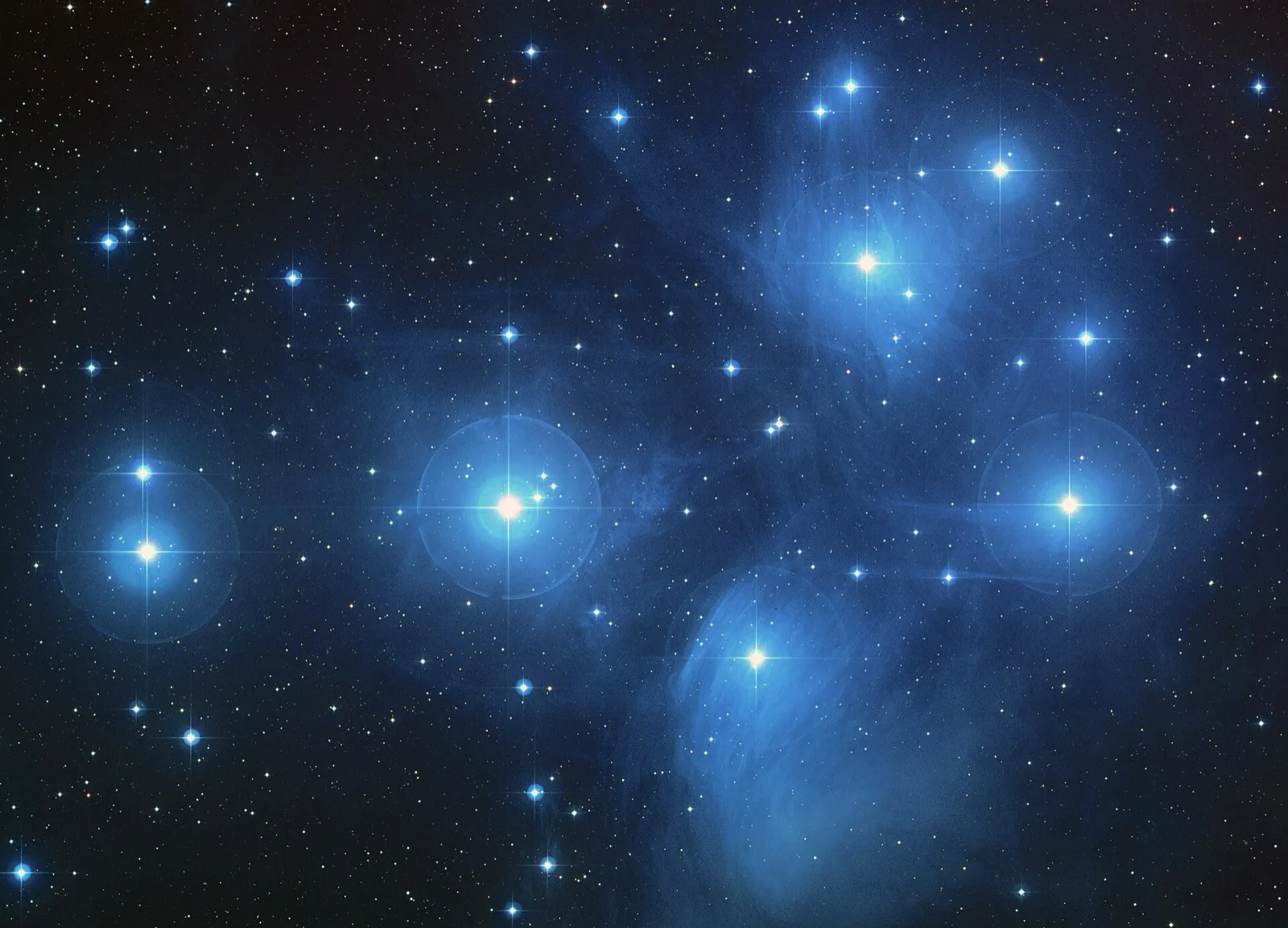 The PleiadesM45 · open star cluster
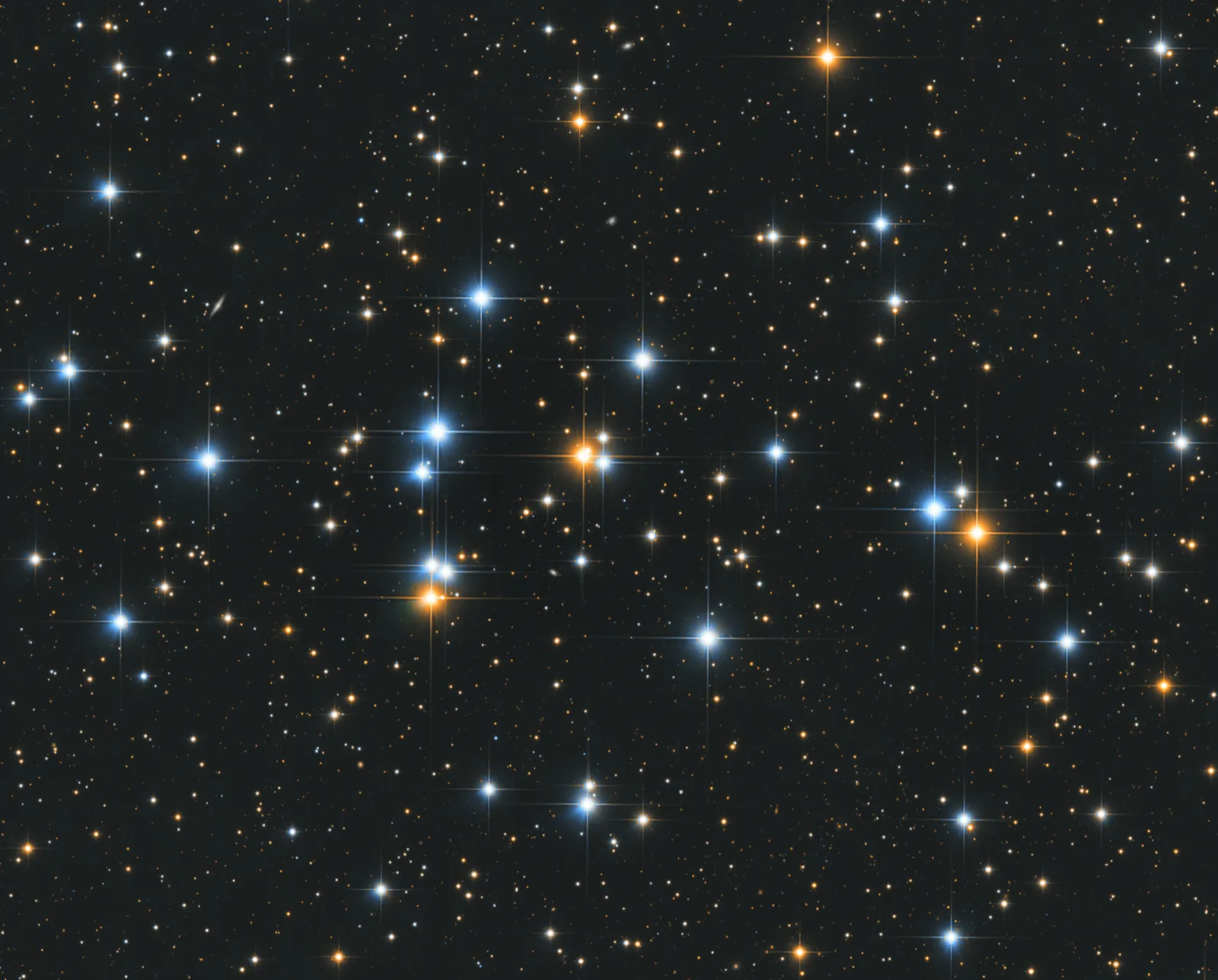 Beehive ClusterM44 · open star cluster
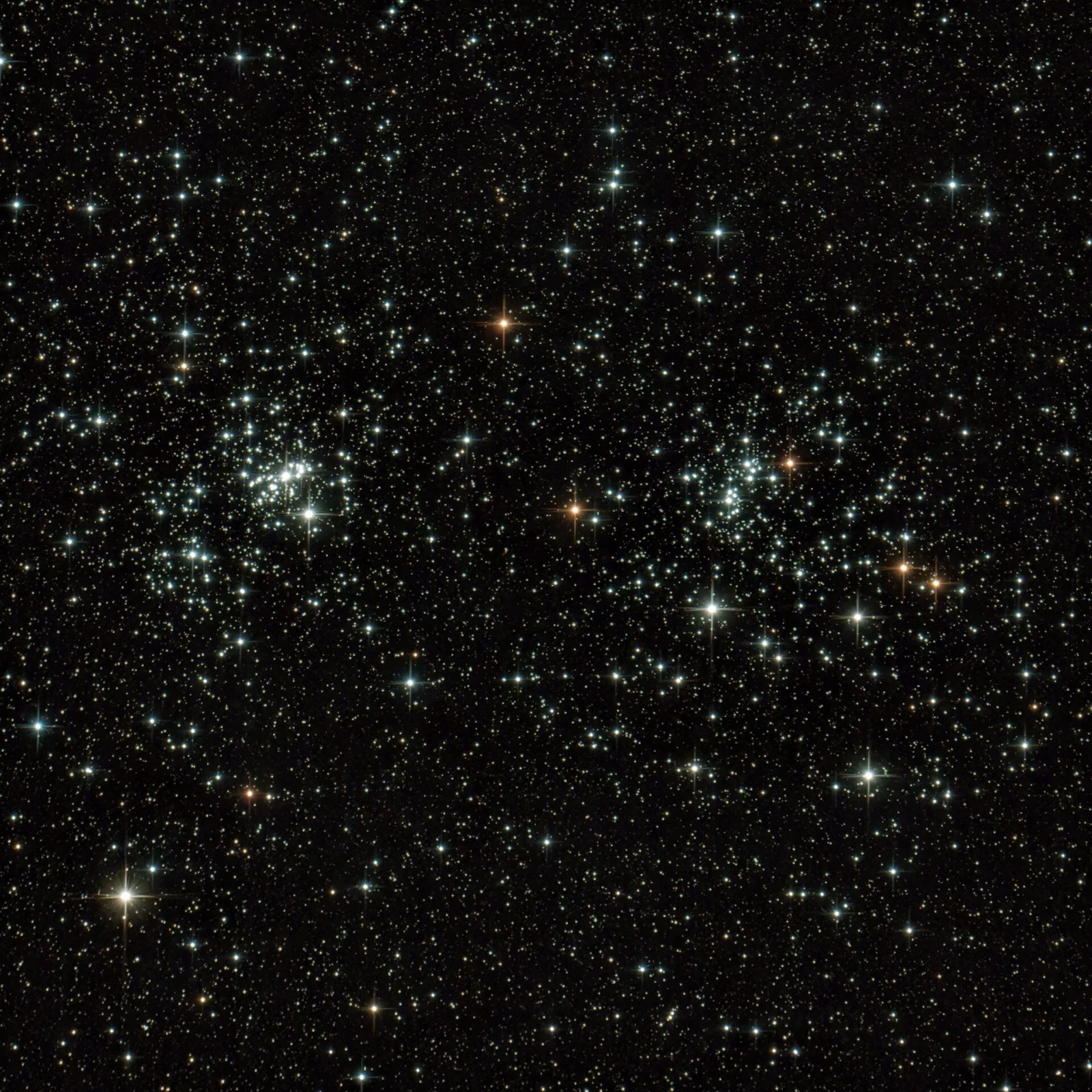 Double ClusterNGC 869 · open star cluster
 Jewel BoxNGC 4755 · open star cluster
Sources
- en.wikipedia.org
- science.nasa.gov
- eso.org
- earthsky.org
- Positions: astronomy-engine (Don Cross).