 SKY
Sky catalog › Galaxies
Black Eye Galaxy
M64, NGC 4826 · A galaxy in Coma Berenices
What is it?
Black Eye Galaxy is a galaxy. A whole island of millions to trillions of stars, far outside our Milky Way.
Why the Black Eye Galaxy is interesting
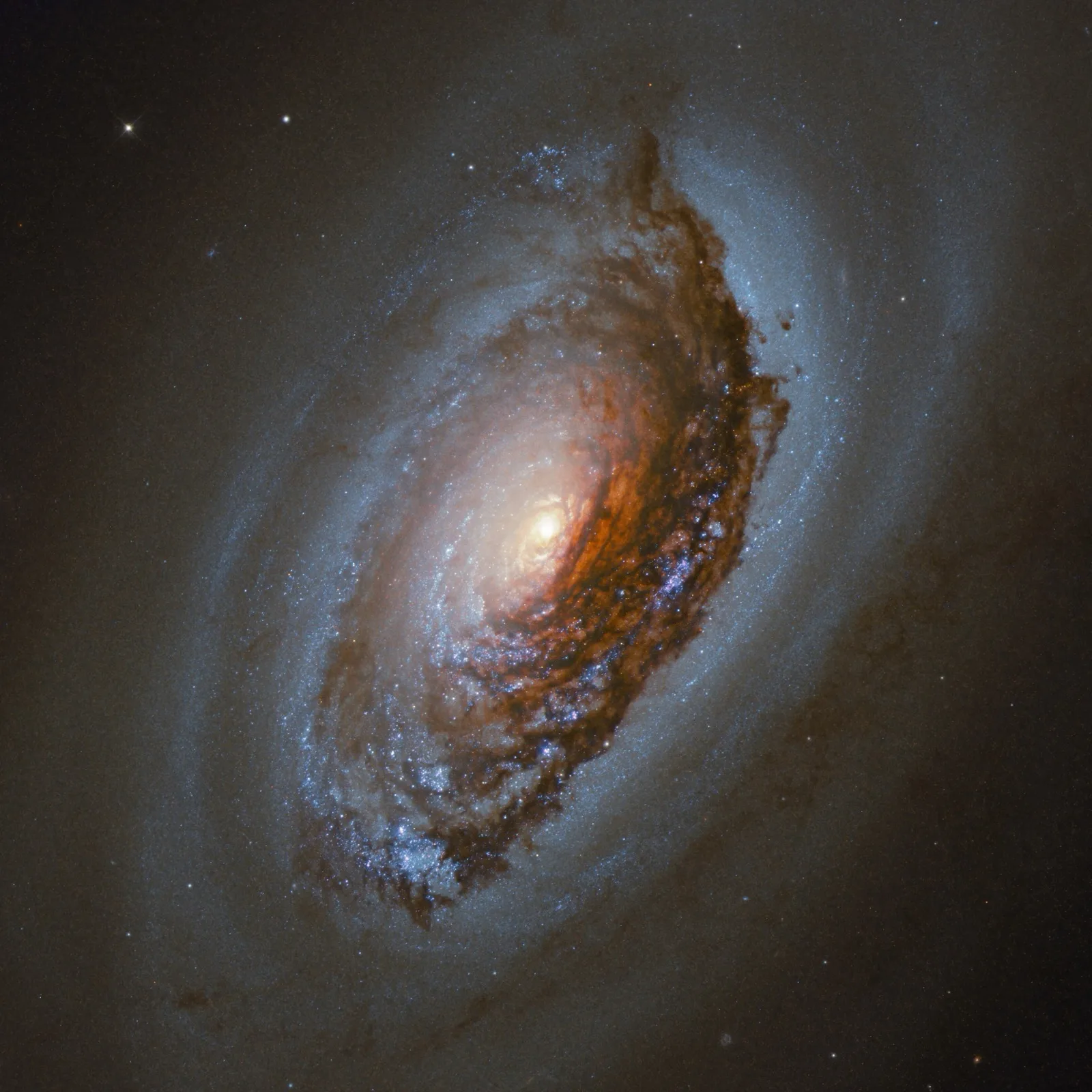
What you see: The bright center is crossed by a band of dark dust that partly hides the core, which is why the galaxy looks like a black eye. science.nasa.gov
How it formed: Its outer gas spins the opposite way, perhaps after a merger with a small satellite galaxy over a billion years ago. Where the opposing gases collide and are compressed, new stars form. science.nasa.gov
To scale: The Black Eye Galaxy is about 53,800 light-years across, so light needs about 53,800 years to cross it. en.wikipedia.org
Three things to know
- A dark band of dust in front of its bright center makes it look like a black eye, which is how it got its name.
- The gas in its outer parts spins the opposite way from the gas and stars in its inner parts.
- Astronomers think that strange spin may come from a merger with a smaller galaxy more than a billion years ago.
12 more fun facts
- Where the two oppositely spinning streams of gas collide, they get squeezed, and that squeeze is sparking new stars. Hubble shows them as hot blue stars beside pink clouds of glowing hydrogen. science.nasa.gov
- Johann Elert Bode found it just twelve days after Edward Pigott did in 1779, and he described it as a "small nebulous star." astronomy.com
- The Black Eye Galaxy holds roughly 100 billion stars and stretches about 53,800 light-years across. en.wikipedia.org
- A faint shell of stars about 45 kiloparsecs (roughly 147,000 light-years) from the galaxy is debris from the small galaxy it swallowed, found with the Subaru telescope's Hyper Suprime-Cam. arxiv.org
- Astronomers estimate the small galaxy that M64 swallowed held about 500 million Suns' worth of stars. arxiv.org
- Skilled observers have glimpsed the dark "black eye" through telescopes as small as 2.4 inches, but only at high magnification. It shows up as a gentle gap in the glow, not a deep black spot. astronomy.com
- John Herschel saw a "vacuity below the nucleus" at 240 times magnification, and at 320 times he thought the bright center looked like a double star. astronomy.com
- The black hole at its center is estimated at about 8.4 million times the mass of the Sun. en.wikipedia.org
- Pigott's discovery was read to the Royal Society of London in 1781, yet Messier never heard of it. Only in 1907 did Guillaume Bigourdan match Pigott's position to M64. astronomy.com
- We see this galaxy tilted about 60 degrees to our line of sight, so it looks like an oval glow rather than a face-on pinwheel. skyatnightmagazine.com
- Its distance is surprisingly hard to pin down: recent estimates range from 14 million to 24 million light-years. astronomy.com
- Its very center glows redder with older stars, while the bulge around it has a blue tint, likely from new stars born when an old merger squeezed its gas. astronomy.com
In the game these unlock one by one as you keep photographing the Black Eye Galaxy.
At a glance
- Type
- Galaxy
- Catalog
- M64, NGC 4826
- Constellation
- Coma Berenices
- Distance
- about 17 million light-years
- Brightness
- magnitude 8.52
- Size in our sky
- 10.7 x 5.1 arcminutes
- Discovered
- Edward Pigott, March 1779
- Position (J2000)
- RA 12h 57m, Dec +21.7°
Looking back in time
The light in this photo left the Black Eye Galaxy about 17 million years ago, when there were no humans at all: apes lived in the forests of Africa, Europe and Asia.
How to see it yourself
Needs a telescope and a dark sky. Photos show far more than the eye can see.
Finding it: Start at Beta Comae Berenices. One degree west is 41 Comae, and 3 degrees west-southwest of that is 35 Comae. M64 sits one quarter of the way from 35 Comae toward 41 Comae, about 1 degree northeast of 35 Comae.
When to look: Best in spring, around May, when Coma Berenices rides high in the evening sky for northern observers.
What you will see: Not visible to the naked eye. In 10x50 binoculars under a dark sky it is a tiny puff of light. A small telescope shows a smooth oval glow about 10 arcminutes long with a bright core, and a 6-inch scope can show the dark patch as a faint arc, fainter than photos suggest.
Best months: April is when it is highest around midnight. About two months later it is highest in the early evening, at around 8 to 9 PM.
Where on Earth: easy from the Northern Hemisphere. South of latitude 58°S it never climbs more than 10° above the horizon.
How it is photographed: long exposures through filters, then the frames are stacked, stretched and combined into color.
Name and story
The name: The dark band of dust partly covering its bright center gives it the nicknames Black Eye, Evil Eye and Sleeping Beauty. Edward Pigott discovered it in March 1779, Johann Elert Bode found it on his own the next month, and Charles Messier cataloged it in 1780 as number 64.
Explored by: NASA's Hubble has photographed M64's dusty heart several times. In March 2026 NASA released a new Hubble view in ultraviolet, visible and near-infrared light showing hot blue young stars and pink glowing hydrogen, along with a composite that adds Webb's infrared data to study star birth in nearby galaxies.
Test yourself
After every photo of the Black Eye Galaxy the game asks one of these. A right answer earns sky points for your observatory.
What is odd about the gas in the Black Eye Galaxy's outer parts?
- It does not move at all
- It spins the opposite way (the answer)
- It is falling into a black hole
The outer gas rotates opposite to the inner parts, maybe after a merger with a satellite galaxy. Where the two streams collide, the squeezed gas forms new stars. science.nasa.gov
Who discovered the Black Eye Galaxy in March 1779?
- Edwin Hubble
- Edward Pigott (the answer)
- Galileo Galilei
Pigott found it first, Johann Elert Bode found it on his own the next month, and Charles Messier cataloged it in 1780 as number 64. en.wikipedia.org
Point a telescope at the Black Eye Galaxy in the game: capture it in real time, then develop the frames like an astrophotographer.
Point a telescope at the Black Eye GalaxyMore galaxies
 Andromeda GalaxyM31 · galaxy
 Triangulum GalaxyM33 · galaxy
 Large Magellanic CloudLMC · galaxy
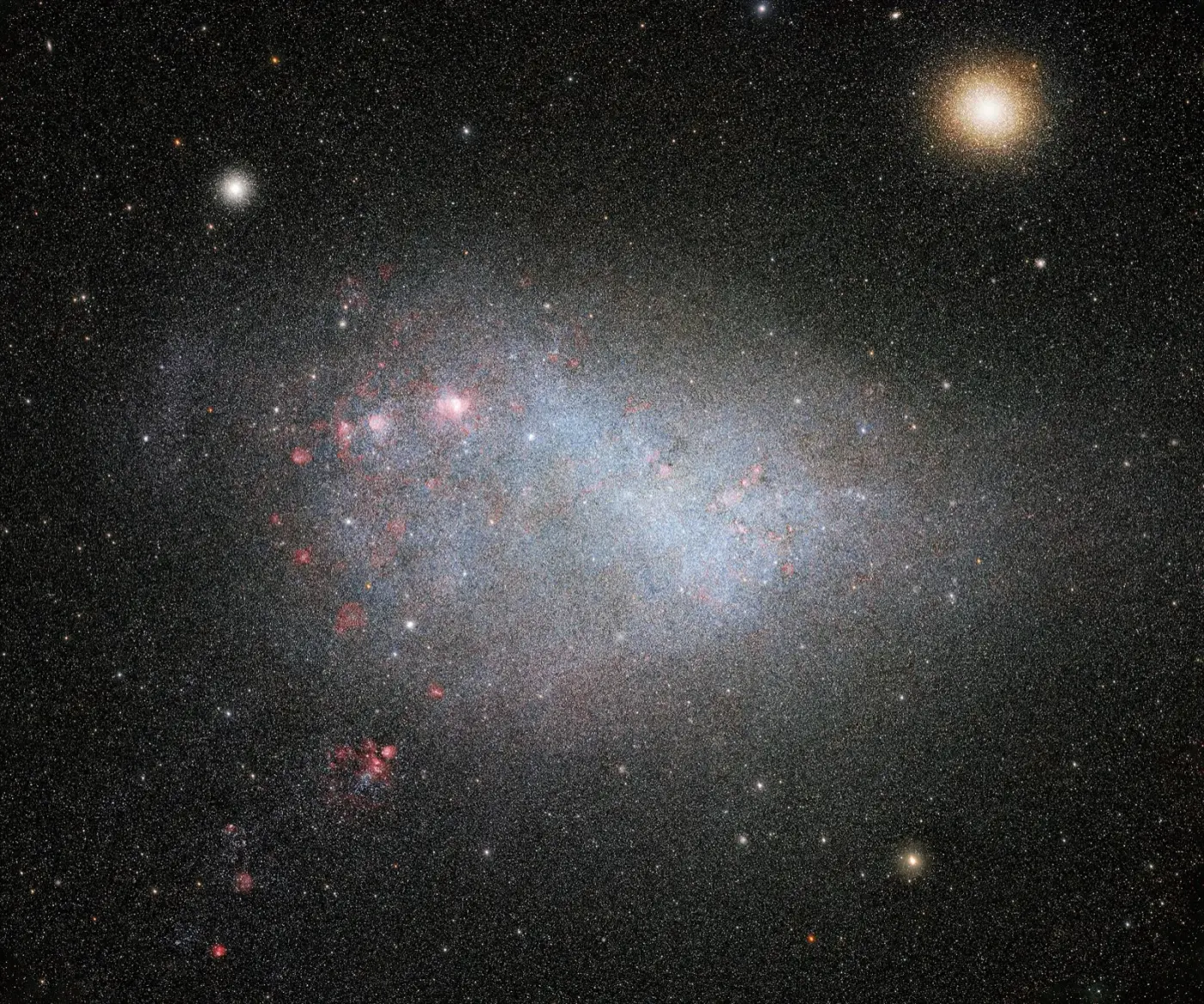 Small Magellanic CloudSMC · galaxy
Sources
- en.wikipedia.org
- science.nasa.gov
- science.nasa.gov
- astronomy.com
- arxiv.org
- skyatnightmagazine.com
- Positions: astronomy-engine (Don Cross).