 SKY
Sky catalog › Galaxies
Sunflower Galaxy
M63, NGC 5055 · A galaxy in Canes Venatici
What is it?
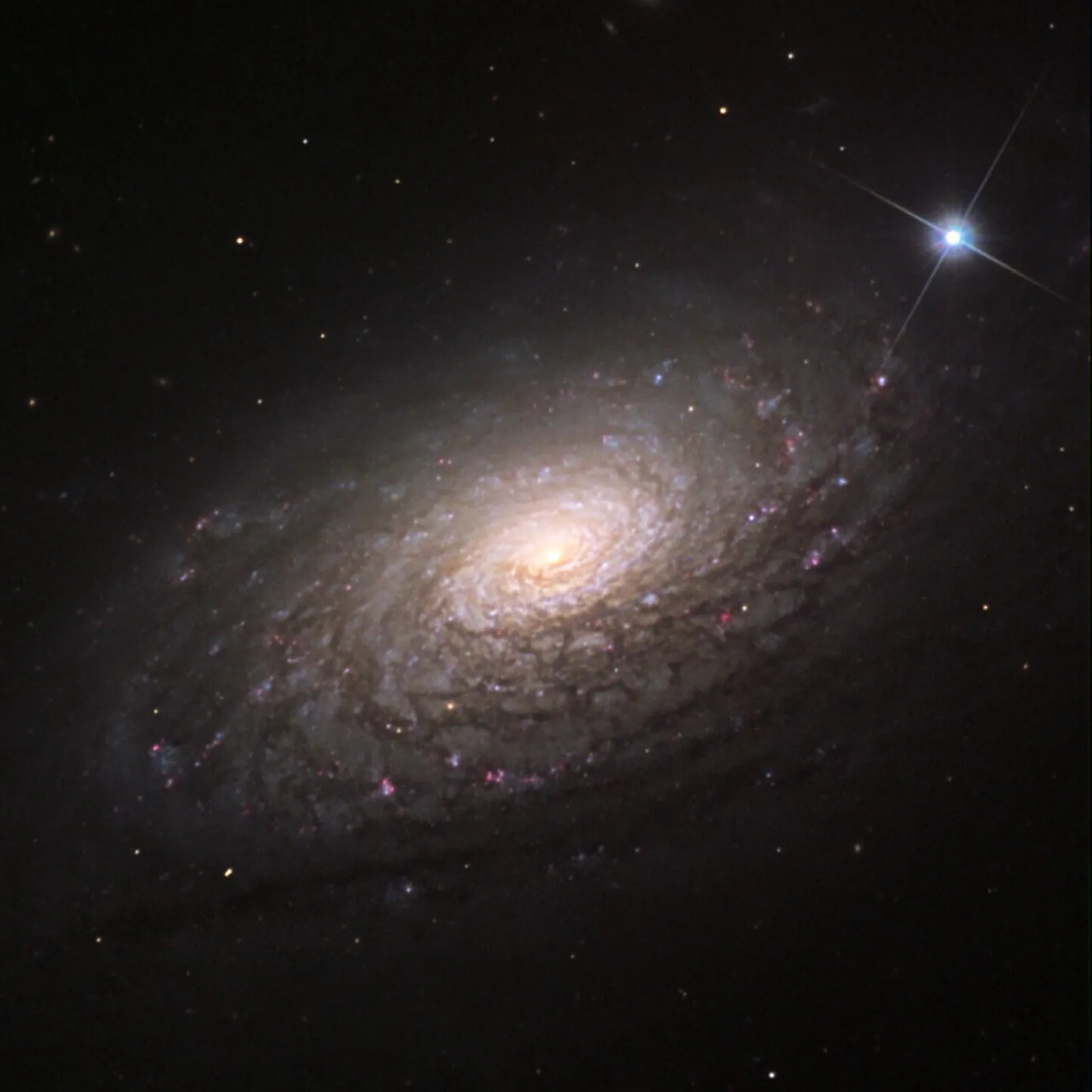
Sunflower Galaxy is a galaxy. A whole island of millions to trillions of stars, far outside our Milky Way.
Why the Sunflower Galaxy is interesting
What you see: The yellow core is wrapped in many short, patchy pieces of spiral arm instead of a few long ones. The arms shine with light from recently formed blue stars. science.nasa.gov
How it formed: A faint arc of stars curls through its outskirts: the torn-apart remains of a small galaxy, about 100 million Suns' worth of mass, that M63 swallowed within the last few billion years. arxiv.org
To scale: The Sunflower Galaxy is about 110,000 light-years across, so light needs about 110,000 years to cross it. en.wikipedia.org
Three things to know
- M63 is a 'flocculent' spiral: instead of a few long, clear arms, it shows many short, patchy pieces of arms around its yellow core.
- In the mid-1800s Lord Rosse saw spiral structure in it, making it one of the first galaxies where spiral arms were spotted.
- It was the first of 24 objects that Pierre Méchain added to Charles Messier's catalog, back in 1779.
12 more fun facts
- A faint arc of stars curls through M63's outskirts. It is the torn-apart remains of a small galaxy, about 100 million Suns' worth of mass, that M63 swallowed within the last few billion years. arxiv.org
- Deep images of M63's ghostly star stream were made with a telescope only 0.16 meters (about 6 inches) across, then confirmed with larger observatory telescopes. arxiv.org
- That stream of stolen stars reaches about 29 kiloparsecs, roughly 95,000 light-years, out from the galaxy's center. arxiv.org
- The Sunflower Galaxy holds roughly 400 billion stars and is about 110,000 light-years across. en.wikipedia.org
- Its patchy look hides a secret: in near-infrared light, M63 shows two neat, matching spiral arms, each wrapping about 150 degrees around the center. en.wikipedia.org
- Its hydrogen gas spreads about 40 kiloparsecs (130,000 light-years) out, far beyond the starry disk, and that gas disk is strongly warped. en.wikipedia.org
- In May 1971 Glenn Jolly discovered a supernova in M63, now called SN 1971I. At its peak it reached magnitude 11.8. en.wikipedia.org
- A faint star sitting at M63's western tip is often mistaken for a supernova, but it is just a foreground star in our own Milky Way. astronomy.com
- M63 belongs to the M51 Group, a small family of galaxies named after its brightest member, the Whirlpool Galaxy. science.nasa.gov
- Hubble's view shows a yellow core of older stars, with arms that glow from recently formed blue-white giant stars. science.nasa.gov
- Astronomers are not yet sure M63 has a giant central black hole. If it does, one estimate puts it at about 850 million times the Sun's mass. en.wikipedia.org
- Heber Curtis took the first photograph of M63, using the Crossley Reflector at Lick Observatory, and noted its nearly star-like nucleus. universetoday.com
In the game these unlock one by one as you keep photographing the Sunflower Galaxy.
At a glance
- Type
- Galaxy
- Catalog
- M63, NGC 5055
- Constellation
- Canes Venatici
- Distance
- about 27 to 29 million light-years (estimates differ)
- Brightness
- magnitude 9.3
- Size in our sky
- 12.6 x 7.2 arcminutes
- Discovered
- Pierre Méchain, 1779
- Position (J2000)
- RA 13h 16m, Dec +42.0°
Looking back in time
The light in this photo left the Sunflower Galaxy 27 million to 29 million years ago, when there were no humans or great apes, and the dinosaurs had already been gone for more than 20 million years.
How to see it yourself
Needs a telescope and a dark sky. Photos show far more than the eye can see.
Finding it: Look between Cor Caroli, the brightest star in Canes Venatici, and Alkaid, the star at the end of the Big Dipper's handle. In binoculars, put Cor Caroli at the southwest edge of the view and find a right triangle of four stars on the far side; M63 lies 1 degree north of 19 Canum Venaticorum, the star at the right angle.
When to look: Spring evenings, from March to May, with May the best month, when Canes Venatici is high overhead for northern observers.
What you will see: Not visible to the naked eye. Binoculars of 35 to 50 mm show an oval smudge with a slightly brighter center. A small telescope shows a faint oval with a concentrated core, and spiral texture starts to appear in 8-inch and larger scopes.
Easy to confuse with:
- Messier 94: M94 lies just north of the line from Cor Caroli to Chara and looks rounder, with a very bright core, while M63 is a longer, thinner oval.
Best months: April is when it is highest around midnight. About two months later it is highest in the early evening, at around 8 to 9 PM.
Where on Earth: easy from the Northern Hemisphere. South of latitude 38°S it never climbs more than 10° above the horizon. From 48°N and farther north it never sets.
How it is photographed: long exposures through filters, many hours in total, which is why the game sends it to a big observatory mirror. then the frames are stacked, stretched and combined into color.
Name and story
The name: Its nickname, the Sunflower Galaxy, comes from its arm pattern, which looks like the pattern at the center of a sunflower. Pierre Méchain discovered it in 1779, and it became number 63 in Charles Messier's catalog, the first of 24 objects Méchain contributed.
Explored by: NASA's GALEX space telescope photographed M63 in ultraviolet light, showing bright areas where young, massive stars are forming. NASA's Spitzer Space Telescope traced the dust in its arms in infrared light and found a small ring of dust just outside the center.
Test yourself
After every photo of the Sunflower Galaxy the game asks one of these. A right answer earns sky points for your observatory.
Why is M63 nicknamed the Sunflower Galaxy?
- Its arm pattern looks like a flower center (the answer)
- It always faces toward our Sun
- It glows bright yellow all over
M63 is a flocculent spiral, with many short, broken arms winding around its yellow core. That patchy pattern resembles the center of a sunflower. science.nasa.gov
How many objects did Pierre Méchain add to Messier's catalog?
- 24, with M63 as the first (the answer)
- Only 2
- About 300
Méchain discovered M63 in 1779, and it became number 63 in Charles Messier's catalog, the first of 24 objects that Méchain contributed. science.nasa.gov
Point a telescope at the Sunflower Galaxy in the game: capture it in real time, then develop the frames like an astrophotographer.
Point a telescope at the Sunflower GalaxyMore galaxies
 Andromeda GalaxyM31 · galaxy
 Triangulum GalaxyM33 · galaxy
 Large Magellanic CloudLMC · galaxy
 Small Magellanic CloudSMC · galaxy
Sources
- en.wikipedia.org
- science.nasa.gov
- arxiv.org
- astronomy.com
- universetoday.com
- Positions: astronomy-engine (Don Cross).