 SKY
Sky catalog › Star clusters
Butterfly Cluster
M6, NGC 6405 · An open star cluster in Scorpius
What is it?
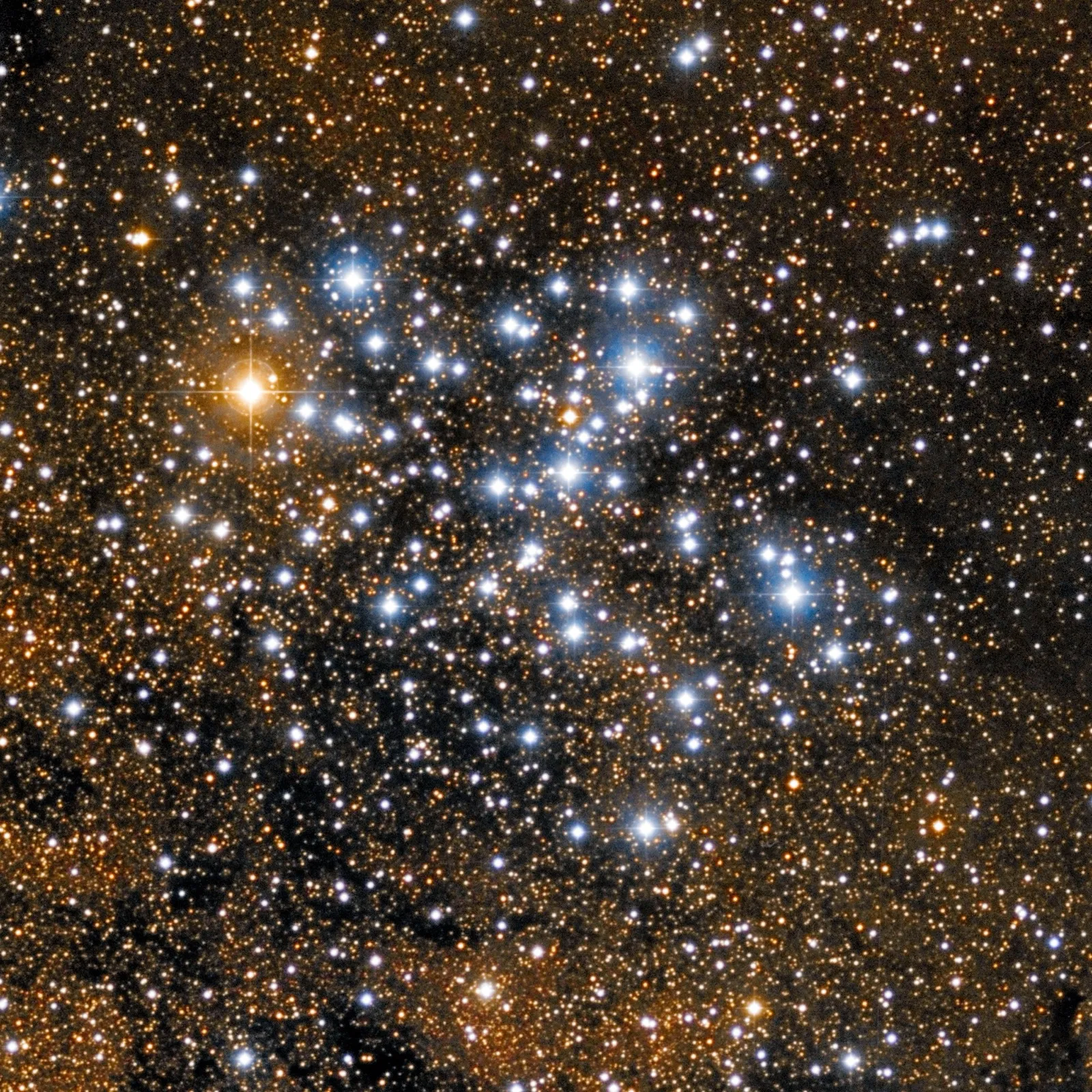
Butterfly Cluster is an open star cluster. A family of young stars born together from the same cloud of gas.
Why the Butterfly Cluster is interesting
What you see: Each dot is a star: about 120 likely members, mostly hot blue stars. The orange giant BM Scorpii, its brightest star, stands out against its blue neighbors in color photos. en.wikipedia.org
How it formed: M6 is a young cluster, about 94 million years old by one estimate. It circles the Milky Way once every 204 million years and passes through the galaxy's flat disk about every 29 million years. en.wikipedia.org
To scale: The butterfly is about 12 to 25 light-years across, depending on how it is measured, so light needs 12 to 25 years to cross it. universetoday.com
Three things to know
- Its stars are arranged in a pattern that reminded stargazers of a butterfly with open wings, which gave the cluster its name.
- Most of its bright stars are hot and blue, but the brightest one, BM Scorpii, is an orange giant that stands out clearly in color photos.
- Of all the objects in Messier's catalog, M6 appears closest in the sky to the center of our galaxy.
12 more fun facts
- M6 and its bright neighbor M7 look like a pair, but they are unrelated. M7 is about 980 light-years away, while M6 lies about 1,600 light-years out. earthsky.org
- When Charles Messier recorded M6 on May 23, 1764, he noted that to the naked eye it looks like a nebula with no stars. universetoday.com
- M6 takes about 204 million years to complete one trip around the center of the Milky Way. en.wikipedia.org
- As it orbits, M6 bobs up and down through the flat disk of our galaxy, crossing it about every 29 million years. Right now it sits about 23 light-years below the middle of the disk. en.wikipedia.org
- The Greek-Roman astronomer Ptolemy may have seen M6 with his naked eye in the 2nd century while noting its neighbor M7, though nobody can be sure. en.wikipedia.org
- Philippe Loys de Cheseaux, who found M6 again in 1745 to 1746, was the first to describe it as a very fine star cluster. universetoday.com
- BM Scorpii, the cluster's brightest star, slowly changes in brightness between about magnitude 5.5 and 7.0 on a semi-regular cycle. en.wikipedia.org
- Age estimates for M6 range from about 51 to 95 million years. That makes it a young cluster, though sources disagree on exactly how young. universetoday.com
- The butterfly is about 12 to 25 light-years across, depending on how the size is measured. universetoday.com
- About 120 stars are thought to be likely members of M6, many of them far too faint to see without a telescope. en.wikipedia.org
- M6's stars contain slightly more heavy elements than the Sun does. en.wikipedia.org
- Eight of M6's stars may be chemically peculiar, showing unusual amounts of certain elements in their outer layers. en.wikipedia.org
In the game these unlock one by one as you keep photographing the Butterfly Cluster.
At a glance
- Type
- Open star cluster
- Catalog
- M6, NGC 6405
- Constellation
- Scorpius
- Distance
- about 1,600 light-years
- Brightness
- magnitude 4.2
- Size in our sky
- about 25 arcminutes
- Discovered
- Giovanni Battista Hodierna, before 1654
- Position (J2000)
- RA 17h 40m, Dec -32.2°
Looking back in time
The light in this photo left the Butterfly Cluster about 1,600 years ago, when the Greek and Roman world watched this same sky; Greek thinkers worked out from the round shadow on the Moon during eclipses that the Earth is a ball.
How to see it yourself
Visible to the naked eye from a dark site. Binoculars show it well, and a small telescope shows more detail.
Finding it: Find the J-shaped Scorpion and the two stars at the tip of its tail, Shaula and Lesath. Draw a line from Lesath through Shaula to reach the bright cluster M7, then hop about 3 degrees northwest to M6.
When to look: M6 is a summer object for northern observers and a winter one in the Southern Hemisphere. It is highest around midnight in mid-June, around 10 p.m. in mid-July and around 8 p.m. in mid-August (add an hour for daylight saving time). From the northern U.S. and Canada it stays low, so you need a clear southern horizon.
What you will see: On a dark, moonless night M6 shows as a small hazy patch to the naked eye. Binoculars show the butterfly shape clearly, with stars of nearly equal brightness, and a small telescope at low power adds more stars and colors, including the orange star BM Scorpii.
Easy to confuse with:
- Messier 7: M7 is brighter, larger and looser and sits closer to the Scorpion's stinger, while M6 is smaller and more compact, about 3 degrees to the northwest.
Best months: June is when it is highest around midnight. About two months later it is highest in the early evening, at around 8 to 9 PM.
Where on Earth: best from the Southern Hemisphere. North of latitude 48°N it never climbs more than 10° above the horizon. South of 58°S it never sets.
How it is photographed: long exposures through filters, then the frames are stacked, stretched and combined into color.
Name and story
The name: The nickname Butterfly Cluster is credited to Robert Burnham Jr., who used it in his Celestial Handbook. Giovanni Battista Hodierna recorded the cluster in 1654, and Charles Messier added it to his catalog as number 6 in 1764. Its other catalog name is NGC 6405.
Test yourself
After every photo of the Butterfly Cluster the game asks one of these. A right answer earns sky points for your observatory.
Why does the star BM Scorpii stand out in M6?
- It is an orange giant among blue stars (the answer)
- It is the closest star to Earth
- It is a planet orbiting the cluster
Most of M6's bright stars are hot and blue. BM Scorpii is a cooler orange giant, so its warm color contrasts sharply in photos. en.wikipedia.org
Who gave M6 its nickname, the Butterfly Cluster?
- Ptolemy
- Robert Burnham Jr. (the answer)
- Charles Messier
Burnham used the name in his Celestial Handbook. Messier only gave it the number 6 in 1764, and Ptolemy may have seen it but left no name. universetoday.com
Point a telescope at the Butterfly Cluster in the game: capture it in real time, then develop the frames like an astrophotographer.
Point a telescope at the Butterfly ClusterMore star clusters
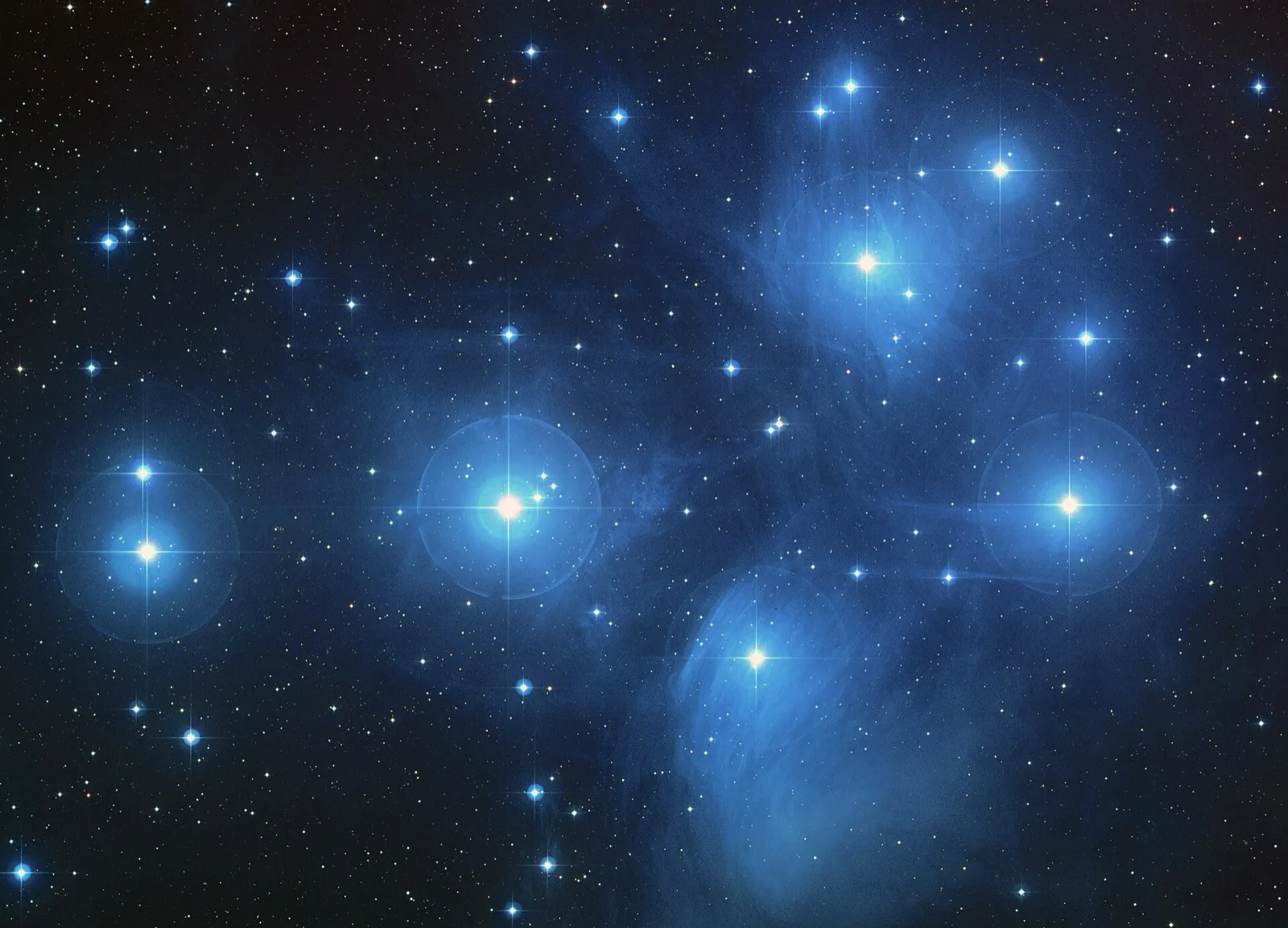 The PleiadesM45 · open star cluster
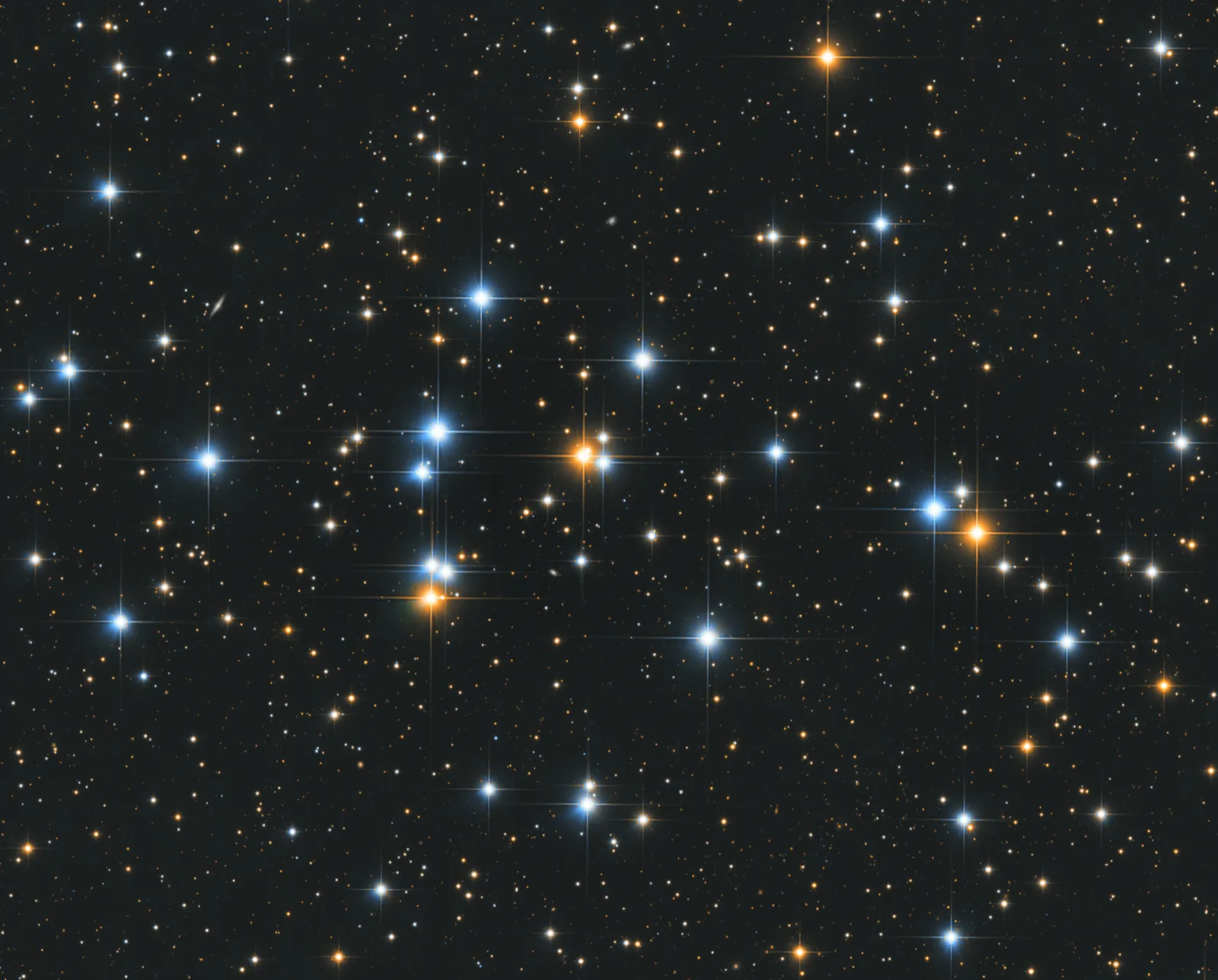 Beehive ClusterM44 · open star cluster
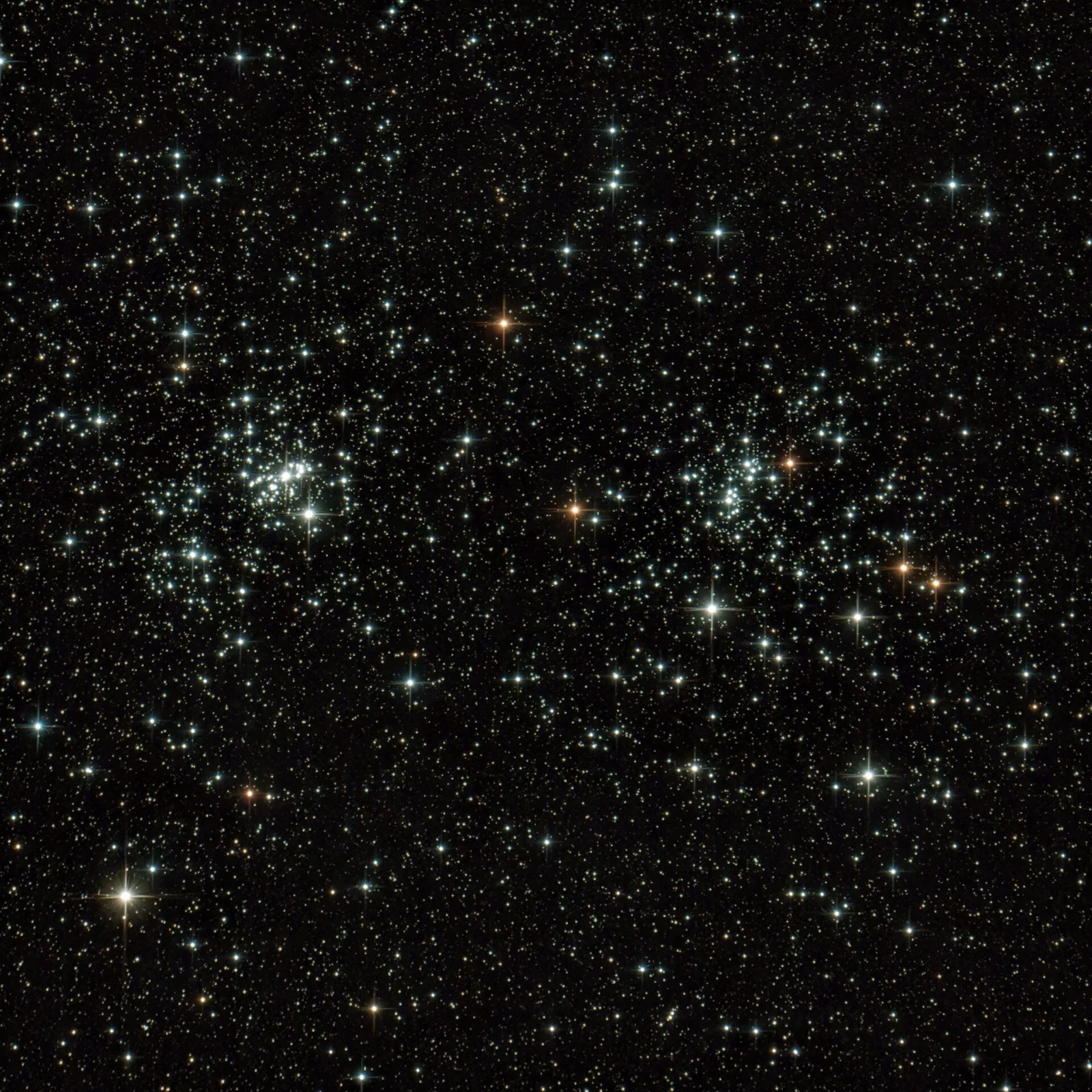 Double ClusterNGC 869 · open star cluster
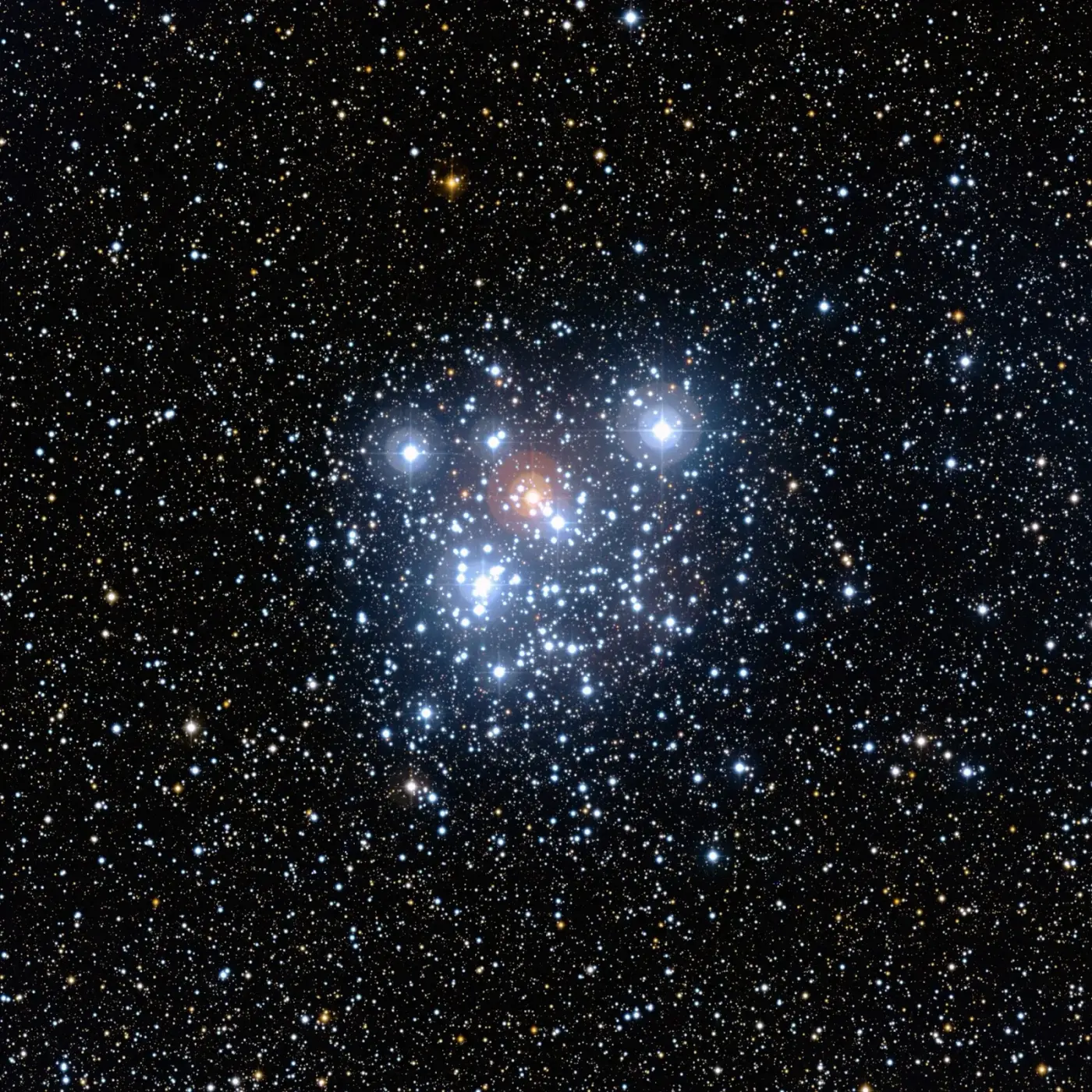 Jewel BoxNGC 4755 · open star cluster
Sources
- en.wikipedia.org
- messier.seds.org
- earthsky.org
- universetoday.com
- Positions: astronomy-engine (Don Cross).