 SKY
Sky catalog › Galaxies
Whirlpool Galaxy
M51, NGC 5194 · A galaxy in Canes Venatici
What is it?
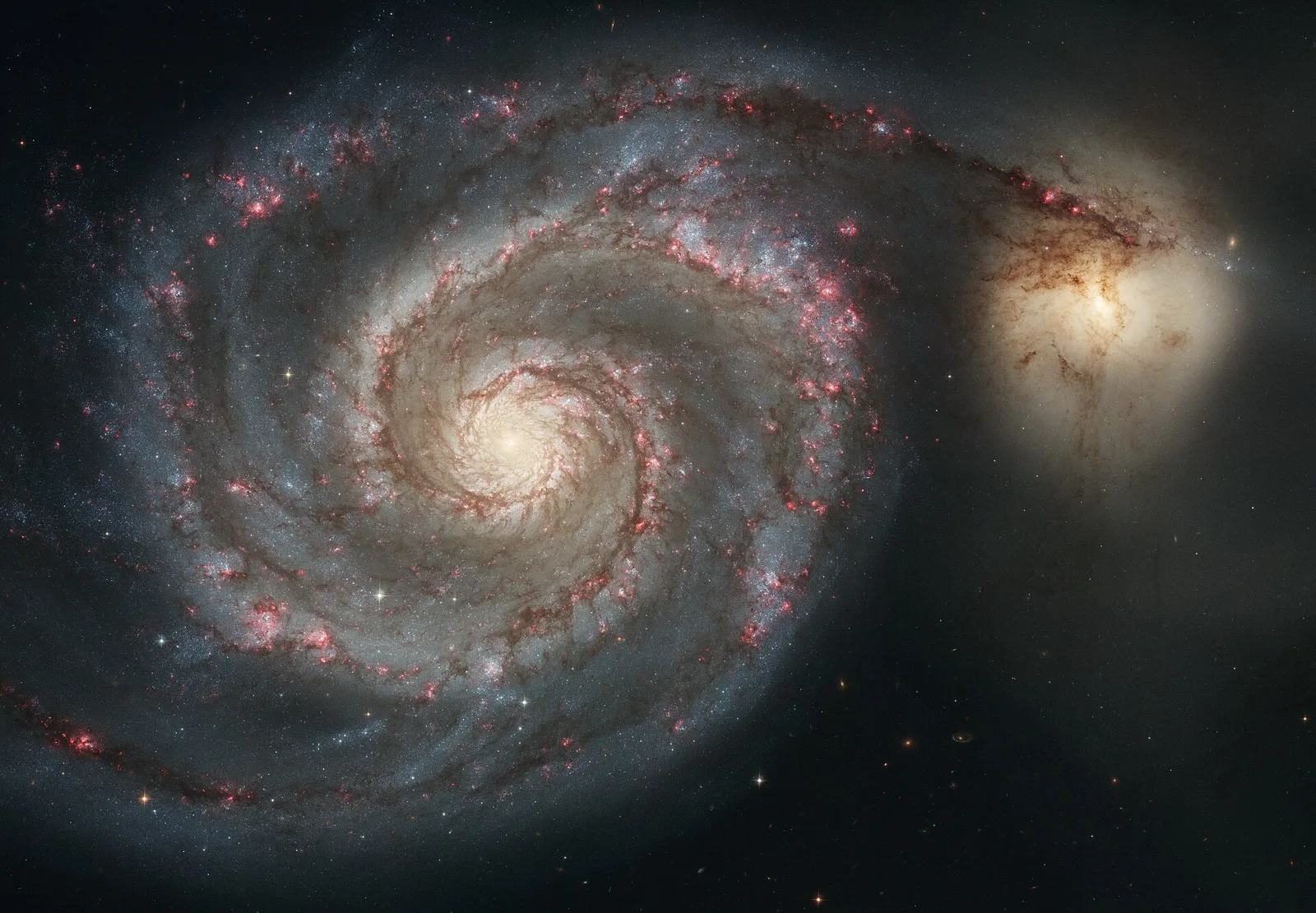
Whirlpool Galaxy is a galaxy. A whole island of millions to trillions of stars, far outside our Milky Way.
Why the Whirlpool Galaxy is interesting
What you see: The curving arms are long lanes of stars and gas laced with dust, dotted with pink star-forming regions. The small yellowish galaxy at the tip of one arm is its companion, NGC 5195. science.nasa.gov
How it formed: The arms work as star factories, squeezing hydrogen gas into clusters of new stars. The companion NGC 5195 appears to tug on one arm, and its tidal forces trigger more star birth. science.nasa.gov
To scale: The Whirlpool is about 76,900 light-years across and holds about 160 billion times the mass of the Sun. en.wikipedia.org
Three things to know
- The Whirlpool was the first galaxy ever classified as a spiral galaxy.
- A smaller galaxy, NGC 5195, is tugging on one of its arms, helping new stars form.
- Under dark skies, a 6-inch (150 mm) telescope can show its spiral arms.
12 more fun facts
- In 2021 astronomers using NASA's Chandra X-ray Observatory reported a possible planet in the Whirlpool, spotted when something briefly blocked X-rays from a star system. It is unconfirmed and will not cross again for about 70 years. chandra.harvard.edu
- Three supernovae were spotted in the Whirlpool within 17 years: SN 1994I, SN 2005cs and SN 2011dh. en.wikipedia.org
- Hubble's infrared map of the Whirlpool's dust revealed hundreds of tiny star clumps, each about 65 light-years wide, that astronomers had never seen before. science.nasa.gov
- Webb's 2023 infrared portrait of the Whirlpool shows warm dust in dark red filaments, and bubbles that young stars have carved into the galaxy's gas. esawebb.org
- The small galaxy NGC 5195 may have plunged through the Whirlpool's disk about 500 to 600 million years ago and crossed it again 50 to 100 million years ago. en.wikipedia.org
- Hubble shows the companion galaxy NGC 5195 passing behind the Whirlpool, a slow flyby that has lasted hundreds of millions of years. science.nasa.gov
- The Whirlpool is about 76,900 light-years across, roughly 88% the size of our Milky Way. en.wikipedia.org
- The Whirlpool holds about 160 billion times the mass of the Sun. en.wikipedia.org
- The Whirlpool's fast pace of star birth may last no more than about 100 million years. en.wikipedia.org
- An active black hole sits at the Whirlpool's heart, with a pair of cones of glowing, energized gas stretching out from it. en.wikipedia.org
- In 2019 the Whirlpool hosted AT 2019abn, a supernova impostor: an outburst that looked like a supernova but turned out to be a luminous red nova. en.wikipedia.org
- The Whirlpool's two big spiral arms wind clockwise as we see them from Earth. en.wikipedia.org
In the game these unlock one by one as you keep photographing the Whirlpool Galaxy.
At a glance
- Type
- Galaxy
- Catalog
- M51, NGC 5194
- Constellation
- Canes Venatici
- Distance
- about 23 to 31 million light-years (estimates differ)
- Brightness
- magnitude 8.4
- Size in our sky
- 11.2 x 6.9 arcminutes
- Discovered
- Charles Messier, October 13, 1773
- Position (J2000)
- RA 13h 30m, Dec +47.2°
Looking back in time
The light in this photo left the Whirlpool Galaxy 23 million to 31 million years ago, when there were no humans or great apes, and the dinosaurs had already been gone for more than 20 million years.
How to see it yourself
Needs a telescope and a dark sky. Photos show far more than the eye can see.
Finding it: Find Alkaid, the star at the end of the Big Dipper's handle, and move about 3.5 degrees southwest.
When to look: Best on spring evenings for mid-northern observers; NASA names May as the easiest month. North of about 43 degrees latitude it is circumpolar and never sets.
What you will see: Too faint for the naked eye. Under dark skies binoculars can show a small faint glow, and a 4-inch (100 mm) telescope shows its basic outline. A 6-inch (150 mm) telescope in a dark sky can begin to reveal the spiral.
Easy to confuse with:
- Pinwheel Galaxy (M101): M101 is also near Alkaid, but it forms a triangle with Alkaid and Mizar instead of lying southwest of Alkaid, and it is a larger, dimmer round glow with no bright companion.
Best months: April is when it is highest around midnight. About two months later it is highest in the early evening, at around 8 to 9 PM.
Where on Earth: easy from the Northern Hemisphere. South of latitude 33°S it never climbs more than 10° above the horizon. From 43°N and farther north it never sets.
How it is photographed: long exposures through filters, many hours in total, which is why the game sends it to a big observatory mirror. then the frames are stacked, stretched and combined into color.
Name and story
The name: Charles Messier discovered it on October 13, 1773 and listed it as M51; it is also NGC 5194. Its nickname, the Whirlpool, describes its swirling pair of spiral arms.
People and history: In 1845 Lord Rosse, using a 72-inch reflector at Birr Castle in Ireland, saw the Whirlpool's spiral shape and drew it. It was the first nebula known to have a spiral structure.
Record: The Whirlpool is the brightest galaxy in the M51 Group, a small family of galaxies that also includes M63, NGC 5023 and NGC 5229.
Explored by: Hubble's famous Whirlpool portrait was made from visible-light exposures taken January 18 to 22, 2005, and its infrared camera mapped the galaxy's dust in December 2005. That dust map shows details as small as 35 light-years and lanes that are smoother than astronomers expected.
Test yourself
After every photo of the Whirlpool Galaxy the game asks one of these. A right answer earns sky points for your observatory.
What is the small galaxy NGC 5195 doing to the Whirlpool?
- Tugging on one of its arms (the answer)
- Hiding its center from our view
- Orbiting deep inside its core
NGC 5195 sits at the outer tip of one arm. Its tidal pull on that arm is thought to trigger new star formation there. science.nasa.gov
What did Lord Rosse reveal about the Whirlpool in 1845?
- Its distance from Earth
- A planet orbiting it
- Its spiral shape (the answer)
Rosse presented its spiral structure at an 1845 meeting, and the Whirlpool became the first galaxy ever classified as a spiral galaxy. en.wikipedia.org
Point a telescope at the Whirlpool Galaxy in the game: capture it in real time, then develop the frames like an astrophotographer.
Point a telescope at the Whirlpool GalaxyLearn more
- Stretching: pulling faint light out of a black frame
Astronomy cameras record light linearly, so a raw galaxy image looks almost black. Here is how a stretch reveals the faint parts, and how too much ruins it.
More galaxies
 Andromeda GalaxyM31 · galaxy
 Triangulum GalaxyM33 · galaxy
 Large Magellanic CloudLMC · galaxy
 Small Magellanic CloudSMC · galaxy
Sources
- en.wikipedia.org
- science.nasa.gov
- chandra.harvard.edu
- esawebb.org
- Positions: astronomy-engine (Don Cross).