 SKY
Sky catalog › Star clusters
Messier 5
M5, NGC 5904 · A globular cluster in Serpens
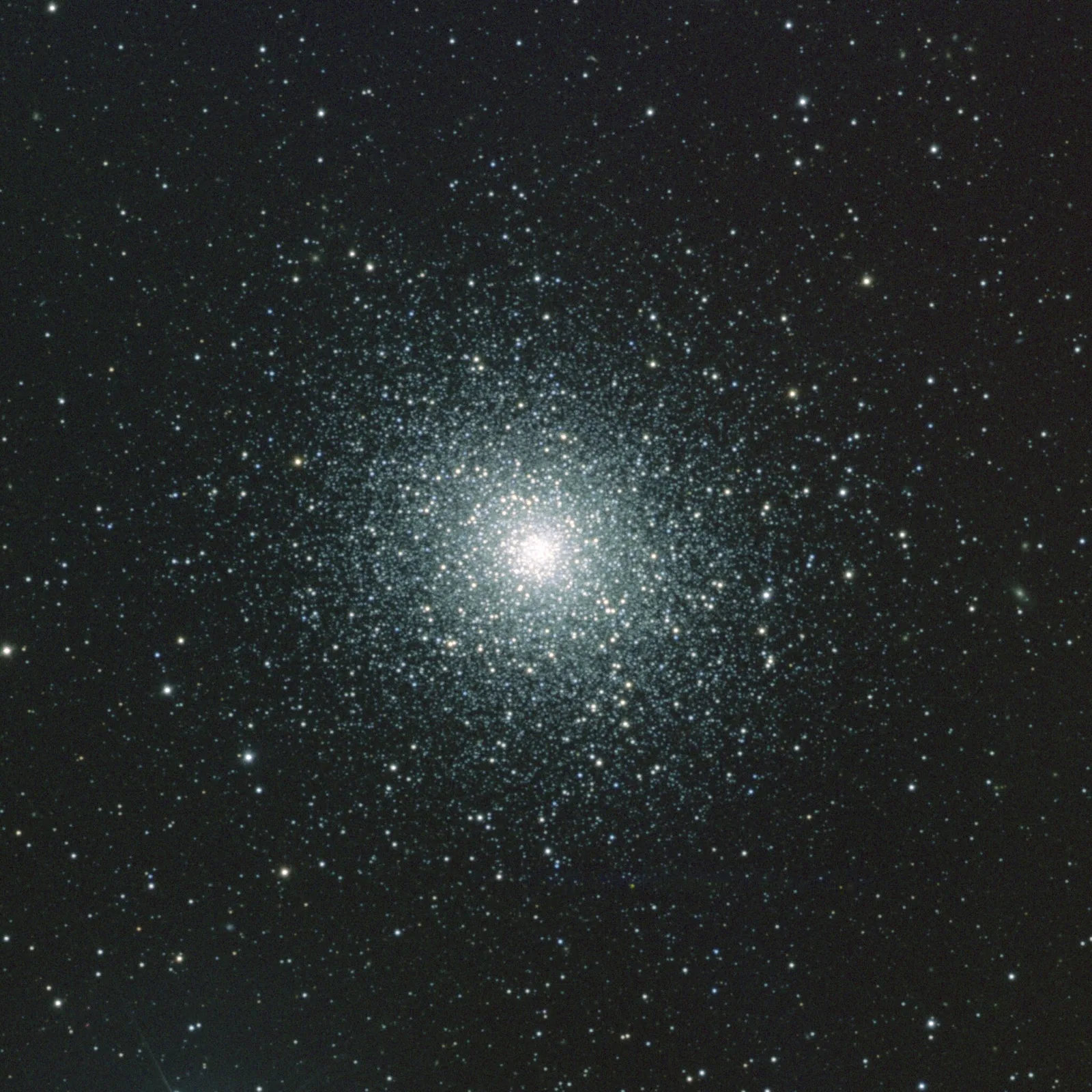
What is it?
Messier 5 is a globular cluster. A tight ball of hundreds of thousands of very old stars.
Why Messier 5 is interesting
What you see: The fuzzy ball is more than 100,000 stars, perhaps as many as 500,000, gathered in one of the largest globular clusters known. earthsky.org
How it formed: Most of its stars formed more than 12 billion years ago. A few look young and blue; these blue stragglers probably formed when stars collided or interacted closely. science.nasa.gov
To scale: M5 spans about 165 light-years, so light itself needs about 165 years to cross from one side to the other. earthsky.org
Three things to know
- M5 is one of the oldest globular clusters in the Milky Way: most of its stars formed more than 12 billion years ago.
- Gottfried Kirch found it in 1702 while he was watching a comet.
- Some of its stars look surprisingly young and blue; astronomers call them blue stragglers and think they formed when stars collided or came very close to each other.
12 more fun facts
- M5 is about 165 light-years across, one of the largest globular clusters known. earthsky.org
- When William Herschel first resolved M5 into stars in 1791, he counted about 200 of them. en.wikipedia.org
- Estimates of M5's population run from more than 100,000 stars to perhaps as many as 500,000. earthsky.org
- M5 is moving away from us at more than 50 km (31 miles) per second. en.wikipedia.org
- M5 has more than 100 known variable stars, including a dwarf nova, a close pair of stars that flares up from time to time. earthsky.org
- Its brightest variable star swings between magnitude 10.6 and 12.1 over a cycle of just under 26.5 days. en.wikipedia.org
- M5 contains two millisecond pulsars, rapidly spinning dead stars, and one of them is in a binary system. en.wikipedia.org
- Physicists have used stars in M5 to test whether neutrinos, ghostly subatomic particles, behave like tiny magnets. en.wikipedia.org
- Through a 4-inch telescope at about 150x, M5's core breaks into several dozen stars; an 11-inch telescope lets you count more than 100. astronomy.com
- Some of M5's oldest stars have already passed the red giant stage and become hot blue horizontal branch stars. science.nasa.gov
- Hubble took an ultraviolet portrait of M5 that makes its young-looking hot blue stars stand out. science.nasa.gov
- M5 holds about 857,000 times the mass of the Sun. en.wikipedia.org
In the game these unlock one by one as you keep photographing Messier 5.
At a glance
- Type
- Globular cluster
- Catalog
- M5, NGC 5904
- Constellation
- Serpens
- Distance
- about 24,500 light-years
- Brightness
- magnitude 5.6
- Size in our sky
- about 23 arcminutes
- Discovered
- Gottfried Kirch, 1702
- Position (J2000)
- RA 15h 19m, Dec +2.1°
Looking back in time
The light in this photo left Messier 5 about 24,500 years ago, when the Earth was in the last Ice Age: mammoths roamed and people painted caves by firelight.
How to see it yourself
Too faint for most eyes, but binoculars show it from a dark site. A small telescope shows its shape.
Finding it: M5 is in Serpens Caput, about two fist-widths southeast of Arcturus and about one fist-width north of Zubeneschamali in Libra. Look about 1/3 degree northwest of the star 5 Serpentis.
When to look: From the Northern Hemisphere M5 appears in the evening sky in May and is best in July; by around September it sets before midnight. NASA lists June as a good month.
What you will see: To the naked eye it is barely detectable as a faint star. Binoculars show a small fuzzy patch, and even a 3.1-inch (80 mm) telescope shows a bright glowing core inside a much fainter halo.
Easy to confuse with:
- 5 Serpentis: This 5th-magnitude star lies just 22 arcminutes southeast of M5; the star is a sharp point, while M5 is a soft glow.
Best months: May is when it is highest around midnight. About two months later it is highest in the early evening, at around 8 to 9 PM.
Where on Earth: close to the celestial equator, so it can be seen from almost everywhere on Earth.
How it is photographed: long exposures through filters, then the frames are stacked, stretched and combined into color.
Name and story
The name: M5 is the fifth object in Charles Messier's catalog, which he recorded in 1764, decades after Gottfried Kirch found it in 1702. It lies in Serpens Caput, the head of the Serpent, and is also known as NGC 5904.
Record: Astronomy magazine calls M5 the brightest globular cluster in the northern half of the sky. Sharp-eyed observers can spot it without optics from a dark site.
Explored by: Hubble has photographed M5 in several ways: a visible and infrared view with the Advanced Camera for Surveys showing over 100,000 stars, an ultraviolet image with Wide Field Camera 3, and a close-up of the center about 20 light-years across.
Test yourself
After every photo of Messier 5 the game asks one of these. A right answer earns sky points for your observatory.
Why do a few stars in the very old M5 look young and blue?
- They moved in from another galaxy
- Stars collided or came very close (the answer)
- A fresh gas cloud keeps making them
M5's stars formed more than 12 billion years ago, so truly young stars should not be there. Astronomers think these blue stragglers formed from collisions or other close meetings of stars. science.nasa.gov
What was Gottfried Kirch watching when he found M5 in 1702?
- The planet Mars
- A solar eclipse
- A comet (the answer)
Kirch spotted the fuzzy patch while observing a comet. Decades later, in 1764, Charles Messier added it as the fifth object in his catalog. en.wikipedia.org
Point a telescope at Messier 5 in the game: capture it in real time, then develop the frames like an astrophotographer.
Point a telescope at Messier 5More star clusters
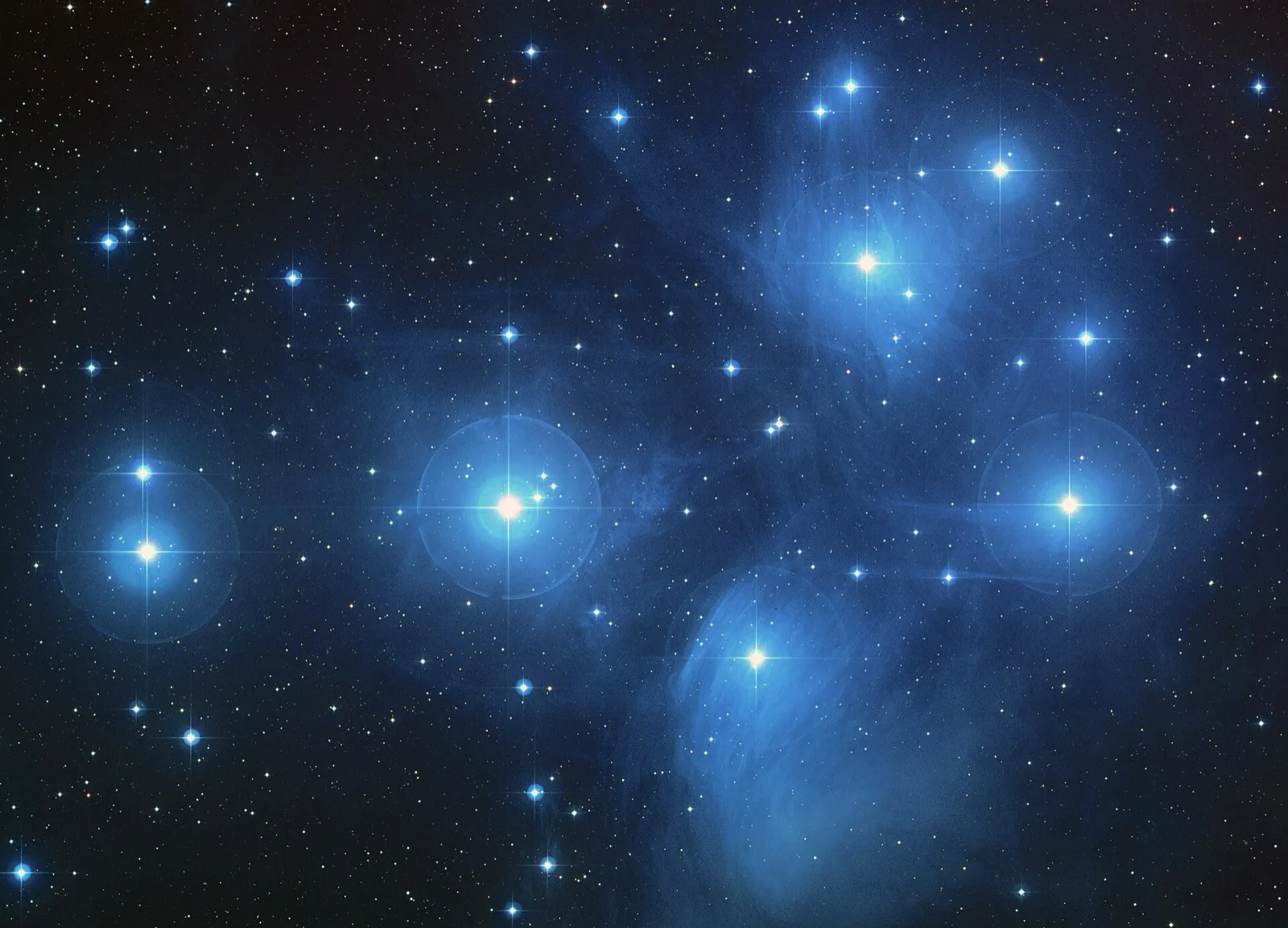 The PleiadesM45 · open star cluster
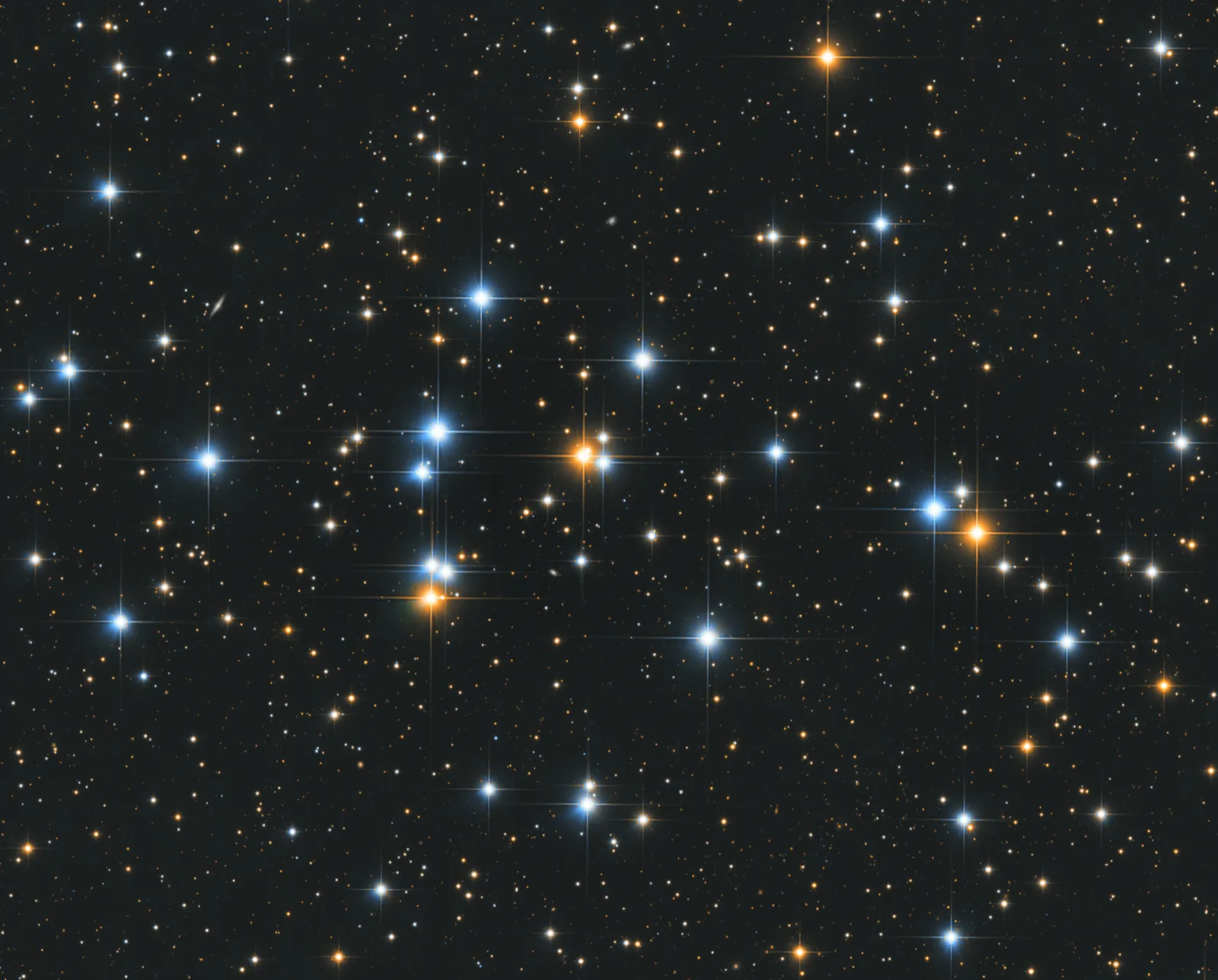 Beehive ClusterM44 · open star cluster
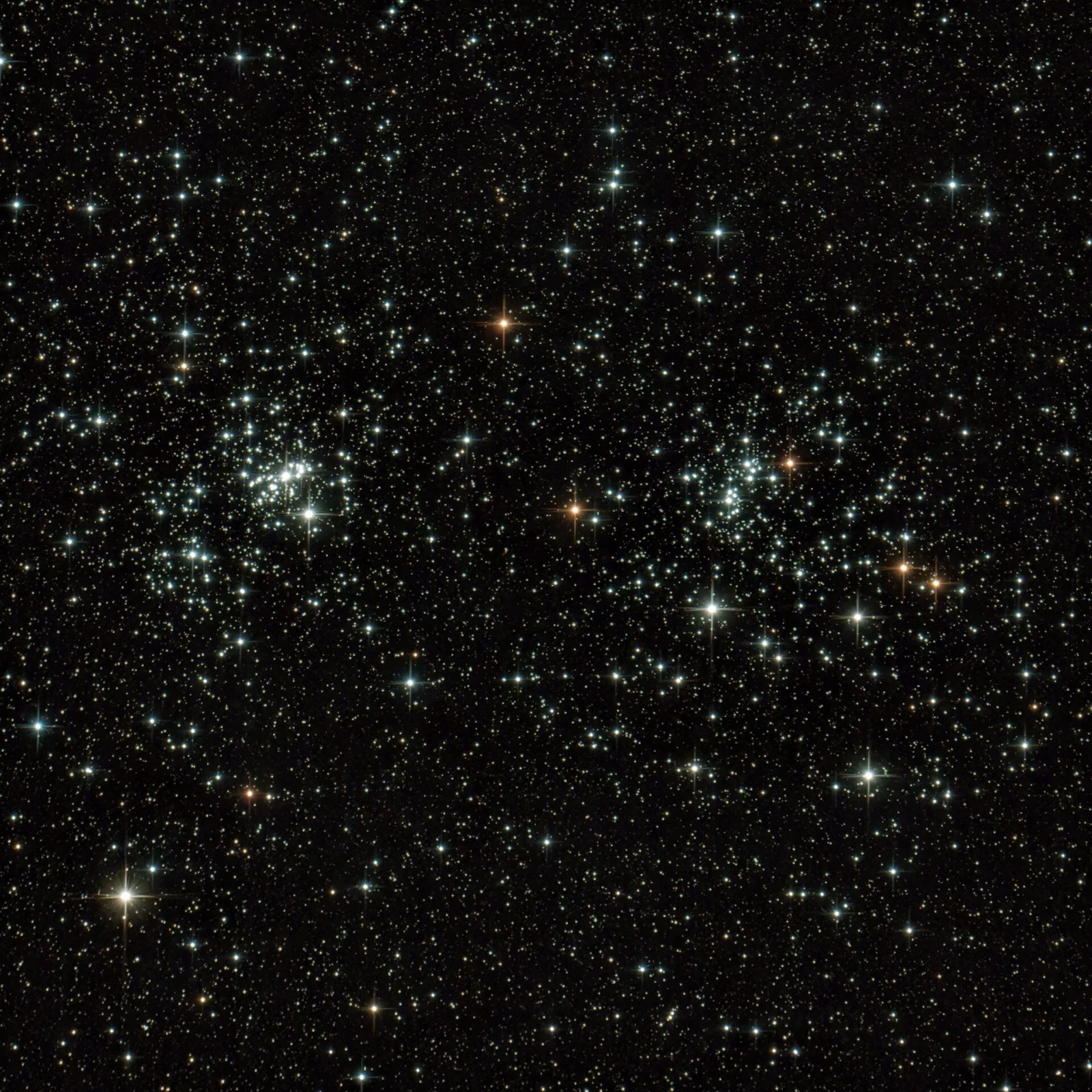 Double ClusterNGC 869 · open star cluster
 Jewel BoxNGC 4755 · open star cluster
Sources
- en.wikipedia.org
- science.nasa.gov
- earthsky.org
- astronomy.com
- Positions: astronomy-engine (Don Cross).