 SKY
Sky catalog › Star clusters
Messier 4
M4, NGC 6121 · A globular cluster in Scorpius
What is it?
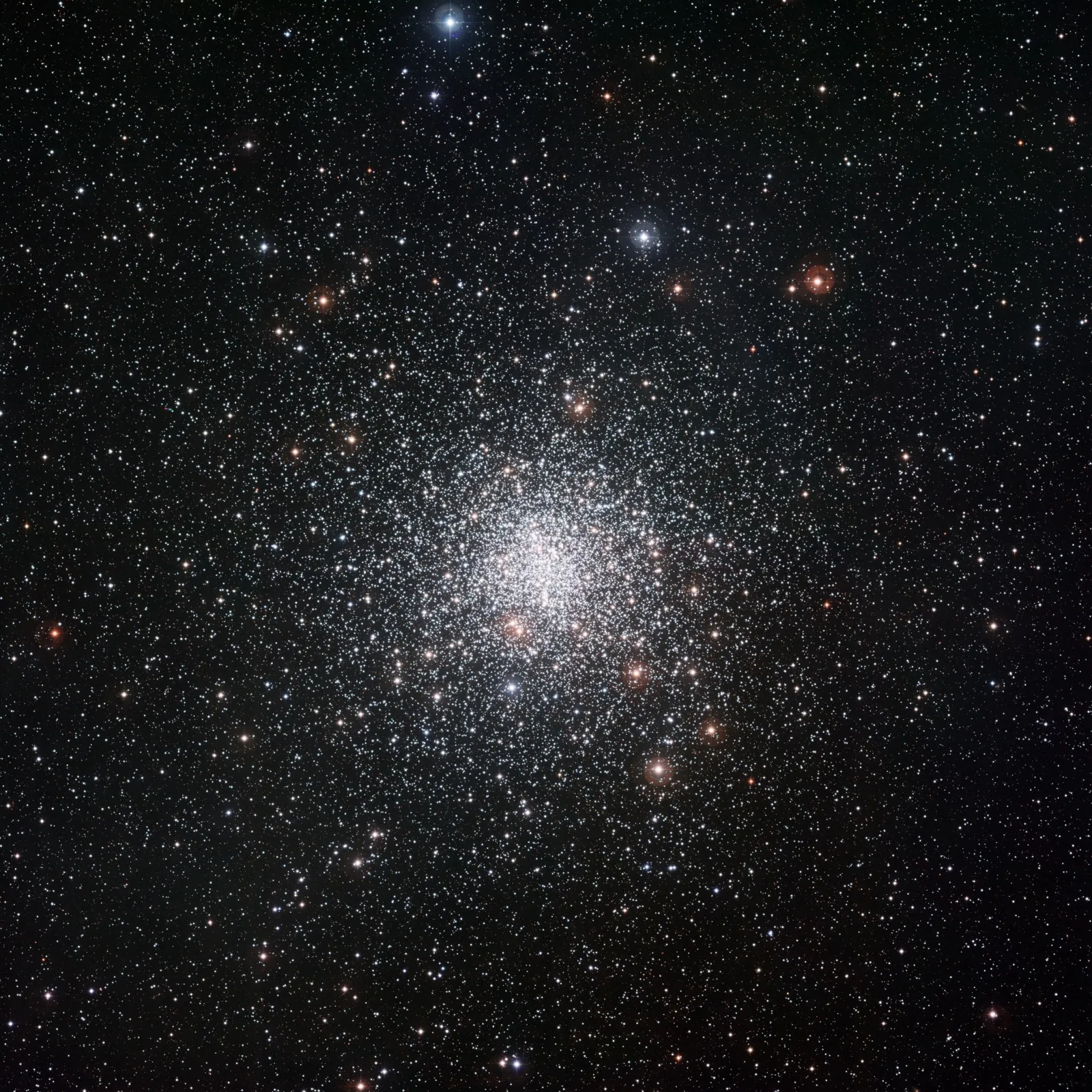
Messier 4 is a globular cluster. A tight ball of hundreds of thousands of very old stars.
Why Messier 4 is interesting
What you see: The loose ball of stars is the closest globular cluster to us, about 6,000 light-years away. A short bar of stars crosses its middle, first noted by William Herschel in 1783. en.wikipedia.org
How it formed: Its stars formed up to 13 billion years ago. Many have died since, leaving as many as 40,000 white dwarfs, dead cores that grow cooler and fainter as they age. science.nasa.gov
To scale: The faintest white dwarfs Hubble found in M4 are about as dim as a 2.5-watt night-light would look from as far away as the Moon. science.nasa.gov
Three things to know
- M4 is the closest globular cluster to our Solar System, only about 6,000 light-years away.
- It is easy to find: it sits just 1.3 degrees west of Antares, the bright orange-red star in Scorpius.
- In 2003 Hubble helped discover a planet in M4 about 2.5 times the mass of Jupiter and about 13 billion years old, circling a white dwarf and a pulsar.
12 more fun facts
- M4 was the first globular cluster in which anyone could make out individual stars. en.wikipedia.org
- A short bar of 11th-magnitude stars, about 2.5 arcminutes long, crosses M4's center; William Herschel first noted it in 1783. en.wikipedia.org
- M4 may hold as many as 40,000 white dwarfs, the cooling leftover cores of dead stars. science.nasa.gov
- The faintest white dwarfs Hubble found in M4 are as dim as a 2.5-watt night-light would be at the Moon's distance; the brightest are like a 100-watt bulb there. science.nasa.gov
- To find M4's faint white dwarfs, Hubble collected nearly eight days of exposure time over a 67-day period. science.nasa.gov
- Because white dwarfs dim as they cool, the faintest ones in M4 helped show that its stars are up to 13 billion years old. science.nasa.gov
- M4 orbits the Milky Way about once every 116 million years on a stretched path that swings within about 2,000 light-years of the galaxy's core. en.wikipedia.org
- Each time M4 passes through the galaxy's disk, tidal shocks may strip away some of its stars, so it may once have been more massive. en.wikipedia.org
- One star in M4 holds far more of the rare element lithium than expected, a puzzle ESO described as a star with "the secret of eternal youth". eso.org
- A 2023 study of Hubble and Gaia data found about 800 Suns' worth of extra mass at M4's center, possibly a middleweight black hole. en.wikipedia.org
- Astronomers rate M4 as loosely concentrated, class IX on the Shapley-Sawyer scale for how tightly a cluster's stars crowd toward its center. en.wikipedia.org
- An object in M4 called CX-1 may be a millisecond pulsar with a companion that it circles every 6.31 hours. en.wikipedia.org
In the game these unlock one by one as you keep photographing Messier 4.
At a glance
- Type
- Globular cluster
- Catalog
- M4, NGC 6121
- Constellation
- Scorpius
- Distance
- about 6,000 light-years (NASA gives 5,500)
- Brightness
- magnitude 5.6
- Size in our sky
- about 26 arcminutes
- Discovered
- Philippe Loys de Chéseaux, 1745 or 1746
- Position (J2000)
- RA 16h 24m, Dec -26.5°
Looking back in time
The light in this photo left Messier 4 about 6,000 years ago, when nobody could write yet (writing began about 5,200 years ago) and the first farming villages were growing.
How to see it yourself
Too faint for most eyes, but binoculars show it from a dark site. A small telescope shows its shape.
Finding it: Find Antares, the bright red star at the heart of Scorpius. M4 lies a little over 1 degree west of it, so both fit in the same binocular field.
When to look: Best on Northern Hemisphere summer evenings or Southern Hemisphere winter evenings. Its neighbor Antares is highest around midnight in early June, around 10 p.m. in early July, and around 8 p.m. in early August.
What you will see: Under very dark skies M4 may just be visible to the naked eye as a faint smudge. Binoculars show a dim hazy ball, and a small or moderate telescope begins to resolve it into individual stars.
Best months: May is when it is highest around midnight. About two months later it is highest in the early evening, at around 8 to 9 PM.
Where on Earth: best from the Southern Hemisphere. North of latitude 53°N it never climbs more than 10° above the horizon.
How it is photographed: long exposures through filters, then the frames are stacked, stretched and combined into color.
Name and story
The name: Jean-Philippe Loys de Cheseaux discovered M4 in 1746, and Charles Messier listed it as object number 4 in his catalog in 1764. The catalog was meant to help comet hunters avoid fuzzy objects that look like comets but are not. It is also NGC 6121.
Record: M4 is the closest globular cluster to the Solar System, at about 6,000 light-years. It was also the first globular cluster in which individual stars were resolved.
Explored by: Hubble studied M4 with its Wide Field Camera 3 and Advanced Camera for Surveys and spent nearly eight days of exposure on its white dwarfs. Hubble also helped find a planet there in 2003, roughly 13 billion years old, orbiting a white dwarf and a pulsar.
Test yourself
After every photo of Messier 4 the game asks one of these. A right answer earns sky points for your observatory.
How did faint white dwarfs help astronomers find M4's age?
- They get brighter with age
- They flash once every million years
- They dim as they get older (the answer)
White dwarfs are dead star cores that cool and dim over time, so the faintest ones in M4 are the oldest, showing its stars are up to 13 billion years old. science.nasa.gov
What did Hubble help discover in M4 in 2003?
- A comet heading straight for Earth
- A newborn star still wrapped in gas
- A planet about 13 billion years old (the answer)
The planet has about 2.5 times Jupiter's mass and circles a white dwarf and a pulsar. Its great age means it formed when the universe was young. science.nasa.gov
Point a telescope at Messier 4 in the game: capture it in real time, then develop the frames like an astrophotographer.
Point a telescope at Messier 4More star clusters
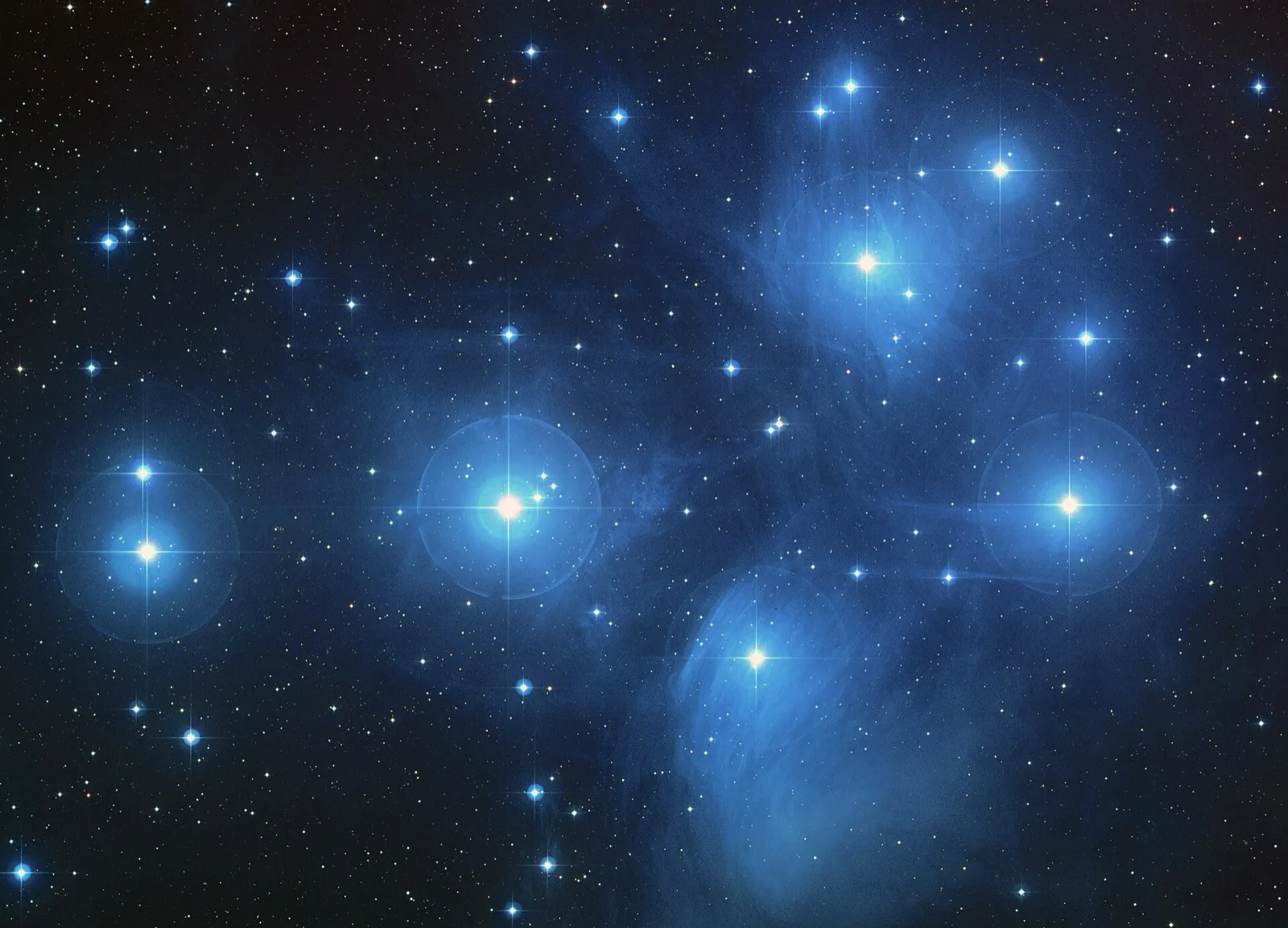 The PleiadesM45 · open star cluster
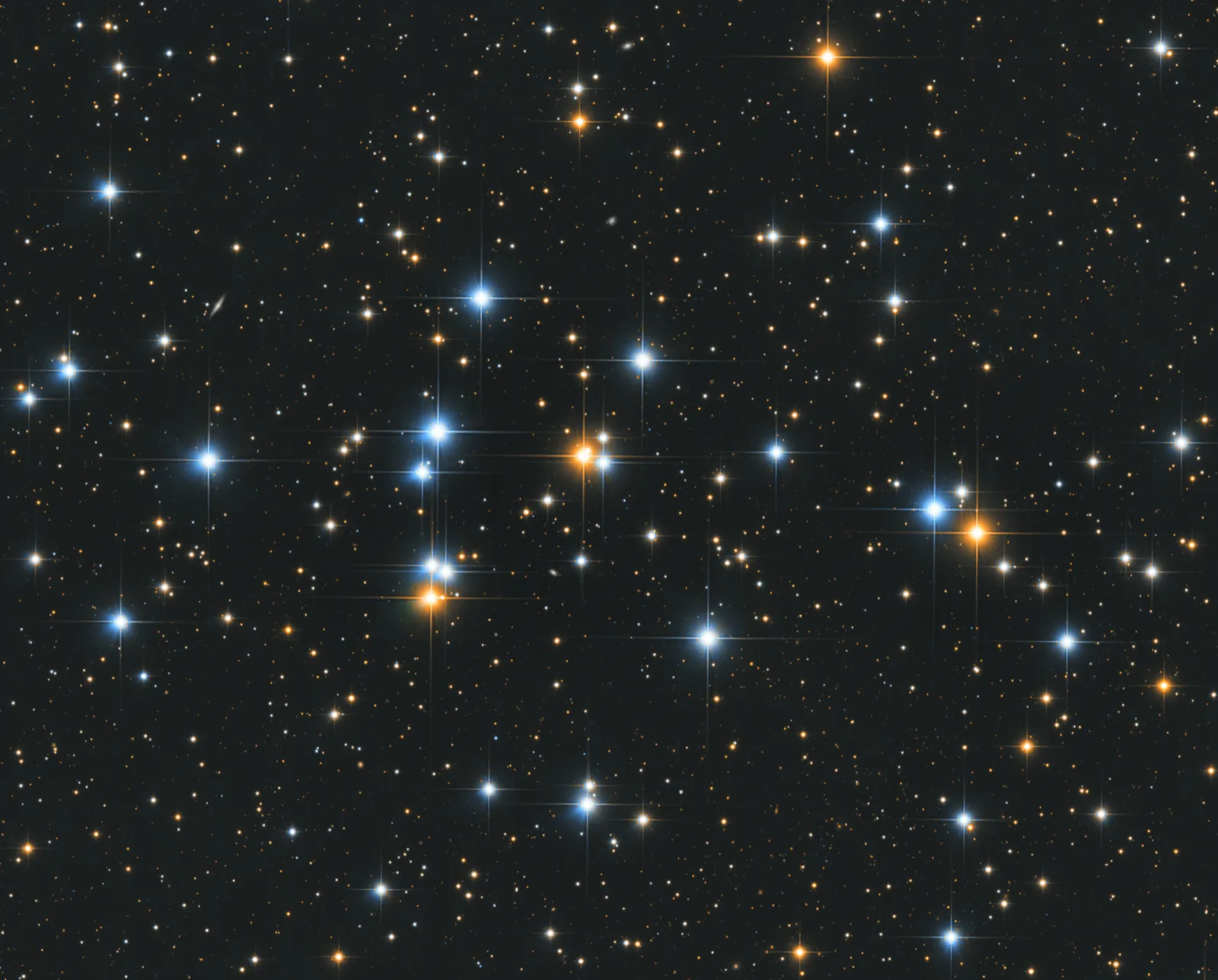 Beehive ClusterM44 · open star cluster
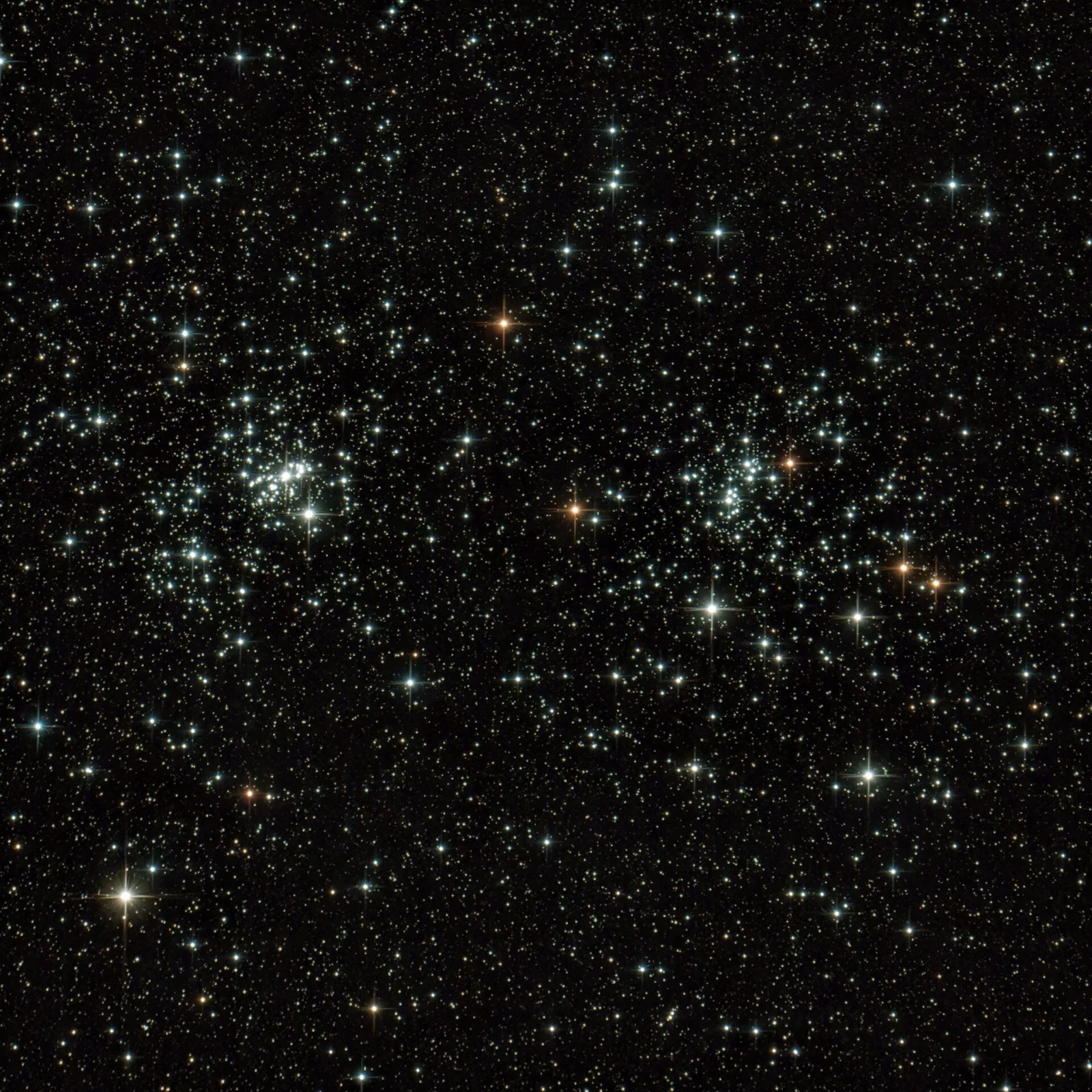 Double ClusterNGC 869 · open star cluster
 Jewel BoxNGC 4755 · open star cluster
Sources
- en.wikipedia.org
- science.nasa.gov
- eso.org
- earthsky.org
- Positions: astronomy-engine (Don Cross).