 SKY
Sky catalog › Star clusters
Messier 37
M37, NGC 2099 · An open star cluster in Auriga
What is it?
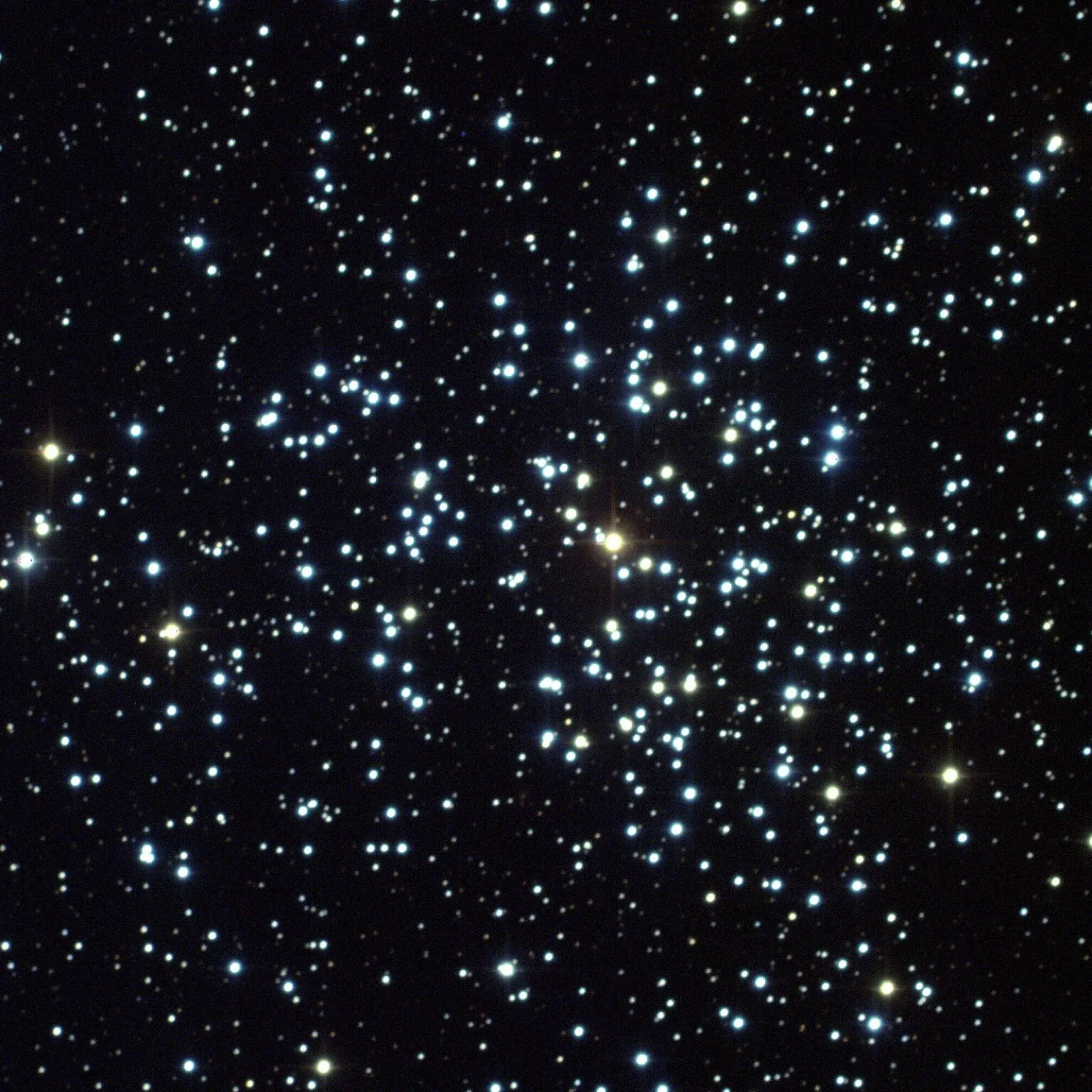
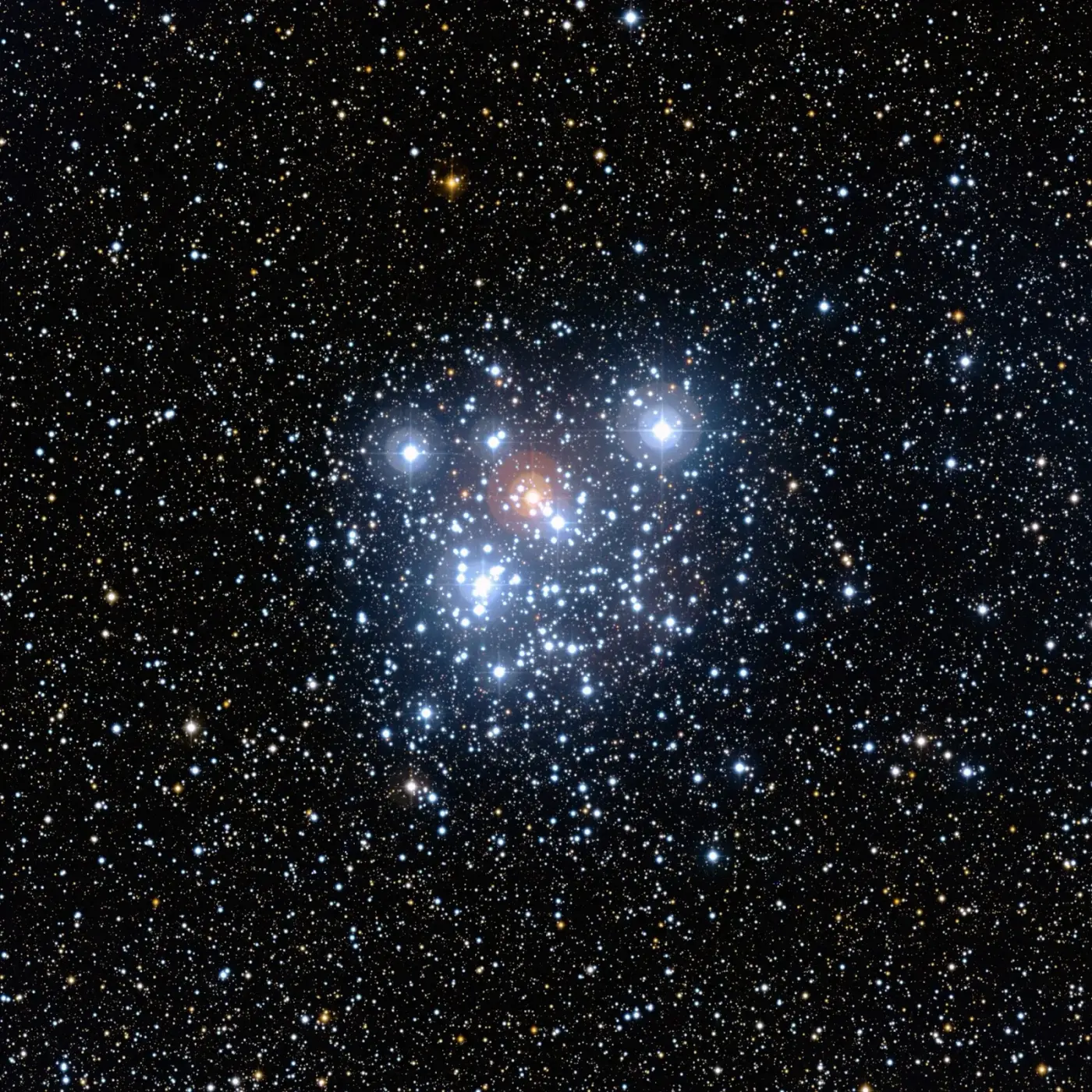
Messier 37 is an open star cluster. A family of young stars born together from the same cloud of gas.
Why Messier 37 is interesting
What you see: Each dot is a star in a family of over 500 identified members. At least a dozen are red giants, older stars that have swelled up. en.wikipedia.org
How it formed: Its stars were born together about 350 to 550 million years ago. Since it formed, M37 has circled the center of the Milky Way about twice. astronomy.com
To scale: The visible cluster is about 20 to 25 light-years across, so light needs 20 to 25 years to cross it from edge to edge. en.wikipedia.org
Three things to know
- M37 is the brightest and richest of the three Messier star clusters in Auriga, with over 500 identified stars.
- At least a dozen of its stars are red giants, a sign of age: the cluster is about 350 to 550 million years old.
- Charles Messier found it in 1764, but Giovanni Battista Hodierna had recorded it before 1654; his notes were not widely known until the 1980s.
12 more fun facts
- M37 contains a planetary nebula, a glowing shell puffed off by a dying star. Only three such nebulae are known inside open star clusters in our galaxy. arxiv.org
- The star at the heart of M37's planetary nebula has a surface temperature of about 90,000 K (about 160,000 degrees Fahrenheit). arxiv.org
- M37 is a graveyard for stars too: at least 14 white dwarfs, the cooling cores of dead stars, are confirmed cluster members. arxiv.org
- Since it formed, M37 has circled the center of the Milky Way about twice. astronomy.com
- When you look at M37, you are looking in the direction exactly opposite the center of our galaxy, out toward one of the Milky Way's outer arms. en.wikipedia.org
- Charles Messier recorded M37 on September 2, 1764, the same night he logged its neighbor M36. astronomy.com
- M37 is much older than its two Auriga neighbors: M36 is about 25 million years old and M38 about 220 million. astronomy.com
- The dying star in M37's planetary nebula is about to become a helium-rich white dwarf. arxiv.org
- The central star of M37's nebula left its giant stage roughly 170,000 to 480,000 years ago, which makes the glowing shell around it unusually old. arxiv.org
- All the stars of M37 together weigh about 1,500 times as much as the Sun. en.wikipedia.org
- The visible cluster is about 20 to 25 light-years across, but its gravity can hold on to stars as far as roughly 46 to 59 light-years from the center. en.wikipedia.org
- M37 lies about 4,500 light-years away, near the inner edge of the Perseus Arm of the Milky Way. astronomy.com
In the game these unlock one by one as you keep photographing Messier 37.
At a glance
- Type
- Open star cluster
- Catalog
- M37, NGC 2099
- Constellation
- Auriga
- Distance
- about 4,500 light-years (estimates range from about 3,600 to 4,700)
- Brightness
- magnitude 6.2
- Size in our sky
- about 24 arcminutes
- Discovered
- Giovanni Battista Hodierna, before 1654
- Position (J2000)
- RA 5h 52m, Dec +32.5°
Looking back in time
The light in this photo left Messier 37 about 4,500 years ago, when the Great Pyramid of Giza was already standing (it was built about 4,500 years ago).
How to see it yourself
Too faint for most eyes, but binoculars show it from a dark site. A small telescope shows its shape.
Finding it: It lies just outside the pentagon of Auriga. Draw a line from Elnath (Beta Tauri) to Theta Aurigae; M37 sits just east of the halfway point. Its neighbors M36 and M38 are a few degrees to the northwest, and all three fit together in a wide binocular view.
When to look: M37 is a winter cluster for northern observers, high in the evening sky from December through February.
What you will see: Under dark skies it can just be glimpsed with the naked eye. Most binoculars show a large, round glow, since its stars are mostly fainter than 10th magnitude. A 6-inch telescope shows about 25 stars at low power and more than 40 at higher power, sprinkled like salt and pepper.
Easy to confuse with:
- Messier 36: M36 is smaller with fewer, brighter stars that resolve easily, while M37 is a larger, rounder glow of many faint stars.
- Messier 38: M38 lies farther northwest and shows a looser, cotton-ball patch with a cross or X pattern, while M37 is richer and finer grained.
Best months: December is when it is highest around midnight. About two months later it is highest in the early evening, at around 8 to 9 PM.
Where on Earth: easy from the Northern Hemisphere. South of latitude 47°S it never climbs more than 10° above the horizon. From 57°N and farther north it never sets.
How it is photographed: long exposures through filters, then the frames are stacked, stretched and combined into color.
Name and story
The name: M37 is number 37 in Charles Messier's catalog and NGC 2099 in the New General Catalogue. Its glittery look has earned it the nickname Salt and Pepper Cluster.
Record: M37 is the richest of the three Messier star clusters in Auriga. It also holds one of only three planetary nebulae known in open clusters of our galaxy.
Explored by: A 2023 study analyzed the faint central star of M37's planetary nebula with spectra and found it is a very hot, hydrogen-poor star of the rare PG1159 type. The same work examined six other white dwarf candidates in the cluster and confirmed one of them as a member.
Test yourself
After every photo of Messier 37 the game asks one of these. A right answer earns sky points for your observatory.
What rare thing hides inside the star cluster M37?
- A planetary nebula from a dying star (the answer)
- A spiral galaxy at its center
- A black hole of a million Suns
A dying star in M37 has puffed off a glowing shell of gas. Only three such planetary nebulae are known inside open clusters in our galaxy. arxiv.org
Who recorded M37 before 1654, long before Messier?
- Henrietta Swan Leavitt
- Edwin Hubble
- Giovanni Battista Hodierna (the answer)
Hodierna recorded it before 1654, but his notes were not widely known until the 1980s, so Charles Messier long got the credit for his 1764 find. en.wikipedia.org
Point a telescope at Messier 37 in the game: capture it in real time, then develop the frames like an astrophotographer.
Point a telescope at Messier 37More star clusters
 The PleiadesM45 · open star cluster
 Beehive ClusterM44 · open star cluster
 Double ClusterNGC 869 · open star cluster
 Jewel BoxNGC 4755 · open star cluster
Sources
- en.wikipedia.org
- messier.seds.org
- arxiv.org
- astronomy.com
- astronomy.com
- Positions: astronomy-engine (Don Cross).