 SKY
Sky catalog › Star clusters
Messier 35
M35, NGC 2168 · An open star cluster in Gemini
What is it?
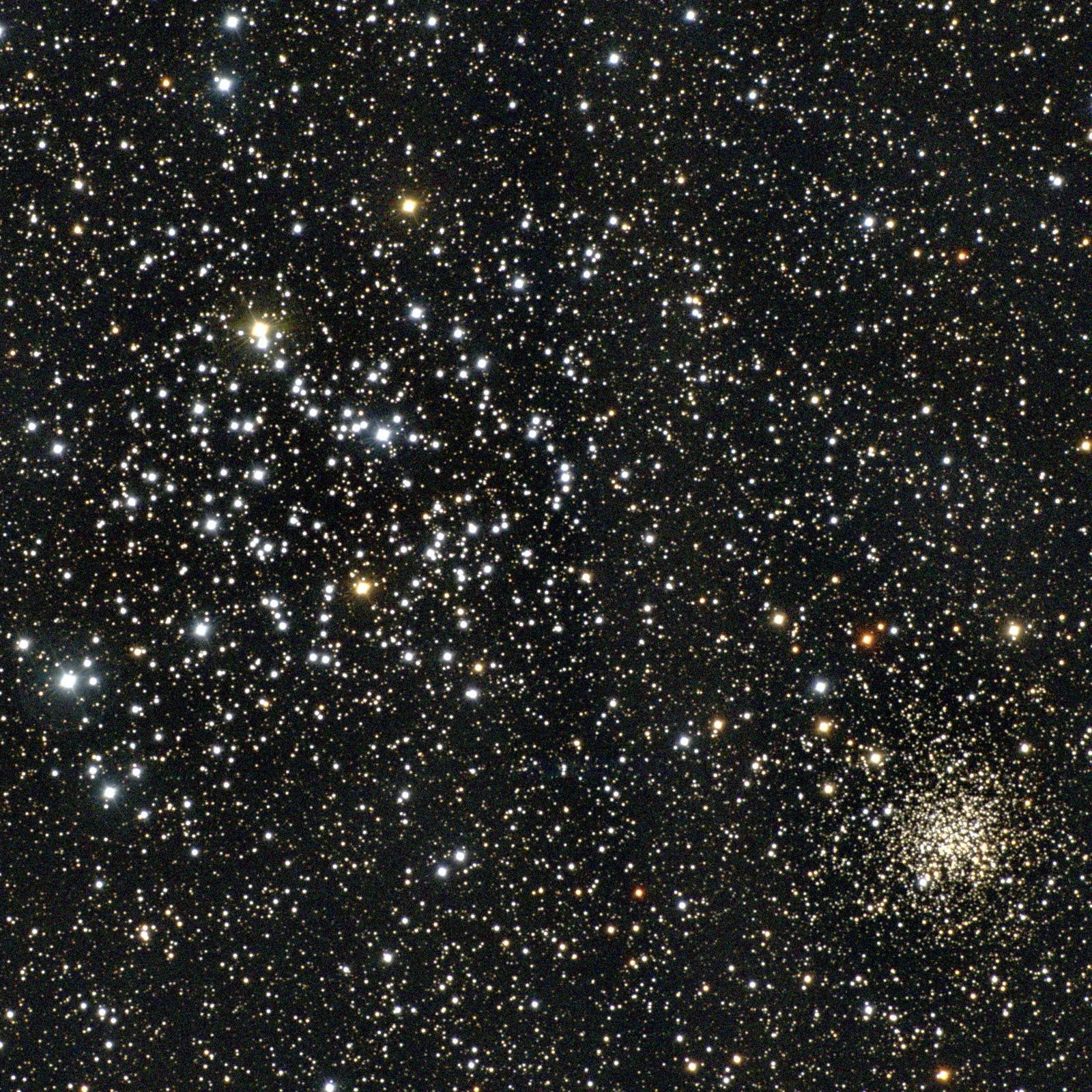
Messier 35 is an open star cluster. A family of young stars born together from the same cloud of gas.
Why Messier 35 is interesting
What you see: The scattered dots are some 400 stars born together: many hot blue stars plus some cooler, older orange and red giants. science.nasa.gov
How it formed: All its stars formed together about 150 million years ago, young for a star cluster. Alongside its many hot blue stars are some cooler, older orange and red giants. science.nasa.gov
To scale: Its stars are spread over a region about 30 light-years across, so light needs about 30 years to cross the cluster. science.nasa.gov
Three things to know
- M35 covers a patch of sky almost as big as the full Moon, and it is the only Messier object in Gemini.
- It is a young cluster, only about 100 to 150 million years old, with hot blue stars and a few cooler orange and red giants.
- Right beside it in photos you can spot a smaller, tighter star cluster called NGC 2158.
12 more fun facts
- Its small neighbor NGC 2158 only looks close. The two clusters are unrelated, and NGC 2158 is about 9,000 light-years farther away. en.wikipedia.org
- NGC 2158, the little cluster beside M35, is thought to be about two billion years old, one of the oldest open clusters known. astronomynow.com
- Astronomers once classified NGC 2158, the compact cluster beside M35, as a globular cluster. It is now known to be an old open cluster. en.wikipedia.org
- Hubble did not photograph M35 for its beauty. The cluster was a test target used to check whether Hubble's instruments were slowly changing in sensitivity. science.nasa.gov
- The stars of M35 are spread across a region about 30 light-years wide. science.nasa.gov
- M35 sits at almost the same height in the sky as the Sun at the June solstice, so it can never be seen from inside the Antarctic Circle. en.wikipedia.org
- The Jellyfish Nebula, the expanding wreck of an exploded star, lies in the sky not far from M35. astronomynow.com
- Two people found M35 on their own: Philippe Loys de Cheseaux around 1745, and the English astronomer John Bevis before 1750. en.wikipedia.org
- All the stars of M35 together add up to roughly 1,600 times the mass of the Sun. en.wikipedia.org
- One study found 64 of M35's stars wobbling back and forth in speed, a sign that each has an unseen partner star. en.wikipedia.org
- About 300 stars are very likely members of M35, but thousands more in the same patch of sky might also belong to it, so star counts differ a lot. en.wikipedia.org
- M35's stars contain a little less iron and other heavy elements than the Sun. en.wikipedia.org
In the game these unlock one by one as you keep photographing Messier 35.
At a glance
- Type
- Open star cluster
- Catalog
- M35, NGC 2168
- Constellation
- Gemini
- Distance
- about 2,970 light-years
- Brightness
- magnitude 5.3
- Size in our sky
- about 28 arcminutes (almost as wide as the full Moon)
- Discovered
- Philippe Loys de Chéseaux, around 1745
- Position (J2000)
- RA 6h 09m, Dec +24.3°
Looking back in time
The light in this photo left Messier 35 about 2,970 years ago, when Egypt was ruled by pharaohs (Ramesses II reigned about 3,250 years ago).
How to see it yourself
Too faint for most eyes, but binoculars show it from a dark site. A small telescope shows its shape.
Finding it: It lies at the feet of Castor in Gemini. From Castor, move about 18 to 20 degrees west along the twin's body to the stars Tejat (Mu Geminorum) and Propus (Eta Geminorum); M35 is just over 2 degrees northwest of Propus.
When to look: M35 is a winter object for northern observers. In January and February it is high in the evening sky, crossing the south around 8 to 10 p.m.
What you will see: Under a very dark, moonless sky it may show as a faint fuzzy patch. Binoculars show a large haze, almost as wide as the full Moon, with many faint stars sparkling in it, and a small telescope reveals around 40 stars. Look about 20 arcminutes to the southwest for the tiny, compact glow of NGC 2158.
Easy to confuse with:
- NGC 2158: NGC 2158 is the much smaller, fainter and yellower knot just southwest of M35, while M35 itself is large and full of brighter, separate stars.
- Messier 37: M37 in Auriga looks like a smaller, finer-grained cluster farther north, while M35 is larger and looser, at the feet of the Gemini twins.
Best months: December is when it is highest around midnight. About two months later it is highest in the early evening, at around 8 to 9 PM.
Where on Earth: easy from the Northern Hemisphere. South of latitude 56°S it never climbs more than 10° above the horizon.
How it is photographed: long exposures through filters, then the frames are stacked, stretched and combined into color.
Name and story
The name: M35 is number 35 in Charles Messier's catalog, which he added it to in 1764, and its NGC number is 2168. It was first found by Philippe Loys de Cheseaux in 1745. It has no popular nickname and is usually just called M35.
Record: Its neighbor in the sky, NGC 2158, is thought to be about two billion years old, which makes it one of the oldest open clusters known.
Explored by: Hubble imaged M35 as part of a calibration program that checks its instruments for changes in sensitivity over time. The two images show some of its roughly 400 stars, many of them hot and blue, with a few cooler orange and red giants.
Test yourself
After every photo of Messier 35 the game asks one of these. A right answer earns sky points for your observatory.
The small knot beside M35, NGC 2158, is how far from M35 in space?
- About 9 light-years farther
- Touching it, in the same cloud
- About 9,000 light-years farther (the answer)
NGC 2158 only looks close because it lies in almost the same direction. The two clusters are unrelated, and NGC 2158 sits about 9,000 light-years farther away. en.wikipedia.org
Why did the Hubble telescope take pictures of M35?
- To hunt for a new planet
- To find a hidden black hole
- To test its own instruments (the answer)
M35 was a calibration target. Looking at the same stars again and again lets scientists check whether Hubble's instruments slowly change in sensitivity. science.nasa.gov
Point a telescope at Messier 35 in the game: capture it in real time, then develop the frames like an astrophotographer.
Point a telescope at Messier 35More star clusters
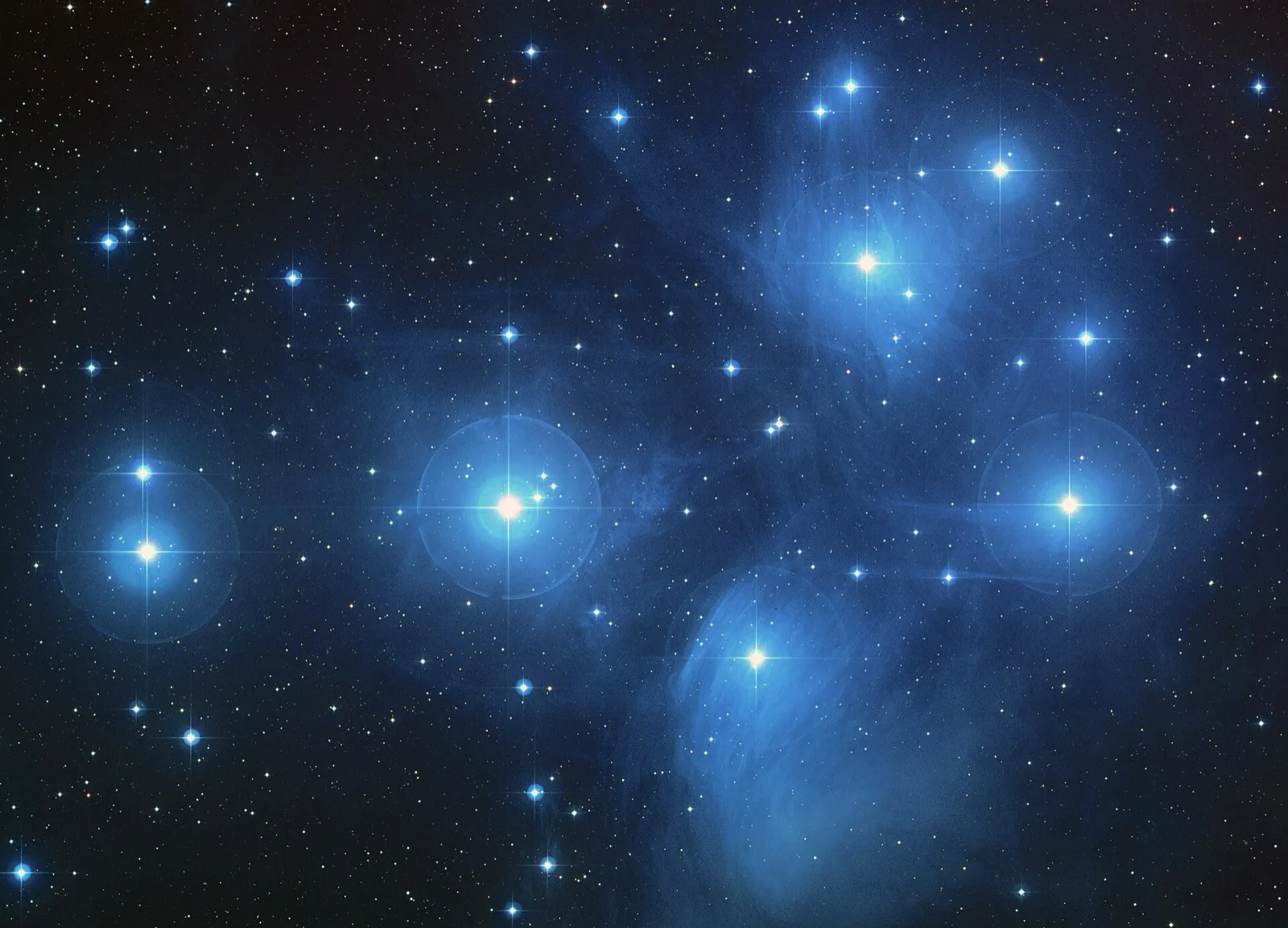 The PleiadesM45 · open star cluster
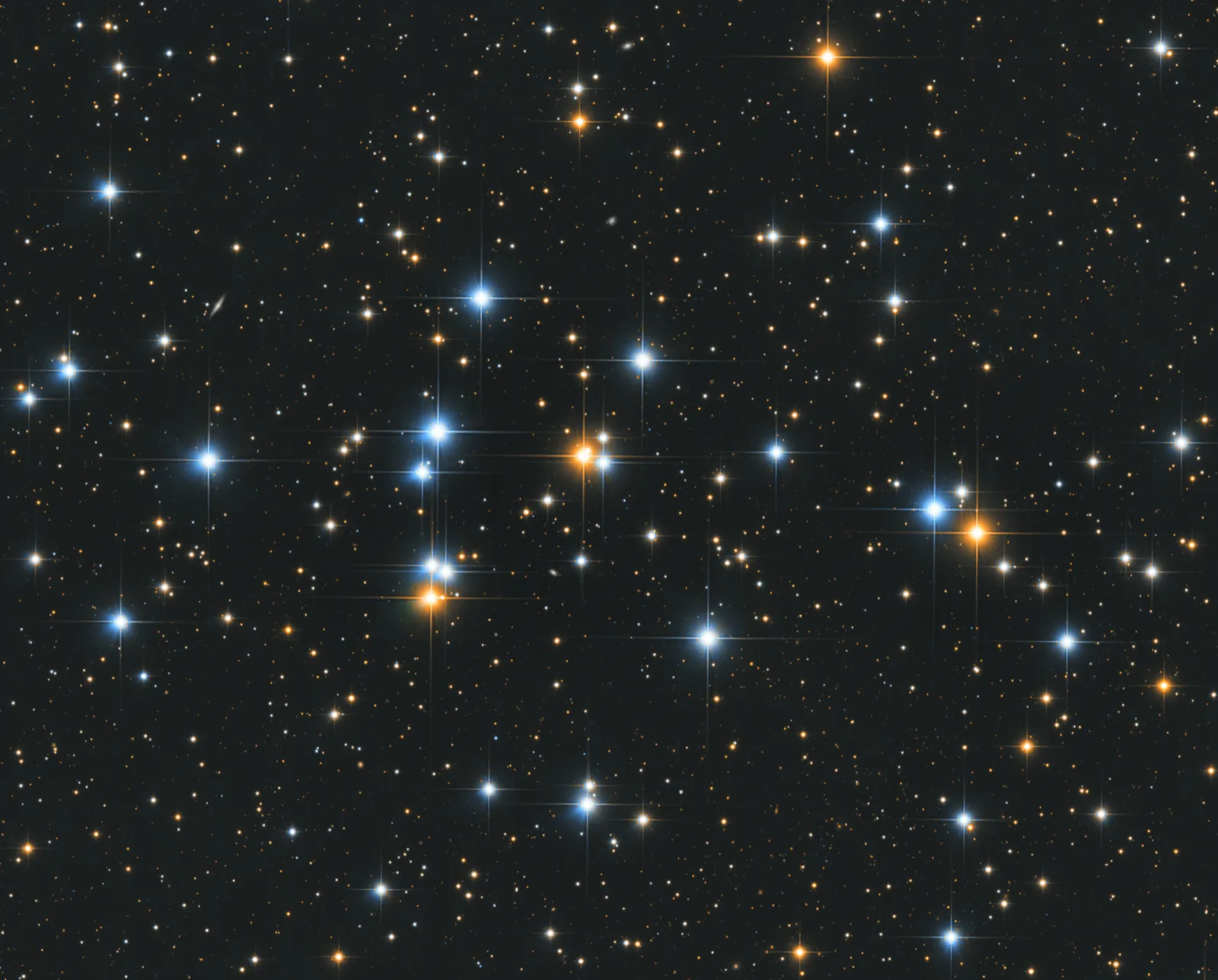 Beehive ClusterM44 · open star cluster
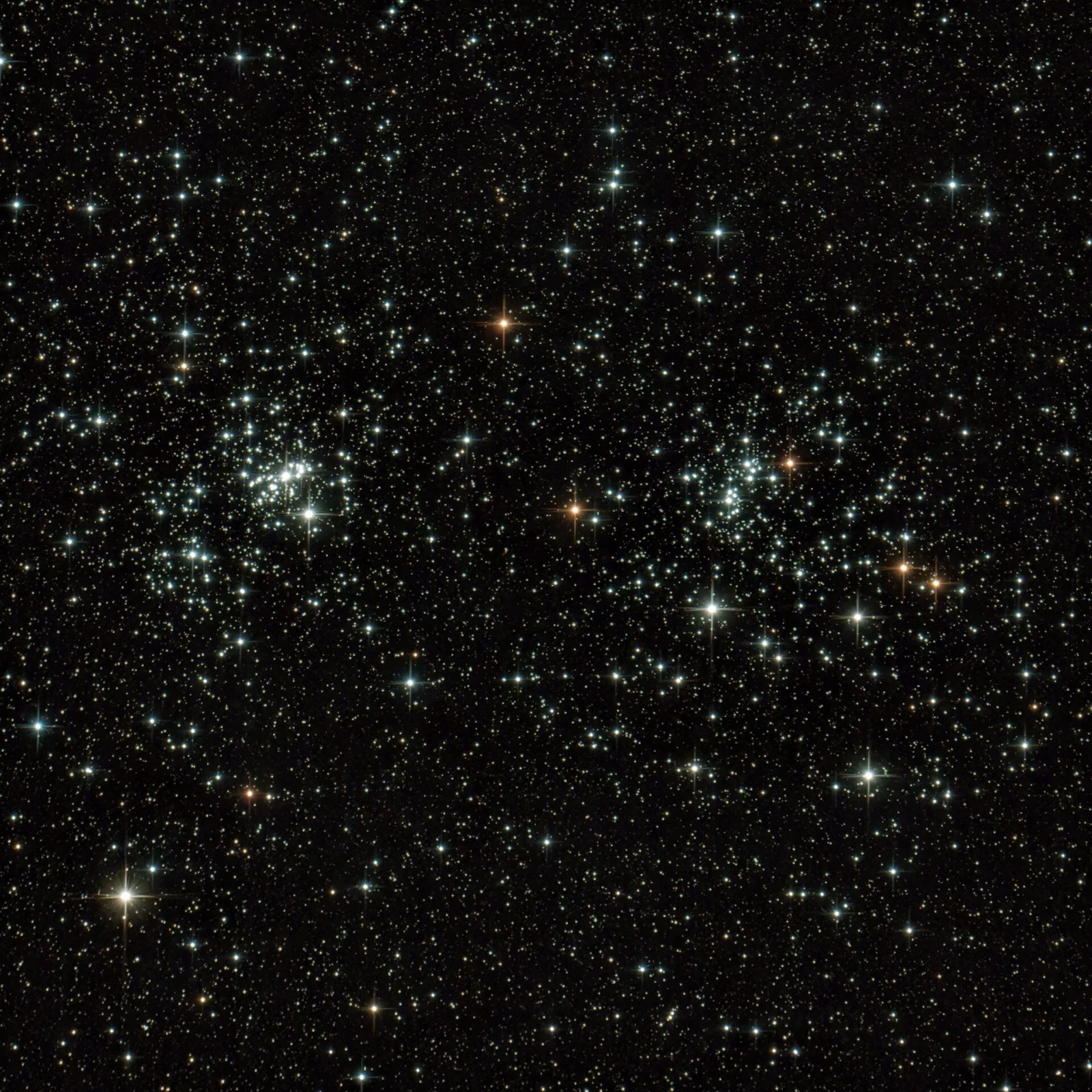 Double ClusterNGC 869 · open star cluster
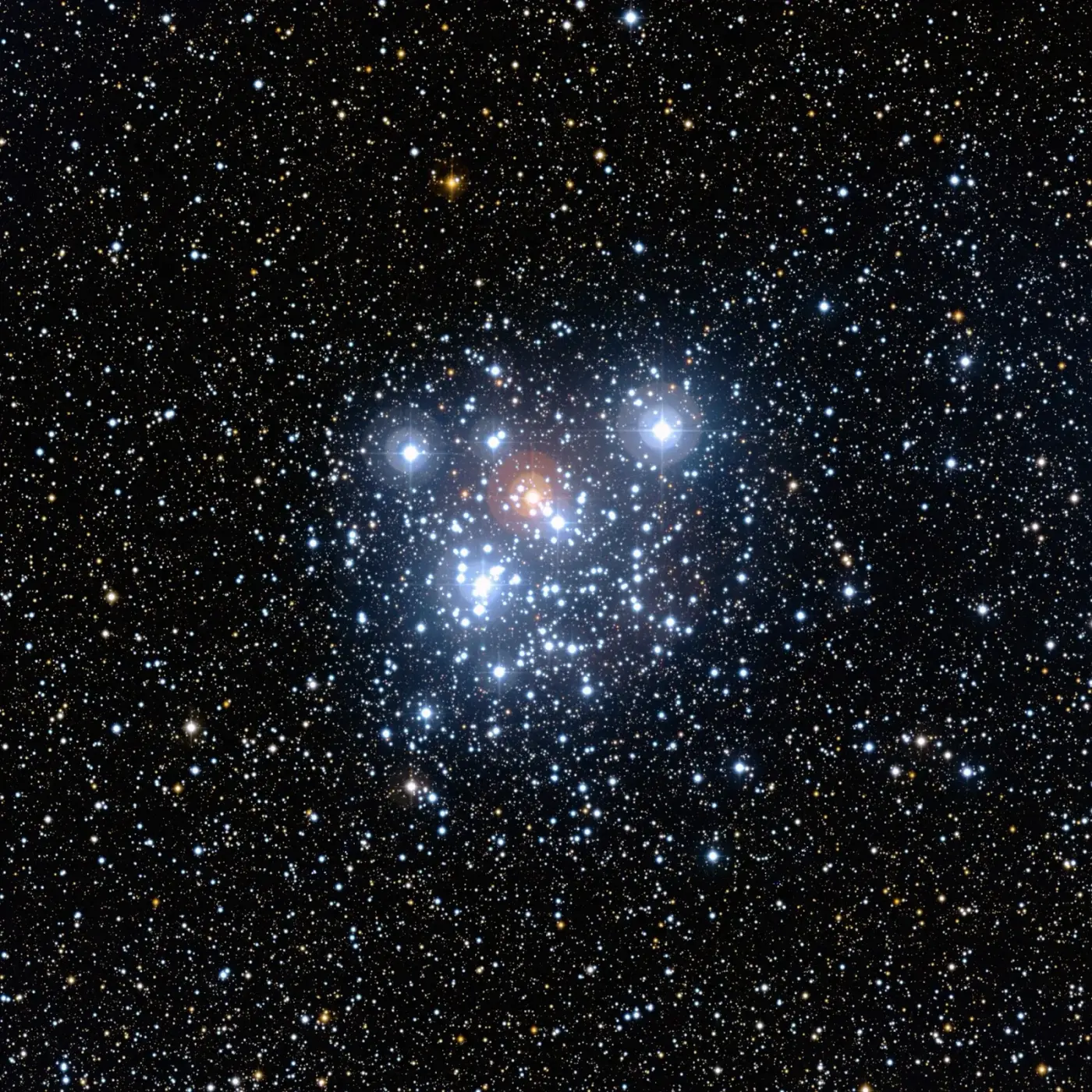 Jewel BoxNGC 4755 · open star cluster
Sources
- en.wikipedia.org
- science.nasa.gov
- en.wikipedia.org
- astronomynow.com
- astronomy.com
- Positions: astronomy-engine (Don Cross).