 SKY
Sky catalog › Nebulae
Dumbbell Nebula
M27, NGC 6853 · A planetary nebula in Vulpecula
What is it?
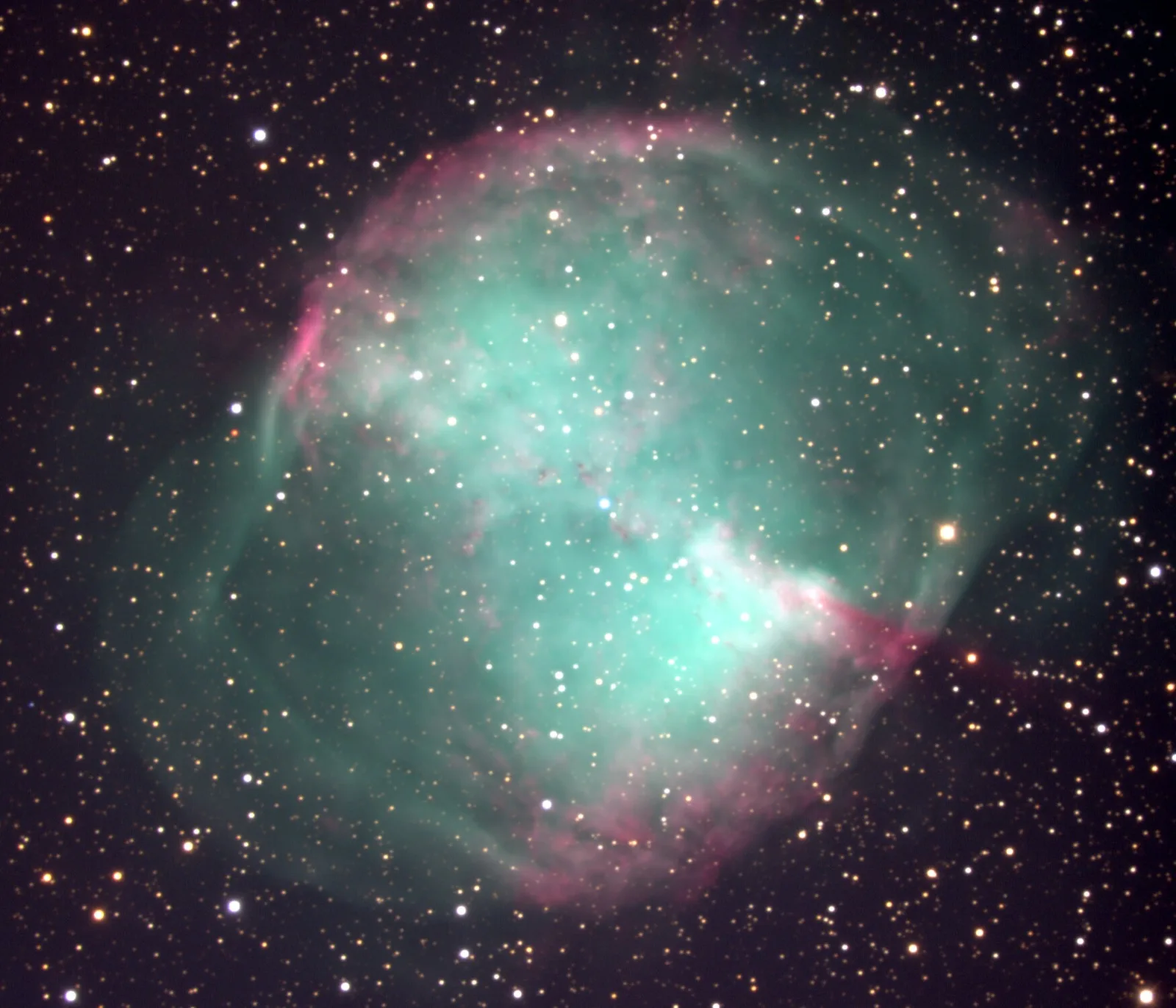
Dumbbell Nebula is a planetary nebula. A shell of gas puffed off by a dying Sun-like star. It has nothing to do with planets: early telescopes made it look like a small planet disk.
Why the Dumbbell Nebula is interesting
What you see: The glow is the outer layers of an old, dying star, shed into space. In Hubble's colors, oxygen shows as blue, hydrogen as green, and sulfur and nitrogen as red. science.nasa.gov
How it formed: The dying star puffed off its outer gas, which is rushing outward at about 31 km (19 miles) per second. At that pace the cloud is about 9,800 years old, at most 14,600. en.wikipedia.org
To scale: Knots of gas inside it are typically 17 to 56 billion km (11 to 35 billion miles) wide, and each holds as much mass as three Earths. science.nasa.gov
Three things to know
- The Dumbbell was the first planetary nebula ever discovered.
- It is the glowing gas puffed off by a dying star, and the cloud has been growing for roughly 10,000 years (estimates go up to 14,600).
- Knots of gas inside it are several times wider than the distance from the Sun to Pluto, and each holds as much mass as three Earths.
11 more fun facts
- The Dumbbell's southern half looks brighter than its northern half, an uneven glow that careful observers can notice at the eyepiece. astronomy.com
- Faint wings called the ears stick out at right angles to the bright hourglass, and they show best in larger telescopes with a nebula filter. astronomy.com
- The whole cloud is shaped like a football with rounded ends: the bright hourglass runs across its short axis and the faint ears along its long axis. astronomy.com
- When Charles Messier found it in July 1764, he described it as a nebula without a star, oval in shape. astronomy.com
- The gas is rushing outward at about 31 km per second, roughly 69,000 miles per hour, according to a 1970 study. en.wikipedia.org
- Its central white dwarf is about 5.5 percent as wide as the Sun, which makes it larger than most known white dwarfs. en.wikipedia.org
- The leftover star in the middle holds about 0.56 times the Sun's mass, packed into an object far smaller than the Sun. en.wikipedia.org
- In Hubble's close-up, some knots of gas look like fingers pointing toward the central star, while others float alone with or without tails. science.nasa.gov
- Hubble's colors show oxygen in blue, hydrogen in green, and sulfur and nitrogen in red. science.nasa.gov
- In 1998 ESO's Very Large Telescope in Chile photographed the Dumbbell almost by accident, during a technical test of new narrow-band filters. eso.org
- Astronomers used the Hubble Space Telescope to measure the tiny yearly shift of its central star against the background, a direct way to find its distance. en.wikipedia.org
In the game these unlock one by one as you keep photographing the Dumbbell Nebula.
At a glance
- Type
- Planetary nebula
- Catalog
- M27, NGC 6853
- Constellation
- Vulpecula
- Distance
- about 1,200 to 1,360 light-years (estimates differ)
- Brightness
- magnitude 7.4
- Size in our sky
- 8.0 x 5.6 arcminutes
- Discovered
- Charles Messier, 1764
- Position (J2000)
- RA 20h 00m, Dec +22.7°
Looking back in time
The light in this photo left the Dumbbell Nebula 1,200 to 1,360 years ago, when the Maya were building great stone cities in Central America.
How to see it yourself
Needs a telescope and a dark sky. Photos show far more than the eye can see.
Finding it: It lies in faint Vulpecula, inside the Summer Triangle formed by Vega, Deneb and Altair. Find the little arrow-shaped constellation Sagitta, then go about 3 degrees due north of its star Gamma Sagittae.
When to look: Best on summer and early autumn evenings from mid-northern latitudes; NASA suggests September, and in August the Summer Triangle is high overhead after nightfall.
What you will see: Not visible to the naked eye. Binoculars show a small fuzzy patch, roughly rectangular with a hint of a pinched waist. A small telescope shows the two-lobed apple-core shape, and at 100x or more with an OIII filter it shows more structure.
Easy to confuse with:
- Little Dumbbell Nebula (M76): M76 is in Perseus, about three times smaller and three magnitudes fainter, so it is far harder to see than M27.
- Ring Nebula (M57): The Ring is a tiny oval with a dark hole, while the Dumbbell is a much larger two-lobed patch with no obvious hole.
Best months: July is when it is highest around midnight. About two months later it is highest in the early evening, at around 8 to 9 PM.
Where on Earth: easy from the Northern Hemisphere. South of latitude 57°S it never climbs more than 10° above the horizon.
How it is photographed: long exposures through filters, then the frames are stacked, stretched and combined into color.
Name and story
The name: John Herschel described it as a nebula shaped like a dumbbell, and that became its popular name; he later said it was shaped something like an hourglass. Other nicknames include the Apple Core Nebula and the Bow Tie Nebula. Charles Messier discovered it in July 1764 and made it number 27 in his catalog.
Record: The Dumbbell was the first planetary nebula ever discovered, found by Charles Messier in 1764. It is also one of the brightest planetary nebulae in the sky, easy to spot in binoculars.
Explored by: Astronomers used the Hubble Space Telescope to measure the parallax of the Dumbbell's central star, helping pin down its distance. The Mayall 4-meter telescope at Kitt Peak has made detailed color images of it, and it is a favorite target for amateur astrophotographers.
Test yourself
After every photo of the Dumbbell Nebula the game asks one of these. A right answer earns sky points for your observatory.
What is left at the center of the Dumbbell Nebula?
- A white dwarf, the dying star's core (the answer)
- A black hole swallowing the gas
- A newborn star still growing
After the star shed its outer layers, only its small hot core remained. It holds about 0.56 times the Sun's mass in a ball only about 5.5 percent as wide as the Sun. en.wikipedia.org
What first does the Dumbbell Nebula hold?
- First planetary nebula ever found (the answer)
- First star cluster ever found
- First galaxy found beyond ours
Charles Messier discovered it in 1764, and no glowing shell from a dying star had been recorded before it. It is also one of the brightest, easy in binoculars. astronomy.com
Point a telescope at the Dumbbell Nebula in the game: capture it in real time, then develop the frames like an astrophotographer.
Point a telescope at the Dumbbell NebulaMore nebulae
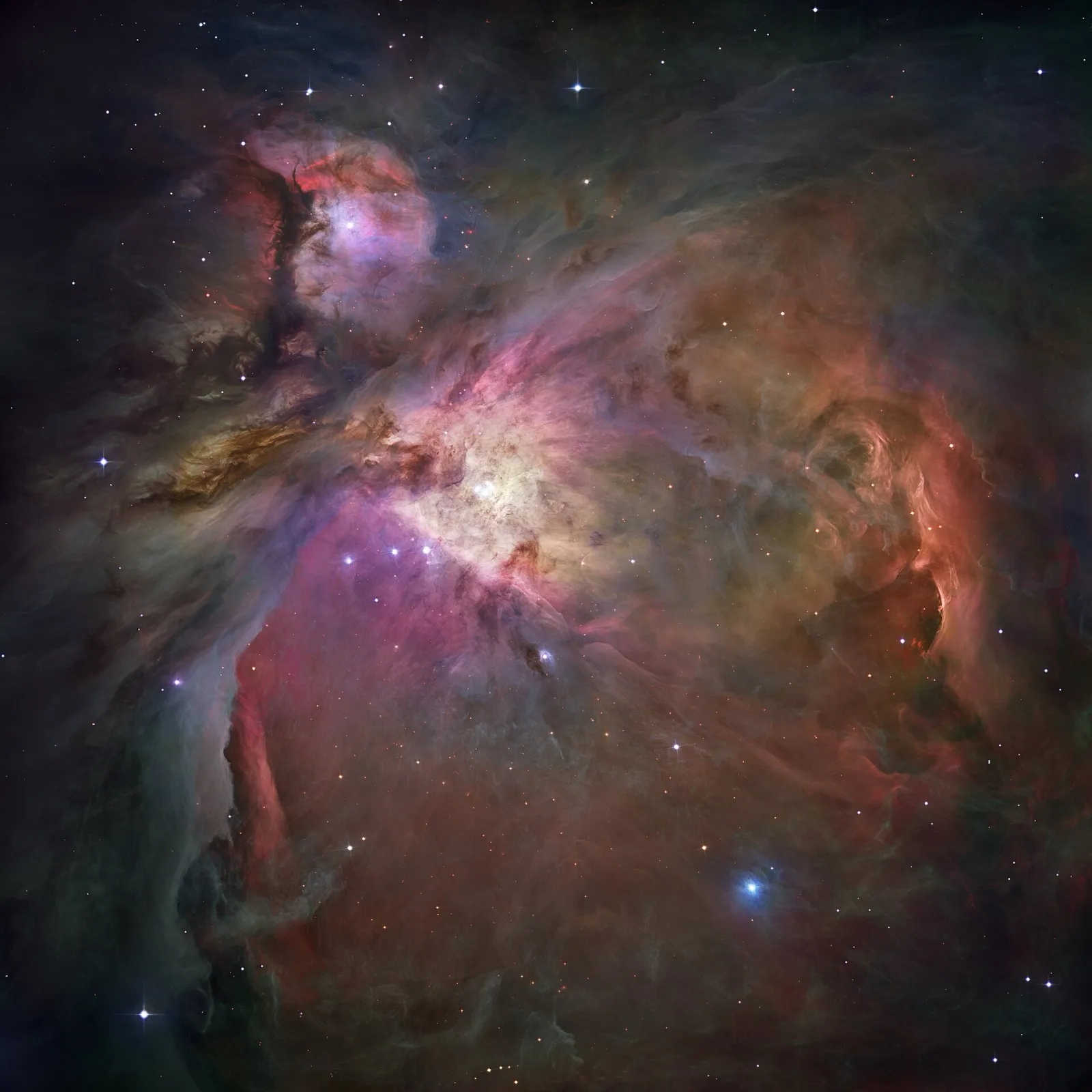 Orion NebulaM42 · star-forming nebula
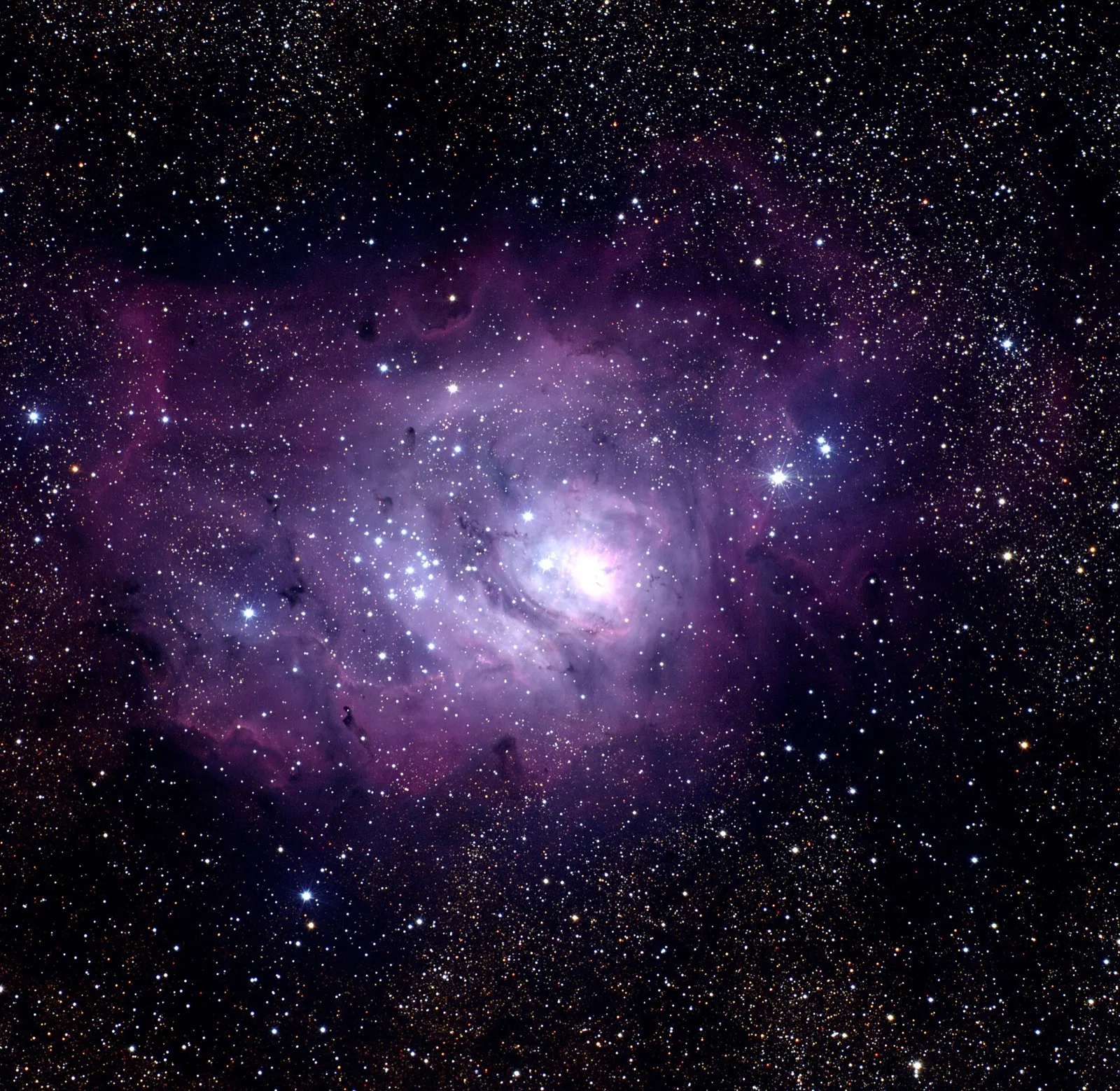 Lagoon NebulaM8 · star-forming nebula
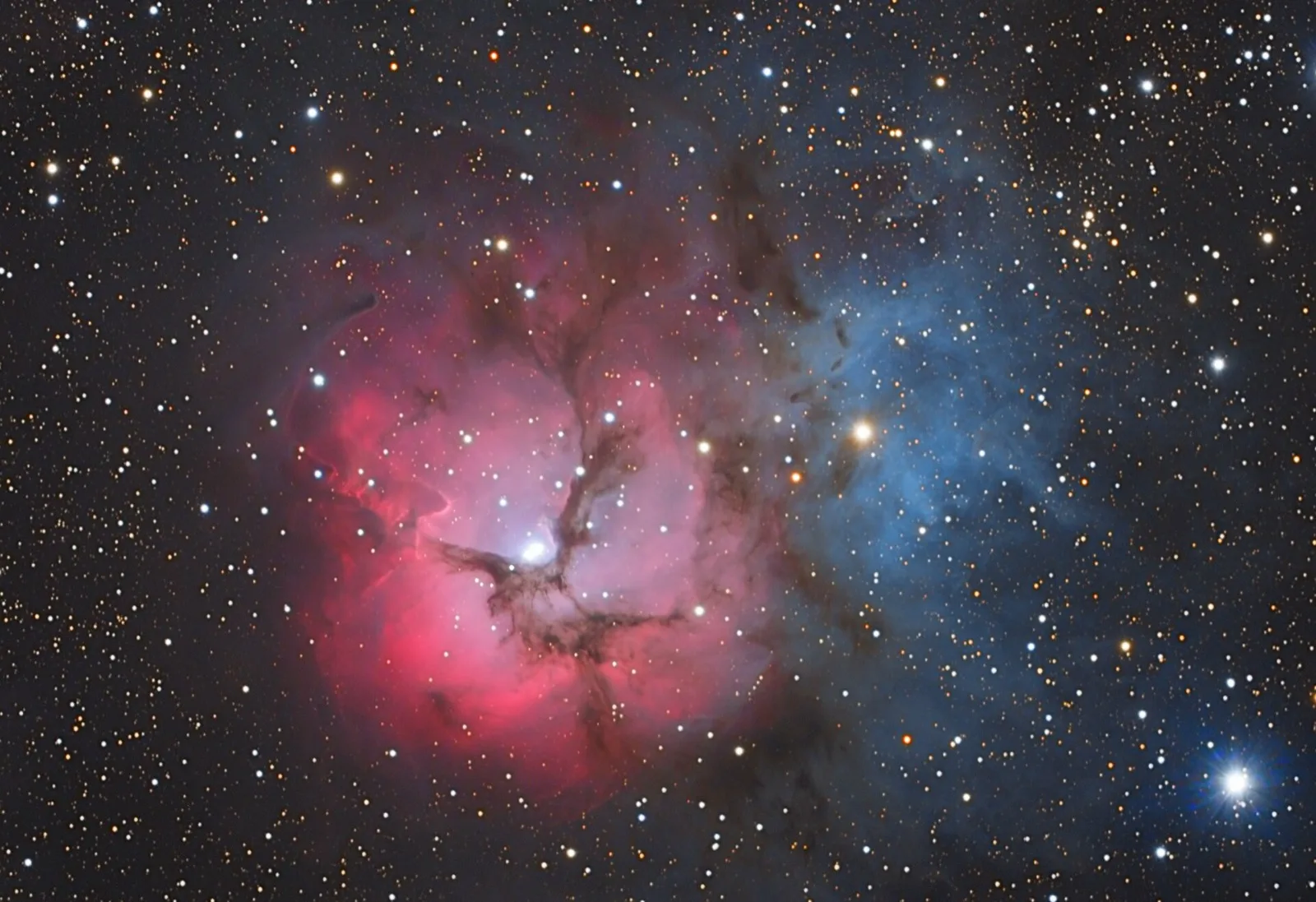 Trifid NebulaM20 · star-forming nebula
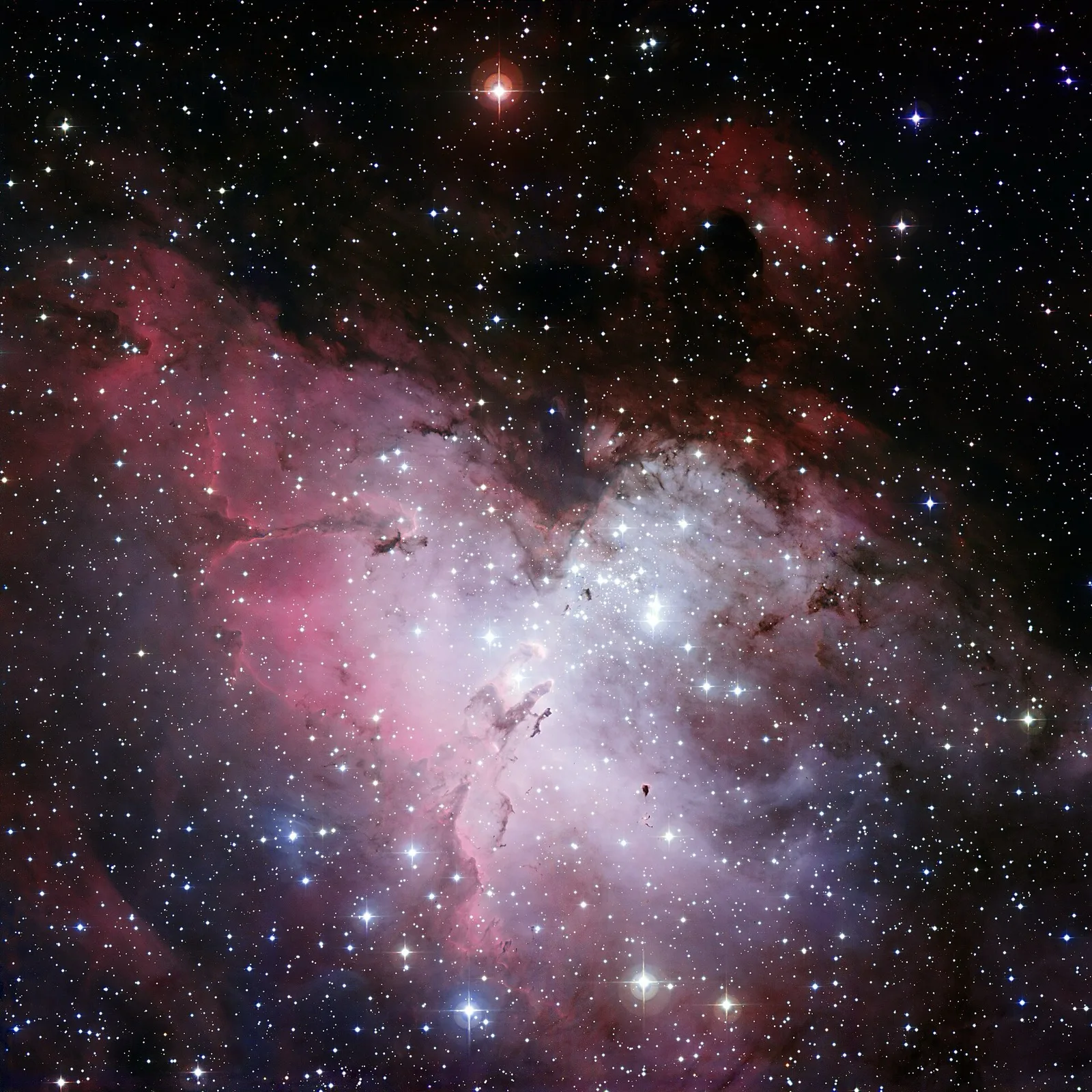 Eagle NebulaM16 · star-forming nebula
Sources
- en.wikipedia.org
- science.nasa.gov
- astronomy.com
- eso.org
- science.nasa.gov
- Positions: astronomy-engine (Don Cross).