 SKY
Sky catalog › Star clusters
Messier 22
M22, NGC 6656 · A globular cluster in Sagittarius
What is it?
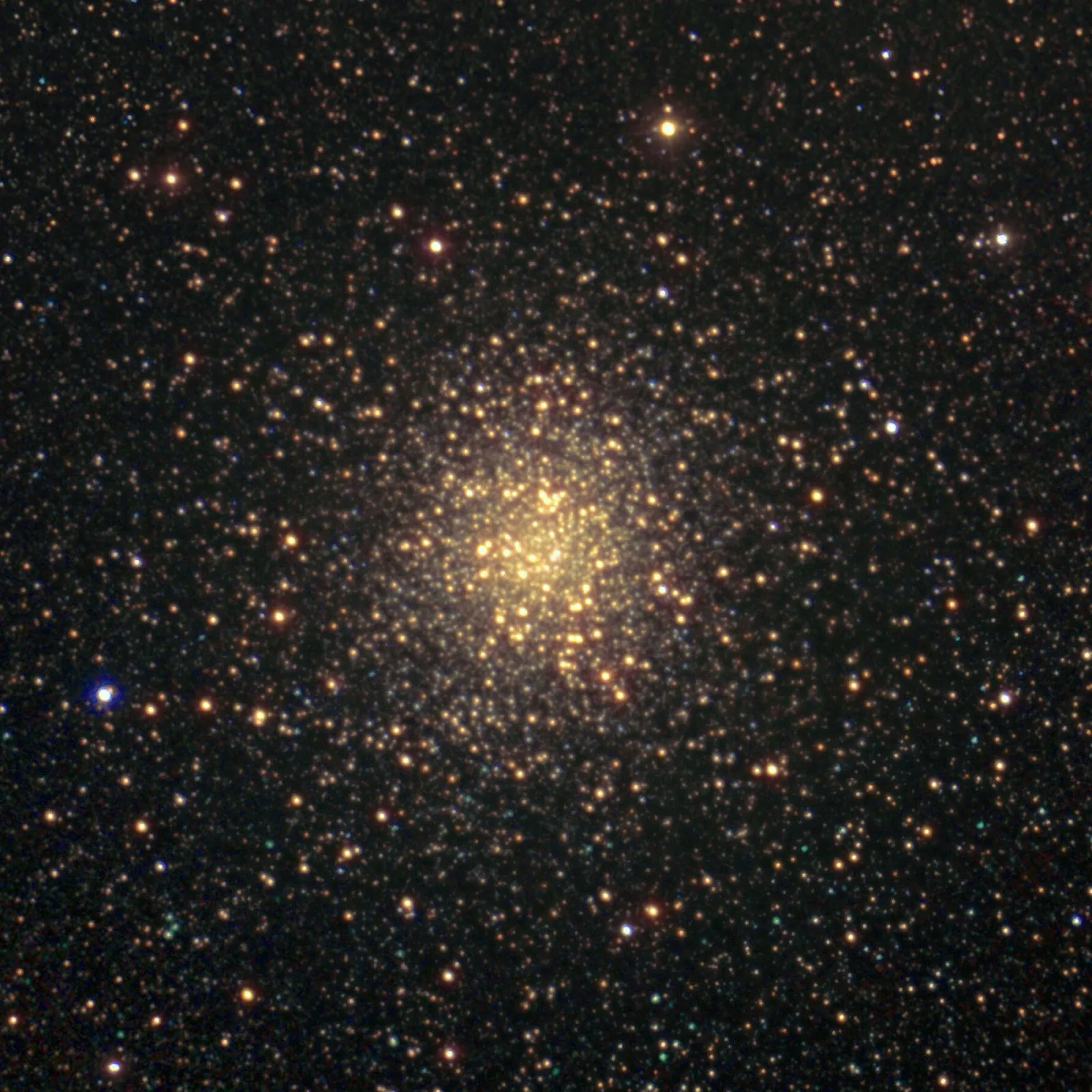
Messier 22 is a globular cluster. A tight ball of hundreds of thousands of very old stars.
Why Messier 22 is interesting
What you see: The ball of dots is a swarm of very old stars with a dense core. In 1930 Harlow Shapley estimated it held roughly 70,000 stars. en.wikipedia.org
How it formed: Its stars are about 12 billion years old. Its unusually large core may have been puffed up by stars interacting with black holes hidden inside it. en.wikipedia.org
To scale: M22 is about 99 light-years wide, so light needs about 99 years to cross it. en.wikipedia.org
Three things to know
- M22 was one of the first globular clusters ever found: Abraham Ihle spotted it in 1665 while looking for Saturn.
- It is the brightest globular cluster you can see from most of North America and Europe, though it stays low in the southern sky.
- It is one of only four globular clusters in our galaxy known to hold a planetary nebula, and in 2012 radio telescopes found two black holes inside it.
12 more fun facts
- Each of the two black holes found in M22 in 2012 weighs about 10 to 20 times the Sun, and the cluster may hide 5 to 100 black holes in all. en.wikipedia.org
- Hubble has found six planet-sized objects in M22 that do not orbit any star. science.nasa.gov
- M22 sits in front of the crowded bulge of the Milky Way, so it is useful for studying microlensing, when its stars bend and briefly brighten light from stars far behind. en.wikipedia.org
- In 1930 Harlow Shapley studied M22 and estimated that it held roughly 70,000 stars. en.wikipedia.org
- M22's planetary nebula, GJJC1, was first noticed by the IRAS infrared satellite in the mid-1980s. en.wikipedia.org
- M22's planetary nebula is probably only about 6,000 years old, very young compared with the roughly 12-billion-year-old cluster around it. en.wikipedia.org
- Seeing M22's planetary nebula yourself takes a 20-inch or larger telescope at 600x or more, on a night with the steadiest air. astronomy.com
- Unlike most round globular clusters, M22 is elliptical, its long axis tilted from northeast to southwest. astronomy.com
- M22 has less than half as many stars as M13, yet it looks bigger and brighter because it is less than half as far away. astronomy.com
- M22 lies just south of the Sun's path; the Sun passes close by it every mid-December. en.wikipedia.org
- M22's unusually large core may have been puffed up by stars interacting with its black holes. en.wikipedia.org
- M22 is bright enough that one binocular observer picked it out even during a full Moon. lightandmatter.com
In the game these unlock one by one as you keep photographing Messier 22.
At a glance
- Type
- Globular cluster
- Catalog
- M22, NGC 6656
- Constellation
- Sagittarius
- Distance
- about 10,600 light-years (NASA gives 10,000)
- Brightness
- magnitude 5.1
- Size in our sky
- about 32 arcminutes (about the size of the full Moon)
- Discovered
- Abraham Ihle, 1665
- Position (J2000)
- RA 18h 36m, Dec -23.9°
Looking back in time
The light in this photo left Messier 22 about 10,600 years ago, when nobody could write yet (writing began about 5,200 years ago) and the first farming villages were growing.
How to see it yourself
Too faint for most eyes, but binoculars show it from a dark site. A small telescope shows its shape.
Finding it: Find the Teapot of Sagittarius. M22 lies just over 2 degrees northeast of Kaus Borealis, the star at the top of the Teapot's lid.
When to look: Best on summer evenings from mid-northern latitudes, where it stays low in the south because it lies nearly 24 degrees south of the celestial equator. NASA lists August as the best month.
What you will see: Under ideal conditions it is visible to the naked eye. Binoculars show it easily, and larger binoculars reveal its oval shape. A 3.5-inch telescope shows some stars around its edges, and an 8-inch shows a multitude of faint stars across the whole cluster.
Easy to confuse with:
- Messier 28: M28 is a smaller, fainter globular less than a degree northwest of Kaus Borealis, while M22 is larger, brighter and just over 2 degrees northeast of that star.
Best months: June is when it is highest around midnight. About two months later it is highest in the early evening, at around 8 to 9 PM.
Where on Earth: best from the Southern Hemisphere. North of latitude 56°N it never climbs more than 10° above the horizon.
How it is photographed: long exposures through filters, then the frames are stacked, stretched and combined into color.
Name and story
The name: Abraham Ihle discovered it in 1665, and Gottfried Kirch's 1682 publication credits him. Charles Messier added it as number 22 to his catalog in 1764. It is also NGC 6656.
Record: The two black holes that the Very Large Array found in M22 in 2012 were the first stellar-mass black holes discovered in any globular cluster of the Milky Way, and the first found by radio instead of X-rays.
Explored by: Radio astronomers used the Very Large Array in New Mexico to find M22's two black holes, and Chandra X-ray observations backed up the find. The IRAS infrared satellite first flagged its planetary nebula as a point source in the 1980s.
Test yourself
After every photo of Messier 22 the game asks one of these. A right answer earns sky points for your observatory.
M22 has fewer stars than M13. Why does it look bigger and brighter?
- It is less than half as far away (the answer)
- It is still growing quickly
- Its stars are all much hotter
Nearer things look bigger and brighter. M22 has less than half as many stars as M13, but it lies less than half as far from us. astronomy.com
What did radio telescopes find inside M22 in 2012?
- A newborn star cloud
- A planet like Earth
- Two black holes (the answer)
The Very Large Array picked them up by their radio glow. They were the first stellar-mass black holes found in any Milky Way globular cluster, and the first found by radio. astronomy.com
Point a telescope at Messier 22 in the game: capture it in real time, then develop the frames like an astrophotographer.
Point a telescope at Messier 22More star clusters
 The PleiadesM45 · open star cluster
 Beehive ClusterM44 · open star cluster
 Double ClusterNGC 869 · open star cluster
 Jewel BoxNGC 4755 · open star cluster
Sources
- en.wikipedia.org
- science.nasa.gov
- astronomy.com
- lightandmatter.com
- astronomy.com
- Positions: astronomy-engine (Don Cross).