 SKY
Sky catalog › Nebulae
Omega Nebula
M17, NGC 6618 · A star-forming nebula in Sagittarius
What is it?
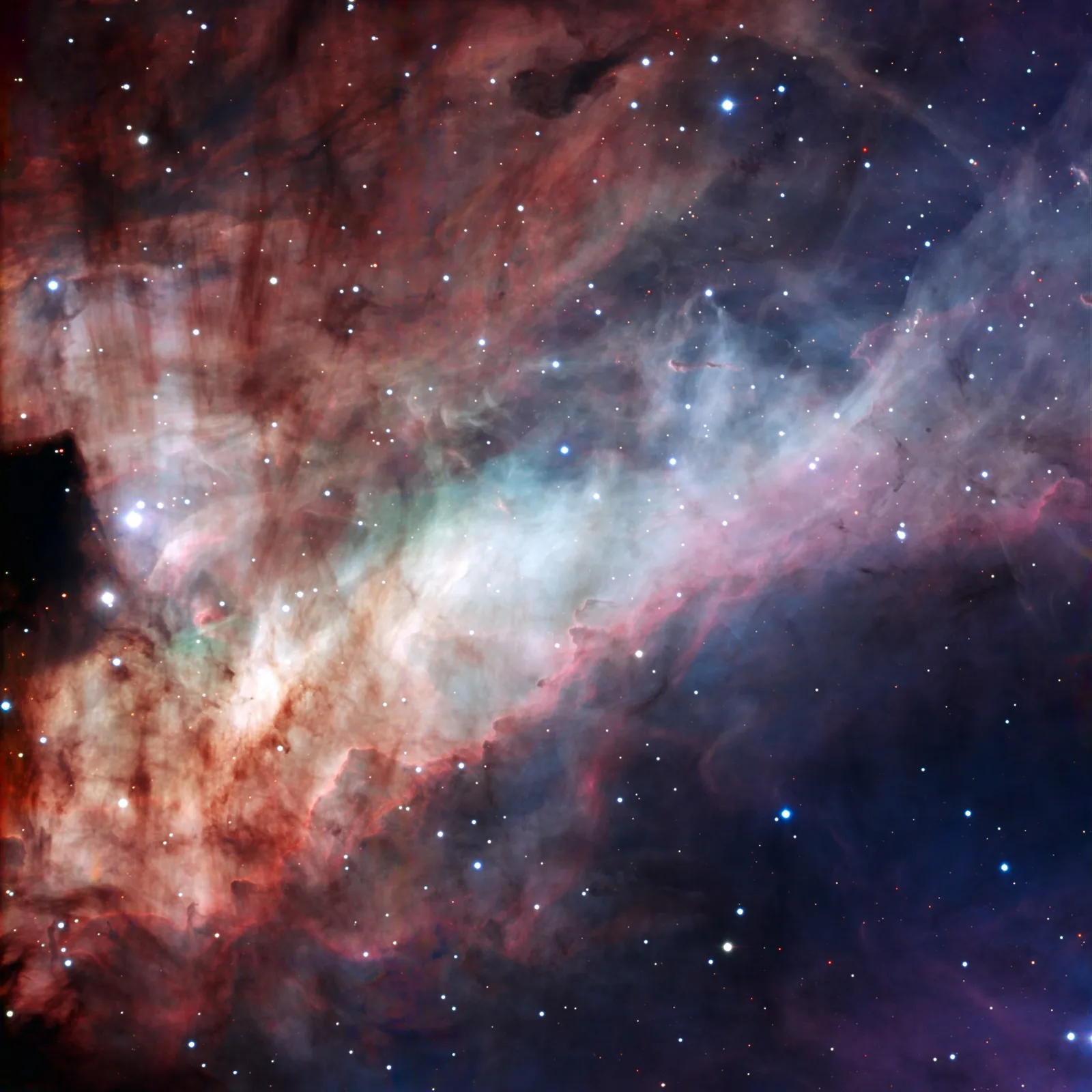
Omega Nebula is a star-forming nebula. A huge cloud of gas lit up by hot young stars born inside it.
Why the Omega Nebula is interesting
What you see: The glow is gas heated and lit up by more than 100 of our galaxy's most massive young stars, packed into its center. jpl.nasa.gov
How it formed: It did not form all at once. The central region formed first, then the northern part, and the southern part is the youngest, where nine hidden protostars were found. jpl.nasa.gov
To scale: The glowing cloud is about 15 light-years across, so light needs about 15 years to cross it. en.wikipedia.org
Three things to know
- The Omega Nebula is one of the brightest and most massive star-forming regions in our galaxy.
- The star cluster inside it is only about 1 million years old, one of the youngest known.
- The glowing cloud is about 15 light-years across, and people have also called it the Swan, Checkmark, Lobster and Horseshoe Nebula.
12 more fun facts
- NASA's SOFIA, a Boeing 747SP jet carrying a 106-inch telescope, found nine previously unseen protostars in the Omega Nebula, mostly in its southern part. jpl.nasa.gov
- The Omega Nebula did not form all at once: its central region is the oldest, the northern part came next, and the southern part is the youngest. jpl.nasa.gov
- The center of the Omega Nebula holds more than 100 of our galaxy's most massive young stars. Less than 1 percent of all stars are that massive. jpl.nasa.gov
- The cloud around the Omega Nebula holds about 30,000 times the mass of the Sun, while the glowing nebula itself has about 800. en.wikipedia.org
- More than a thousand stars are forming in the outer parts of the Omega Nebula. en.wikipedia.org
- A dense pocket of gas at the center of the Omega Nebula's brightest region is about 10 times larger than our solar system. science.nasa.gov
- Charles Messier described the Omega Nebula as "a train of light without stars, of 5 or 6 minutes in extent." constellation-guide.com
- The Omega Nebula's discoverer, Jean-Philippe Loys de Cheseaux, wrote in 1745 that it had "the form of a ray, or of the tail of a comet." constellation-guide.com
- The Omega Nebula is shaped much like the Orion Nebula, but we see it edge-on. en.wikipedia.org
- In 1875 Edward Singleton Holden sketched the Omega Nebula through the 26-inch Clark refractor at the U.S. Naval Observatory. constellation-guide.com
- The Omega Nebula is one of the three finest emission nebulae for northern observers with small telescopes, along with the Lagoon and Orion nebulae. constellation-guide.com
- William Lassell sketched the Omega Nebula in 1862 using a 4-foot telescope in Malta. constellation-guide.com
In the game these unlock one by one as you keep photographing the Omega Nebula.
At a glance
- Type
- Star-forming nebula
- Catalog
- M17, NGC 6618
- Constellation
- Sagittarius
- Distance
- about 5,500 light-years (estimates range from 5,000 to 6,000)
- Brightness
- magnitude 6
- Size in our sky
- about 11 arcminutes
- Discovered
- Philippe Loys de Chéseaux, 1745
- Position (J2000)
- RA 18h 20m, Dec -16.2°
Looking back in time
The light in this photo left the Omega Nebula about 5,500 years ago, when nobody could write yet (writing began about 5,200 years ago) and the first farming villages were growing.
How to see it yourself
Too faint for most eyes, but binoculars show it from a dark site. A small telescope shows its shape.
Finding it: Start at Lambda Sagittarii, the star at the top of the Teapot's lid, and sweep north with binoculars past the bright Sagittarius Star Cloud (M24). The small cluster M18 comes next, and M17 is about another degree beyond it, just over 2 degrees southwest of the star Gamma Scuti.
When to look: A summer object, best on August evenings, when it sits in the southern sky for mid-northern observers.
What you will see: Under good dark skies it can just be seen without optics from places not too far north. Binoculars show it even with some light pollution, and a small telescope shows a bright bar of glow that observers liken to a swan, a checkmark or the Greek letter omega.
Easy to confuse with:
- Eagle Nebula (M16): The Eagle, a little to the north, shows a scattered star cluster wrapped in faint haze, while the Omega is a bright streak of glow.
Best months: June is when it is highest around midnight. About two months later it is highest in the early evening, at around 8 to 9 PM.
Where on Earth: best from the Southern Hemisphere. North of latitude 64°N it never climbs more than 10° above the horizon.
How it is photographed: long exposures through filters, then the frames are stacked, stretched and combined into color.
Name and story
The name: Its main name comes from its likeness to the Greek capital letter omega, as John Herschel described it in his 1833 drawing; Swan, Checkmark, Horseshoe and Lobster are other nicknames for its shape. Jean-Philippe Loys de Cheseaux discovered it in 1745, and Charles Messier cataloged it on June 3, 1764.
Explored by: NASA's flying SOFIA observatory studied the Omega Nebula in infrared light, with results published in 2020, and combined its data with earlier observations from the Spitzer and Herschel space telescopes. Together they showed that different parts of the nebula formed at different times.
Test yourself
After every photo of the Omega Nebula the game asks one of these. A right answer earns sky points for your observatory.
What rare kind of star crowds the Omega Nebula's center?
- Burnt-out white dwarfs
- Old, dying red giants
- Very massive young stars (the answer)
Its center holds more than 100 of the galaxy's most massive young stars. Less than 1 percent of all stars are that big, so this nursery is a rare chance to study them. jpl.nasa.gov
What carried NASA's SOFIA telescope that studied this nebula?
- A Boeing 747 jetliner (the answer)
- A weather balloon
- A rover on the Moon
SOFIA was a Boeing 747SP modified to carry a 106-inch telescope. Studying infrared light, it found nine protostars here that had not been seen before. jpl.nasa.gov
Point a telescope at the Omega Nebula in the game: capture it in real time, then develop the frames like an astrophotographer.
Point a telescope at the Omega NebulaMore nebulae
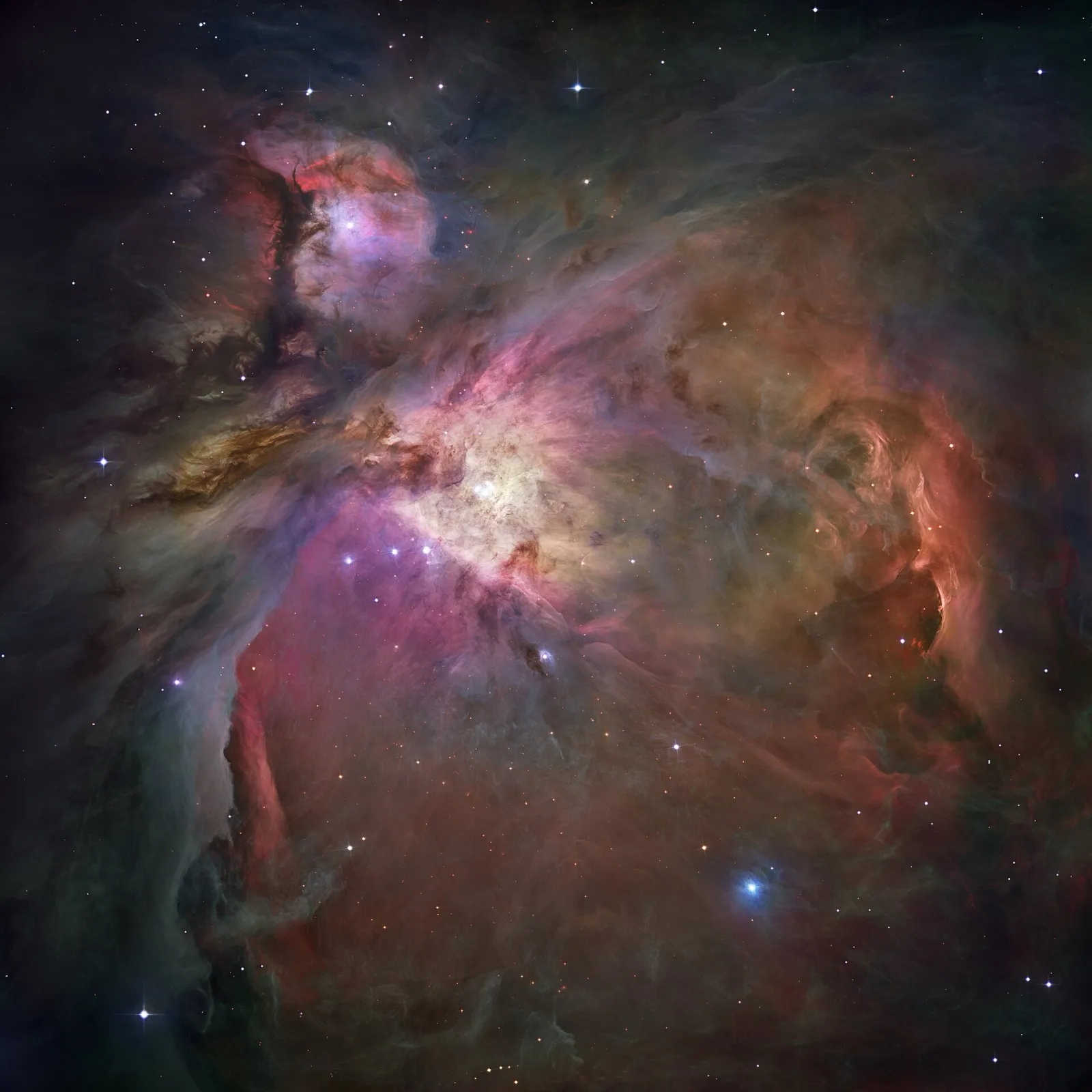 Orion NebulaM42 · star-forming nebula
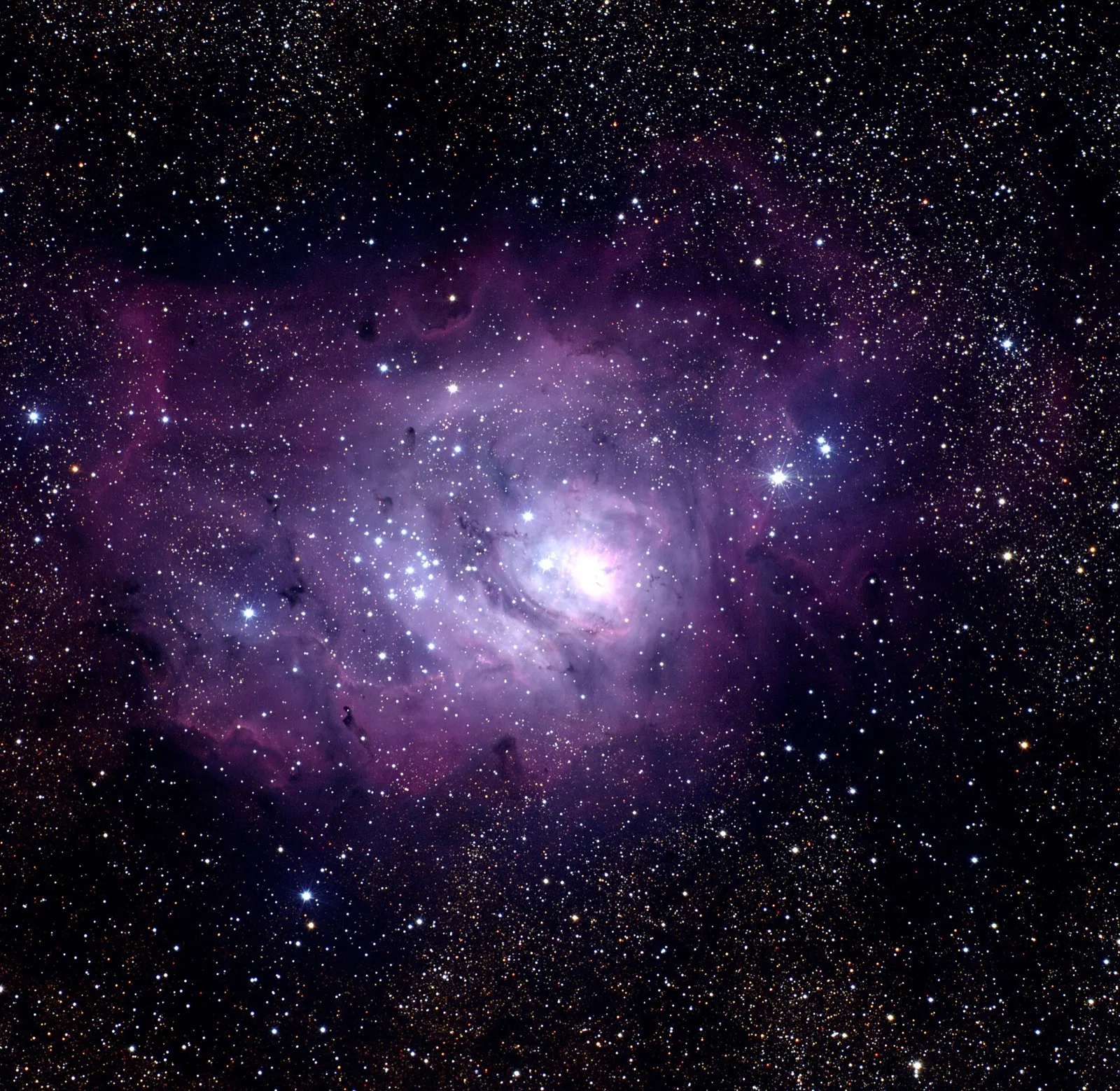 Lagoon NebulaM8 · star-forming nebula
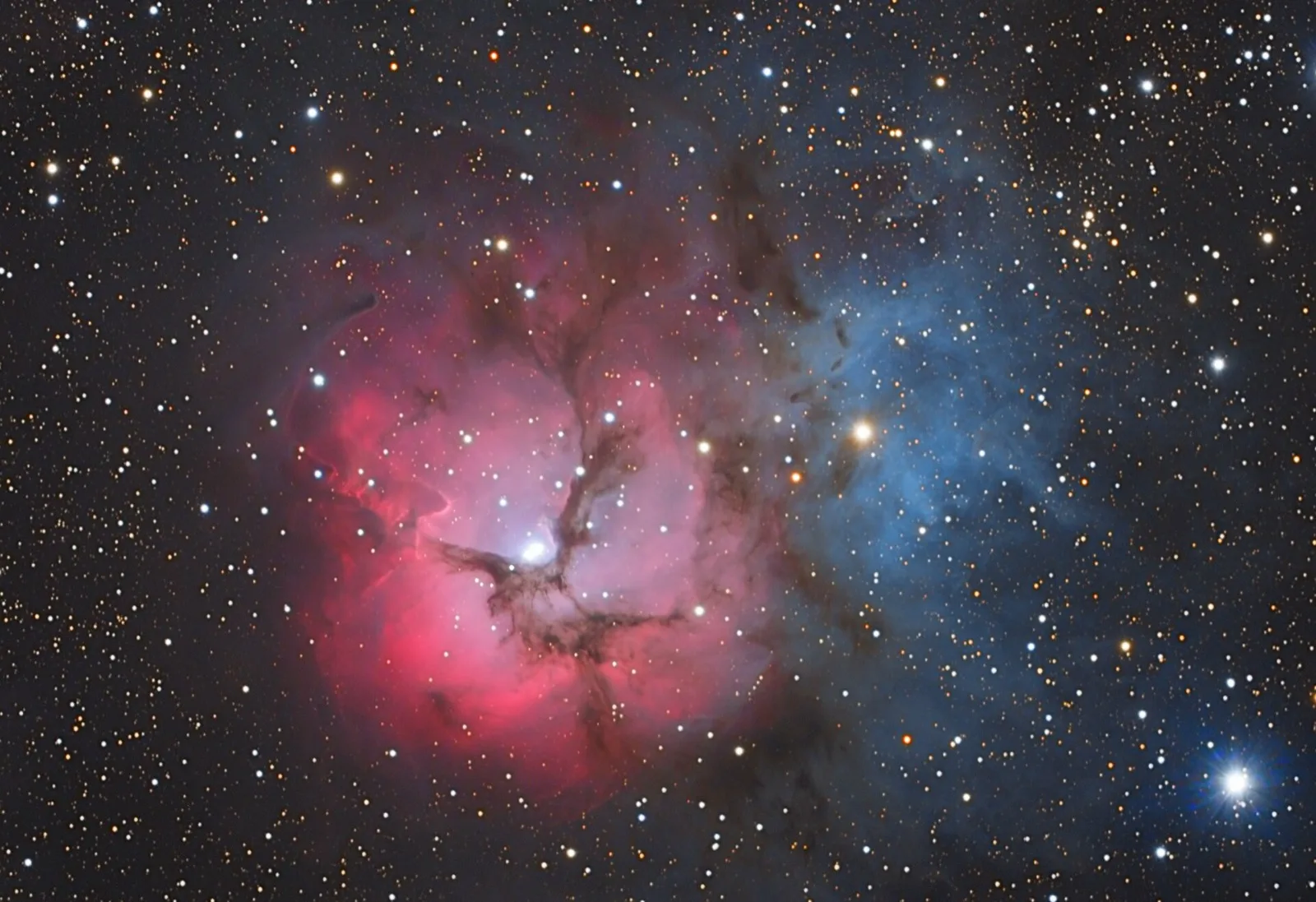 Trifid NebulaM20 · star-forming nebula
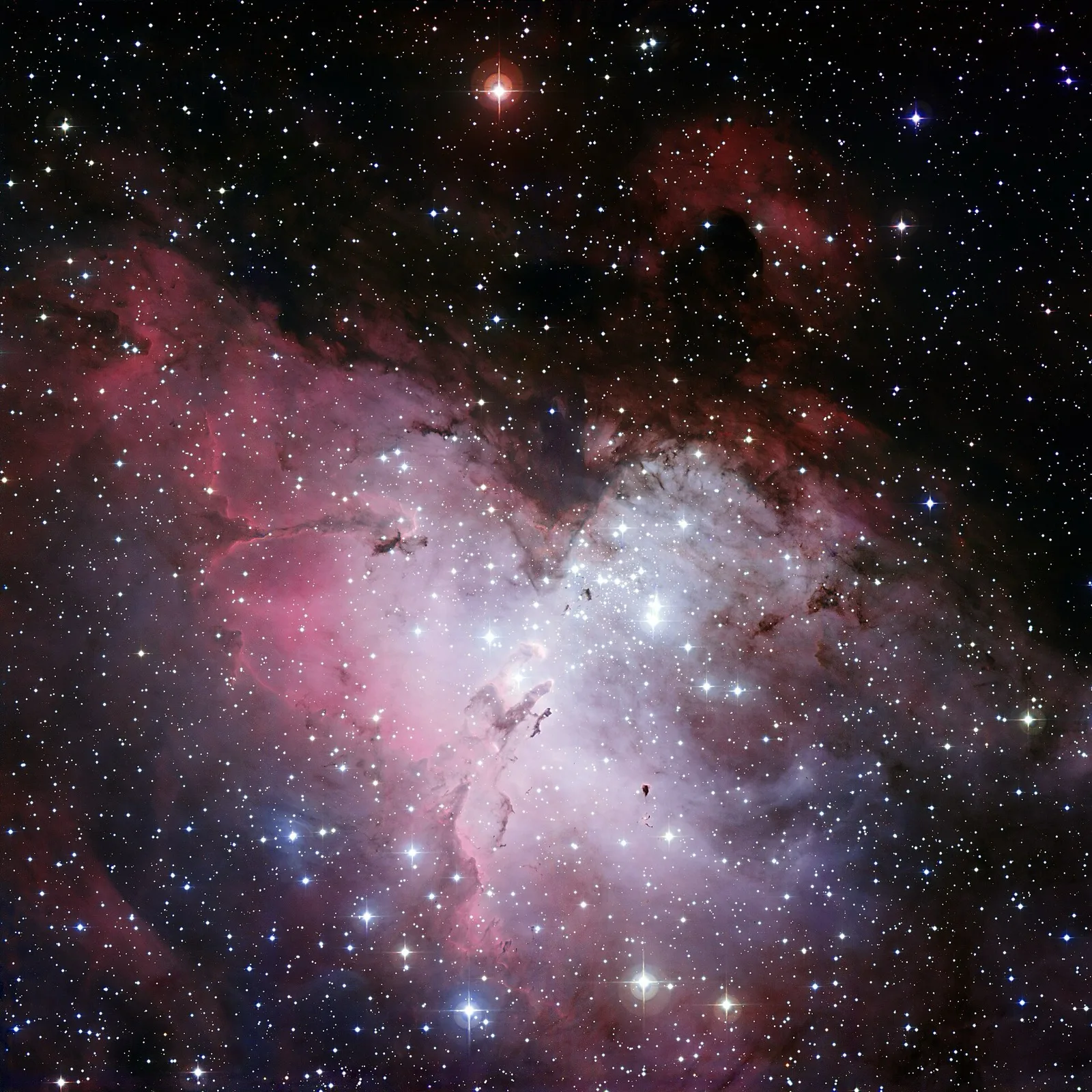 Eagle NebulaM16 · star-forming nebula
Sources
- en.wikipedia.org
- science.nasa.gov
- jpl.nasa.gov
- constellation-guide.com
- Positions: astronomy-engine (Don Cross).