 SKY
Sky catalog › Star clusters
Messier 15
M15, NGC 7078 · A globular cluster in Pegasus
What is it?
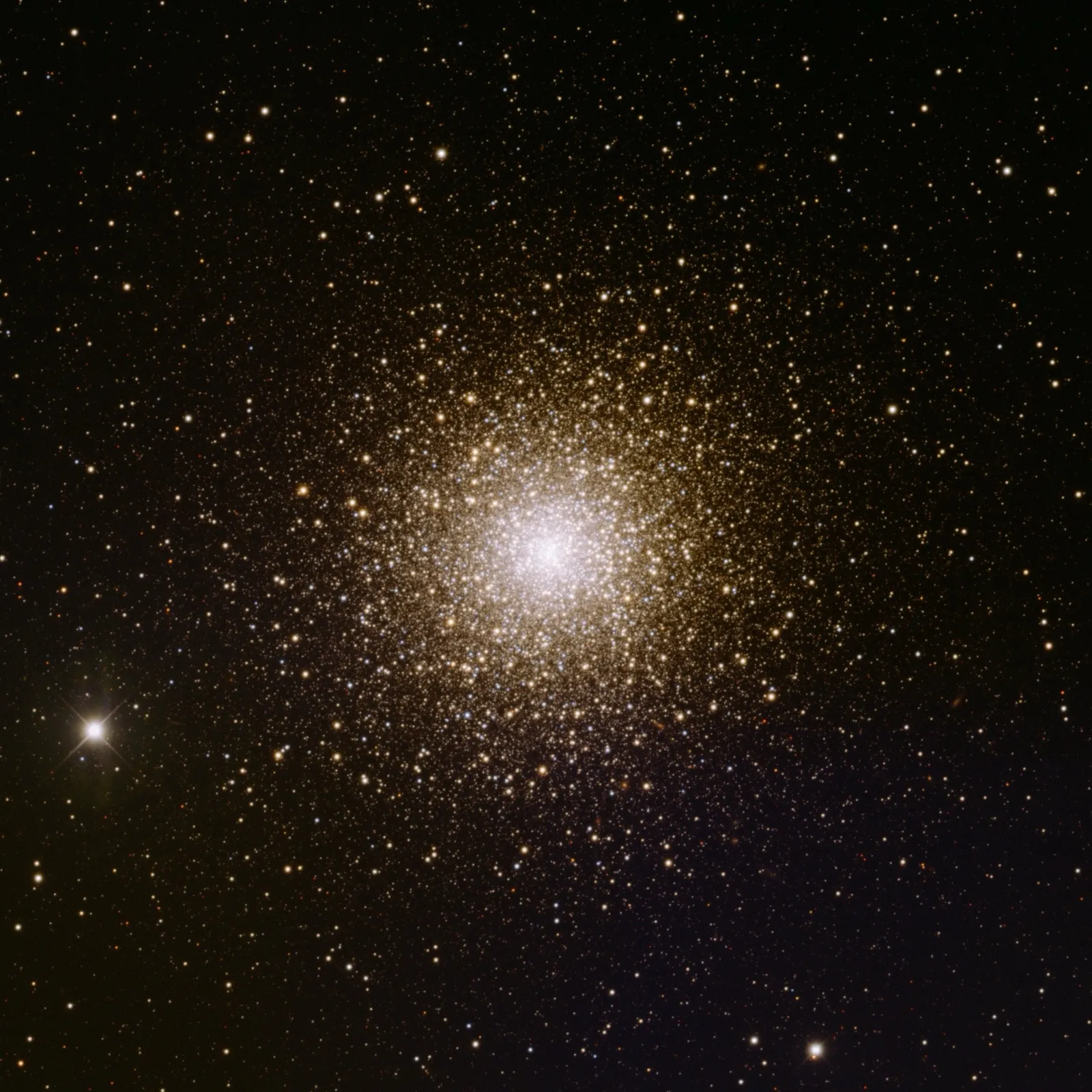
Messier 15 is a globular cluster. A tight ball of hundreds of thousands of very old stars.
Why Messier 15 is interesting
What you see: Each point is one of over 100,000 stars. Very hot blue stars and cooler golden ones swarm together toward a brilliant, crowded center. esahubble.org
How it formed: M15 formed around 12 billion years ago, making it one of the oldest globular clusters known. Over time its stars crowded into an extremely dense center, called core collapse. en.wikipedia.org
To scale: M15 is about 175 light-years across, so light needs about 175 years to cross it, yet the whole ball covers only about one third the area of the full Moon. en.wikipedia.org
Three things to know
- M15 is one of the most densely packed globular clusters known, with more than 100,000 stars crowding toward a very bright core.
- It holds Pease 1, found in 1928, the first planetary nebula (the glowing shell of a dying star) ever found inside a globular cluster.
- At an estimated 12.5 billion years old, M15 is one of the oldest globular clusters known.
12 more fun facts
- M15 gives off about 360,000 times as much light as the Sun. en.wikipedia.org
- M15's core has gone through "core collapse": its stars have crowded into an extremely dense center. en.wikipedia.org
- In 2002 Hubble found something dark and heavy at M15's heart; astronomers think a middleweight black hole is more likely than a cluster of neutron stars. esahubble.org
- M15 holds 8 known pulsars, including M15-C, a pair of neutron stars orbiting each other. en.wikipedia.org
- An X-ray source in M15, called M15 X-1, appears to be the first X-ray source ever detected in the constellation Pegasus. en.wikipedia.org
- The planetary nebula Pease 1 was found on a photographic plate taken with the 100-inch Hooker Telescope at Mount Wilson Observatory. astronomy.com
- Seeing Pease 1 with your own eyes is a real challenge: it takes an 11-inch or larger telescope, 200x or more and a nebula filter. astronomy.com
- Hubble's images show very hot blue stars and cooler golden stars, both crowding more and more toward M15's brilliant center. esahubble.org
- Astronomers have counted 112 variable stars in M15, stars whose brightness changes over time. en.wikipedia.org
- In our sky, M15 covers about one third the area of the full Moon. astronomy.com
- Through a 4-inch telescope at about 100x, dozens of stars appear around M15's bright core, with chains of stars winding outward. astronomy.com
- M15 is about 175 light-years across. en.wikipedia.org
In the game these unlock one by one as you keep photographing Messier 15.
At a glance
- Type
- Globular cluster
- Catalog
- M15, NGC 7078
- Constellation
- Pegasus
- Distance
- about 33,600 to 35,700 light-years (estimates differ)
- Brightness
- magnitude 6.2
- Size in our sky
- about 18 arcminutes
- Discovered
- Jean-Dominique Maraldi, 1746
- Position (J2000)
- RA 21h 30m, Dec +12.2°
Looking back in time
The light in this photo left Messier 15 33,600 to 35,700 years ago, when the Earth was in the last Ice Age: mammoths roamed and people painted caves by firelight.
How to see it yourself
Too faint for most eyes, but binoculars show it from a dark site. A small telescope shows its shape.
Finding it: Start at Markab, a corner of the Great Square of Pegasus, follow the horse's neck to Biham, then on to Enif, the horse's nose. Continue that line a little more than 4 degrees past Enif to reach M15.
When to look: Pegasus rides high on autumn evenings in the Northern Hemisphere (spring evenings in the Southern Hemisphere). NASA lists September as the best month for M15.
What you will see: M15 is close to naked-eye visibility from a dark site. Binoculars show a fuzzy star, and a telescope of at least 6 inches begins to resolve individual stars around its bright core.
Easy to confuse with:
- A 6th-magnitude star: A star of magnitude 6.1 lies about a quarter degree east of M15; to the naked eye they look alike, but in binoculars M15 is a fuzzy glow.
- Messier 2: M2 is a similar globular about 5 degrees north of Sadalsuud in Aquarius, while M15 sits about 4 degrees northwest of Enif in Pegasus.
Best months: August is when it is highest around midnight. About two months later it is highest in the early evening, at around 8 to 9 PM.
Where on Earth: easy from the Northern Hemisphere. South of latitude 68°S it never climbs more than 10° above the horizon.
How it is photographed: long exposures through filters, then the frames are stacked, stretched and combined into color.
Name and story
The name: Jean-Dominique Maraldi discovered M15 in 1746 while searching for comets, and Charles Messier included it in his 1764 catalog. It is sometimes called the Great Pegasus Cluster and is also NGC 7078.
Record: M15 is one of only four globular clusters known to contain a planetary nebula; the others are Messier 22, NGC 6441 and Palomar 6. It is also one of the densest and oldest globular clusters known.
Explored by: Hubble has studied M15 many times. A 2002 study found a dark mass at its center, and a 2013 image combined Wide Field Camera 3 and Advanced Camera for Surveys data in ultraviolet, visible and infrared light.
Test yourself
After every photo of Messier 15 the game asks one of these. A right answer earns sky points for your observatory.
What is Pease 1, found inside M15 in 1928?
- The glowing shell of a dying star (the answer)
- A young galaxy far behind it
- A comet passing in front of it
Pease 1 is a planetary nebula, gas puffed off by a dying star. It was the first one ever found inside a globular cluster. en.wikipedia.org
About how old is the star cluster M15?
- About 5,000 years
- About 100 million years
- About 12 billion years (the answer)
Hubble studies put its age at around 12 billion years, one of the oldest globular clusters known, with most of its mass packed into its core. esahubble.org
Point a telescope at Messier 15 in the game: capture it in real time, then develop the frames like an astrophotographer.
Point a telescope at Messier 15More star clusters
 The PleiadesM45 · open star cluster
 Beehive ClusterM44 · open star cluster
 Double ClusterNGC 869 · open star cluster
 Jewel BoxNGC 4755 · open star cluster
Sources
- en.wikipedia.org
- science.nasa.gov
- esahubble.org
- astronomy.com
- earthsky.org
- Positions: astronomy-engine (Don Cross).