 SKY
Sky catalog › Star clusters
Wild Duck Cluster
M11, NGC 6705 · An open star cluster in Scutum
What is it?
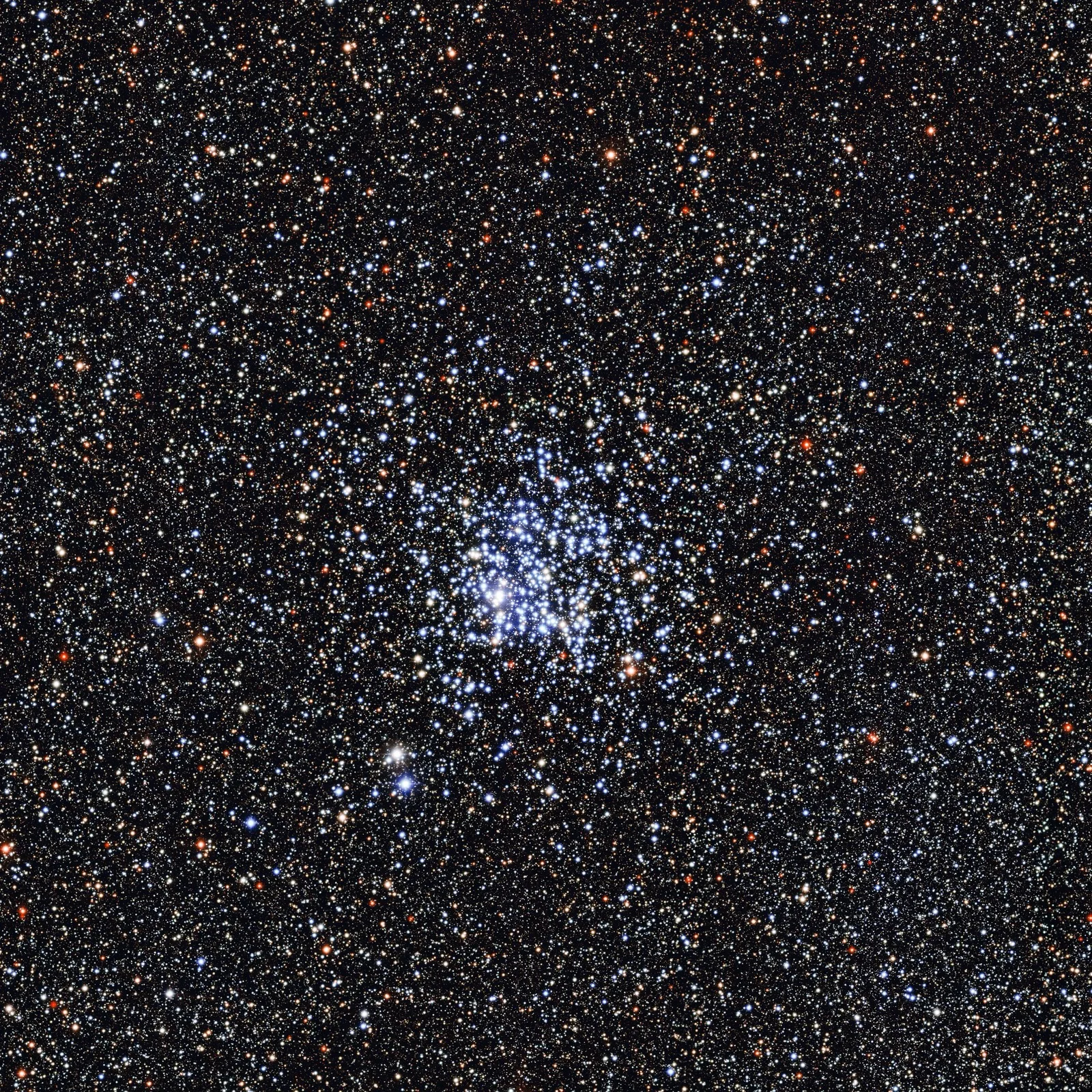
Wild Duck Cluster is an open star cluster. A family of young stars born together from the same cloud of gas.
Why the Wild Duck Cluster is interesting
What you see: The glow is more than 2,900 stars packed close together. Its brightest members, only about magnitude 8, form a V shape like a flock of flying ducks. en.wikipedia.org
How it formed: Its stars formed together roughly 220 million years ago. Open clusters are only loosely held by gravity, so over time stronger pulls draw their stars away. science.nasa.gov
To scale: M11's dense core is only about 8 light-years across, so light crosses it in about 8 years, yet its gravity holds stars out to roughly 95 light-years from the center. en.wikipedia.org
Three things to know
- Its brightest stars form a V shape, like a flock of ducks flying across the sky, which gave it the name Wild Duck Cluster.
- M11 is one of the richest and most compact open clusters known, with more than 2,900 stars.
- Of all the open clusters in the Messier catalog, M11 is the most distant one you can see with the naked eye.
11 more fun facts
- No single star of M11 is bright enough to see with the naked eye. Its brightest member is only magnitude 8, so the cluster shows up as one hazy glow. en.wikipedia.org
- Estimates of M11's total mass range from about 3,700 to 11,000 times the Sun, depending on the method astronomers use. en.wikipedia.org
- Its dense core is only about 8 light-years across, but its gravity still holds on to stars out to roughly 95 light-years from the center. en.wikipedia.org
- Gottfried Kirch spotted M11 in 1681, but it was the English naturalist William Derham who first saw it as separate stars, in 1733. earthsky.org
- M11 is one of the few open clusters in Messier's catalog that Hubble has photographed, using both visible and ultraviolet light. science.nasa.gov
- The black stripe across Hubble's picture of M11 is not a dark cloud. It is the small gap between the two detectors of the camera. science.nasa.gov
- NASA puts M11's age at about 220 million years, worked out from its brightest, hottest stars. Other studies get older ages, so estimates differ. science.nasa.gov
- M11 is richer in iron and other heavy elements than the Sun, so astronomers call it a metal-rich cluster. en.wikipedia.org
- M11 lies about 22,000 light-years from the center of the Milky Way. en.wikipedia.org
- M11 sits just east of the middle of the Scutum Star Cloud, a rich, glowing patch of the summer Milky Way. en.wikipedia.org
- Astronomers have found at least nine variable stars that very likely belong to M11, plus dozens of possible ones, two of them eclipsing binaries. en.wikipedia.org
In the game these unlock one by one as you keep photographing the Wild Duck Cluster.
At a glance
- Type
- Open star cluster
- Catalog
- M11, NGC 6705
- Constellation
- Scutum
- Distance
- about 6,100 to 6,200 light-years (estimates differ)
- Brightness
- magnitude 5.8
- Size in our sky
- about 23 arcminutes
- Discovered
- Gottfried Kirch, 1681
- Position (J2000)
- RA 18h 51m, Dec -6.3°
Looking back in time
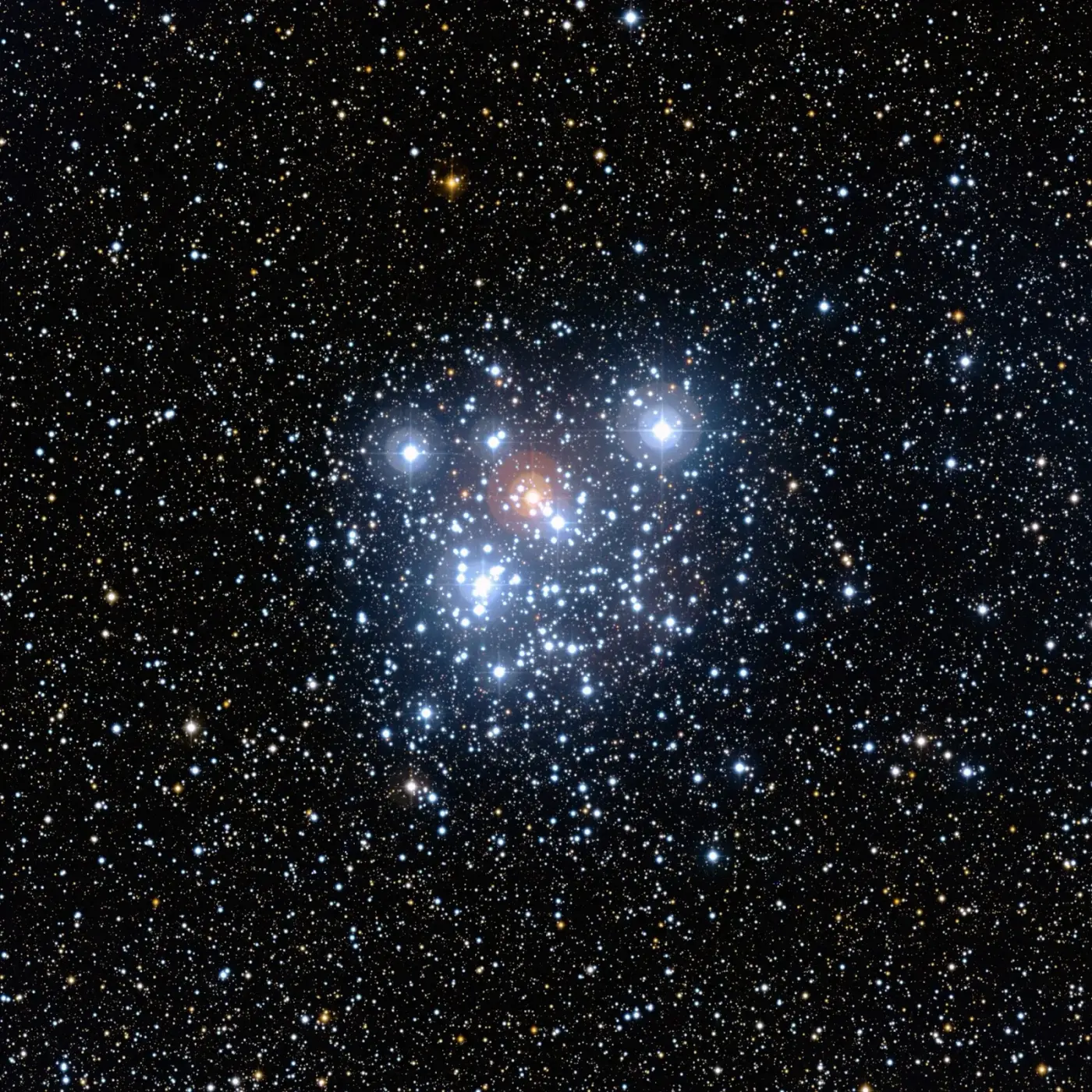
The light in this photo left the Wild Duck Cluster about 6,100 years ago, when nobody could write yet (writing began about 5,200 years ago) and the first farming villages were growing.
How to see it yourself
Too faint for most eyes, but binoculars show it from a dark site. A small telescope shows its shape.
Finding it: Start at Altair, the bright star in Aquila the Eagle. Hop about 8 degrees to Delta Aquilae, then keep going a bit more than twice that distance toward the tail of the Eagle. With binoculars, look for a little semicircle of stars; M11 is the hazy spot just beneath it in Scutum.
When to look: M11 is best in late summer and early fall evenings from mid-northern latitudes, when it is fairly high in the south. In early summer it is up late at night, and in spring only before dawn.
What you will see: From a dark site it can be glimpsed without optics as a faint smudge in the Milky Way. Binoculars show a small, triangular patch of light, and a small telescope breaks it into a tight swarm of many faint stars.
Easy to confuse with:
- Globular clusters such as M22: In small telescopes M11 can look as packed as a globular cluster, but it has the duck-like V pattern and a slightly ragged edge instead of a smooth round ball.
Best months: July is when it is highest around midnight. About two months later it is highest in the early evening, at around 8 to 9 PM.
Where on Earth: close to the celestial equator, so it can be seen from almost everywhere on Earth.
How it is photographed: long exposures through filters, then the frames are stacked, stretched and combined into color.
Name and story
The name: Admiral William Henry Smyth looked at the cluster in 1835 and thought its bright stars looked like a flight of wild ducks, which gave it its nickname. Gottfried Kirch discovered it in 1681, and Charles Messier added it to his catalog as number 11 in 1764. It is also listed as NGC 6705.
Record: With over 2,900 stars, M11 is one of the most densely populated open clusters known. Of the 26 open clusters in the Messier catalog, it is the most distant one that can be seen with the naked eye, at about 6,200 light-years.
Explored by: Hubble imaged part of M11 in visible and ultraviolet light, one of the few Messier open clusters it has observed. Astronomers used the cluster's brightest, hottest main-sequence stars to estimate its age at about 220 million years.
Test yourself
After every photo of the Wild Duck Cluster the game asks one of these. A right answer earns sky points for your observatory.
Where does the Wild Duck Cluster get its name?
- It was found by a duck hunter at night
- It glows green like a duck's head
- Its bright stars make a V like flying ducks (the answer)
In 1835 Admiral William Henry Smyth thought the cluster's brightest stars looked like a flight of wild ducks, and the nickname stuck. earthsky.org
Who first saw M11 as separate stars, in 1733?
- Galileo Galilei
- William Derham (the answer)
- Edwin Hubble
Gottfried Kirch spotted M11 in 1681 as a fuzzy patch, but the naturalist William Derham was first to split it into stars. earthsky.org
Point a telescope at the Wild Duck Cluster in the game: capture it in real time, then develop the frames like an astrophotographer.
Point a telescope at the Wild Duck ClusterMore star clusters
 The PleiadesM45 · open star cluster
 Beehive ClusterM44 · open star cluster
 Double ClusterNGC 869 · open star cluster
 Jewel BoxNGC 4755 · open star cluster
Sources
- en.wikipedia.org
- science.nasa.gov
- earthsky.org
- Positions: astronomy-engine (Don Cross).