 SKY
Sky catalog › Galaxies
Messier 106
M106, NGC 4258 · A galaxy in Canes Venatici
What is it?
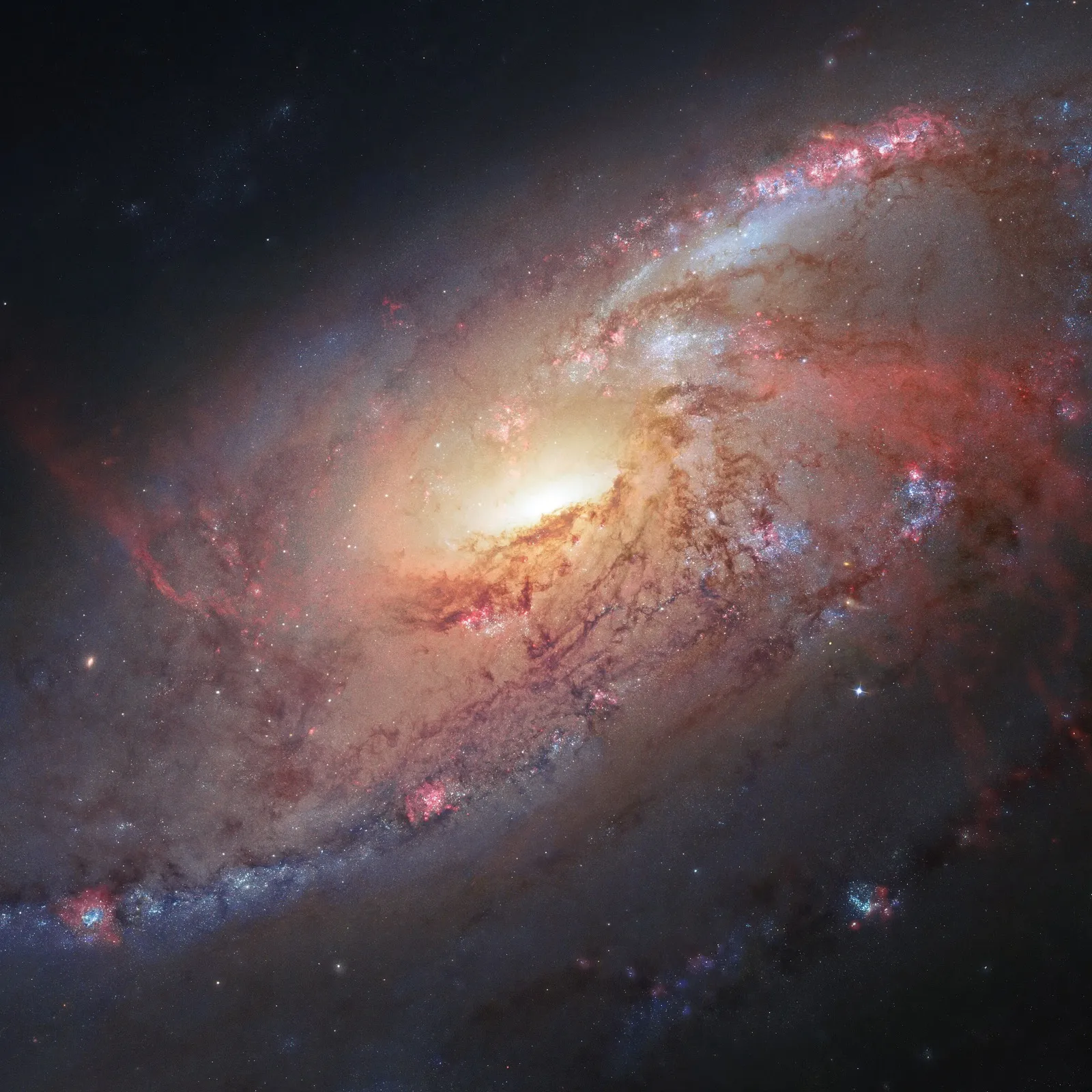
Messier 106 is a galaxy. A whole island of millions to trillions of stars, far outside our Milky Way.
Why Messier 106 is interesting
What you see: The bright disk holds two normal spiral arms of stars. M106 also has two extra 'anomalous' arms of hot gas that cut across the disk instead of lying in it. chandra.harvard.edu
How it formed: Jets from the supermassive black hole at its center strike the disk, and the shock waves heat gas equal to about 10 million Suns, which is what makes the extra arms. chandra.harvard.edu
To scale: M106 is about 135,000 light-years across, roughly one-third larger than estimates for our Milky Way. astronomy.com
Three things to know
- Besides its two normal spiral arms, M106 has two extra 'ghost' arms made of hot gas, which astronomers link to the supermassive black hole at its center.
- Water molecules near its center act like a natural microwave laser, and they allowed the first direct measurement of the distance to a galaxy.
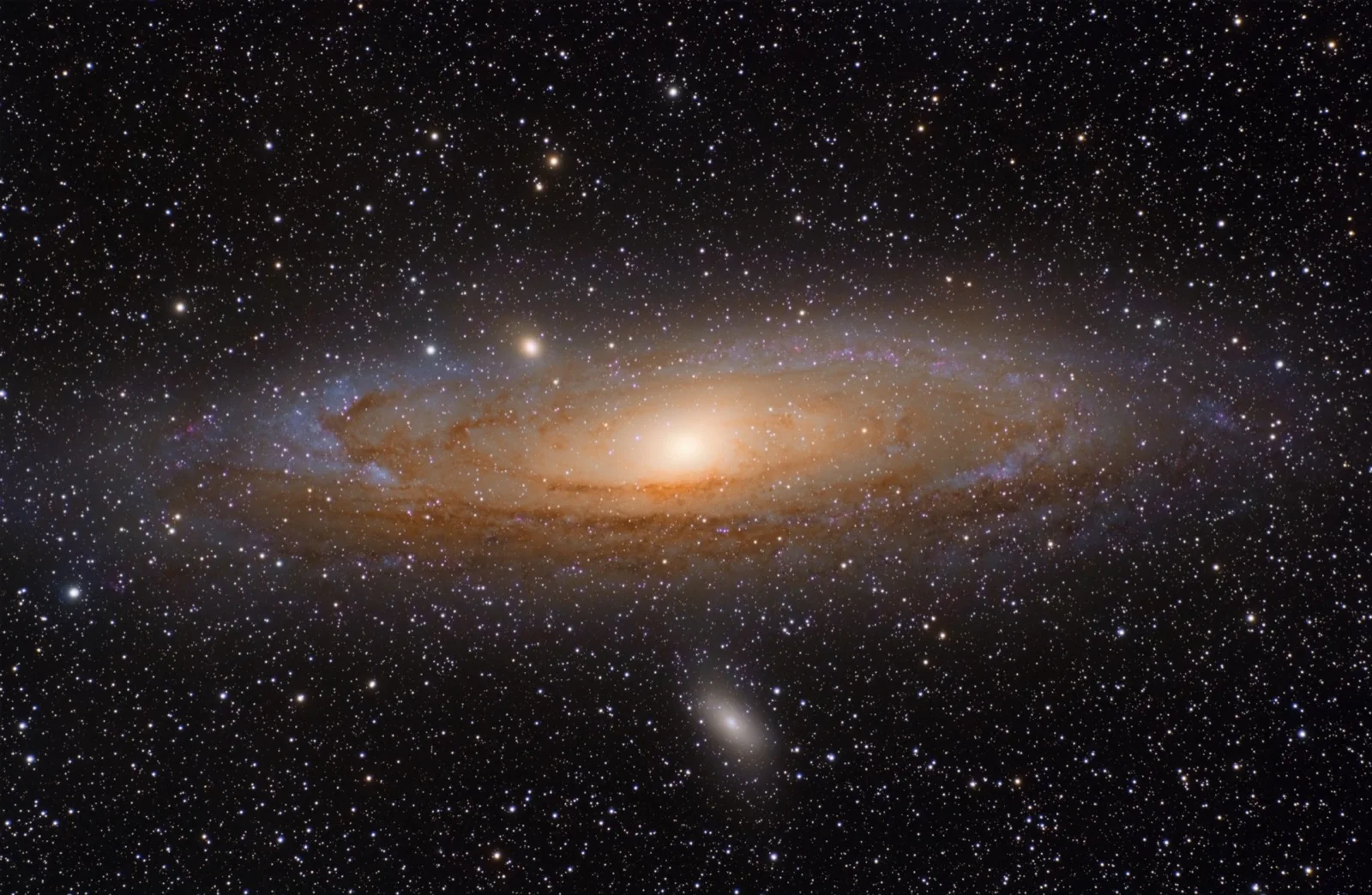
- It is one of the largest and brightest nearby galaxies, similar in size and brightness to the Andromeda Galaxy.
12 more fun facts
- Shock waves, likely driven by jets from M106's central black hole, are heating a mass of gas equal to about 10 million Suns to thousands of degrees. chandra.harvard.edu
- M106 is losing its star-making gas: unless new gas flows in, the gas left in its disk could be blown out within about 300 million years. chandra.harvard.edu
- The center of M106 makes new stars at only about one-tenth the rate of our Milky Way. chandra.harvard.edu
- Chandra's X-ray view shows huge bubbles of gas above and below M106's disk, heated to millions of degrees and pushed outward by the black hole's jets. chandra.harvard.edu
- M106's black hole jets are tipped 30 degrees to the galaxy's disk. Projected onto the disk, they line up almost perfectly with the galaxy's two extra arms. chandra.harvard.edu
- M106's extra pair of arms puzzled astronomers for more than 40 years, from their discovery in the early 1960s until X-ray and infrared studies tied them to shock-heated gas. chandra.harvard.edu
- M106 only got its Messier number in 1947, when Helen Sawyer Hogg added it to Messier's catalog along with M105 and M107. en.wikipedia.org
- Because its distance is known so precisely, M106's Cepheid variable stars serve as a yardstick that helps astronomers measure distances to galaxies much farther away. en.wikipedia.org
- M106 is about 135,000 light-years across, roughly one-third larger than estimates for our Milky Way. astronomy.com
- The water masers at M106's heart orbit in a thin, slightly warped disk less than one parsec (about 3 light-years) across, circling a central mass of about 40 million Suns. en.wikipedia.org
- NASA's well-known Hubble portrait of M106 fills in the areas Hubble did not cover with images by amateur astronomer Robert Gendler, colorized with help from fellow amateur Jay GaBany. science.nasa.gov
- Two supernovae have been seen in M106: SN 1981K, confirmed from archive photos taken on November 3, 1981, and SN 2014bc, found by the Pan-STARRS survey on May 19, 2014. en.wikipedia.org
In the game these unlock one by one as you keep photographing Messier 106.
At a glance
- Type
- Galaxy
- Catalog
- M106, NGC 4258
- Constellation
- Canes Venatici
- Distance
- about 24 million light-years (estimates range from 22 to 25 million)
- Brightness
- magnitude 8.4
- Size in our sky
- 18.6 x 7.2 arcminutes
- Discovered
- Pierre Méchain, 1781
- Position (J2000)
- RA 12h 19m, Dec +47.3°
Looking back in time
The light in this photo left Messier 106 about 24 million years ago, when there were no humans or great apes, and the dinosaurs had already been gone for more than 20 million years.
How to see it yourself
Needs a telescope and a dark sky. Photos show far more than the eye can see.
Finding it: Find Phecda (Gamma Ursae Majoris), the bottom corner of the Big Dipper's bowl nearest the handle, and Chara (Beta Canum Venaticorum). M106 sits roughly halfway between them, about one binocular field northwest of Chara.
When to look: Spring evenings, with May the best month, when the Big Dipper and Canes Venatici ride high overhead for northern observers.
What you will see: Not visible to the naked eye. Binoculars show a relatively large, oval glow less than a degree west of a 6th-magnitude star. A small telescope shows it at about 9th magnitude, and spiral structure starts to appear in moderate telescopes and becomes clearer with larger ones.
Easy to confuse with:
- NGC 4217: NGC 4217 is a much fainter, thin edge-on spiral with a dust lane near M106, while M106 is a large, bright oval.
Best months: March is when it is highest around midnight. About two months later it is highest in the early evening, at around 8 to 9 PM.
Where on Earth: easy from the Northern Hemisphere. South of latitude 33°S it never climbs more than 10° above the horizon. From 43°N and farther north it never sets.
How it is photographed: long exposures through filters, many hours in total, which is why the game sends it to a big observatory mirror. then the frames are stacked, stretched and combined into color.
Name and story
The name: Pierre Méchain, Charles Messier's observing assistant, discovered this galaxy in 1781. It has no popular nickname, so astronomers know it by catalog names: Messier 106 and NGC 4258.
Explored by: In 2014 NASA released a portrait of M106 combining Chandra X-ray, VLA radio, Hubble visible-light and Spitzer infrared data. Together they show shock-heated gas and huge hot bubbles pushed out by the black hole's jets. ESA's Herschel telescope helped confirm that the center makes stars only slowly.
Test yourself
After every photo of Messier 106 the game asks one of these. A right answer earns sky points for your observatory.
What makes M106's two extra 'ghost' arms of hot gas?
- Jets from its central black hole (the answer)
- Dust lit by a nearby star
- Stars torn from another galaxy
Jets of high-energy particles from the black hole strike the disk, and the shock waves heat the gas. That is why the extra arms cross the disk instead of lying in it. chandra.harvard.edu
What did water molecules near M106's center let astronomers do first?
- Find water on an alien planet
- Hear radio sounds from a black hole
- Measure a galaxy's distance directly (the answer)
Water there acts like a natural microwave laser, called a maser. Tracking it near the center gave the first direct measurement of the distance to any galaxy. en.wikipedia.org
Point a telescope at Messier 106 in the game: capture it in real time, then develop the frames like an astrophotographer.
Point a telescope at Messier 106More galaxies
 Andromeda GalaxyM31 · galaxy
 Triangulum GalaxyM33 · galaxy
 Large Magellanic CloudLMC · galaxy
 Small Magellanic CloudSMC · galaxy
Sources
- en.wikipedia.org
- science.nasa.gov
- chandra.harvard.edu
- chandra.harvard.edu
- en.wikipedia.org
- astronomy.com
- astronomy.com
- Positions: astronomy-engine (Don Cross).