 SKY
Sky catalog › Galaxies
Sombrero Galaxy
M104, NGC 4594 · A galaxy in Virgo
What is it?
Sombrero Galaxy is a galaxy. A whole island of millions to trillions of stars, far outside our Milky Way.
Why the Sombrero Galaxy is interesting
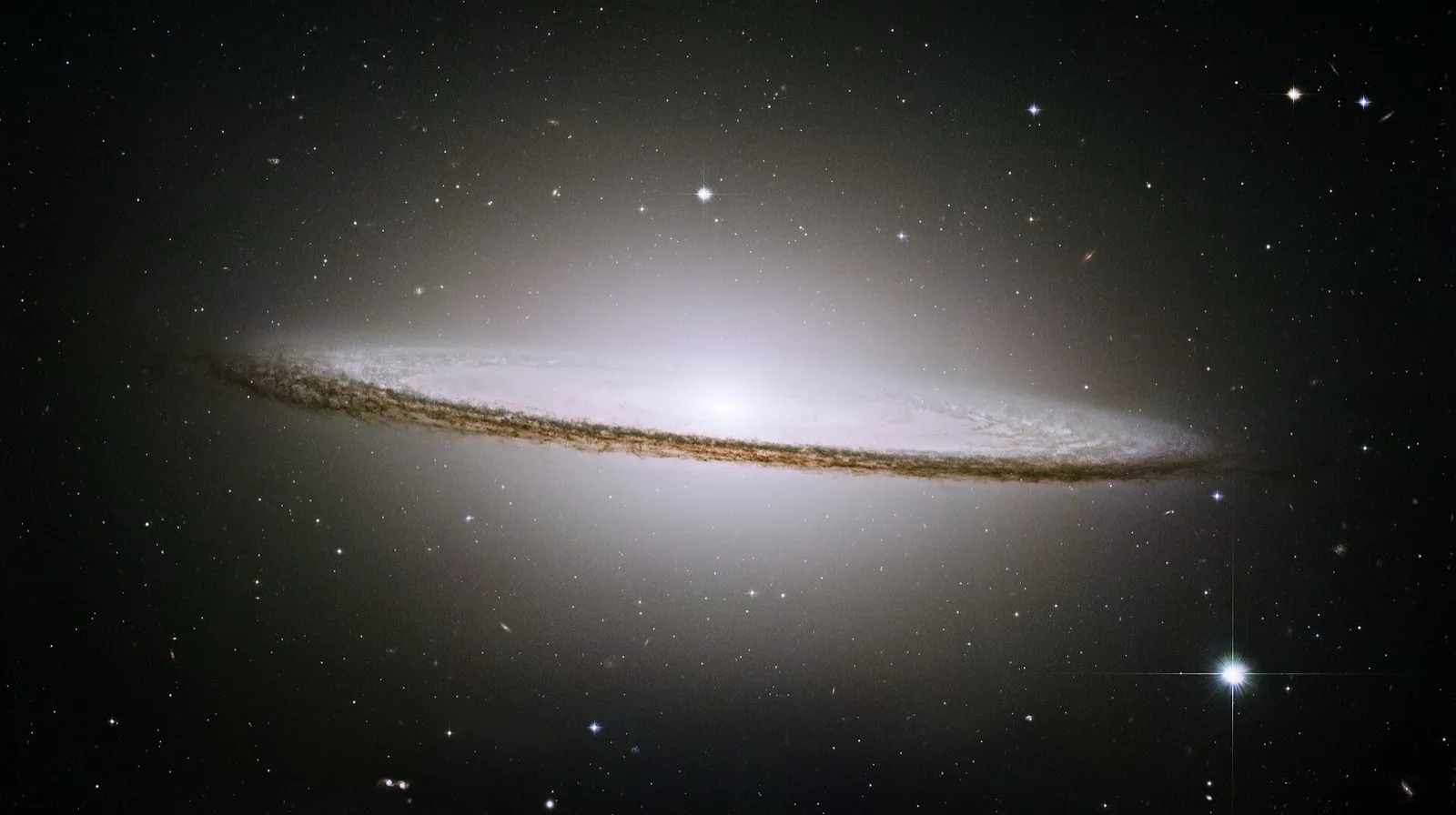
What you see: We see this spiral galaxy almost edge-on. The bright white core is its huge bulge, and the dark band is a ring of dust that holds most of its cold gas. en.wikipedia.org
How it formed: The Spitzer telescope found its halo far larger and heavier than expected, a sign the Sombrero may be a giant elliptical galaxy. Most of its new stars form in the dust ring. en.wikipedia.org
To scale: The Sombrero has a mass equal to about 800 billion Suns. science.nasa.gov
Three things to know
- Its bright bulge and dark ring of dust make it look like a sombrero hat seen from the side.
- It has about 2,000 globular star clusters, 10 times more than our Milky Way.
- The Sombrero has as much mass as about 800 billion Suns.
12 more fun facts
- In mid-infrared light from Webb, the Sombrero's bright core fades away and the galaxy looks more like an archery target. science.nasa.gov
- In the 1910s Vesto Slipher found the Sombrero racing away from us at about 1,000 km (620 miles) per second, one of the fast-moving spirals that helped reveal the expanding universe. astronomy.com
- The Sombrero's rings make less than one Sun's worth of new stars each year, while the Milky Way makes about two. science.nasa.gov
- Messier noted the Sombrero in his own records, but it was officially added to his catalog only in 1921, by Camille Flammarion. en.wikipedia.org
- Webb revealed clumps in the Sombrero's outer dust ring that looked smooth to the Spitzer Space Telescope. science.nasa.gov
- Spitzer found that the Sombrero's halo is much larger and heavier than expected, so it may be a giant elliptical galaxy with a disk inside. en.wikipedia.org
- Estimates of the Sombrero's central black hole vary a lot. NASA's Webb team gives about 9 billion times the Sun's mass, and says it feeds slowly and gives off a small jet. science.nasa.gov
- The Sombrero is about 95,000 to 105,000 light-years across, slightly larger than the Milky Way. en.wikipedia.org
- The Sombrero's dark band is really a ring of dust around its bulge, holding most of its cold gas and most of its star formation. en.wikipedia.org
- The Sombrero's globular star clusters are 10 to 13 billion years old, similar in age to those of the Milky Way. science.nasa.gov
- A smaller disk, tilted compared with the main disk, is hidden inside the Sombrero's core. science.nasa.gov
- William Herschel found the Sombrero on his own in 1784, three years after Pierre Méchain. en.wikipedia.org
In the game these unlock one by one as you keep photographing the Sombrero Galaxy.
At a glance
- Type
- Galaxy
- Catalog
- M104, NGC 4594
- Constellation
- Virgo
- Distance
- about 28 to 31 million light-years (estimates differ)
- Brightness
- magnitude 8
- Size in our sky
- 9 x 4 arcminutes
- Discovered
- Pierre Méchain, 1781
- Position (J2000)
- RA 12h 40m, Dec -11.6°
Looking back in time
The light in this photo left the Sombrero Galaxy 28 million to 31 million years ago, when there were no humans or great apes, and the dinosaurs had already been gone for more than 20 million years.
How to see it yourself
Needs a telescope and a dark sky. Photos show far more than the eye can see.
Finding it: It sits on the border of Virgo and Corvus, about 11.5 degrees west of the bright star Spica and about 5.5 degrees northeast of Eta Corvi.
When to look: Best on spring evenings; NASA names May as the easiest month. It is visible from both mid-northern and mid-southern latitudes.
What you will see: Beyond naked-eye visibility. It shows as a small glow in 7x35 binoculars or a 4-inch telescope. An 8-inch telescope separates the bulge from the disk, and a 10- or 12-inch telescope shows the dark dust lane.
Best months: April is when it is highest around midnight. About two months later it is highest in the early evening, at around 8 to 9 PM.
Where on Earth: best from the Southern Hemisphere. North of latitude 68°N it never climbs more than 10° above the horizon.
How it is photographed: long exposures through filters, many hours in total, which is why the game sends it to a big observatory mirror. then the frames are stacked, stretched and combined into color.
Name and story
The name: Pierre Méchain discovered it on May 11, 1781, and it became M104; it is also NGC 4594. Its nickname comes from its bright bulge and dark dust lane, which together look like a wide-brimmed sombrero hat.
Record: NASA describes Hubble's Sombrero picture as one of the largest mosaics ever put together from Hubble observations.
Explored by: On November 25, 2024 NASA released Webb's mid-infrared view of the Sombrero. Webb's MIRI instrument showed a smooth inner disk, a clumpy outer ring where carbon-rich molecules called PAHs glow, and a core that no longer outshines everything.
Test yourself
After every photo of the Sombrero Galaxy the game asks one of these. A right answer earns sky points for your observatory.
What makes the dark band across the Sombrero?
- A ring of dust around the galaxy (the answer)
- A giant black hole
- A shadow from a nearby star
Dust blocks the light of the stars behind it. The ring holds most of the galaxy's cold gas and dust and is its main place for making new stars. en.wikipedia.org
What did Vesto Slipher find about the Sombrero in the 1910s?
- It is about to hit our galaxy
- It is shrinking fast
- It is racing away from us (the answer)
He measured it moving away at about 1,000 km (620 miles) per second. Fast spirals like it helped reveal that the universe is expanding. astronomy.com
Point a telescope at the Sombrero Galaxy in the game: capture it in real time, then develop the frames like an astrophotographer.
Point a telescope at the Sombrero GalaxyLearn more
- Stretching: pulling faint light out of a black frame
Astronomy cameras record light linearly, so a raw galaxy image looks almost black. Here is how a stretch reveals the faint parts, and how too much ruins it.
More galaxies
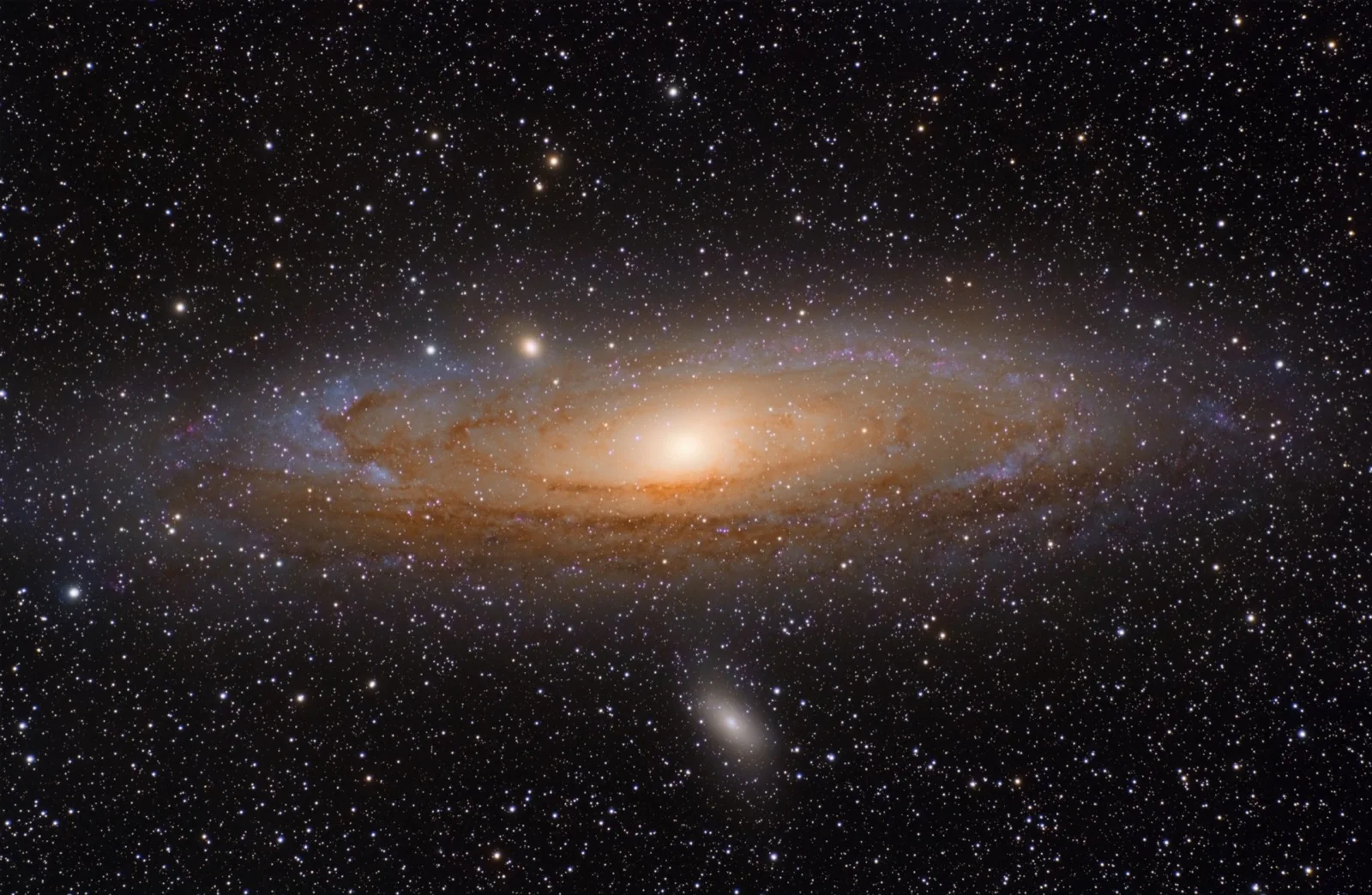 Andromeda GalaxyM31 · galaxy
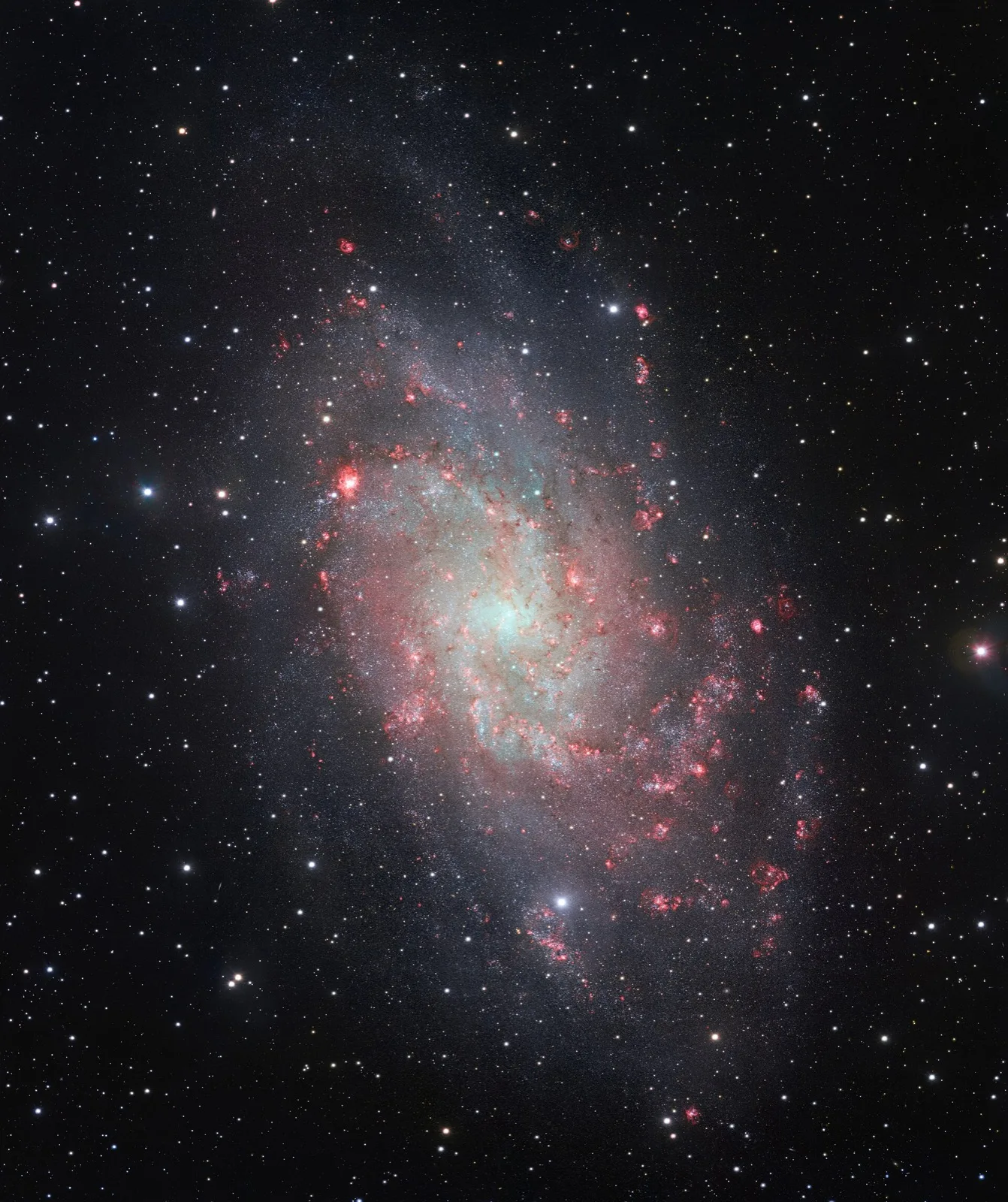 Triangulum GalaxyM33 · galaxy
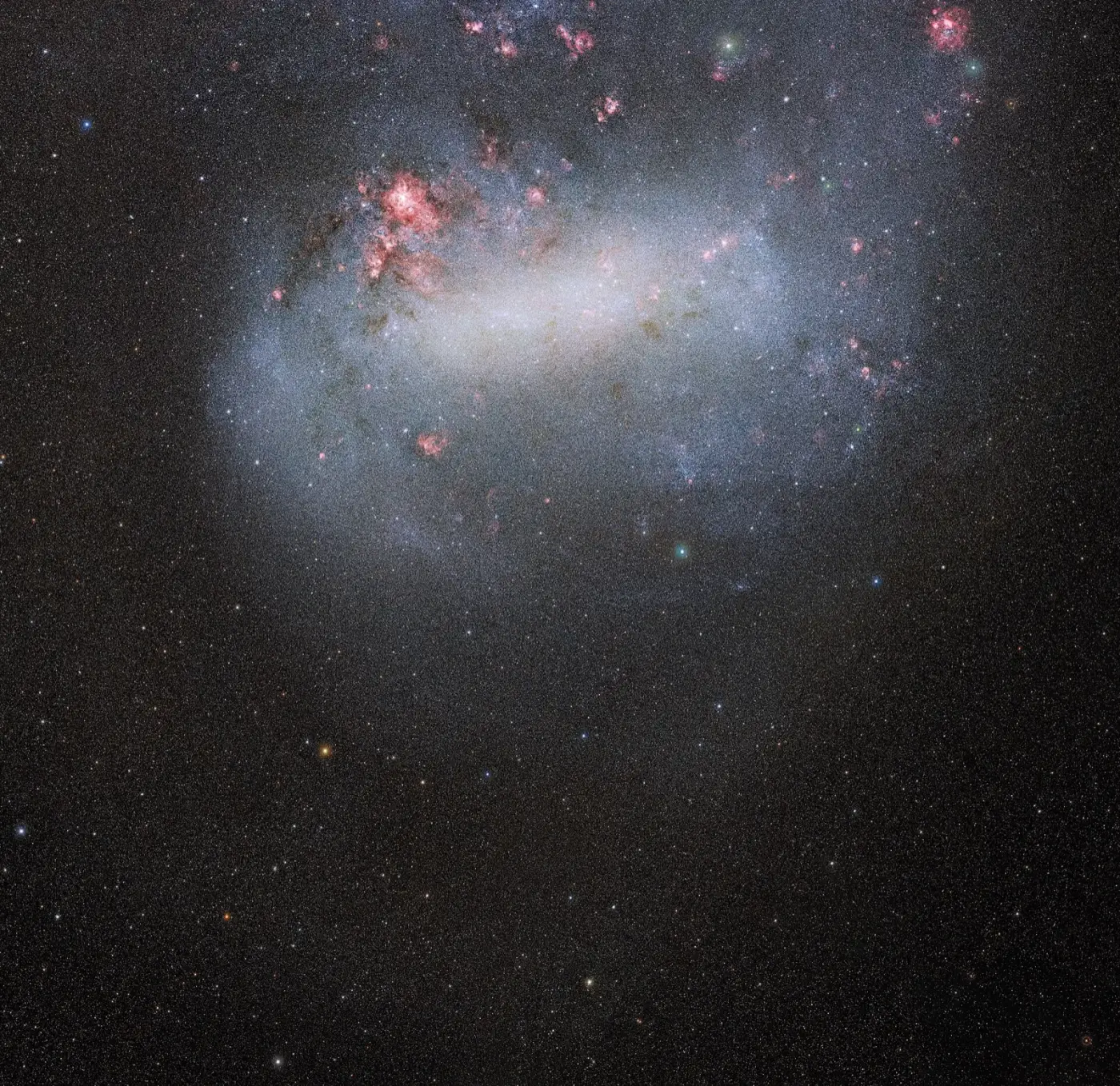 Large Magellanic CloudLMC · galaxy
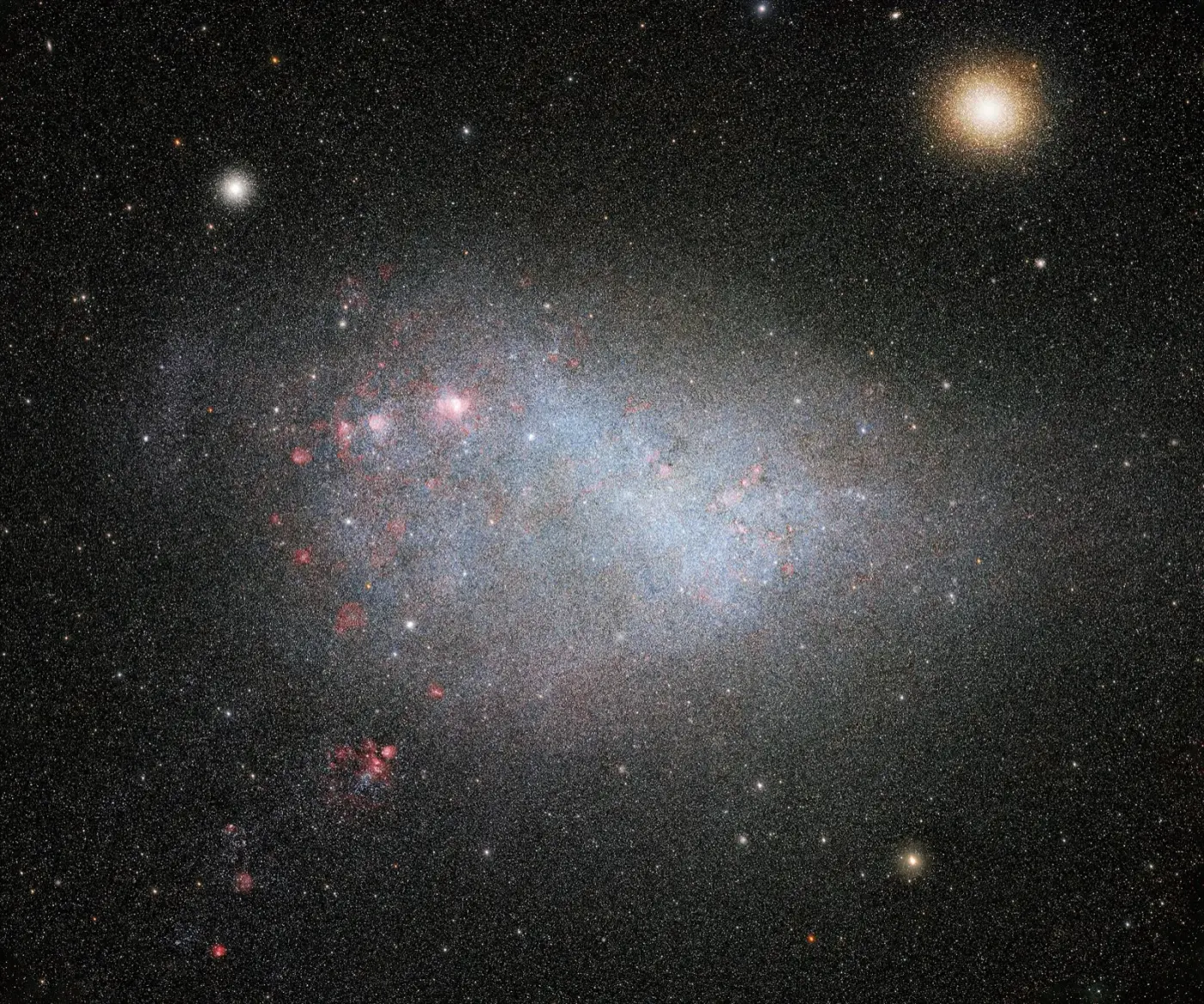 Small Magellanic CloudSMC · galaxy
Sources
- en.wikipedia.org
- science.nasa.gov
- science.nasa.gov
- astronomy.com
- Positions: astronomy-engine (Don Cross).